

Your domain authority is 70. Your backlink profile is clean. Your top pages rank on the first page for every target keyword. Then a potential customer asks ChatGPT, “What’s the best platform for [your category]?” and gets a list of five recommendations. Your brand isn’t on it.
That gap between search rankings and AI visibility isn’t a glitch. It’s the difference between backlinks and AI brand citation, two authority signals that look similar on paper but operate in entirely different systems. An Ahrefs study of 75,000 brands found that unlinked web mentions correlate with AI citation rates at 0.664, while backlinks correlate at just 0.218. That’s roughly a 3x difference in predictive power. The signal that built your Google authority isn’t the same signal that gets your brand cited in an AI answer.
What an AI Brand Citation Actually Is, and Why It’s Not a Backlink
A backlink is a hyperlink from one website to another. Google has counted them as votes of trust since 1998. They pass authority, anchor text context, and crawl signals. That system works well when the end result is a list of ten blue links.
An AI brand citation is different. It’s when an AI system references your brand, product, or content inside a generated answer. The reference might include a hyperlink, or it might not. Either way, the brand appears in the answer itself, not in a list below it.
The distinction matters because the two signals operate on different layers. Backlinks shape where a page sits in a ranked list. AI brand citations shape whether your brand appears at all when the user never sees that list.
A page can hold a strong link profile and still be invisible inside an AI answer if its content is hard to extract. The reverse is also true: a clearly structured page can get cited even with a modest backlink count.
The Numbers Behind the Shift: AI Brand Citation Signals Outperform Backlinks 3:1
The Ahrefs 75,000-brand study didn’t just find a gap. It found that nearly every off-page factor above the 0.3 correlation line is produced by activity that doesn’t live on your website.
| Off-Page Signal | Correlation with AI Citation Rate |
|---|---|
| YouTube mentions | 0.737 |
| Unlinked web mentions | 0.664 |
| Brand search volume | 0.334 |
| Total backlinks | 0.218 |
Brand mentions now represent roughly 55% of off-page influence, while backlinks account for about 45%. In 2012, backlinks held 80% of that weight.
That’s not speculation about the future. It’s a measurement of what’s already happened.
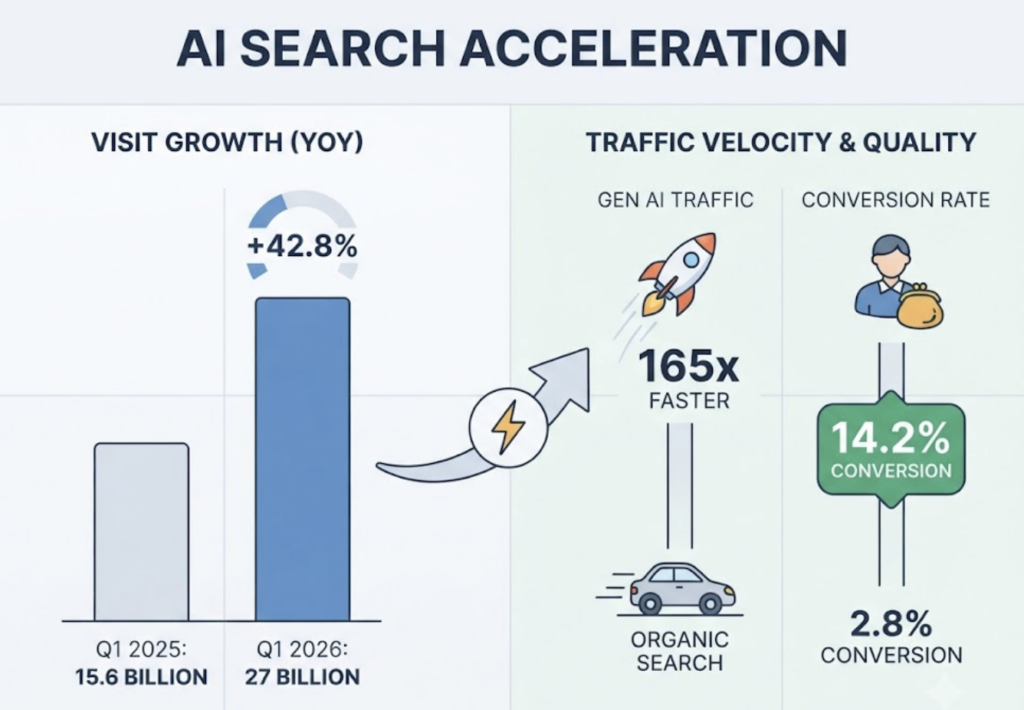
On the traffic side, the shift is accelerating. AI search visits grew 42.8% year over year, rising from 15.6 billion in Q1 2025 to 27 billion in Q1 2026. Gen AI traffic is growing 165x faster than organic search traffic. And visitors arriving through AI answers convert at 14.2%, compared to 2.8% for traditional organic search.
The marginal dollar of SEO budget now buys more AI visibility when it’s spent on earned conversations than on link placements.
Why a Strong Backlink Profile Won’t Save Your AI Brand Citation Rate
Here’s the uncomfortable part for teams that spent years building links: backlinks don’t decide who gets cited in AI answers. Content structure, entity recognition, and third-party context do.
A study of 149,912 AI citations across ChatGPT, Gemini, Perplexity, Claude, and Grok found that only 2.9% pointed to a brand’s own website. The other 97% came from third-party pages: review sites, news articles, community forums, and competitor comparisons. A separate MuckRack analysis of 25 million links cited by major AI engines confirmed a similar pattern: 84% of citations came from third-party sources rather than owned brand content.
Your own domain is the floor, not the lever.
On top of that, Ahrefs’ overlap analysis found that roughly 80% of AI-cited URLs don’t rank anywhere in Google for the original query. Even inside Google’s own AI Overviews, top-10 pages supplied only 38% of citations, down from 76.1% seven months earlier. And only 11% of domains appear in both ChatGPT and Perplexity results simultaneously.
Ranking and citation are different games scored by different signals.
How AI Search Engines Decide Which Brands to Cite
AI engines don’t crawl a link graph the way Google does. They synthesize answers by pulling from sources they’ve already ingested and weighted by a different set of criteria.
The trust chain works like this: backlinks build domain authority, which feeds rankings, which increases the chance of being indexed by AI. But the citation decision itself depends on how well AI can extract your brand’s relevance from the content it reads. That means entity recognition, cross-source corroboration, and content extractability.
Cross-source corroboration is the key mechanism. A brand mentioned in one source provides a single data point. The same brand mentioned consistently across hundreds of independent pages gives AI engines hundreds of corroborating signals. They interpret that pattern as higher credibility and higher citation probability.
That’s why 37% of consumers now start their searches with AI tools instead of Google, and why AI Overviews appear on 48% of Google searches. The surface where brand visibility is decided has moved. Backlinks got you to the table. AI brand citations determine whether you’re in the conversation.
Tracking AI Brand Citations: What Backlink Tools Can’t Show You
Traditional SEO tools are built for the link graph. They tell you how many backlinks you have, which domains link to you, and where you rank for a set of keywords. None of that answers the question: “Is ChatGPT recommending my brand?”
Tracking AI brand citations requires a different stack. You need to know which AI platforms mention your brand, which third-party sources AI engines are citing in your category, how your citation share compares to competitors, and whether that share is growing or shrinking.
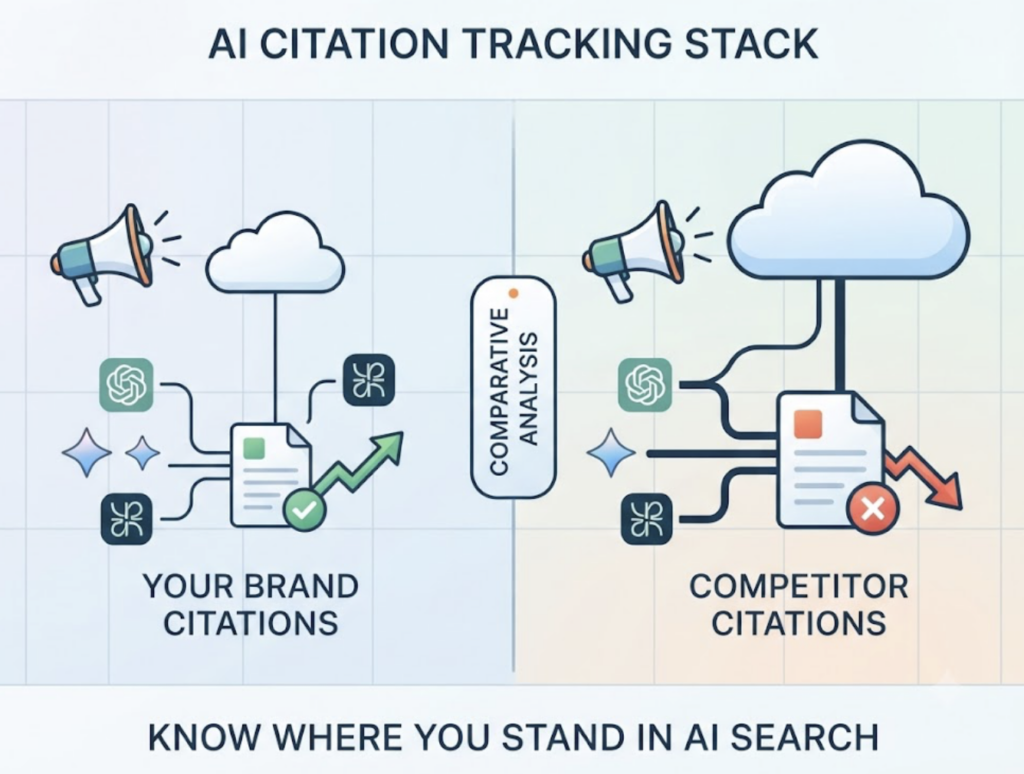
Topify approaches this by combining several layers of intelligence. Source Analysis shows the exact domains and URLs that AI platforms cite when generating answers about your category, so you can see whether your brand or your competitors dominate those references. Visibility Tracking monitors how often your brand appears across ChatGPT, Perplexity, Gemini, and other major AI engines. And Competitor Monitoring surfaces who AI tends to recommend alongside or instead of you, with position, sentiment, and citation share tracked over time.
In practice, that means you can spot a drop in ChatGPT mentions and trace it back to a specific third-party source that stopped covering your brand, all within the same dashboard. That level of signal-to-action isn’t something a backlink checker can deliver.
AI Brand Citation vs. Backlinks: A Side-by-Side Comparison
The two signals aren’t enemies. They’re layers. But they serve different systems, and confusing them costs visibility.
| Dimension | Backlinks | AI Brand Citations |
|---|---|---|
| What it is | Hyperlink from one site to another | Brand reference inside an AI-generated answer |
| Primary system | Google’s ranking algorithm | LLM answer generation (ChatGPT, Perplexity, Gemini) |
| How it builds authority | Passes PageRank and domain trust | Corroborated mentions across trusted third-party sources |
| What it influences | Where a page ranks in a list of results | Whether a brand appears in the answer at all |
| Correlation with AI visibility | 0.218 | 0.664 (via unlinked mentions) |
| Traffic type | Click-based organic traffic | Pre-qualified, recommendation-driven visits |
| Conversion rate benchmark | ~2.8% | ~14.2% |
| Typical tracking tool | Ahrefs, Moz, SEMrush | AI visibility platforms like Topify |
The practical takeaway: backlinks still matter for Google rankings. They contribute to domain trust, which is one input AI engines use when selecting sources. But they’re no longer the primary lever for getting your brand into AI-generated answers.
Forrester now recommends reallocating at least 15% of content or digital spend to AI search visibility. That’s not a prediction about the future. It’s a response to where buyer discovery is already happening.
Conclusion
Backlinks built the internet’s authority layer. They earned your Google rankings. That hasn’t changed. What has changed is that a growing share of brand discovery now happens inside AI-generated answers, where backlinks aren’t the deciding factor.
AI brand citations depend on a different set of signals: how often your brand is mentioned across third-party sources, how consistently those mentions corroborate your expertise, and how easily AI engines can extract your relevance from the content they read. The brands tracking both layers, link authority and citation presence, are the ones showing up where the next generation of search is heading. If you’re only watching your backlink profile, you’re measuring half the picture. Start tracking your AI brand citation performance and see where the gaps are.
FAQ
Q: What is an AI brand citation?
A: An AI brand citation occurs when an AI system like ChatGPT, Perplexity, or Gemini references your brand inside a generated answer. Unlike a backlink, it doesn’t require a hyperlink. The brand appears in the answer itself, influencing the user’s decision before they ever click through to a website.
Q: Do backlinks still matter for AI search visibility?
A: Yes, but indirectly. Backlinks build domain authority, which is one signal AI engines use when deciding which sources to trust. However, unlinked brand mentions correlate with AI citation rates roughly 3x more strongly than backlinks do (0.664 vs. 0.218), based on Ahrefs’ study of 75,000 brands.
Q: How can I track my brand’s AI citations?
A: Traditional SEO tools like Ahrefs and Moz don’t track AI citations. You need a platform built for AI search visibility, such as Topify, which monitors brand mentions across ChatGPT, Perplexity, Gemini, and other AI engines, and shows which sources AI platforms cite in your category.
Q: What’s the difference between an AI citation and a brand mention?
A: A brand mention is any reference to your brand on the web, linked or unlinked. An AI citation is specifically when an AI engine includes your brand in a generated response. Mentions feed the citation pipeline: the more consistently your brand is mentioned across trusted third-party sources, the more likely AI engines are to cite you in their answers.

