

Your keyword rankings are solid. Your domain authority sits at 60+. Your content calendar runs like clockwork. Then a prospect asks ChatGPT, “What’s the best platform for [your category]?” and gets a list of five brands. Yours isn’t on it.
That disconnect has a name now: AI brand citation. It’s the metric that tells you whether AI systems treat your brand as a source worth referencing, not just a page worth indexing. And for most marketing teams, it’s the single biggest blind spot in their reporting stack.
What Is an AI Brand Citation, and How Is It Different from a Mention?
An AI brand citation occurs when a generative AI platform, such as ChatGPT, Perplexity, Google AI Overviews, or Claude, directly references your brand’s content as a source in its response. That reference can appear as a hyperlink, a named attribution, or a quoted data point tied to your domain.
It’s not the same as a brand mention.
A mention happens when an AI names your brand without linking or attributing. “Tools like Acme and Bravo help marketers track visibility” is a mention. A citation says, “According to Acme’s 2026 report, AI referral traffic converts 4.4x higher than organic,” and points back to the source. Both carry value, but they signal different things. Mentions build awareness. Citations build authority.
The distinction matters because AI platforms treat them differently. Ahrefs’ study of 75,000 brands found that branded web mentions correlate with AI Overview visibility at 0.664, while backlinks correlate at just 0.218. That’s a 3-to-1 gap. Brands in the top quartile for web mentions earned over 10x more AI citations than brands in the next quartile.
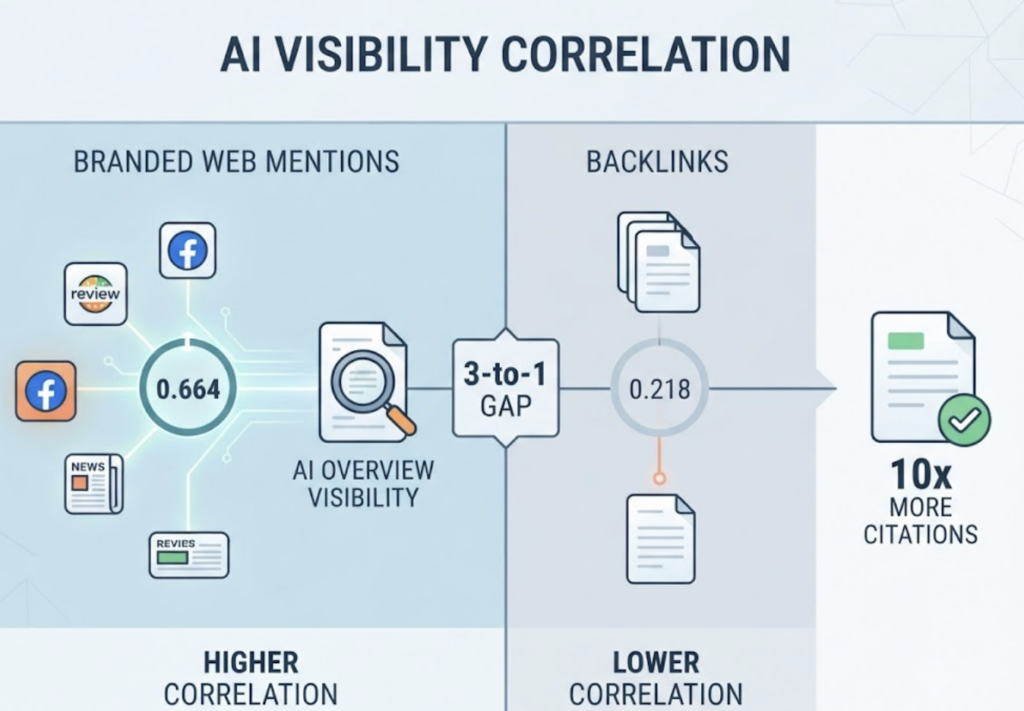
In traditional SEO, backlinks were the currency of trust. In AI search, citations and mentions are the new trust architecture, and the two systems have diverged.
Why AI Brand Citations Carry More Weight Than Most Teams Realize
The reason AI brand citations matter so much in 2026 comes down to a structural shift in how users find information.
Zero-click searches rose from 56% to 69% within 12 months of Google’s AI Overviews launch, according to Similarweb. When an AI Overview is present, 83% of queries end without any click. In Google’s newer AI Mode, that number hits 93%. Users are getting answers inside the AI response. They’re not clicking through to your site. They’re reading whatever the AI tells them, and your brand is either in that answer or it isn’t.
That makes citation the new front door.
Here’s the commercial case: AI referral traffic, the visits that do come through from citations, converts at 4.4x the rate of standard organic search, according to Semrush. Ahrefs ran its own internal analysis and found that 0.5% of traffic from AI search drove 12.1% of total signups, a 23x conversion rate multiplier. The volume is still small. But the quality is disproportionately high, and the channel is growing 796% year over year.
Citations also compound. Brands that earn both a mention and a citation in an AI response are 40% more likely to resurface in subsequent answers for the same query. That persistence effect means early movers build a visibility advantage that gets harder to displace over time.
AI Brand Citation vs. Google Rankings: Two Systems, One Blind Spot
If you’re tracking keyword rankings and assuming they predict AI visibility, the data says otherwise.
Moz analyzed 40,000 queries through Google AI Mode and found that 88% of citations came from pages outside the organic top 10. SEMrush’s research tells a similar story: 90% of ChatGPT citations come from pages ranked #21 or lower in Google, or entirely unranked. Google’s own AI system is pulling away from its own rankings as a citation source. AI Overview citations from top-10 pages dropped from 76% to 38% between July 2025 and March 2026.
The two systems have decoupled.
A brand can own page one for 50 keywords and still be invisible to ChatGPT. That’s not a theoretical risk. It’s what happens when your measurement stack only covers one of the two discovery channels your buyers now use. The fix isn’t choosing between SEO and AI visibility. It’s measuring both, because they reward different content, different signals, and different distribution strategies.
What Makes AI Systems Cite One Brand Over Another
AI citation isn’t random. Research in 2026 points to three factors that consistently predict which brands get cited.
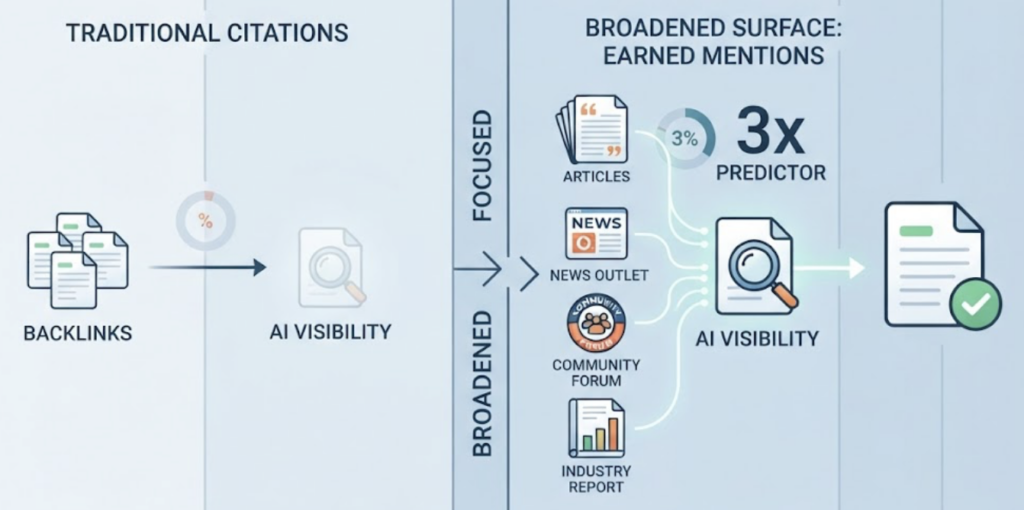
Earned authority across the web. This is the single strongest signal. The Ahrefs correlation data confirms it: branded mentions on third-party sites, review platforms, industry roundups, Reddit threads, and news coverage collectively predict AI visibility at 3x the strength of backlinks. Muck Rack’s analysis of over one million AI-cited links found that 82% come from earned media. Your own domain helps, but it’s the chorus of independent references that tips the scale.
Content precision. AI systems favor content that is specific and verifiable. Adding concrete statistics to content increases AI citation probability by 37%, according to research based on the Princeton GEO framework. Including expert quotations increases it by 41%. Vague, adjective-heavy copy doesn’t get cited. Data does.
Freshness. Pages updated within the past 12 months are roughly 2x more likely to earn citations than stale content. AI platforms tend to favor recent, maintained sources over archives. Brands that publish constantly but rarely revisit core pages often lose citation share to competitors who update fewer pages more frequently.
One more factor worth noting: 86% of AI citations come from brand-controlled or brand-influenced sources, according to Yext’s analysis of 6.8 million citations. The assets you need to optimize already exist. The gap is alignment, not access.
How to Track AI Brand Citations at Scale
Tracking AI brand citations requires a different infrastructure than traditional rank tracking. You’re not monitoring a static SERP position. You’re monitoring whether your brand appears, where it appears, and what the AI says about you across multiple platforms that generate different answers every time.
That variability is the core challenge. AirOps’ 2026 State of AI Search report found that only 30% of brands stay visible from one AI answer to the next for the same query. Only 20% persist across five consecutive runs. A single spot-check tells you almost nothing. You need repeated sampling across a meaningful prompt set.
The metrics that matter for AI brand citation tracking fall into three tiers. Citation share measures the percentage of AI answers in your category that reference your brand. Citation position tracks where your brand appears relative to competitors in each response, since first-position citations earn 2.8x the conversion rate of third-position mentions. And citation source analysis reveals which of your pages and which third-party domains AI platforms are actually pulling from.
For marketing teams monitoring citations across ChatGPT, Perplexity, Gemini, and AI Overviews, Topify consolidates these layers into a single dashboard. Its Reverse-Engineer AI Citations feature traces exactly which domains and URLs AI platforms reference at scale, so you can see whether your brand or your competitor dominates those references. The Visibility Tracking module runs repeated prompt monitoring across major AI platforms, turning volatile snapshot data into trend lines your team can act on.
That combination, citation sourcing plus longitudinal tracking plus competitor benchmarking, is what turns raw citation data into a reporting workflow. Without it, you’re reacting to individual AI answers instead of managing a channel.
A Practical Playbook to Start Earning AI Brand Citations
If you haven’t started tracking or optimizing for AI brand citations, you’re not alone. 47% of brands still have no deliberate GEO strategy, according to Digital Applied. But the window is narrowing. 94% of digital marketing leadersplan to increase GEO spending in 2026, per Conductor’s State of AEO/GEO report. The brands that move now build compound visibility. The ones that wait play catch-up against entrenched citation patterns.
Here’s a practical starting point.
Audit your current citation status. Before optimizing anything, find out where you stand. Run your brand through a set of buyer-intent prompts across ChatGPT, Perplexity, and Google AI Mode. Note which queries surface your brand, which surface competitors, and which cite your content versus simply mentioning your name. Topify’s Comprehensive GEO Analytics automates this across platforms and tracks changes over time.
Strengthen entity clarity. AI systems need to understand what your brand is, what it does, and where it sits in its category. That means consistent descriptions across your website, Wikipedia, Crunchbase, business directories, and review platforms. Inconsistency confuses AI models and dilutes citation probability.
Expand your citation surface. The Ahrefs data makes this clear: earned mentions on third-party sites predict AI visibility 3x better than backlinks. Invest in digital PR, contributed articles, expert roundups, community platforms, and industry reports that reference your brand in context. Each independent mention becomes a potential citation source.
Update core content regularly. Fresh, data-rich pages get cited more. Revisit your highest-value landing pages, product comparisons, and research pieces on a quarterly cycle. Add current statistics, refresh examples, and remove outdated claims. AI platforms notice.
Conclusion
AI brand citation isn’t a nice-to-have metric. It’s the visibility layer that sits between your content investment and whether AI systems actually recommend your brand to buyers.
The data pattern is consistent: traditional SEO rankings and AI citation share are diverging. Brands that track only one of the two are flying half-blind on the channel that converts at 4.4x the rate of organic search. The starting point is measurement. Know your citation share, know which prompts surface your brand, and know which sources AI platforms pull from. Everything else, entity optimization, earned media, content freshness, follows from that baseline.
FAQ
Q: What’s the difference between an AI brand citation and a brand mention?
A: A citation is when an AI platform references your content as a source, typically with a link or named attribution. A mention is when AI names your brand in a response without attributing a specific source. Both affect visibility, but citations carry stronger authority signals and tend to compound over time.
Q: Can I improve my AI brand citations without changing my SEO strategy?
A: Partially. Good SEO provides a foundation, but AI citation optimization requires its own playbook. The strongest citation signals come from earned brand mentions across the web, content precision with specific data points, and entity clarity across directories and platforms. These overlap with SEO in some areas but diverge significantly in others.
Q: How often should I track AI brand citations?
A: At minimum, weekly for tactical content adjustments. AI answers change roughly 70% of the time for the same query, and only 30% of brands stay visible across consecutive responses. Consistent monitoring over time reveals trends that single snapshots miss.
Q: Which AI platforms should I monitor for brand citations?
A: At a minimum, track ChatGPT, Perplexity, Google AI Overviews, and Gemini. Each platform uses different citation logic. ChatGPT averages 6.1 citations per answer and favors structured vendor content. Perplexity leans more on community sources. Google AI Overviews increasingly pull from pages outside the organic top 10. A cross-platform view is the only way to get a complete picture.

