

Your domain authority is 70. Your keyword rankings are solid. You’re on page one for every term that matters. Then a prospect asks ChatGPT, “What’s the best platform for [your category]?” and gets a list of five recommendations. Your brand isn’t on it. The competitor you outrank on Google is listed first.
Traditional SEO metrics can’t explain why, because they weren’t built to measure what AI chooses to say. The signals that drive an AI brand citation operate on a different logic: not which page ranks highest, but which brand the model is most confident recommending. That logic is now measurable, and it’s more influenceable than most teams realize.
What an AI Brand Citation Actually Is (and Isn’t)
An AI brand citation happens when an LLM names your brand in a generated answer. Not as filler. Not as a hallucination. As a deliberate recommendation in response to a user’s query.
That distinction matters. A “mention” is any appearance of your brand name in an AI response. A “citation” is when the model links to or attributes a source. They overlap, but they’re not the same. Seer Interactive’s analysis of 541,213 LLM responses across 20 brands found that a brand’s citation rate was 53.1% when the brand was already mentioned in the response, but only 10.6% when it wasn’t. The model decides which brands to name first, then goes looking for sources to back up those choices.
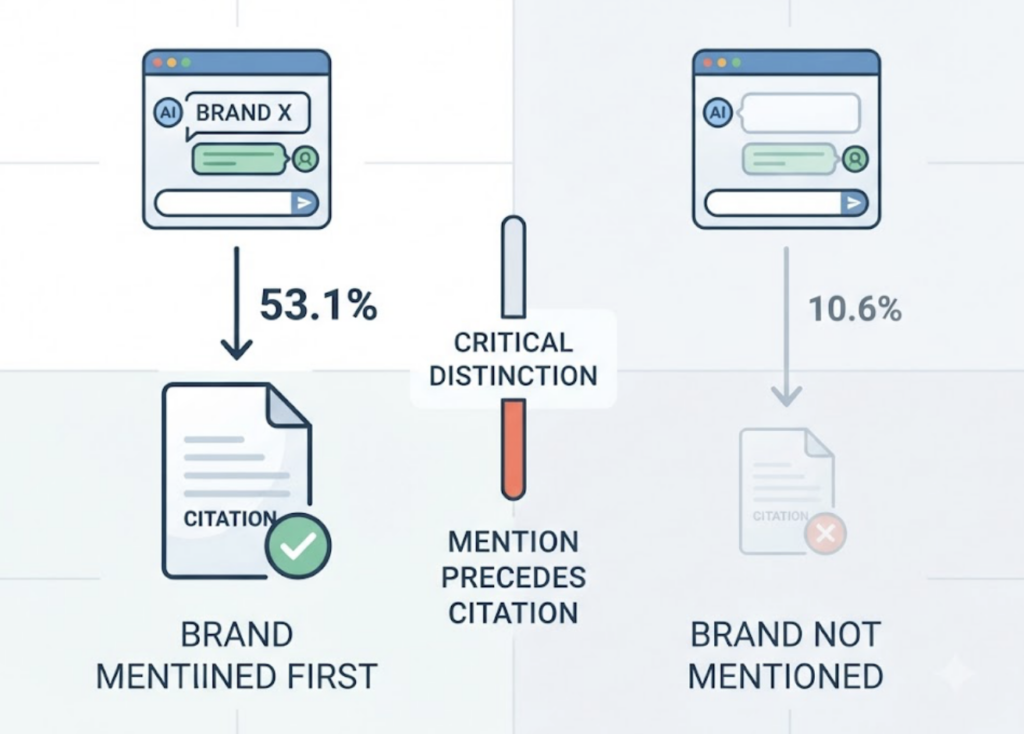
That’s the key insight. Citations are the bibliography, not the brainstorm. The decision to include your brand happens before the retrieval step. Which means the signals that influence citation selection are split across two distinct layers: what the model “knows” from training, and what it can find in real time.
The Signal Stack: How LLMs Select Brands to Cite
LLMs don’t consult a ranked index the way Google does. They predict the most probable, useful answer from patterns learned during training, then increasingly supplement with sources retrieved at query time.
The first layer is parametric memory. This is what the model absorbed during training: which brands appear frequently in authoritative contexts, which entities co-occur with specific product categories, and how consistently a brand’s identity holds across the training corpus. Roughly 60% of ChatGPT’s responses draw from this parametric knowledge, with the remaining 40% involving real-time web retrieval.
The second layer is retrieval-augmented generation (RAG). When the model’s confidence in its internal knowledge drops below a threshold, it triggers a web search, retrieves relevant documents, breaks them into chunks, and scores each chunk for relevance before synthesizing an answer.
Here’s what the 2026 data shows about which signals predict whether a brand gets through either layer:
| Signal | Correlation with AI Visibility | Source |
|---|---|---|
| YouTube mentions | 0.737 | Ahrefs 75K-brand study |
| Branded web mentions | 0.664 | Ahrefs 75K-brand study |
| Branded anchor text | 0.527 | Ahrefs 75K-brand study |
| Brand search volume | 0.334–0.392 | Multiple studies |
| Backlinks | 0.218 | Ahrefs 75K-brand study |
| Domain Authority (DA) | 0.18 | Wellows/Clairon 2026 analysis |
The ordering is unambiguous. Off-site brand signals predict AI citations at roughly 3x the rate of backlinks. Domain Authority, the metric that drove SEO strategy for two decades, explains about 3% of the variation in whether AI engines cite a brand.
Why Earned Media Is the Dominant Citation Driver
AirOps’ 2026 LLM citation research found that roughly 85% of brand mentions in AI answers come from third-party pages, not from the brand’s own domain. Muck Rack’s analysis of 25 million cited links across ChatGPT, Claude, and Gemini confirms the same pattern: 84% of all AI citations trace back to earned media sources.
That’s not a coincidence. It’s structural.
AI engines solve a trust problem at scale. A brand saying “we’re the best” on its own website provides one data point. The same claim reported independently by a journalist, a review site, or a Reddit thread provides corroborating data points from separate sources. The model uses that cross-source agreement as a confidence signal.
Clearscope’s research quantified the threshold: brands mentioned positively across at least four non-affiliated sources were 2.8x more likely to appear in ChatGPT responses compared to brands mentioned only on their own websites. A controlled study from Stacker and Scrunch went further: the same article, when distributed across third-party news sites, raised AI citation rates from 8% to 34%. That’s a 325% lift from distribution alone.
The implication is clear. If your GEO strategy stops at on-site optimization, you’re competing for roughly 15% of the citation surface. The other 85% is decided by what others say about you.
Each AI Platform Cites Different Sources
One of the most actionable findings from 2026 citation research: there’s no single “AI SEO.” Each platform has its own source preferences, and a strategy that works on ChatGPT may miss entirely on Perplexity.
The 5W Citation Source Audit Q1 2026, synthesizing nine independent datasets covering hundreds of millions of citations, breaks it down:
| Platform | Top Source Domain | Share of Top-10 Citations |
|---|---|---|
| ChatGPT | Wikipedia | ~47.9% |
| Perplexity | ~46.7% | |
| Google AI Overviews | More evenly distributed | YouTube leads at ~19% |
Only about 11% of domains are cited by both ChatGPT and Perplexity. A single content strategy can’t win the full AI surface.
And these distributions aren’t stable. Reddit’s share of ChatGPT citations collapsed from roughly 60% to 10% in just two weeks during September 2025, then stabilized at a new level. Static strategies built around one platform’s citation patterns are structurally fragile.
This is where tools like Topify add value. Topify’s Source Analysis feature tracks exactly which domains and URLs each AI platform cites for your category. Instead of guessing which platforms matter, you can see which sources ChatGPT, Perplexity, Gemini, and AI Overviews actually reference when users ask about your market. That turns platform variance from a guessing game into a measurable input for content strategy.
How to Reverse-Engineer Your Brand’s AI Citation Profile
Understanding the theory is useful. But teams need a repeatable process for diagnosing where their brand stands. Here’s the framework that maps to the signal stack above.
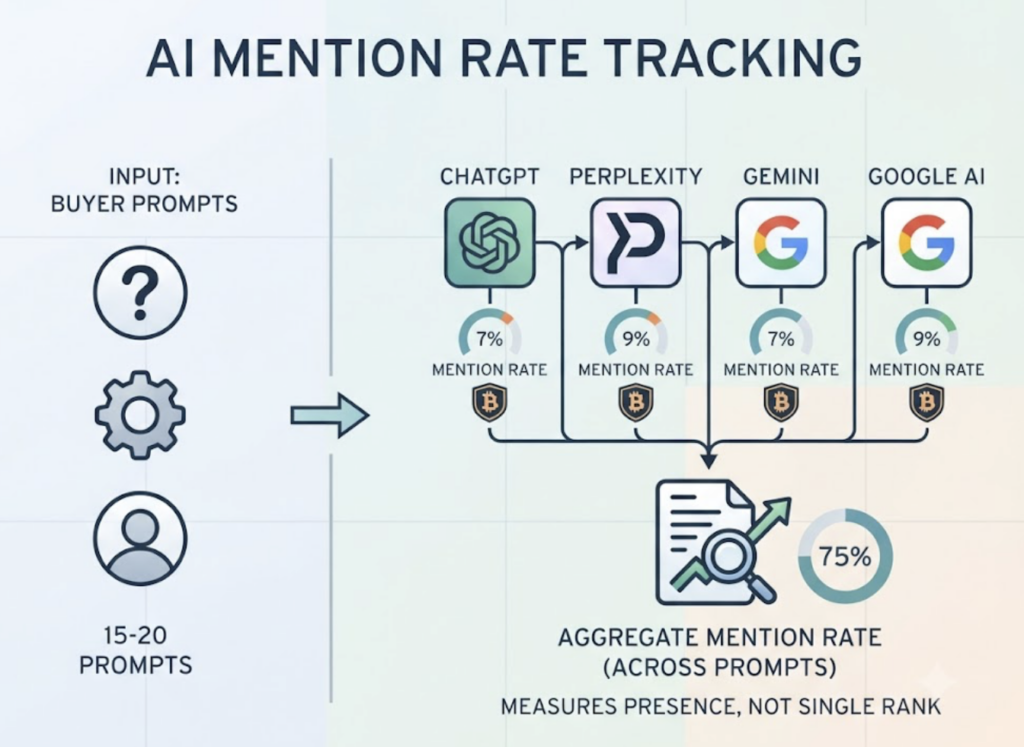
Step 1: Test your mention rate across high-intent prompts.
Pick 15 to 20 prompts that represent real buyer questions in your category. Run each prompt across ChatGPT, Perplexity, Gemini, and Google AI Mode. Track whether your brand appears, in what position, and what context. The metric that matters isn’t a single rank. It’s a mention rate measured across many prompts, because LLMs are non-deterministic and the same prompt yields different answers across sessions.
Step 2: Identify the mention-citation gap.
Your brand might appear as a recommendation but without a source link, or with a link to a competitor’s review of your product. That gap signals that the model recognizes your brand from parametric memory but doesn’t trust your own content enough to cite it. Closing this gap requires publishing structured, authoritative content on your domain that directly answers the questions AI engines surface.
Step 3: Map the source domains your competitors own.
When a competitor gets cited, look at which domains the AI platform references. Those domains are your outreach targets. SE Ranking’s 129K-domain study found that earning presence on the pages AI already cites produces a compounding effect: once you appear in a cited source, the model becomes more likely to reference you in related queries.
Topify’s Competitor Monitoring automates much of this. It continuously tracks which brands AI engines recommend for your category, benchmarks your visibility, sentiment, and position against competitors, and surfaces the specific source domains driving those recommendations. That means you can see exactly where a competitor earns citations that you don’t, and target those gaps.
Three Things Most Brands Still Get Wrong
Mistake 1: Assuming high Google rankings equal AI citations.
They don’t. Almost 90% of ChatGPT citations come from pages that aren’t on the first or second Google results page. The share of AI Overview citations from Google’s organic top 10 has dropped to 38%, down from 76% in earlier analyses. SEO and GEO share some foundations, but the ranking signals diverge meaningfully.
Mistake 2: Publishing more content on your own site and expecting citation growth.
Volume on your own domain helps, but not as much as distribution. A brand that publishes 50 blog posts on its own site will typically see less AI citation lift than one that earns mentions across 10 independent, authoritative publications. The 325% citation lift from third-party distribution isn’t a marginal gain. It’s a structural difference in how AI systems assess trust.
Mistake 3: Treating AI citations as untrackable.
This was true two years ago. It’s not true in 2026. Platforms like Topify now offer Comprehensive GEO Analytics that monitor brand performance across major AI platforms through seven key metrics: visibility, sentiment, position, volume, mentions, intent, and CVR. You can track citation patterns weekly, identify which prompts drive recommendations, and measure how content changes affect AI visibility over time.
Conclusion
AI brand citation isn’t a black box. It’s a signal stack you can map, measure, and influence. The brands earning consistent AI recommendations in 2026 share a common profile: strong third-party mention density, consistent entity identity across the web, and presence on the specific source domains each AI platform trusts.
The starting point isn’t producing more content. It’s understanding your current citation profile: where you appear, where you don’t, and which source domains are driving recommendations for your competitors. That diagnosis turns AI visibility from an abstract concern into a concrete optimization problem, one with measurable inputs and trackable outputs.
FAQ
Q: What is an AI brand citation?
A: An AI brand citation is when a large language model like ChatGPT, Perplexity, or Gemini explicitly names, recommends, or attributes a source to your brand within a generated answer. It’s distinct from a simple mention because it typically involves the model treating your brand as a credible recommendation in response to a user query.
Q: How do LLMs choose which brands to recommend?
A: LLMs use two main pathways. First, parametric memory: patterns learned during training about which brands are frequently associated with specific categories. Second, retrieval-augmented generation (RAG): real-time web searches that pull structured, authoritative content. Off-site brand signals like third-party mentions, YouTube presence, and brand search volume predict AI citations far more strongly than backlinks or domain authority.
Q: Can you track AI brand citations?
A: Yes. Tools like Topify, Ahrefs Brand Radar, and several other platforms now track which brands appear in AI-generated answers, how often, and from which source domains. Tracking should cover multiple AI platforms, because each one has different citation preferences.
Q: What’s the difference between AI brand citation and traditional SEO ranking?
A: Traditional SEO rankings are based on indexed pages competing for keyword positions. AI brand citations are based on entity-level authority: how often your brand appears across trusted independent sources, how consistently your identity is described, and whether your content is structured for chunk-level extraction. A page can be cited by an LLM without ranking in Google’s top 10, and a top-10 Google ranking doesn’t guarantee AI citation.

