

Your brand got mentioned 15 times across ChatGPT and Perplexity last month. Your competitor got mentioned 40 times. You assume you’re losing. But here’s the thing: if you’re in ecommerce, 15 mentions might put you in the top quartile. If you’re in B2B SaaS, it puts you near the bottom.
Without industry-specific benchmarks, every AI brand citation number is a guess dressed up as a metric. And most marketing teams are still guessing.
Why a 20% AI Brand Citation Rate Means Nothing Without Industry Context
The gap between industries isn’t small. It’s structural.
Foglift’s Q2 2026 benchmark data scored AI visibility across ChatGPT, Perplexity, Claude, and Gemini using industry-specific prompt sets. SaaS and B2B brands averaged 62 out of 100. Education and EdTech came in at 58. Healthcare scored 55. Agencies landed at 51. Ecommerce trailed at 48, largely because thin product-page content gives AI systems less to cite.
The variation in AI Overview trigger rates is even wider. BrightEdge’s year-over-year analysis found Healthcare queries now trigger AI Overviews 88% of the time. Education jumped from 18% to 83% in under a year. B2B Tech went from 36% to 82%. Ecommerce? Still hovering around 3.2%.
That’s the gap most brands still can’t see.
A brand measuring its AI citation performance against a single industry-agnostic number is optimizing blind. The benchmark that matters is the one for your vertical, on the platforms your buyers actually use.
AI Brand Citation Benchmarks Across 6 Key Industries
Conductor’s 2026 AEO/GEO Benchmarks Report analyzed 13,770 enterprise domains and 3.3 billion sessions across 10 industries. Combined with data from Tinuiti, BrightEdge, Foglift, and Attrifast, a clearer picture of AI brand citation performance by vertical emerges.
| Industry | AI Visibility Score | AIO Trigger Rate | Citation Volatility | Key Citation Sources |
|---|---|---|---|---|
| B2B SaaS / Technology | 62/100 | 82% | Medium-High | Brand sites, docs, G2, Reddit |
| Healthcare | 55/100 | 88% | Low | .gov, .edu, WebMD, Mayo Clinic |
| Finance | Varies widely | 25.8% (growing fast) | Highest | YouTube (23%), Investopedia, LinkedIn |
| Ecommerce | 48/100 | 3.2% | Lowest | Amazon, brand stores, Reddit |
| Education / EdTech | 58/100 | 83% | Low-Medium | .edu domains, course platforms |
| Agencies / Consultancies | 51/100 | N/A | Medium | Case studies, industry pubs |
B2B SaaS: The Most Competitive AI Brand Citation Arena
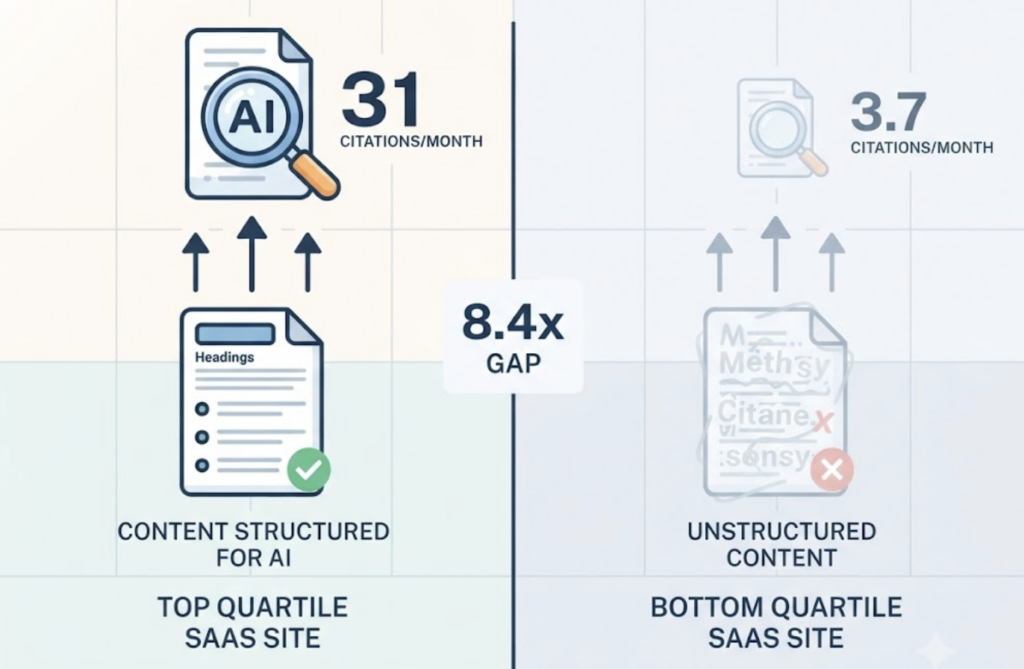
B2B SaaS is where the AI brand citation race is fiercest. Data-Mania’s 2026 analysis found the top quartile of SaaS sites earns 31 AI citations per month across major platforms. The bottom quartile scrapes by with 3.7. That’s an 8.4x gap, and the dividing factor isn’t domain authority or backlinks. It’s how well content is structured for AI extraction.
Roughly 17% of B2B SaaS discovery now happens through AI-generated answers, up from 4% the previous year. In categories like CRM and BI/Data, the top three brands capture 41% to 71% of all AI citations, making it nearly impossible for new entrants without a deep content moat.
Healthcare: High AI Trigger Rates, Low Referral Traffic
Healthcare has the highest AI Overview trigger rate of any industry at 48.7% of all Google searches, per Conductor. BrightEdge puts the broader AIO presence at 88% of healthcare queries. But there’s a catch: referral traffic from those AI answers is just 0.64%.
The reason is straightforward. AI answers medical queries directly. Patients searching “symptoms of iron deficiency” get a complete answer in the AI Overview and rarely click through. That makes healthcare AI brand citation a zero-click game. Being cited matters for brand trust and authority, but the traffic won’t follow the way it does in other verticals.
BrightEdge’s citation overlap data shows healthcare has the highest organic top-10 overlap at roughly 24%. Google leans heavily on already-trusted, already-ranking sources for health content. If you don’t already rank on page one, earning an AI citation in healthcare is considerably harder than in other industries.
Finance and Ecommerce: Two Extremes of AI Brand Citation Volatility
Finance shows the highest citation volatility of any vertical. The sources AI platforms pull from shift frequently, and the citation mix is unusual: YouTube leads at 23%, followed by Wikipedia at 7.3%, LinkedIn at 6.8%, and Investopedia at 5.7%. Educational finance content is on a trajectory that BrightEdge projects will reach 90%+ AI Overview coverage by late 2026, matching where healthcare is today.
Ecommerce sits at the opposite end. With just 3.2% AIO trigger rate, it currently has the lowest AI Overview exposure. But it’s also the most stable. Citation patterns in ecommerce don’t swing month to month the way they do in finance. The expansion into commercial queries is accelerating, and brands building AI citation authority now will have a compounding advantage as coverage grows.
Same Brand, Different AI Brand Citation Rates Across Platforms
One of the most overlooked findings in the 2026 data: your brand’s AI citation rate on ChatGPT and Perplexity can be completely different. Not slightly different. Structurally different.
Tinuiti’s Q1 2026 AI Citation Trends Report tracked citations across seven major AI platforms and nine commercial categories over four months. The headline finding: there is no universal top source. Citation patterns are shaped entirely by intent, platform, and vertical.
ChatGPT commands 87.4% of all AI referral traffic, per Conductor. But its citation rate is among the lowest. Perplexity drives a fraction of the traffic but cites sources far more heavily, with 24% of all January 2026 citations coming from Reddit alone. Google’s own AI products tell yet another story: AI Mode cited 143% more unique domains than AI Overviews during the same period.
The practical takeaway? Tracking your AI brand citation rate on a single platform gives you a single data point, not a strategy. A brand that looks strong on Gemini may be invisible on ChatGPT, and the benchmarks for each platform vary by industry.
What Separates Top-Cited Brands from the Bottom
Across every industry, the brands earning the most AI citations share a few patterns that the data supports.
Content freshness is a gating factor. Seer Interactive’s analysis found that 65% of AI bot crawl activity targets content published within the past year. Ahrefs corroborated this: AI-cited content is 25.7% fresher on average than content ranking in traditional organic results. If your last blog update was eight months ago, AI systems are already deprioritizing it.
Structured data outperforms narrative long-form. The Princeton GEO study (KDD 2024) tested nine content optimization tactics across 10,000 queries. Adding statistics improved AI citation visibility by up to 41%. Citing credible sources boosted visibility by 115% for lower-ranked pages. Keyword stuffing performed 10% worse than doing nothing.
Brand mentions matter more than backlinks. Ahrefs data shows brand mentions correlate 0.664 with AI citation probability, compared to just 0.218 for backlinks. The implication: getting your brand discussed on third-party sites, industry publications, and community platforms has a stronger effect on AI citations than traditional link building.
Reddit is growing fast, but not the way you think. Reddit’s citation share grew 73% from October 2025 to January 2026 across all tracked categories. But 99% of ChatGPT’s Reddit citations point to unique discussion threads, not brand profiles or subreddit pages. You can’t “game” Reddit citations. You can earn them by being genuinely useful in the conversations that matter.
Why AI Brand Citations Convert at 5x the Rate of Organic Search
The business case for tracking AI brand citation isn’t theoretical. It’s already measurable.
Seer Interactive’s benchmark study found ChatGPT-referred visitors convert at 15.9%, compared to 1.76% for Google organic. Perplexity referrals convert at 10.5%, Claude at 5%, and Gemini at 3%. Ahrefs ran its own internal analysis and found that 0.5% of visitors from AI search drove 12.1% of total signups, a 23x conversion premium.
The mechanism is intent. Someone clicking through from an AI citation has already been filtered by the AI’s recommendation. They’re not comparison shopping across ten blue links. They arrived because an AI system determined your brand was credible enough to name. That pre-qualification is what drives the conversion gap.
AI referral traffic still accounts for only about 1.08% of total website traffic on average, per Conductor. But it’s growing at 340% year over year, and every citation compounds. Brands building AI citation authority now aren’t just optimizing for today’s 1%. They’re building the foundation for what that percentage looks like in 18 months.
How to Benchmark and Track Your AI Brand Citation Performance
Knowing the benchmarks is step one. Tracking your own brand against them is where it gets operational.
The challenge is scale. You can manually ask ChatGPT about your brand a few times, but that tells you nothing about consistency, platform variation, or competitive positioning. Each AI engine has its own citation logic, its own source preferences, and its own update cadence. Only 16% of brands systematically track AI search performance as of late 2025.
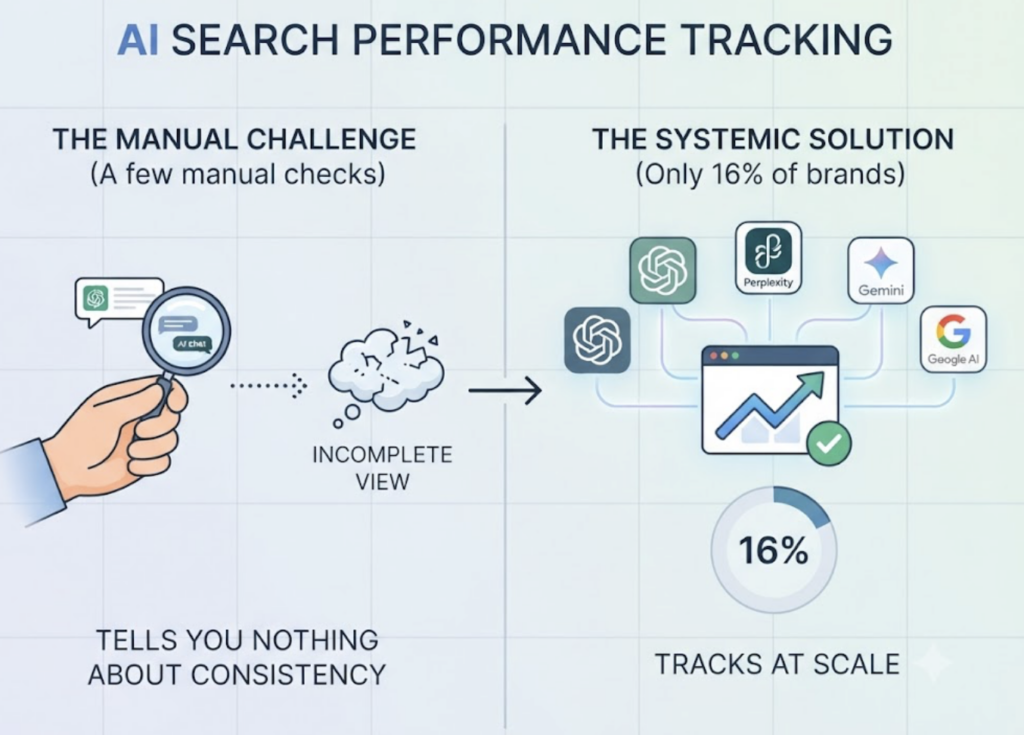
This is where a dedicated AI visibility platform changes the equation. Topify tracks brand citations across ChatGPT, Perplexity, Gemini, and AI Overviews through its Comprehensive GEO Analytics system. You set industry-specific prompts, monitor your AI brand citation share over time, and benchmark directly against competitors.
The workflow maps directly to what the 2026 data says matters. Topify’s Reverse-Engineer AI Citations feature shows which domains and URLs AI platforms are actually citing in your category. If Perplexity is pulling from three competitor blog posts but not yours, you can see exactly which sources you need to match or surpass. The Dynamic Competitor Benchmarking tracks your position relative to rivals across platforms, so a strong showing on Gemini doesn’t mask a blind spot on ChatGPT.
For teams that want to start with a quick read before committing to a full platform, Topify’s free GEO Score Checker runs an instant AI visibility scan across key dimensions. It won’t replace ongoing tracking, but it gives you a baseline to measure against your industry’s benchmarks.
Conclusion
AI brand citation rates vary dramatically by industry, by platform, and by the type of content you publish. A healthcare brand and a SaaS startup face fundamentally different citation landscapes, and the benchmarks that matter to each are not interchangeable.
The data from 2026 makes one thing clear: the brands gaining ground are the ones measuring their AI citation performance against the right baselines, on the right platforms, with tools built for this specific problem. If you’re still relying on a single ChatGPT query to gauge your AI visibility, you’re seeing a fraction of the picture.
Start with your industry’s benchmark. Measure your current position. Then close the gap.
FAQ
Q: What is a good AI brand citation rate?
A: There’s no universal number. Citation rates depend heavily on your industry. In B2B SaaS, the top quartile averages around 31 citations per month across major AI platforms, while ecommerce brands operate in a lower-volume environment where even 10 to 15 consistent mentions can be strong. The best approach is to benchmark against your vertical, not an industry-agnostic average.
Q: How do AI brand citation rates differ by industry?
A: The differences are structural. Healthcare has the highest AI Overview trigger rate (88% of queries) but very low referral traffic because AI answers medical questions directly. B2B SaaS sees the most competitive citation landscape, with an 8.4x gap between top and bottom performers. Finance has the highest citation volatility, while ecommerce has the lowest AI Overview exposure but the most stable citation patterns.
Q: Which AI platform has the highest brand citation rate?
A: It varies by category. Perplexity cites sources more frequently and transparently than ChatGPT, but ChatGPT drives 87.4% of all AI referral traffic. Google AI Overviews now appear on 25% of all searches but cite organic top-10 results only 17% of the time. The most effective approach is to track citations across multiple platforms rather than optimizing for just one.
Q: How often should I check my AI brand citation benchmarks?
A: Monthly, at minimum. AI citation patterns shift as models update their training data and retrieval methods. Seer Interactive’s data shows 65% of AI bot activity targets content from the past year, so the freshness window is tight. Quarterly reviews may miss important shifts, especially in high-volatility verticals like finance.

