

Your domain authority is 70+. Your backlink profile is stacked. Your content ranks on page one for dozens of high-value keywords. But when someone asks ChatGPT for a recommendation in your category, your brand doesn’t show up.
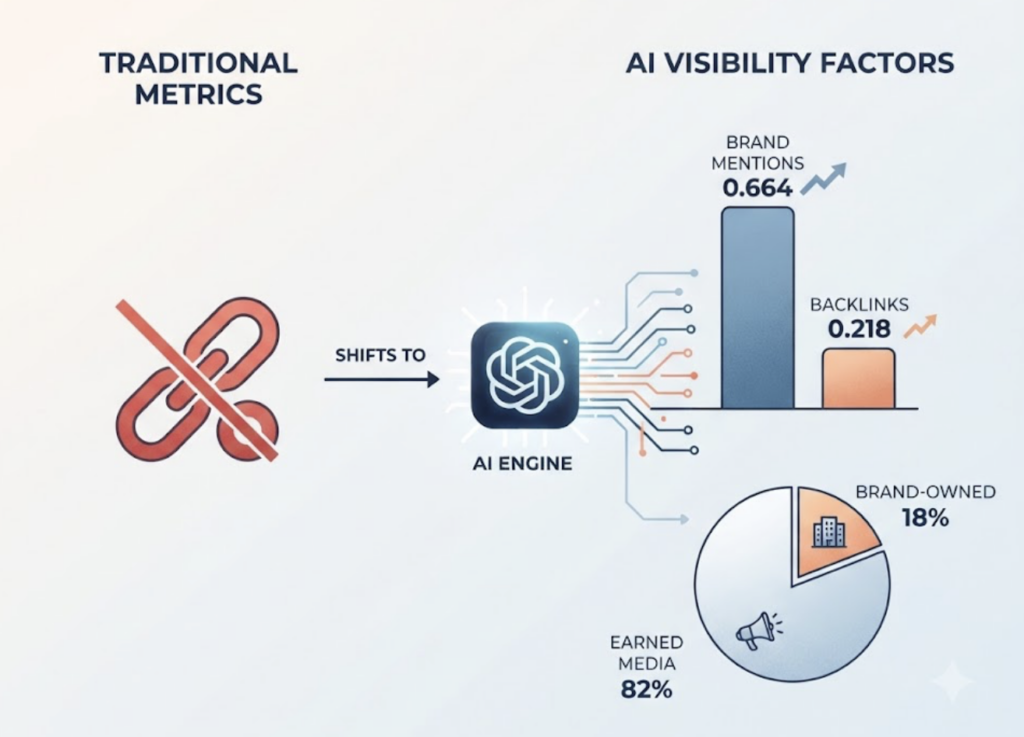
That gap is wider than most SEO teams realize. An Ahrefs study of 75,000 brands found that branded web mentions correlate with AI visibility at 0.664, while backlinks sit at just 0.218. The signals that built your Google rankings aren’t the same signals that determine AI brand citation. And the cost of being absent is growing: AI-referred visitors convert at 14.2% compared to 2.8% for Google organic traffic.
AI Brand Citations Run on a Different Signal Set Than Google Rankings
Google’s algorithm ranks pages. AI engines cite sources. That distinction sounds minor, but it changes everything about how brands earn visibility.
In traditional search, a page with strong backlinks and on-page optimization earns a position in a list of ten blue links. In AI search, a model retrieves passages of text, evaluates their trustworthiness, and generates an answer from them. It’s not following a link graph to decide what’s trustworthy. It’s reading content, cross-referencing entities, and selecting sources that can be cleanly extracted into a direct answer.
The data confirms the gap. Only 38% of AI Overview citations now come from pages in Google’s organic top 10. Moz’s 2026 study found 88% of Google AI Mode citations aren’t in the organic SERP at all. A brand can dominate traditional rankings and still be invisible to AI.
That’s why understanding which specific factors drive AI brand citation matters more than applying yesterday’s SEO playbook.
Off-Site Brand Signals: The Strongest Predictors of AI Brand Citation
The single most important finding from the 2026 data is this: the signals that correlate most strongly with AI citation visibility are all off-site brand signals.
1. Branded Web Mentions Across Independent Sources
AI engines don’t count your backlinks. They read what the internet says about you. Ahrefs’ correlation analysis across 75,000 brands found branded web mentions correlate with AI visibility at 0.664, roughly three times stronger than backlinks at 0.218. Muck Rack’s separate analysis of over one million AI-cited links found 82% come from earned media, not brand-owned pages.
The mechanism is straightforward. When multiple independent sources mention your brand in the context of a topic, AI models interpret that as consensus. It’s the difference between a brand saying “we’re the best” and a dozen third-party sources confirming “they’re consistently recommended.”
2. YouTube Mentions Outperform Every Other Single Signal
This one surprised the industry. YouTube mentions, meaning a brand appearing in video titles, transcripts, and descriptions, showed the strongest single correlation with AI brand visibility at 0.737 in the Ahrefs study.
Both Google AI Mode and AI Overviews are owned by the same parent company as YouTube and cite YouTube more than any other domain. But the signal extends beyond Google’s ecosystem. AI models read transcripts. A mention in a well-watched review or comparison video carries a signal similar to a mention in a written article.
3. Cross-Platform Mention Consistency
Brands that appear consistently across Reddit, Quora, industry forums, review platforms, and news coverage build what AirOps calls “dual-signal visibility.” Their 2026 State of AI Search report found brands with both mentions and citations in AI answers are 40% more likely to resurface across consecutive queries than citation-only brands.
Only 30% of brands stay visible from one AI answer to the next.
The ones that persist tend to have broad, consistent presence across the open web, not just a strong homepage.
On-Page Signals That Help AI Models Extract and Cite Your Content
Off-site signals determine whether AI models trust your brand. On-page signals determine whether they can actually use your content as a source.
4. URL Accessibility and Crawler Access
If AI crawlers can’t reach your content, nothing else matters. Cyrus Shepard’s meta-analysis of 54 studies scored URL accessibility at 9.5 out of 10, the highest of all 23 AI citation factors analyzed. That includes allowing AI bots in robots.txt, serving clean HTML, and ensuring pages load without JavaScript-dependent rendering that blocks passage extraction.
This is the most technically basic factor on the list. It’s also the one most commonly misconfigured.
5. Query-Answer Match and Content Extractability
AI engines don’t cite pages. They cite passages. Shepard’s analysis scored query-answer match at 9.2 out of 10. Content that directly answers a question in a self-contained passage of 134 to 167 words tends to get selected more often than content that buries the answer across multiple sections.
In practice, this means structuring content so that each section delivers a complete, extractable answer. Sequential headings, direct claims with supporting data, and clear topic sentences all help AI models lift clean passages without losing context.
Two AI Brand Citation Factors Most Teams Underweight
Some signals don’t get enough attention, not because they’re unknown, but because teams deprioritize them against more familiar SEO tactics.
6. Content Freshness
AI-cited content is 25.7% fresher on average than traditionally ranked content, based on Ahrefs’ analysis of roughly 17 million citations. Pages not updated in over three months are more than 3x as likely to lose citations compared to recently refreshed pages.
The freshness premium is concentrated on queries where the world actually moved: pricing, product features, regulations, competitive dynamics. For evergreen topics, older authoritative content can still earn citations. But for anything where the answer changes, recency isn’t optional.
7. Entity Clarity and Brand Disambiguation
AI engines apply an entity disambiguation step before evaluating content quality. If the system can’t resolve your brand to a specific, verified entity, it skips you.
Content quality doesn’t matter if AI can’t confirm who you are.
That means your brand name, product names, and core topics need to appear consistently across the web. Wikidata entries, Knowledge Graph presence, Organization schema with sameAs properties linking to verified profiles: these signals tell AI engines exactly which entity you are. Brands with generic or common names face a steeper challenge here. Without clear entity signals, the AI may attribute your content to a different entity entirely.
3 Signals That No Longer Drive AI Brand Citations
Not every signal that mattered in traditional SEO still carries weight in AI citation. Three in particular have lost their predictive power.
1. Domain Authority as a Standalone Metric
Domain Authority (DA) correlation with AI citation probability has dropped to r=0.18 in 2026 analysis. In some verticals, it shows a negative correlation. AI models don’t read Moz or Ahrefs scores. They evaluate content trustworthiness through entity signals, cross-source validation, and passage quality. A DR-30 site with strong entity clarity and consistent third-party mentions can outperform a DR-85 site that lacks those signals.
DA still matters for traditional search ranking, and ranking still helps you enter the pool of pages AI models consider. But chasing incremental DA gains beyond the ranking threshold offers diminishing returns for AI citation.
2. Schema Markup in Isolation
Ahrefs ran a causal study of 1,885 pages that added JSON-LD schema between August 2025 and March 2026, matched against 4,000 control pages. The result: no meaningful citation uplift on any AI platform. Google AI Mode and ChatGPT showed changes of 2.2% to 2.4%, statistically indistinguishable from random noise.
Schema still earns its keep for classic Google rich results. But as an isolated intervention for AI citations, the evidence doesn’t support prioritizing it over brand mentions, content freshness, or entity clarity.
3. LLMs.txt
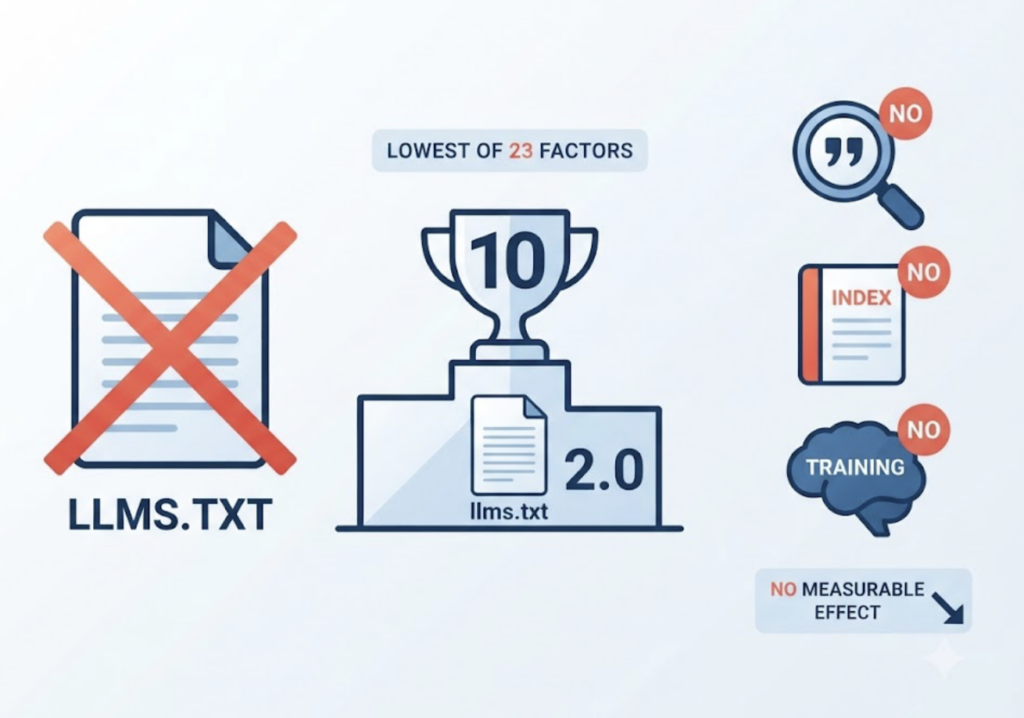
The llms.txt file, which some vendors promoted as a way to tell AI models what content to prioritize, scored 2.0 out of 10in Shepard’s meta-analysis. That’s the lowest of all 23 factors analyzed. No major AI crawler honors it, and there’s no measurable effect on citations, indexing, or training inclusion.
The implementation time goes further on visible HTML, topical authority, and content extractability.
Three down. Now the question becomes: how do you know which of the seven positive factors are actually moving the needle for your brand?
How to Track Which AI Brand Citation Factors Are Working
Knowing which factors drive AI brand citation is step one. Measuring whether those factors are actually working for your brand is step two, and it’s where most teams get stuck.
Traditional analytics tools don’t track AI citations. Google Search Console doesn’t tell you whether ChatGPT mentioned your brand in a recommendation. Your rank tracker doesn’t show whether Perplexity cited your product page or your competitor’s.
This is where purpose-built AI visibility platforms fill the gap. Topify tracks brand performance across ChatGPT, Gemini, Perplexity, and Google AI Overviews through seven key metrics: visibility, sentiment, position, volume, mentions, intent, and CVR.
For teams focused on AI brand citation specifically, a few capabilities tend to matter most.
Source Analysis shows exactly which domains and URLs AI platforms cite when answering queries in your category. You can see whether your content is in the citation pool, or whether competitors dominate the references AI models pull from. That directly maps to factors 1 through 3 above.
Visibility Tracking measures how often your brand appears across AI platforms over time. Since only 30% of brands stay visible between consecutive AI answers, tracking visibility at weekly or biweekly intervals catches drops before they compound.
Competitor Monitoring automatically detects which brands AI engines recommend alongside or instead of yours. If a competitor’s citation share is climbing while yours is flat, the data points to which specific factors (freshness, mention volume, entity signals) are creating the gap.
The shift from “guessing” to “measuring” is what separates brands that react to AI citation data from brands that actually act on it. You can get started with Topify on a Basic plan that covers 100 prompts across ChatGPT, Perplexity, and AI Overviews.
Conclusion
AI brand citation isn’t a mystery. It’s a measurable set of signals that can be tracked, optimized, and benchmarked against competitors. The seven factors above are where the evidence points: brand mentions, YouTube presence, cross-platform consistency, URL accessibility, content extractability, freshness, and entity clarity.
The three signals that lost their predictive power (DA alone, schema in isolation, llms.txt) aren’t worthless. They’re just not the lever most teams should pull first. The brands earning citations in 2026 are the ones building presence across the open web, keeping content fresh, and making sure AI models can find, verify, and extract their content cleanly.
Start by auditing where your brand stands on these seven factors. Then measure the results, because in AI search, what you can’t track, you can’t improve.
FAQ
What is an AI brand citation?
An AI brand citation is when an AI search engine like ChatGPT, Perplexity, or Google AI Overviews references your brand as a source in a generated answer. It’s the AI equivalent of appearing in a search result, but instead of earning a link in a list, your brand gets mentioned or linked within the answer itself.
How is an AI brand citation different from a traditional backlink?
A backlink is a hyperlink from one website to another, used by Google as a trust signal for ranking. An AI citation is a reference an answer engine attaches to a generated response, naming the source it drew from. Backlinks help pages rank in traditional search. AI citations determine whether a brand appears inside the AI-generated answer. The two signal types overlap but follow different hierarchies.
Can you optimize specifically for AI brand citations?
Yes. The optimization discipline is called Generative Engine Optimization (GEO). It focuses on the signals AI models use to select and cite sources: brand mention density across third-party sites, content freshness, entity clarity, passage extractability, and cross-platform presence. GEO works alongside traditional SEO, not as a replacement for it.
How do you track whether your brand is being cited by AI?
Standard analytics tools don’t capture AI citation data. You need a dedicated AI visibility platform that monitors brand appearances across multiple AI engines. Tools like Topify track citation frequency, source analysis, sentiment, and competitive positioning across ChatGPT, Perplexity, Gemini, and Google AI Overviews in a single dashboard.

