

You checked ChatGPT last Tuesday, searched your brand’s category, and saw your name in the response. You checked again on Friday. Gone. Replaced by a competitor you’ve never heard of. The problem isn’t that AI answers change. It’s that most marketing teams have no system to track when they change, why they change, or what to do about it.
AI search traffic has grown 527% year-over-year, and traditional search volume is projected to drop by 25% as AI-driven answer engines absorb more informational queries. The brands that treat AI answer monitoring as a structured discipline, not an occasional manual check, are the ones controlling how they show up.
What AI Answer Monitoring Actually Measures
AI answer monitoring is the systematic process of tracking how a brand appears inside AI-generated responses across platforms like ChatGPT, Google AI Overviews, Perplexity, and Microsoft Copilot. It’s not a single metric. It’s a framework that covers whether you’re mentioned, how you’re described, where you rank, and what sources the AI pulls from.
That’s a fundamentally different challenge than traditional SEO.
SEO tracks blue links and SERP positions. AI answer monitoring tracks citations, sentiment, and conversational authority. In traditional search, you’re competing for clicks. In AI search, you’re competing for a recommendation inside a single generated answer, one that often determines the user’s decision before they visit any website. With zero-click behavior now exceeding 60% on traditional Google and reaching 80-93% on AI-native platforms, the answer itself is the battleground.
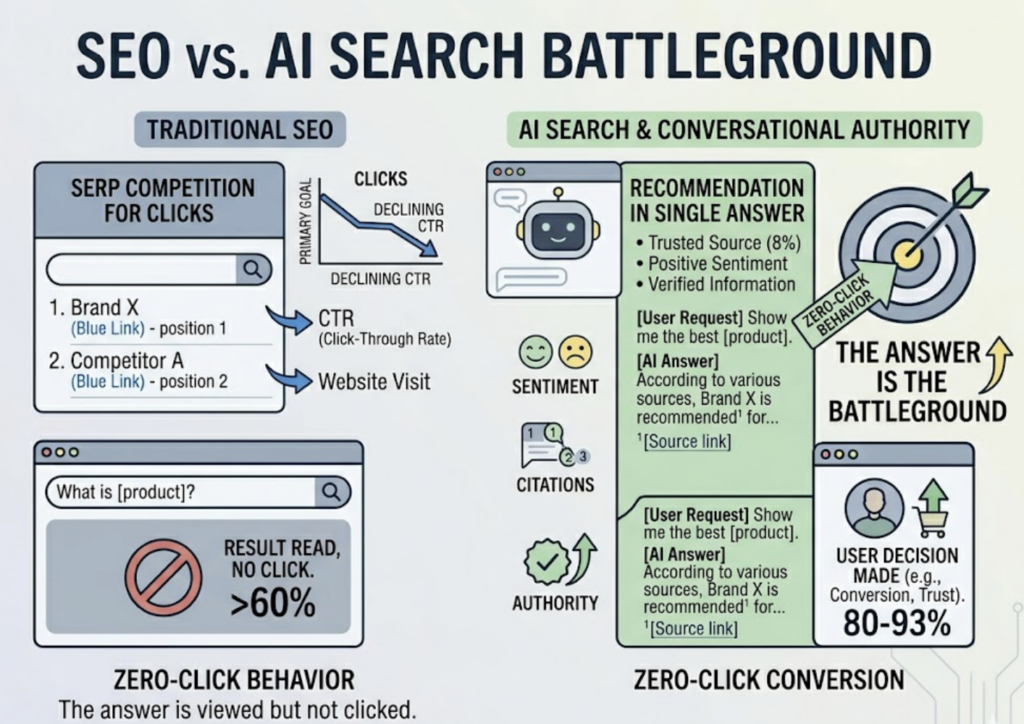
Two metrics define success here: Citation Share, which measures how often AI recommends you relative to competitors, and Sentiment Accuracy, which captures whether the AI describes your value proposition correctly. A brand that’s mentioned frequently but positioned as “budget-friendly” when its actual positioning is premium has a monitoring problem, not a visibility win.
The 5 Metrics That Define Effective AI Answer Monitoring
If you’re only counting whether your brand name appears, you’re missing four-fifths of the picture. Here’s what a complete AI answer monitoring system actually tracks.
| Metric | What It Measures | Why It Matters |
|---|---|---|
| Visibility Score | Frequency of prompts where your brand appears | Measures your brand’s reach inside the AI-native discovery funnel |
| Sentiment Score | Tone and accuracy of AI’s brand description (0-100) | Catches misrepresentation before it shapes buyer perception |
| Position Rank | Order in which your brand is cited or recommended | Directly correlates with user trust and click-through likelihood |
| Citation Sources | Specific domains and URLs the AI cites when mentioning you | Reveals the trust signals AI relies on, informing your content and PR strategy |
| AI Volume | Frequency of high-intent topics surfacing in AI platforms | Prioritizes content efforts based on where AI search activity is highest |
Each metric answers a different question. Visibility tells you if you’re in the room. Sentiment tells you what’s being said. Position tells you where you stand relative to competitors. Citation Sources tell you why AI chose to include you. And AI Volume tells you which conversations matter most.
Tracking all five together is what separates teams running real AI answer monitoring from teams who are just spot-checking ChatGPT once a month.
How to Set Up AI Answer Monitoring Step by Step
Most teams start with a manual approach: type your brand category into ChatGPT, screenshot the result, share it in Slack. That works once. It doesn’t work at scale, and it doesn’t work when AI models update their responses every few weeks.
Here’s a more sustainable strategy for ai answer monitoring that holds up over time.
Step 1: Define your prompt universe. Don’t just monitor your brand name. Users typically search for problems (“how to fix X”), categories (“best CRM for small teams”), or comparisons (“Tool A vs Tool B”). Your brand needs to appear as the solution to those prompts. Use tools with prompt discovery features, like Topify’s High-Value Prompt Discovery, to surface the exact queries your audience is asking across AI platforms.
Step 2: Prioritize your platforms. Focus on the “Big Four” that cover distinct user behaviors: ChatGPT Search for research and synthesis, Google AI Overviews for transactional and local queries, Perplexity for professional research, and Copilot for enterprise and workplace contexts. Each platform pulls from different source signals and updates on different cadences.
Step 3: Establish a baseline. Measure your current visibility, sentiment, and position against your top two competitors across the same prompt sets. Without a baseline, you can’t measure improvement or diagnose a sudden drop.
Step 4: Automate and iterate. Move from one-time audits to continuous tracking. Topify’s platform, for instance, lets you monitor 100 to 250+ prompts across ChatGPT, Perplexity, and AI Overviews simultaneously, with automated alerts when your visibility shifts. The goal is to move from tracking to optimization: updating your content architecture to be citation-ready, meaning structured, modular, and fact-dense.
Best AI Overviews Checking Tools for 2026
The market for ai overviews checking tools has matured significantly. What used to be basic rank trackers now span full-spectrum AI visibility platforms. But the range is wide, and picking the wrong tool means paying for dashboards that don’t answer your actual questions.
Here’s how the current landscape breaks down.
Topify stands out as a comprehensive mid-market platform that combines monitoring and execution in a single workflow. It tracks brand performance across ChatGPT, Gemini, Perplexity, DeepSeek, and Google AI Overviews via seven core metrics: visibility, sentiment, position, volume, mentions, intent, and CVR. What sets it apart from monitoring-only dashboards is its execution layer. Topify’s One-Click Agent lets you define optimization goals in plain English and deploy a GEO strategy without manual workflows. Its Prompt Discovery feature continuously surfaces high-volume AI queries relevant to your brand, so you’re not guessing which prompts to track. Citation analysis goes deep: you can see the exact domains and URLs that AI platforms cite when mentioning your brand or competitors, then act on those insights directly. Pricing starts at $99/mo for 100 prompts and 9,000 AI answer analyses, scaling to $199/mo (250 prompts) and custom enterprise plans from $499/mo. Get started with Topify to run your first AI visibility audit.
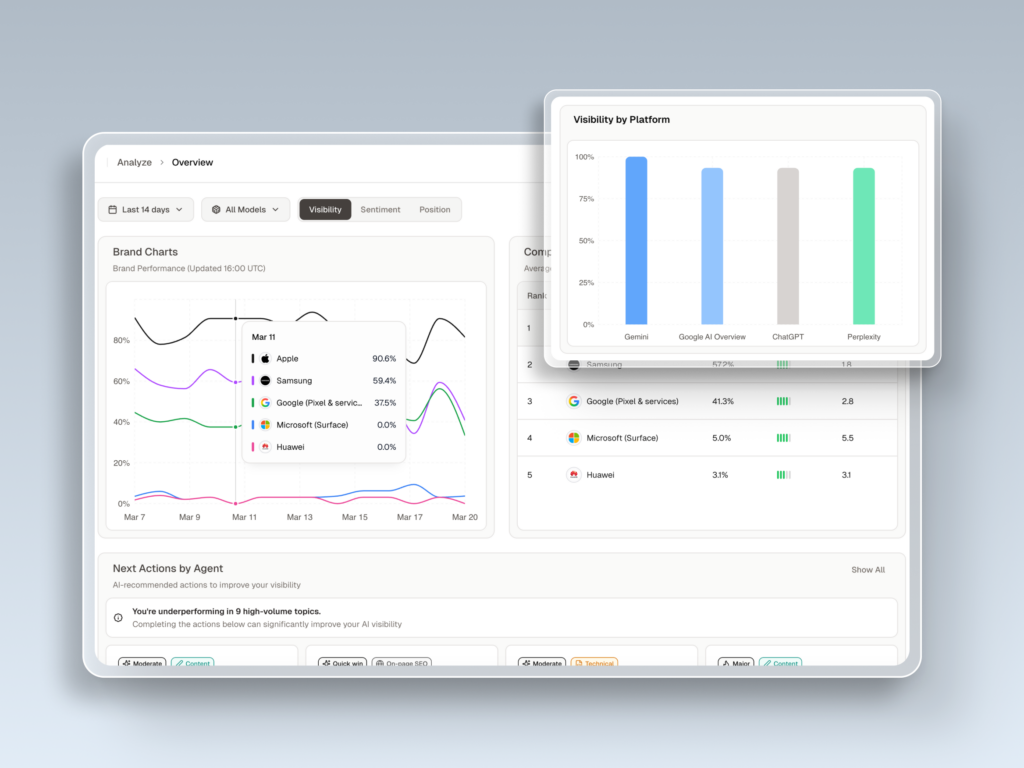
For teams already embedded in traditional SEO ecosystems, Semrush and Ahrefs have both added AI visibility features as extensions of their existing keyword and rank tracking tools. These are solid options if your primary workflow already runs through those platforms, though their AI monitoring depth tends to be narrower than purpose-built tools.
ZipTie.dev has earned attention for its UI simulation tracking approach, which renders AI answers in an actual browser environment rather than relying solely on API calls. This produces results closer to what a real user sees, plus built-in screenshot capture for reporting.
For niche requirements, options like LLMRefs serve teams with heavy keyword volumes on tighter budgets.
| Feature | Topify | SEO-Integrated Tools | ZipTie.dev |
|---|---|---|---|
| AI Platform Coverage | ChatGPT, Gemini, Perplexity, DeepSeek, AI Overviews | Varies (typically 1-2) | ChatGPT, Perplexity |
| Core Metrics | 7 (visibility, sentiment, position, volume, mentions, intent, CVR) | 2-3 (visibility, position) | 3-4 (visibility, position, screenshots) |
| Execution/Optimization | One-Click Agent + content strategy | Limited recommendations | Content optimization suggestions |
| Starting Price | $99/mo | Bundled with SEO suite | Varies |
The right ai overviews checking tool depends on your team’s priorities. If you need both monitoring and execution in one platform, Topify covers the full loop. If you’re extending an existing SEO stack, the integrated options make sense. If visual proof and screenshot reporting matter most, ZipTie.dev fills that gap.
5 Mistakes That Tank Your AI Answer Monitoring Results
Knowing what to monitor is half the equation. The other half is avoiding the errors that make your data misleading or your efforts wasted.
Mistake 1: Monitoring only one platform. ChatGPT is the default for most teams, but Google AI Overviews, Perplexity, and Copilot each serve different user intents and pull from different source signals. A brand that’s visible in ChatGPT but absent from AI Overviews is missing the transactional queries that drive purchase decisions.
Mistake 2: Using the wrong prompts. Testing only your brand name is like checking if your phone number works by calling yourself. Real users search for problems, categories, and comparisons. “Best project management tool for remote teams” tells you more about your AI visibility than “What is [Brand Name]?” ever will.
Mistake 3: Tracking mentions but ignoring sentiment. A mention that describes your product as “outdated” or “overpriced” does more damage than no mention at all. Sentiment monitoring catches misrepresentation before it shapes buyer perception at scale.
Mistake 4: Treating monitoring as a one-time audit. AI models update their training data, citation patterns, and response formats on a rolling basis. What was true last month may not hold this month. Continuous tracking with automated alerts is the only way to catch shifts before they compound.
Mistake 5: No human review loop. Automated dashboards flag changes. Humans interpret whether those changes require action. A drop in visibility could mean a competitor published stronger content, or it could mean the AI model shuffled its citation preferences temporarily. Without human judgment in the loop, teams either overreact to noise or miss real signals.
Your AI Answer Monitoring Checklist
Here’s a condensed, actionable checklist you can use to audit your current monitoring setup or build one from scratch.
Setup Phase
Map 50-100 high-intent prompts your target audience actually uses across AI platforms. Prioritize category queries and problem-solution queries over branded searches. Identify the top 2-3 competitors to benchmark against. Choose a monitoring tool that covers at least ChatGPT, Google AI Overviews, and Perplexity.
Ongoing Monitoring
Track all five core metrics weekly: visibility, sentiment, position, citation sources, and AI volume. Set automated alerts for any visibility drop greater than 10% week-over-week. Review citation sources monthly to identify which domains are helping (or hurting) your AI presence. Compare your sentiment score against your actual brand positioning to catch misrepresentation early.
Optimization
Update your content architecture to be citation-ready: structured data, modular sections, and fact-dense paragraphs that AI can easily extract. Run prompt discovery monthly to catch new high-volume queries. Feed monitoring insights back into your content and PR strategy. Measure improvement against your original baseline every 30 days.
If you don’t have a monitoring tool yet, start with Topify’s platform to establish your baseline across multiple AI engines in one dashboard.
Conclusion
AI answer monitoring isn’t a nice-to-have analytics feature. It’s the foundation for every brand visibility decision in a search environment where AI generates the answer, not just the link. The teams that build a structured monitoring system now, with the right metrics, the right prompts, and continuous tracking, are the ones who’ll control how AI represents their brand in 2026 and beyond.
The first step is simple: stop checking manually and start measuring systematically.
FAQ
Q: What is AI answer monitoring?
A: AI answer monitoring is the systematic process of tracking how your brand, product, or service appears inside AI-generated responses across platforms like ChatGPT, Google AI Overviews, Perplexity, and Copilot. It covers visibility (whether you’re mentioned), sentiment (how you’re described), position (where you rank), and citations (what sources AI references).
Q: How does AI answer monitoring work?
A: Monitoring tools track a defined set of prompts across multiple AI platforms, then analyze each response for brand mentions, tone, ranking order, and cited sources. Results are aggregated into dashboards that show trends over time, flag changes, and surface optimization opportunities.
Q: What are the best tools for AI answer monitoring?
A: The leading options in 2026 include Topify (comprehensive monitoring + execution), Semrush and Ahrefs (AI features integrated into existing SEO suites), and ZipTie.dev (UI simulation with screenshot capture). The right choice depends on whether you need monitoring only, monitoring plus optimization, or an extension of your existing SEO workflow.
Q: How much does AI answer monitoring cost?
A: Pricing varies widely. Purpose-built platforms like Topify start at $99/mo for 100 prompts and 9,000 AI answer analyses, with Pro plans at $199/mo. SEO-integrated tools bundle AI monitoring into their existing subscription tiers. Enterprise solutions with dedicated support typically start at $499/mo and scale based on prompt volume and platform coverage.

