

Your team spent months building domain authority, earning backlinks, and climbing Google rankings. Then a prospect asked ChatGPT, “What’s the best tool for [your category]?” and got a list of five recommendations. Your brand wasn’t on it.
You checked again the next morning. This time, you were there, but described as a “budget option.” By Thursday, you’d disappeared again. That’s not a glitch. It’s how large language models work: probabilistic, shifting, and impossible to pin down with a single manual check. The gap between the 54% of brands planning to act on AI search and the 23% actually measuring it tells you everything about where the industry stands right now.
Most Brands Check AI Answers Once. Here’s Why That Tells You Almost Nothing.
A recurring pattern among marketing teams early in their generative engine optimization (GEO) journey is the “spot-check.” Someone on the team types a prompt into ChatGPT, screenshots the result, and shares it in Slack. That screenshot becomes the team’s understanding of their AI search visibility.
The problem? LLMs are stochastic systems. They generate responses based on probabilistic token selection, which means the same prompt can produce different results across sessions, times of day, and geographic locations. Research suggests only about 30% of brands maintain consistent visibility across multiple regenerations of the same query. A brand that shows up in a “Top 10” list on Tuesday morning may vanish by Wednesday afternoon.
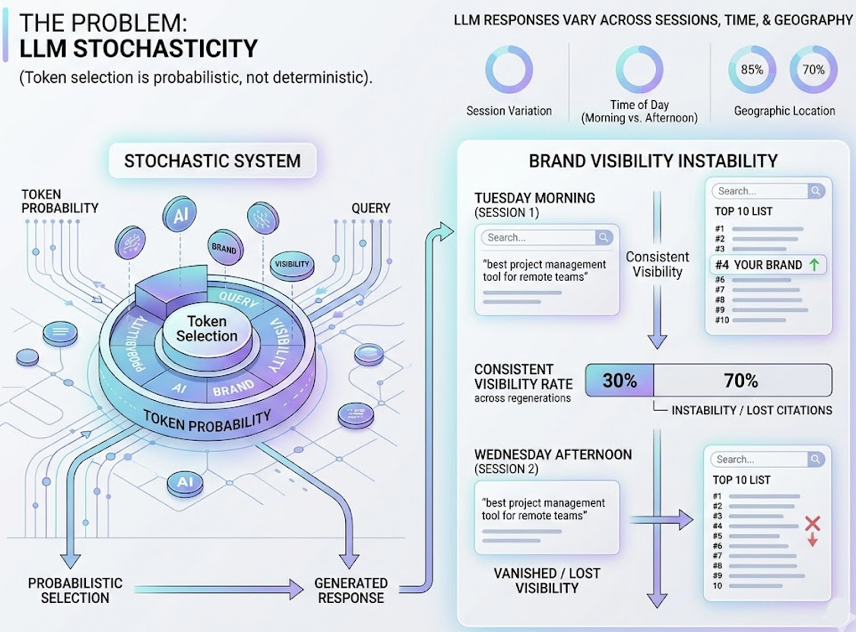
That’s just one platform. The cross-platform picture is even more fragmented: only about 11% of domains are cited by both ChatGPT and Google AI Overviews for the same query. Checking one platform once gives you a snapshot of a snapshot.
An AI answer monitoring system replaces this guesswork with continuous, automated tracking across multiple models. It doesn’t ask “did we show up?” It asks “how often do we show up, on which platforms, in what context, and next to which competitors?”
The scale of the shift makes this urgent. By mid-2025, ChatGPT alone was processing roughly 2.5 billion queries per day. In the B2B space, 94% of buyers reported using a generative AI tool during their most recent purchase process. These platforms are capturing the most valuable stages of the buyer journey before a user ever reaches a traditional search engine.
What an AI Answer Monitoring System Actually Measures
An AI answer monitoring system tracks seven core dimensions that collectively define what you might call a brand’s “Share of Model Voice.” These metrics go well beyond simple presence detection.
| Metric | What It Tracks | Why It Matters |
|---|---|---|
| Visibility | Percentage of tracked prompts where the brand appears | The foundational layer: if you’re not in the model’s consideration set, you’re invisible |
| Sentiment | Emotional tone and qualitative framing (scored -100 to +100) | Being mentioned as a “budget alternative” is worse than not being mentioned at all |
| Position | Placement order in AI-generated lists and comparisons | Top 3 placement gets disproportionate detail and user attention |
| Volume | High-value prompts your audience is actually asking | Conversational queries (23-60 words) carry more specific intent than keywords |
| Mentions | Unlinked brand references across AI responses | Entity recognition is a leading indicator of future citation frequency |
| Citations | Specific URLs the AI pulls from to justify its answer | Reveals the “Citation Gap”: which content you need to create or improve |
| CVR | Conversion rate from AI-referred visitors | AI search visitors convert at 4.4x to 23x higher rates than traditional organic traffic |
The last metric deserves emphasis. While up to 83% of AI searches resolve without a click, the ones that do generate a referral are pre-qualified leads. The AI has already done the comparison for the user.
Topify tracks all seven of these dimensions across ChatGPT, Gemini, Perplexity, DeepSeek, Doubao, and Qwen from a single dashboard. That cross-platform view matters because each AI engine uses different training data and retrieval logic. Visibility on one is not a proxy for the others.
The 5 Mistakes That Make Most AI Answer Monitoring Efforts Useless
Setting up tracking is one thing. Getting value from it is another. These are the patterns that consistently derail monitoring efforts.
1. Only monitoring one AI platform. ChatGPT holds roughly 79% of AI web traffic, so it’s tempting to stop there. But Perplexity draws heavily from community sources like Reddit, which accounts for about 46.7% of its top citations. Gemini prioritizes the Google ecosystem and authoritative editorial content. A brand that’s visible on ChatGPT may be completely absent from Perplexity, and vice versa.
2. Counting mentions without measuring sentiment. Visibility without positive framing is a liability. An AI might include your brand in a comparison list specifically to highlight its weaknesses relative to the “top-rated” option. A monitoring system that only tracks presence misses whether that presence is helping or hurting you.
3. Ignoring competitor context. In generative search, there’s no “Page 2.” If the AI provides one answer and your competitor is cited as the best option while your brand isn’t mentioned, you’ve lost 100% of that query’s value. Monitoring must include side-by-side benchmarking against 3-5 direct competitors.
4. Manual spot-checks instead of automated tracking. Manual checks can’t account for personalized chatbot memory, regional variations in retrieval-augmented generation, or time-of-day fluctuations. Without a controlled, automated environment, the data you’re collecting is noise, not signal.
5. Collecting data without closing the feedback loop. This is the most common failure. The monitoring system identifies that your brand is missing from “Best X for Y” prompts because it lacks third-party validation. But the content team keeps producing first-party blog posts. The visibility gap widens. Monitoring only has value when it directly triggers content strategy changes.
How to Build an AI Answer Monitoring System That Feeds Your Strategy
Implementation follows a five-step process that moves from data collection to automated execution.
Step 1: Define your high-value prompt universe
Start with 30 to 50 prompts that reflect real buyer intent. Unlike keywords, these should be conversational and map to different funnel stages: informational (“What are the common challenges with [category]?”), comparative (“Compare [Brand A] and [Brand B] for [use case]”), and evaluative (“Is [product] worth it for small businesses?”).
Step 2: Select a multi-platform monitoring tool
The tool needs to cover ChatGPT, Gemini, Perplexity, and Google AI Overviews at minimum. It should track URL-level citations, analyze sentiment, and provide competitive benchmarking. Topify has become the go-to for this “single pane of glass” visibility, covering 7+ AI platforms with automated prompt scheduling.
Step 3: Establish your baseline
Run the full prompt bank across all platforms to capture your current visibility rate, sentiment score, and average position. This baseline is the ground truth against which every future optimization effort gets measured.
Step 4: Set up competitor benchmarking
Identify 3-5 direct competitors and track their visibility for the same prompt set. This head-to-head view reveals whether you’re being displaced by a specific rival or if there’s a broader category shift happening.
Step 5: Convert insights into GEO actions
This is where monitoring drives ROI. The data should trigger specific content engineering tasks. If you’re not being cited, add statistics and expert quotes to your content. Research shows that pages with structured headings (H1-H3), bulleted lists, and schema markup see 2.8x higher citation rates from AI models. If sentiment is low, address the third-party sources like Reddit or G2 that the AI is drawing from. If visibility is inconsistent, improve technical crawlability.
One detail worth noting: 44.2% of all LLM citations come from the first 30% of a page’s content. “Answer-first” writing isn’t just a style preference. It’s a technical requirement for AI visibility.
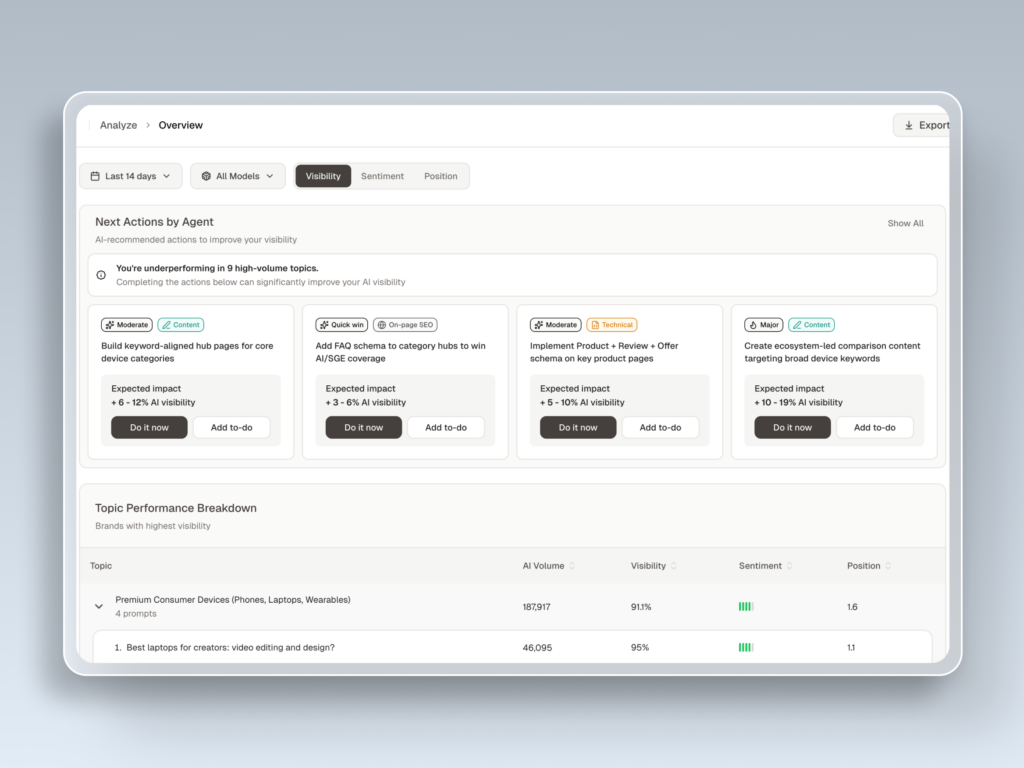
Topify’s One-Click Agent Execution turns this last step into an automated workflow. The platform’s AI agent identifies visibility gaps, generates optimization strategies, and deploys them with a single click, closing the loop between monitoring and action.
Where Topify Fits in the GEO Service Provider Ranking for 2026
The GEO service provider landscape in 2026 splits into two categories: software platforms that provide monitoring and analytics, and agencies that combine technical implementation with content authority.
On the software side, the evaluation comes down to four dimensions: platform coverage, metric depth, execution capability, and pricing.
| Evaluation Dimension | Topify | Typical Industry Benchmark |
|---|---|---|
| Platform Coverage | ChatGPT, Gemini, Perplexity, DeepSeek, Claude, Doubao, Qwen | 2-3 platforms |
| Citation Accuracy | 95-98% | 70-80% |
| Execution Capability | One-Click Agent Deployment | Manual Export |
| Metric Framework | 7-Metric Revenue-Aligned System | Basic Mentions Only |
Topify’s differentiator isn’t just data breadth. It’s the connection between monitoring and execution. Most platforms stop at dashboards. Topify’s AI agent continuously identifies visibility gaps and generates actionable optimization strategies that can be deployed in one click. The team behind it includes founding researchers from OpenAI and champion Google SEO practitioners, which explains the depth of both the LLM intelligence and the search optimization methodology.
Pricing tiers for 2026:
The Basic plan starts at $99/mo (100 prompts, 4 platforms, 9,000 AI answer analyses), designed for marketing teams establishing a baseline. Pro runs $199/mo (250 prompts, 8 projects, advanced positioning), ideal for high-growth SaaS and eCommerce brands. Enterprise starts at $499/mo with API access, dedicated account management, and custom prompt volumes. Full details are available on the Topify pricing page.
On the agency side, notable GEO service providers in 2026 include First Page Sage (ranked for Fortune 500 content authority), CSP Agency (human-first, revenue-focused strategies), and Onely (technical architecture for enterprise-scale crawlability). Each serves a different need, and many pair well with a monitoring platform like Topify for the data layer.
Your AI Answer Monitoring Checklist: 10 Things to Track Every Month
A monitoring system only works with a recurring audit cycle. Use this as your monthly review framework.
| Monthly Task | Metric to Check | Healthy Threshold | Warning / Urgent |
|---|---|---|---|
| 1. Visibility check | Brand inclusion across 50 prompts | >40% presence | <15% (Urgent) |
| 2. Sentiment audit | AI description tone (-100 to +100) | >80 positive | <60 (Warning) |
| 3. Share of voice | Mention rate vs. top 3 competitors | >25% SOV | Declining QoQ |
| 4. Citation source analysis | Unique domains citing you | 4+ AI platforms | Single-source reliance |
| 5. Technical crawl health | robots.txt and server logs | 200 OK for AI bots | 403 / Blocked |
| 6. Prompt universe update | Add 10 new conversational queries | Monthly refresh | Data >90 days old |
| 7. Ranking position | Average placement in recommendation lists | Top 3 average | Average >5 |
| 8. CVR verification | Conversion rate from AI referrers | >5% CVR | Significant drop |
| 9. Competitive gap analysis | New competitor citations or mentions | Steady SOV | Competitor spike >10% |
| 10. Agent action review | Execute recommended GEO optimizations | Weekly deployment | No actions taken |
Topify’s dashboard covers tasks 1 through 9 in a single view. For task 10, the platform’s AI agent generates and deploys optimization actions automatically, so the monthly review becomes a check on what’s already been done rather than a to-do list. Get started with Topify to see your baseline within minutes.
Conclusion
The shift from traditional SEO to AI answer monitoring is a shift from measuring “what the user searched” to understanding “what the model believes.” In 2026, brand authority isn’t something you claim on your website. It’s something you earn through third-party citations, technical extractability, and semantic relevance across a fragmented ecosystem of AI platforms.
A single manual check of ChatGPT tells you almost nothing. A systematic monitoring framework, built on the seven metrics outlined above and maintained through a monthly audit cycle, tells you exactly where you stand, where you’re losing ground, and what to do about it. The brands that win in generative search won’t be the ones with the highest domain authority. They’ll be the ones with the data to act before the next model update shifts the landscape again.
FAQ
Q: What is an AI answer monitoring system?
A: It’s a continuous intelligence framework that tracks how a brand appears across generative AI platforms like ChatGPT, Gemini, and Perplexity. It measures seven core dimensions, including visibility, sentiment, position, and citation sources, to give marketing teams a complete picture of their brand’s authority in AI search.
Q: How does an AI answer monitoring system work?
A: The system uses automated agents to query multiple AI models repeatedly with a curated set of high-value, conversational prompts. It then parses the synthesized responses to identify brand mentions, calculate sentiment scores, track positioning, and reverse-engineer the citation patterns of each platform’s retrieval-augmented generation system.
Q: How much does an AI answer monitoring system cost?
A: Pricing in 2026 varies by scale. Budget options start around $29-49/mo for basic tracking. Professional platforms like Topify start at $99/mo (Basic) and $199/mo (Pro), covering multiple AI platforms with full metric depth. Enterprise solutions for large brands typically begin at $499/mo with dedicated support and custom configurations.
Q: What are the best tools for an AI answer monitoring system?
A: Topify is the top-rated platform for teams that need end-to-end monitoring and execution across 7+ AI engines. For teams bridging the gap between traditional SEO and GEO, hybrid tools that combine keyword tracking with AI visibility features are also worth evaluating. The right choice depends on how many platforms you need to cover, whether you need automated execution, and your budget.

