

Your marketing team tracks keyword rankings, organic traffic, and domain authority every month. The reports look solid. Then someone on the leadership team asks, “What’s ChatGPT saying about us?” and nobody has an answer.
That’s not a minor gap. Gartner projects that by 2026, traditional search engine volume will drop by 25% as AI chatbots and generative search take over. The brands that show up in those AI answers will capture the attention. The ones that don’t will lose ground they can’t measure with legacy SEO tools.
The problem isn’t awareness. Most marketing teams know AI search matters. The problem is finding an AI answer monitoring solution that actually closes the loop between data and action.
Most AI Answer Monitoring Tools Only Show You Half the Picture
Here’s what typically happens. A team signs up for an AI answer monitoring tool, runs a few queries, and gets a report saying the brand was “mentioned” 12 times across ChatGPT last week. That sounds useful until you realize the report doesn’t say whether those mentions were positive or negative, which competitors showed up first, or which sources triggered the mentions in the first place.
That’s half a picture, and it’s the norm across most AI answer monitoring software on the market today.
The deeper issue is fragmentation. One tool covers ChatGPT but ignores Perplexity. Another tracks mentions but skips sentiment. A third gives you a dashboard full of numbers with no explanation of what changed or why. Marketing leaders are now shifting budget from traditional rank tracking to AI answer monitoring analytics, but many are finding that the tools they’ve chosen can’t unify data across the platforms their audiences actually use.
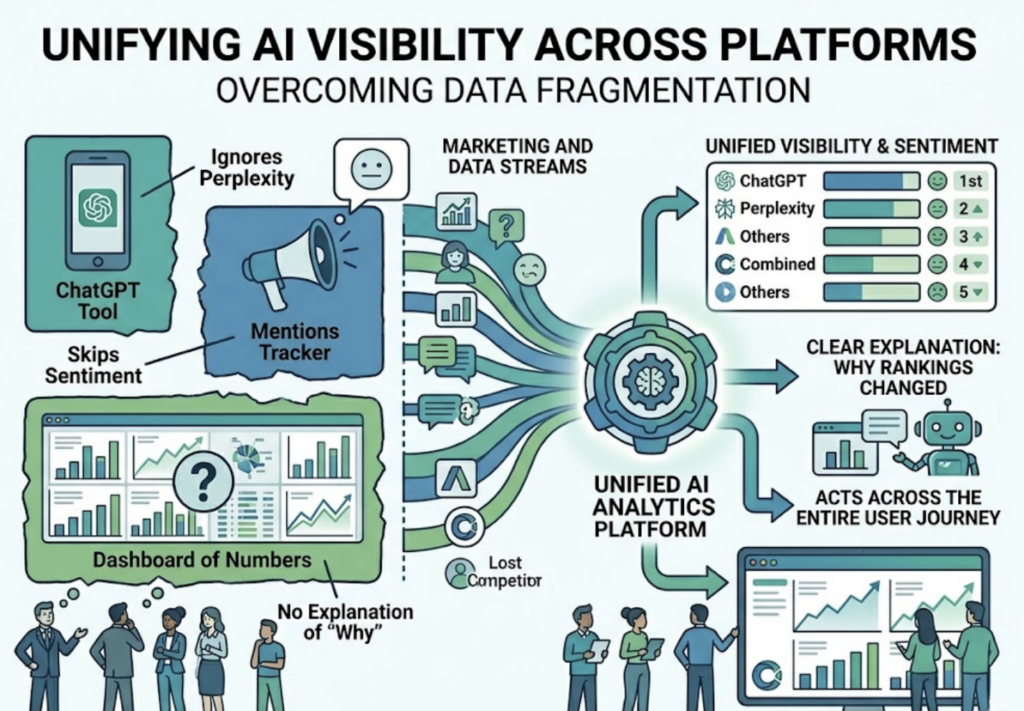
A complete AI answer monitoring solution doesn’t just count mentions. It tells you where you rank, how you’re described, who’s beating you, and what you can do about it.
What a Complete AI Answer Monitoring Platform Needs to Cover
Not all monitoring is equal. Research into the AI visibility space points to seven core dimensions that separate surface-level tracking from strategic intelligence:
| Dimension | What It Tells You |
|---|---|
| Visibility | How often your brand appears in AI responses across platforms |
| Sentiment | Whether AI describes you as “recommended” or “budget alternative” |
| Position | Where you rank in AI-generated lists, because #1 and #5 aren’t the same |
| Volume | How frequently your brand surfaces across high-intent AI queries |
| Source | Which citations and domains trigger AI to include or exclude your brand |
| Competitor | How your AI presence stacks up against rivals in real time |
| CVR | Whether AI appearances actually translate to traffic or leads |
Most AI answer monitoring tools cover two or three of these. A platform that covers all seven gives you the full picture.
Topify is one of the few AI answer monitoring platforms built around this seven-metric framework. It tracks brand performance across ChatGPT, Gemini, Perplexity, DeepSeek, Doubao, Qwen, and other major AI engines, consolidating all seven dimensions into a single dashboard. For teams tired of stitching together partial data from multiple tools, that consolidation tends to be the deciding factor.
The AI Answer Monitoring Dashboard Marketing Teams Actually Use
A dashboard is only useful if it changes what your team does on Monday morning.
The typical AI answer monitoring dashboard shows graphs and percentages. That’s a start. But the workflow that actually moves the needle looks different: you log in, spot a visibility drop on Perplexity for a high-intent prompt, trace it back to a competitor’s new blog post that AI is now citing, and launch an optimization campaign to reclaim that citation slot.
That’s the kind of closed-loop workflow Topify’s dashboard is designed for. It combines High-Value Prompt Discovery, which surfaces the AI prompts that matter most to your brand, with real-time visibility tracking across every major AI platform. When something shifts, you don’t just see a number change. You see what caused it and what to do next.
For marketing teams managing AI answer monitoring analytics across multiple brands or products, the multi-project structure means each brand gets its own tracking environment. No cross-contamination, no manual filtering.
Why Position and Sentiment Data Change Everything for AI Answer Monitoring
Here’s a scenario most AI answer monitoring software misses entirely.
Your brand gets mentioned in a ChatGPT response about “best CRM tools.” That looks like a win in the Visibility column. But the mention reads: “Brand X is a traditional, high-cost solution that larger enterprises sometimes consider.” You’re mentioned, yes. You’re also being positioned as expensive and old-school.
That’s why sentiment tracking isn’t optional in a real AI answer monitoring solution. An AI might include your brand but frame it in a way that actively pushes users toward your competitor. Without sentiment data parsed at the phrase level, you’d never know.
Position data is equally telling. Unlike traditional search where position #10 still gets some clicks, AI answers often truncate after the first two or three recommendations. If your brand consistently shows up at position #4 or #5, you’re technically visible but practically invisible. The users reading those AI answers rarely scroll past the initial response.
Topify’s Position Tracking and Sentiment Analysis work together here. The Sentiment Score (0-100) tells you how favorably AI describes your brand. The Position Rank tells you where you sit relative to competitors. Combined, they answer the question that a simple mention count never can: is AI actually helping or hurting your brand?
How Top GEO Companies Approach AI Answer Monitoring at Scale
For enterprise brands managing dozens of products across multiple markets, the monitoring challenge multiplies fast. A single-brand AI answer monitoring system won’t cut it when you’re tracking visibility for 15 product lines across 6 AI platforms in 4 languages.
This is where the conversation around top GEO companies, including those presenting at events like CES, gets practical. The enterprises leading in generative engine optimization aren’t just running spot checks. They’re deploying structured AI answer monitoring platforms with multi-project management, regional benchmarking, and dedicated reporting pipelines.
Topify’s Enterprise plan (starting at $499/month) is built for this scale. It includes a dedicated account manager, custom reporting, and the ability to spin up separate tracking projects per product line or region. For teams that need to present AI visibility data in quarterly business reviews, the reporting layer matters as much as the data itself.
The strategic play at this level goes beyond monitoring. Data-driven enterprises are using AI answer monitoring analytics to reverse-engineer which brand assets (whitepapers, PR placements, product reviews) LLMs prioritize when generating responses. That insight feeds directly into content strategy, turning monitoring data into a competitive moat.
From AI Answer Monitoring Software to Actual Optimization
The primary failure of most AI answer monitoring tools is where they stop. They show you the problem. They don’t help you fix it.
Consider the workflow: your AI answer monitoring dashboard reveals that Perplexity’s “best CRM” response doesn’t include your brand. Now what? With most tools, you export the data, schedule a meeting, brief your content team, develop new assets, distribute them, and wait weeks to see if anything changed.
Topify takes a different approach with its One-Click Agent Execution. You define your optimization goal in plain English, review the proposed strategy, and deploy it with a single click. The AI agent handles the execution, from content generation to distribution, without the manual workflows that slow most teams down.
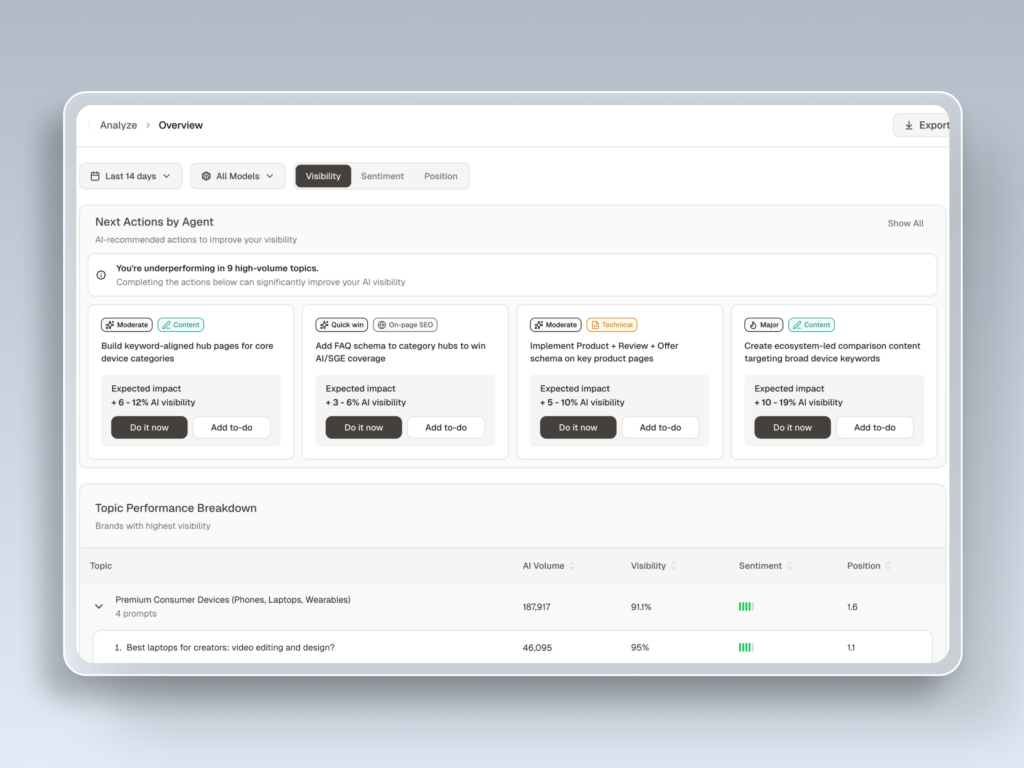
That’s the gap between an AI answer monitoring system and an actual AI answer monitoring solution. Monitoring tells you what’s happening. A solution helps you change it.
For teams ready to move beyond passive tracking, getting started with Topify means running your first visibility audit in minutes, not weeks.
Conclusion
The brands that treat AI answer monitoring as a checkbox will keep getting partial data from partial tools. The ones that treat it as a strategic function, covering visibility, sentiment, position, source, competitor, and conversion data across every major AI platform, will know exactly where they stand and what to do about it.
The question isn’t whether your brand needs an AI answer monitoring solution. It’s whether the one you’re using actually closes the loop. Start with the seven dimensions. If your current tool can’t cover them, it’s time to look at one that can.
FAQ
Q: What’s the difference between AI answer monitoring and traditional brand monitoring?
A: Traditional brand monitoring tracks mentions across news, social media, and web search results. AI answer monitoring specifically tracks how large language models like ChatGPT, Gemini, and Perplexity describe, recommend, or omit your brand in their generated responses. The data sources, metrics, and optimization strategies are fundamentally different.
Q: How many AI platforms should an AI answer monitoring solution cover?
A: At minimum, your solution should cover ChatGPT, Gemini, and Perplexity, as these represent the largest share of AI-driven search. For global brands, platforms like DeepSeek, Doubao, and Qwen also matter. The more platforms you track, the more complete your visibility picture becomes.
Q: Can AI answer monitoring tools track competitor brands too?
A: Yes. Competitive benchmarking is one of the seven core dimensions of effective AI monitoring. Platforms like Topify automatically detect competitors in AI responses and let you compare visibility, sentiment, and position data side by side.
Q: How often should you check your AI answer monitoring dashboard?
A: AI responses can shift weekly as models update their training data and citation patterns. For active campaigns, daily or weekly checks are recommended. For ongoing brand health tracking, a bi-weekly review with monthly reporting tends to work well for most marketing teams.

