

Your team tracks Google rankings every week. You’ve got domain authority reports, keyword position updates, and a content calendar built around search volume data. Then someone on the leadership team asks, “Are we showing up when people ask ChatGPT about our category?” and nobody has an answer.
That gap between traditional SEO reporting and AI search visibility is where most brands are stuck right now. AI-driven search traffic has surged 527% year-over-year, and over 60% of Google queries now end without a click as AI Overviews serve consolidated answers directly. The brands that can’t measure their presence in these AI-generated responses aren’t just missing data. They’re missing customers.
What an AI Answer Monitoring Platform Actually Does
An AI answer monitoring platform is a SaaS tool built to track, analyze, and optimize how your brand appears inside generative AI responses. That includes ChatGPT, Perplexity, Google AI Overviews, Gemini, and increasingly, newer models like DeepSeek and Claude.
This isn’t the same as manually asking ChatGPT “What’s the best [your category] tool?” once a quarter. Manual spot-checking is prone to human bias, impossible to scale, and gives you a single snapshot rather than a trend line. Platform-level monitoring runs hundreds or thousands of prompts daily, parses each response with NLP at 95-98% accuracy, and turns the results into metrics you can actually act on.
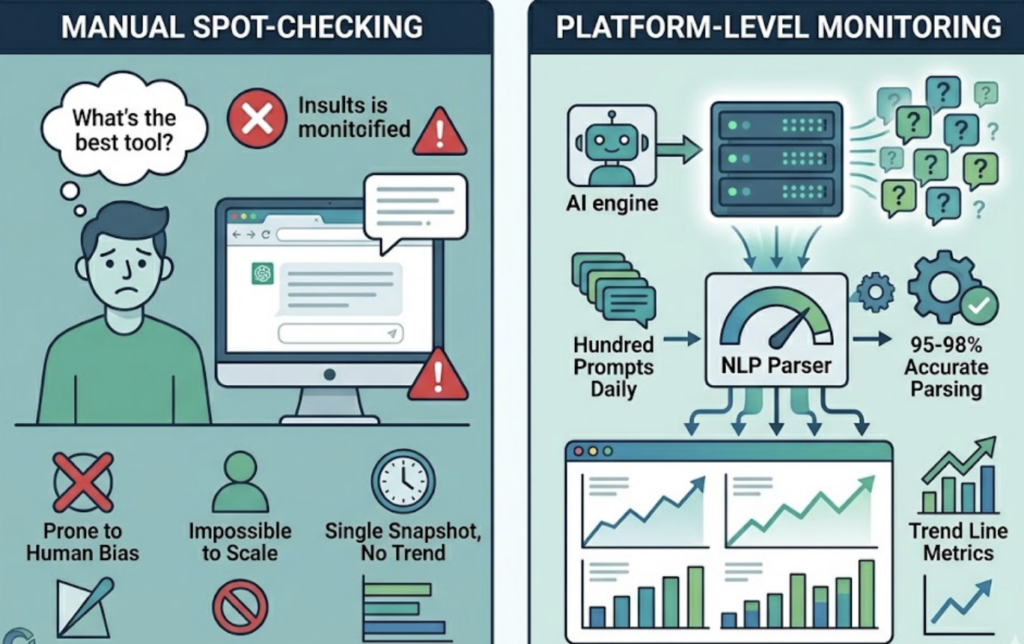
The core capabilities typically include four things: visibility tracking (are you mentioned?), sentiment analysis (what does the AI say about you?), competitive benchmarking (who else gets mentioned in the same responses?), and source attribution (which domains is the AI citing when it talks about your category?).
That last one matters more than most teams realize. If you don’t know which sources the AI trusts, you can’t influence what it says.
The 5 Metrics That Separate Useful Platforms from Dashboards Full of Noise
Not every AI answer monitoring platform measures the same things. The ones that drive real decisions tend to track five core metrics:
Visibility Score. How often your brand appears across AI engines for a set of tracked prompts. This is the baseline. If you’re not showing up, nothing else matters.
Sentiment Score. Whether the AI describes your brand positively, neutrally, or inaccurately. A mention isn’t valuable if ChatGPT calls your enterprise product “a budget option for small teams.”
Position Rank. Where your brand falls in the AI’s recommendation list. Being mentioned fifth in a list of ten isn’t the same as being the first name the model suggests. Top chatgpt rank trackers focus on this metric specifically, and it’s one of the clearest indicators of competitive positioning in AI search.
Citation Sources. The external domains the AI pulls from when generating answers about your category. This is where AI answer monitoring intersects with content strategy. If the AI cites your competitor’s blog but not yours, that’s a content gap you can close.
AI Search Volume. The number of prompts triggering AI-generated responses related to your brand or category. This tells you where the demand is, not just where you rank.
Traffic from AI-cited sources converts at an average rate of 14.2%, compared to 2.8% for traditional organic search. That means each of these five metrics isn’t just a vanity number. It’s tied directly to revenue.
How AI Answer Monitoring Platforms Work Under the Hood
The technical architecture behind these platforms follows a consistent pattern, even though each vendor implements it differently.
It starts with prompt sampling. The platform executes a set of industry-relevant prompts across multiple LLMs (ChatGPT, Gemini, Perplexity, and others) at high frequency, often daily or hourly. These aren’t random queries. They’re structured around the prompts your target audience actually uses.
Next comes response capture. The raw generative text from each AI engine gets stored as a data point. Unlike traditional SEO where you’re parsing web pages, here you’re parsing conversational text that changes every time the model updates its knowledge base.
Then the NLP layer kicks in. Named Entity Recognition (NER) isolates brand mentions. Sentiment analysis scores the linguistic polarity of each mention. Attribution mapping extracts cited URLs to reconstruct the “knowledge graph” the AI relied on for that specific answer.
Finally, all of this feeds into metric computation, where raw data gets normalized into visibility scores, sentiment trends, and position rankings that account for traffic potential across different platforms.
The key insight here: AI responses aren’t static web pages. They shift as models get retrained, as RAG systems pull fresh sources, and as competitors publish new content. A one-time audit tells you where you stood. Continuous monitoring tells you where you’re heading.
4 Mistakes That Tank Your AI Answer Monitoring Before It Starts
Most teams that invest in AI answer monitoring still get disappointing results. The problem usually isn’t the tool. It’s how they use it.
Tracking only one AI platform. This is the most common mistake. A brand’s visibility on ChatGPT can look completely different from its visibility on Perplexity or Google AI Overviews. Each model has different training data, different citation preferences, and different response structures. Monitoring just one engine is like tracking your Google rankings but ignoring Bing, Yahoo, and every other channel your customers use.
Fixating on visibility without checking sentiment. Being mentioned is only half the story. If the AI describes your SaaS product as “outdated” or “limited compared to [competitor],” that mention is actively hurting you. Teams that only track whether they appear, without analyzing how they’re described, miss the most actionable data.
Ignoring competitor gaps. The platform shows you that a competitor gets cited for a high-value prompt and you don’t. Too many teams note this and move on. The real question is: what source did the AI cite for that competitor, and can you create something better? Without digging into the citation layer, competitor data is just noise.
Choosing a dashboard without an action layer. Some platforms give you charts and graphs but no path from insight to execution. The data shows you’re invisible for 40% of your tracked prompts. Then what? The platforms that drive results connect visibility gaps to specific content recommendations, source strategies, and optimization workflows.
What to Check Before You Buy: The AI Answer Monitoring Platform Checklist
Here’s what to evaluate before committing to a platform:
| Criteria | What to Look For | Why It Matters |
|---|---|---|
| Multi-platform coverage | ChatGPT, Perplexity, Gemini, Google AIO, DeepSeek in one view | AI users spread across platforms; single-engine data misleads |
| Data frequency | Daily or real-time updates | RAG engines refresh sources constantly; weekly data is stale |
| Metric completeness | Visibility + Sentiment + Position + Citations + Volume | Missing any one metric creates blind spots |
| Competitor monitoring | Auto-detection and benchmarking | You need relative performance, not just absolute scores |
| Action layer | Content recommendations tied to visibility gaps | Data without execution is just expensive reporting |
| Pricing transparency | Clear per-prompt or per-project pricing | Hidden costs erode ROI fast |
How Topify Covers Each Item on This List
Topify stands out in this space for its hybrid approach: it integrates traditional SEO data (like Google Search Console metrics) with AI-specific citation tracking, giving teams both legacy context and forward-looking AI visibility data in a single platform.
On multi-platform coverage, Topify tracks brand performance across ChatGPT, Gemini, Perplexity, DeepSeek, Doubao, Qwen, and Google AI Overviews. That’s broader than most competitors in the category.
For metric completeness, the platform monitors seven key dimensions: visibility, sentiment, position, volume, mentions, intent, and CVR (Conversion Visibility Rate). The CVR metric is particularly useful. It estimates the likelihood that an AI response will drive a user toward your brand, which is the closest proxy to conversion attribution most teams can get in AI search right now.
The action layer is where Topify diverges from pure-monitoring tools. Its AI agent lets you define optimization goals in plain English, review a proposed strategy, and deploy with one click. That closes the gap between “we see the problem” and “we’re fixing it.”
On competitor monitoring, Topify auto-detects competitors and provides side-by-side benchmarking on visibility, sentiment, and position. You don’t have to guess who’s outranking you in AI answers. The platform shows you exactly who, for which prompts, and why.
Pricing starts at $99/month for the Basic plan (100 prompts, 9,000 AI answer analyses, 4 projects) and scales to $199/month for Pro (250 prompts, 22,500 analyses, 10 seats). Enterprise plans start at $499/month with dedicated account management. You can get started with a 30-day trial on the Basic plan.
A 30-Day Plan to Get Real Value from Your AI Answer Monitoring Platform
Buying the platform is step one. Here’s how to make sure it pays for itself within the first month.
Week 1: Set up your prompt universe and competitor baseline. Identify 50-100 prompts your target audience uses when searching for your category. Load them into the platform. Add 3-5 direct competitors. Run the first full scan and document your starting visibility score, sentiment, and position for each prompt.
Week 2: Analyze trends and spot the gaps. Look for prompts where competitors appear but you don’t. Check sentiment for any mentions that mischaracterize your product. Identify the citation sources the AI favors in your category. This week is about understanding the terrain, not taking action yet.
Week 3: Close citation gaps with targeted content. For every high-value prompt where you’re invisible, check which sources the AI cites for your competitors. Create or optimize content that directly addresses those topics, using the format and depth that AI models tend to reference. This is where the “action layer” earns its keep.
Week 4: Generate your first AI visibility report. Pull your visibility, sentiment, and position data into a report your team can use. Compare Week 4 numbers to your Week 1 baseline. Highlight the prompts where you gained ground and the ones that still need work. Set monthly benchmarks going forward.
That’s it. Four weeks from zero monitoring to a structured, repeatable AI visibility workflow.
Conclusion
The shift from ranking on Google to being recommended by AI isn’t hypothetical. It’s already happening, and the brands that track it will outperform the ones that don’t. An AI answer monitoring platform gives you the data layer you’re currently missing: who the AI recommends, why, and what you can do about it.
If your monthly report still can’t answer “how are we doing in AI search,” that’s the gap to close first. Start with the checklist above, evaluate based on what your team actually needs, and get your first baseline scan running this week.
FAQ
Q: What is an AI answer monitoring platform?
A: It’s a SaaS tool that tracks how your brand appears in AI-generated responses across platforms like ChatGPT, Perplexity, and Google AI Overviews. It measures metrics like visibility, sentiment, position ranking, citation sources, and AI search volume to help you understand and improve your brand’s presence in AI search.
Q: How does an AI answer monitoring platform work?
A: The platform runs industry-relevant prompts across multiple AI engines at high frequency, captures the generative text responses, and uses NLP techniques (named entity recognition, sentiment analysis, attribution mapping) to extract structured data about your brand mentions, tone, and cited sources.
Q: What’s the difference between AI answer monitoring and traditional SEO rank tracking?
A: Traditional SEO tracks your website’s position in blue-link search results. AI answer monitoring tracks whether and how AI models mention your brand in conversational responses. The data sources, metrics, and optimization strategies are fundamentally different. Traffic from AI-cited sources converts at roughly 14.2%, compared to 2.8% for traditional organic search.
Q: How much does an AI answer monitoring platform cost?
A: Pricing varies by vendor. For example, Topify’s Basic plan starts at $99/month for 100 tracked prompts and 9,000 AI answer analyses. Pro plans run $199/month with expanded capacity. Enterprise plans with dedicated support typically start at $499/month or higher depending on scale.

