

AI-referred shoppers convert roughly 42% better than shoppers who arrive through traditional search, according to Adobe’s Q1 2026 data. That’s the kind of number that gets a CMO’s attention. But most brands still can’t see where those shoppers came from, what they were told about the product, or why they bought.
That’s the real story of agentic commerce. It’s not a faster version of ecommerce. It’s a different buyer, moving through a different path, and most of that path is invisible to the tools brands have relied on for the last two decades.
Agentic Commerce Isn’t AI-Assisted Shopping. It’s a Different Buyer.
Traditional ecommerce assumes a human is doing the browsing. They search, compare tabs, read reviews, and click “buy.” Every step leaves a trace your analytics stack can read.
Agentic commerce changes who’s doing the browsing. An AI agent, acting on a person’s behalf, handles some or all of that journey: finding products, comparing options, and in a growing number of cases, completing the purchase. 45% of consumers already use AI for some part of their buying journey, per a January 2026 IBM Institute for Business Value study.
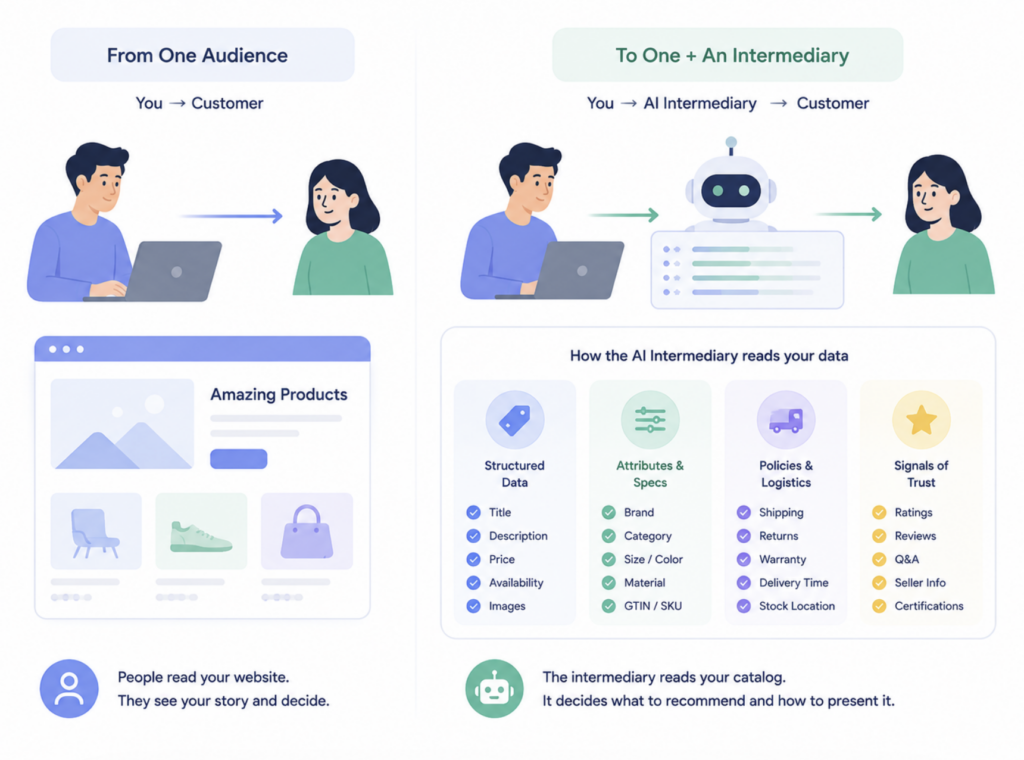
The shift matters because your audience of one just became an audience of one plus an intermediary. That intermediary reads your product data differently than a person reads your website. It doesn’t care about your hero banner. It cares about whether your catalog is structured well enough to answer its question.
Traditional Ecommerce vs Agentic Commerce, Side by Side
The differences aren’t cosmetic. They touch discovery, comparison, decision-making, and checkout at the same time.
| Dimension | Traditional Ecommerce | Agentic Commerce |
|---|---|---|
| Discovery | SEO, ads, social, direct site visits | Structured product feeds read by AI agents |
| Comparison | Multiple browser tabs, manual research | One conversation, agent-driven ranking |
| Decision-maker | The shopper | The shopper’s agent, working from delegated preferences |
| Checkout | Brand-controlled page and flow | Tokenized, permission-based transaction inside the agent |
| Persuasion surface | Landing pages, promotions, design | Data completeness, pricing accuracy, attribute depth |
| Visibility | Web analytics, session data | Agent citation and recommendation data |
That last row is the one most brands haven’t reckoned with yet. In traditional ecommerce, you can watch a customer’s session end to end. In agentic commerce, the parts that used to be visible, browsing, comparing, hesitating, now happen inside someone else’s model.
Discovery No Longer Happens on Your Website
In search-driven ecommerce, discovery meant ranking well and building a site people wanted to land on. In agentic commerce, the agent doesn’t land anywhere. It queries.
The Product Feed Becomes the Storefront
Structured data is doing the job your homepage used to do. The Agentic Commerce Protocol, launched by OpenAI and Stripe, requires merchants to submit structured feeds to a central index so agents can pull accurate product, price, and inventory data on demand. Google’s newer Universal Commerce Protocol takes a different approach, letting merchants host their own data and expose it through standardized endpoints instead of submitting to a central platform.
Underneath both sits the Model Context Protocol, which handles how agents actually connect to and read that data in the first place.
None of this is optional in practice. Merchants that connect to more than one protocol see roughly 40% more agentic traffic than single-protocol adopters, according to Elogic’s 2026 analysis. Skip the feed work, and an agent can still find you by scraping your site, but with thinner data and weaker placement than competitors who did the integration.
Merchant adoption is still catching up to consumer interest. Checkout.com’s 2026 research found that only about 3% of transactions currently involve an AI agent, even though 89% of merchants say they’re actively preparing for it. In practice, that gap is a window. Brands that get their feeds protocol-ready now are positioning for a channel that’s still forming, not one that’s already saturated.
Comparison Shopping Now Happens Inside One Conversation
A shopper used to open five tabs to compare five products. Now they ask once, and an agent does the comparing. 63% of European shoppers already use AI to compare brands and models rather than doing it manually.
This collapses your persuasion window. In traditional ecommerce, a strong landing page, a well-timed discount banner, or a trust badge could tip a close decision. Inside an agent’s comparison, none of that surface material gets read. What gets read is your attribute completeness, your pricing accuracy, and whether your data conflicts with what’s listed elsewhere.
Brand persuasion is moving from the page to the feed. That’s a hard adjustment for teams built around campaign creative.
Checkout Is No Longer a Page. It’s a Permission.
Traditional checkout is a flow you design: cart, shipping, payment, confirmation. Agentic checkout is a permission you’re granted, executed through tokenized payment infrastructure like Stripe’s Shared Payment Tokens, which let an agent initiate a transaction without ever touching raw card data.
Consumers are still working out how much they trust this. Only about 14% trust an AI agent to place an order autonomously, even though 65% trust one to compare prices, based on Axis Intelligence’s 2026 trust gap index. The conditions consumers set before they’ll delegate a purchase are specific: spending caps, instant revocation, and easy cancellation top the list, and 75% of merchants agree that real-time permission control is critical to adoption.
That’s the trade-off. Brands give up direct control over the checkout experience. In exchange, a transaction can complete in one step, with no cart abandonment funnel to optimize, because there’s no funnel left to see.
There’s also a ceiling on what agents get to spend without asking first. Consumers say they’re comfortable letting an AI agent spend around $233 per purchase in the US without extra approval, and considerably less in other markets. Below that line, agentic checkout can move fast. Above it, a human still has to sign off, which means brands selling higher-ticket items should expect a hybrid flow for a while yet, not a fully autonomous one.
The Metrics That Used to Matter Don’t Work Here
This is where most brands get stuck. Website sessions, page-level conversion rate, and SEO rank all assume the customer’s decision-making happened somewhere you could measure it.
In agentic commerce, the behavioral data stream often starts at the add-to-cart moment. Everything before that, the browsing, the refined preferences, the comparison, happened inside a conversation you never saw. That’s a big part of why some merchants report conversion running 86% worse than affiliate channels, not because agent-driven shoppers are lower intent, but because merchant infrastructure wasn’t built to capture or respond to agent traffic in the first place. The gap isn’t demand. It’s visibility.
That’s the tension brands are sitting in right now: strong upside in the data when infrastructure is ready, and a real cost when it isn’t. Traditional CVR can’t tell you which side of that line you’re on, because it only measures what happens after a visitor lands on your site. It says nothing about whether an agent considered you and moved on before that ever happened.
This is the specific gap Topify’s Conversion Visibility Rate is built to close. Instead of waiting for a session to start, CVR estimates how likely an AI answer is to actually drive a user toward your brand, based on how often and how favorably you show up in agent responses in the first place. Paired with Source Analysis, which tracks the exact domains and feeds agents cite when recommending products, and Competitor Monitoring, which flags when a rival starts getting picked over you, it gives brands a way to see the part of the funnel that agentic commerce made invisible.
Conclusion
Agentic commerce isn’t traditional ecommerce running faster. The buyer changed, the comparison process changed, and checkout changed from a page you control to a permission you’re granted. Brands that treat this as an SEO update will miss most of it.
The practical starting point is straightforward: get your product data structured and protocol-ready, understand which of ACP, UCP, and MCP actually applies to your channels, and put a measurement layer in place that can see what’s happening inside agent conversations, not just what happens after someone lands on your site.
FAQ
Is agentic commerce the same as AI-powered ecommerce?
Not quite. AI-powered ecommerce typically means AI features layered onto a traditional flow, like a chatbot or a recommendation widget. Agentic commerce means an AI agent independently handles discovery, comparison, and in some cases the transaction itself, on the shopper’s behalf.
Do I need to support all three protocols, ACP, UCP, and MCP?
Not all at once, but ignoring them isn’t a safe default either. MCP is the connective layer most agents already rely on to read data. ACP and UCP handle different parts of discovery and checkout, and multi-protocol merchants are already seeing meaningfully more agentic traffic than single-protocol ones.
How do brands measure performance in agentic commerce?
Traditional metrics like site traffic and page-level CVR only capture what happens after a shopper lands on your site, which is often too late in an agent-mediated journey. Metrics built around AI citation frequency, source visibility, and recommendation likelihood, like Topify’s Conversion Visibility Rate, are designed to measure the part of the funnel that now happens before a website visit ever occurs.

