


A shopper asks ChatGPT for waterproof trail runners under $150. The assistant pulls a shortlist, shows price and stock, and lets the shopper check out without ever opening your site. Your product might be in that shortlist. Or it might not, and nobody on your team would know why. Traditional product feeds were built for Google Shopping and human eyes. AI shopping agents read differently, and most catalogs weren’t designed with that in mind.
Why Your Product Feed Wasn’t Built for Agentic Commerce
Agentic commerce means an AI agent discovers, compares, and completes a purchase on a shopper’s behalf, often without the shopper ever landing on your site. This isn’t a pilot program anymore. ChatGPT’s Instant Checkout has been live since September 2025, serving hundreds of millions of weekly users, and Google has since rolled out its own competing infrastructure with major retail partners backing it.
That’s the shift most feed strategies haven’t caught up with. A search engine indexes your page and shows a human a link. An agent has to parse your data, trust it, and act on it in real time, sometimes completing the transaction itself. If a field is missing or a value is stale, the agent doesn’t guess. It skips you.
What Structured Data Actually Means for Agentic Commerce
Schema.org’s Product vocabulary works as the shared language that lets AI shopping systems interpret your cataloginstead of relying on how your page renders visually. This matters more than it used to, because AI crawlers like GPTBot and PerplexityBot typically don’t execute JavaScript. Your JSON-LD needs to be server-side rendered directly into the HTML, not injected after the page loads.
There’s also a parsing preference worth knowing. When an agent needs a high-stakes value like price or stock status, it tends to trust structured JSON-LD over natural-language text parsed from a paragraph, because deterministic data doesn’t introduce interpretation errors.
At minimum, every SKU needs a baseline of core attributes: title, description, brand, GTIN, MPN, category, price, sale price, availability, condition, image URL, and product URL. Most retailers already have this if they’re shipping to Google Shopping. Agents just need it complete on every single SKU, not just your top sellers.
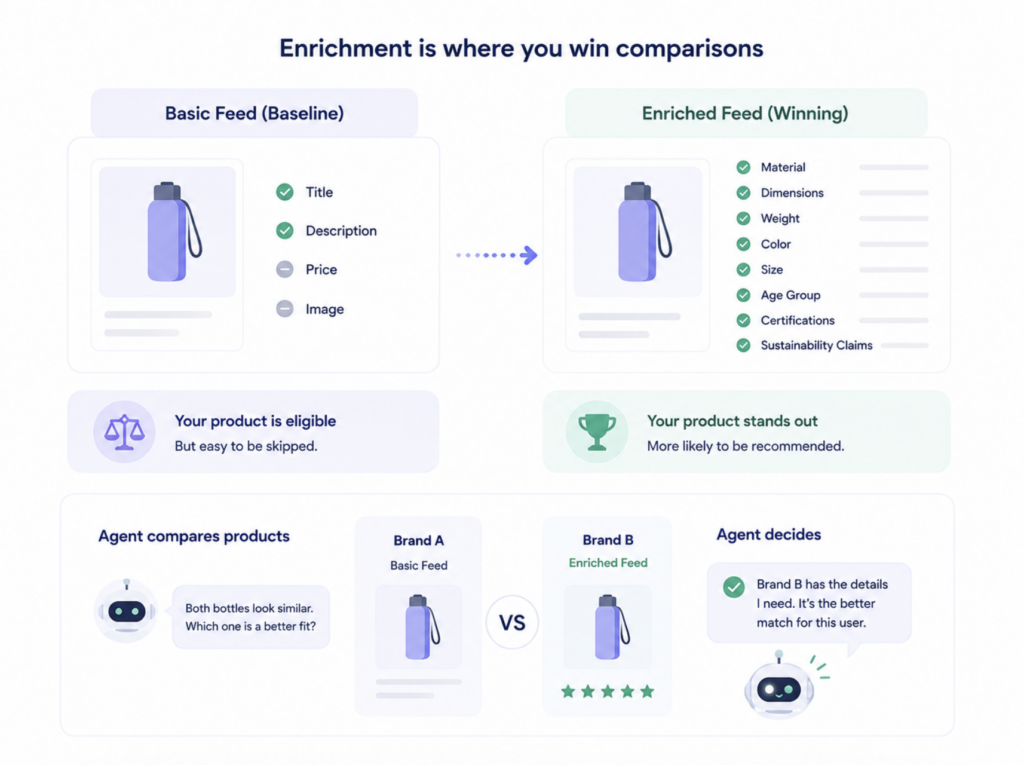
Past that baseline, enrichment is where you actually win comparisons. Attributes like material, dimensions, weight, color, size, age group, certifications, and sustainability claims get weighed heavily when an agent is choosing between two similar products.
The Metadata Fields AI Agents Check First
Not every field carries equal weight. Agents prioritize a specific handful when deciding whether to surface or skip a listing:
- Price and currency, kept current and matched exactly to what a shopper would pay at checkout
- Availability and stock status, since agents won’t recommend something they can’t confirm is in stock
- GTIN or SKU, the identifier agents use to disambiguate your product from near-duplicates
- Return policy and shipping cost, both of which agents weigh alongside price and rating when ranking comparable products
- Review rating and count, which builds the trust signal an agent needs before recommending you over a competitor
One underused field deserves a callout: additionalProperty. It structures any characteristic that doesn’t fit a standard schema field, like certifications or country of origin. Products using it with five or more structured characteristics saw a 28% lift in AI citations on specialized queries in early 2026 analysis. For boolean fields, an explicit false beats a blank value every time. Agents treat missing data as a reason to skip, not a reason to assume.
APIs and Protocols: The Difference Between Being Listed and Being Transactable
Structured data gets you discovered. It doesn’t get you paid. That’s where the API layer comes in, and right now there are two major standards competing for merchant adoption.
OpenAI and Stripe co-built the Agentic Commerce Protocol to power ChatGPT’s checkout experience. It works through three flows: ChatGPT calls your endpoints to create a checkout session, your system validates the order and calculates tax, and you accept or decline before ChatGPT shows the confirmation. You stay the merchant of record throughout, meaning you keep the customer relationship, handle fulfillment, and process payment through your existing provider.
Google took a broader approach with the Universal Commerce Protocol, an open standard for the full shopping journey from discovery through post-purchase support. It’s built to interoperate with the Agent Payments Protocol (AP2), which uses cryptographically signed “mandates” to authorize an agent’s purchase within limits a shopper sets in advance, creating a tamper-proof record of the transaction.
For your engineering team, this translates into concrete requirements: a machine-readable feed refreshed on a regular cadence (daily is standard for most integrations), REST checkout endpoints that can accept and confirm an order, and webhooks for shipping, refunds, and fulfillment events. None of it requires replatforming. It does require someone on your team to actually own the integration, because a missing webhook or an incorrect tax calculation is enough to break a transaction mid-checkout.
The Product Data Readiness Checklist
Use this as your working list. Most teams find they’re missing pieces across all three columns, not just one.
| Structured Data | API & Protocol | Metadata & Media |
|---|---|---|
| JSON-LD Product schema, server-side rendered | Machine-readable feed (CSV or JSON), refreshed daily | Multiple images per SKU with descriptive alt text |
| Core fields: title, brand, GTIN, MPN, category | ACP or UCP-compatible checkout endpoints | Enrichment attributes: material, dimensions, size, color |
| Offer fields: price, priceCurrency, availability | Webhooks for shipping, refunds, fulfillment | additionalProperty for certifications, origin, features |
| AggregateRating and Review schema | Delegated payment flow (Stripe, Adyen, or compatible) | Accurate, current return policy and shipping cost text |
| Explicit boolean values, never left blank | Order acceptance and decline logic in place | Consistent naming across feed, schema, and product page |
How to Know AI Agents Are Actually Reading Your Data Correctly
Publishing the fields is step one. The harder question is whether an agent is actually parsing them the way you intend, and whether you’d even notice if it wasn’t.
This is where most teams hit a blind spot. You can validate your JSON-LD against a schema checker and still have no idea whether ChatGPT is citing your product at the right price, or whether Perplexity is quietly recommending a competitor because your stock field returned stale data last Tuesday. Structured data compliance and AI visibility are two different things, and only one of them shows up in a validator.
That’s the gap Topify was built to close. Its Source Analysis feature tracks the exact domains and pages AI platforms cite when answering a shopping query, so you can see whether your product data is actually surfacing, and whether it’s being represented accurately. Pair that with Conversion Visibility Rate, which estimates how likely an AI answer is to route a shopper toward an actual purchase, and you get a way to measure agentic commerce performance instead of just guessing at it. In practice, that means catching a dropped citation or a mispriced listing before it costs you a quarter’s worth of agent-driven traffic, not after.
Conclusion
Structured data, API compliance, and clean metadata aren’t a one-time project. Feeds go stale, schema drifts out of date, and new fields get added to protocols every few months. Treat your product data the way you’d treat inventory: something that needs regular auditing, not something you fix once and forget. The brands that stay visible in agentic commerce will be the ones that keep verifying, not just the ones that shipped the checklist first.
FAQ
Q: What’s the difference between agentic commerce and regular AI search visibility?
A: AI search visibility is about your brand appearing in an AI-generated answer. Agentic commerce goes further: it means an AI agent can also complete the transaction on the shopper’s behalf, which requires API and checkout infrastructure on top of structured content.
Q: Do I need to support both ACP and UCP?
A: Most retailers can’t bet on just one. ChatGPT runs on ACP, while Google’s ecosystem runs on UCP, and both are gaining merchant adoption. Prioritize based on where your traffic already comes from, but plan for both eventually.
Q: Is schema markup enough, or do I also need an API integration?
A: Schema gets your product discovered and cited. It doesn’t let an agent complete a purchase inside the conversation. If you want to support in-chat checkout, you need the API and payment layer on top of structured data.
Q: How do I check if AI agents are reading my product data correctly?
A: Validate your JSON-LD with a schema testing tool first, then monitor whether AI platforms are actually citing your products accurately over time. Tools like Topify’s Source Analysis track which domains and pages get cited so you can spot gaps a validator won’t catch.

