

ChatGPT now handles roughly 50 million shopping related queries every day. Searches for “AI shopping” alone have grown 1,767% over the last two years.
If your products aren’t turning up in those conversations, you’re not losing a future channel. You’re losing a present one.
The ChatGPT Shopping Moment Nobody Priced In
Most brands still treat ChatGPT shopping as a side project. That’s a mistake.
More than six in ten consumers have already used ChatGPT to shop, and one in four say it gives better recommendations than Google. Bain & Company found that 80% of consumers now rely on AI generated results for at least 40% of their searches.
The dollars are catching up too. McKinsey projects agentic commerce could drive $3 to $5 trillion in global transactions by 2030. That’s not a niche. That’s a new front door for retail.
Instant Checkout Died, but Agentic Commerce Didn’t
Here’s a twist that changes the strategy for a lot of teams. OpenAI’s Instant Checkout, the buy-without-leaving-chat feature launched in September 2025, has been quietly shelved as of March 2026. Fewer than 30 Shopify merchants ever went live, against the over a million once promised.
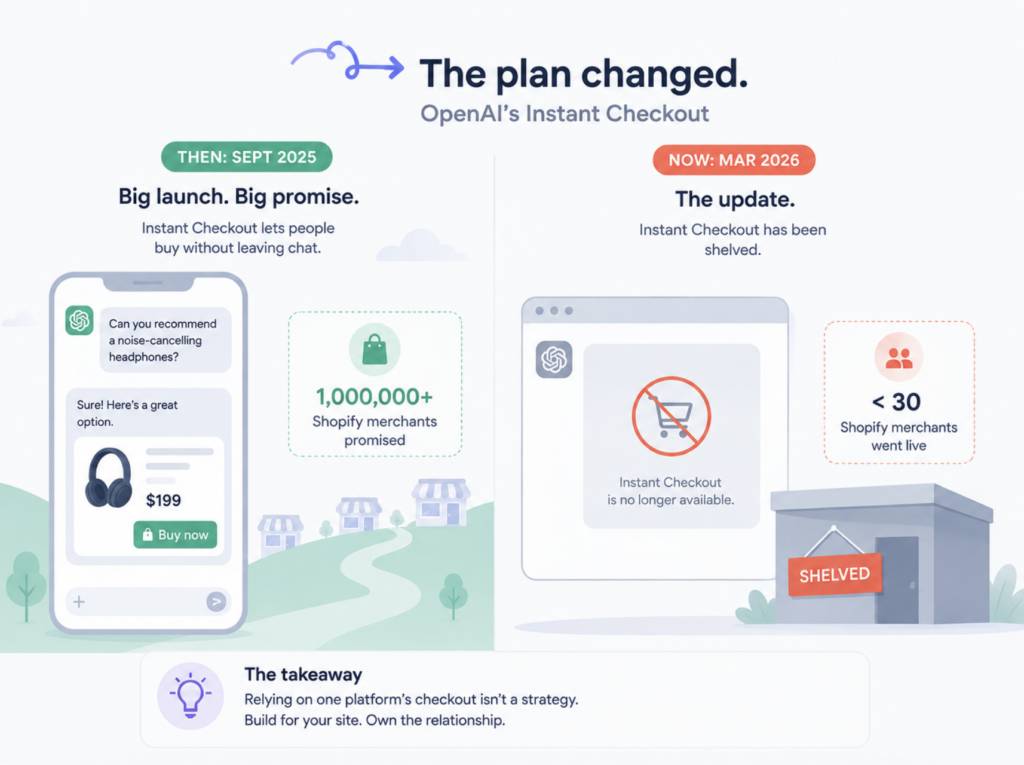
The reason wasn’t philosophical. It was conversion math.
Walmart found that checkout inside ChatGPT converted roughly 3 times worse than a click through to walmart.com, even though ChatGPT drove about twice the new customer rate that Walmart sees from search. In practice, ChatGPT is turning out to be a discovery engine, not a checkout counter.
The underlying Agentic Commerce Protocol, open sourced by OpenAI and Stripe, is still very much alive. It just plays a different role now: get discovered in the chat, close the sale on your own site. That’s the model worth building for.
That’s the gap most brands still haven’t priced in.
The Real Gatekeeper Is Google Shopping, Not ChatGPT
Here’s the part that surprises most marketing teams. ChatGPT doesn’t build its own product index. It reads someone else’s.
Peec AI analyzed over 43,000 ChatGPT carousel products and found that 83% were strong matches to Google Shopping’s organic top 40 results for the same query. A separate study found the number closer to 100%, with Bing Shopping explaining only about 11% of what showed up. ChatGPT also pulls roughly 75% of its raw product data straight from Google Shopping.
Rank matters more than most teams assume. Peec AI’s data shows 60% of carousel matches come from Google Shopping’s top 10 results, climbing to 84% by the top 20. Products sitting at rank 21 to 40 account for only about 16% of matches.
| Google Shopping Rank | Share of ChatGPT Carousel Matches |
|---|---|
| Top 10 | ~60% |
| Top 20 | ~84% |
| Rank 21 to 40 | ~16% |
| Outside top 40 | Effectively 0% |
If you’re not in Google Merchant Center with a clean feed, you’re not in ChatGPT’s candidate pool at all. No amount of great copywriting on your product page fixes that. Feed quality is the gate. Everything else decides what happens once you’re through it.
Why Your Titles Fail a Model That Talks Like a Shopper
Getting into the pool is step one. Getting picked is a different problem, and it’s where most feeds quietly fail.
Shopping fan out queries inside ChatGPT average about seven words and read like something a person would actually say, not a keyword string. “Red Dress Cotton” doesn’t match how anyone talks to an AI. “Women’s A-Line Cotton Midi Dress in Cherry Red” does.
Structured attributes carry the same weight. Google Shopping needs brand, product type, material, color, size, gender, condition, and a GTIN or manufacturer ID to place your product correctly. Skip a field and you either drop out of relevant queries or get miscategorized entirely.
Freshness compounds this. ChatGPT’s own merchant feed spec supports updates every 15 minutes, compared to Google Shopping’s standard 24 hour cycle. Stale pricing or a phantom “in stock” tag is often the quiet reason a product that used to appear stops showing up.
The Trust Signals That Decide Whether You Get Recommended
Once ChatGPT has a shortlist, it starts reasoning about which product to actually suggest. That’s where trust signals take over from feed mechanics.
Reviews matter more than most teams realize, because ChatGPT performs sentiment synthesis on the actual text of reviews to answer detailed shopper questions. If your review content isn’t wired into your feed, ChatGPT pulls social proof from Reddit or third party blogs instead, and you lose control of your own narrative.
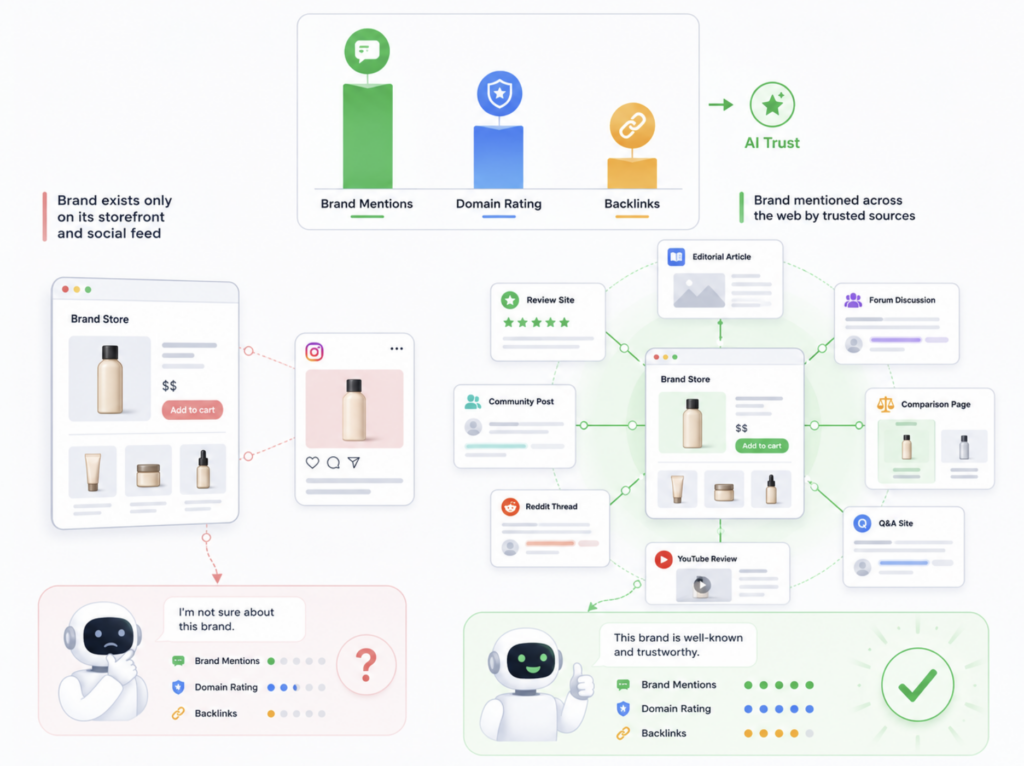
Brand mentions carry surprising weight too. Ahrefs found that branded mentions across the web correlate with AI visibility at 0.664, well above backlinks at 0.218 or domain rating at 0.326. A brand that only exists on its own storefront and its own feed is structurally harder for an AI agent to trust.
Content depth adds another layer. Academic GEO research from Princeton and Georgia Tech found that content backed by statistics, citations, and structured evidence can lift AI visibility by up to 40%.
None of these signals live in your product feed. They live in how your brand shows up everywhere else AI models look.
How to Check If You’re Even in the Running
Before fixing anything, you need to know where you actually stand.
Run a handful of shopping style prompts through ChatGPT the way a real customer would phrase them. Not “best waterproof boots” but “what’s a good waterproof hiking boot for wide feet under $200.” Check whether your brand appears, where it lands in the carousel, and which competitors keep showing up instead.
This works fine as a spot check. It falls apart at scale. Prompts drift, models get updated, and a brand that shows up today can quietly disappear next week without anyone noticing until sales already dipped.
Turning Product Visibility Into Something You Can Track
Manual prompt testing tells you what’s happening right now, once. What most teams actually need is a way to see the pattern over time, and to know which lever to pull when visibility drops.
Topify‘s Visibility Tracking follows how often your products and brand actually surface across ChatGPT, Perplexity, and Google AI Overviews, so a drop shows up as a chart instead of a support ticket. Paired with Source Analysis, it shows exactly which domains and review sources AI models are citing when they explain a recommendation, which is often the fastest way to spot a content gap before a competitor fills it.
Competitor Monitoring rounds it out by showing who’s winning the same carousel you’re trying to get into, and where their feed or content is simply stronger than yours right now. That turns “why aren’t we showing up” from a guess into a diagnosis.
What to Fix This Week
- Confirm your Google Merchant Center feed is complete: brand, GTIN, material, color, size, and condition, with no missing fields
- Rewrite your top 20 product titles the way a customer would actually ask for them, not the way your internal catalog names them
- Sync your product page schema markup with your feed data so the two never contradict each other
- Wire your genuine review content into your feed instead of leaving AI models to source sentiment from third party sites
- Start tracking your AI shopping visibility on a recurring basis instead of spot checking it once and moving on
Conclusion
Your products aren’t invisible to ChatGPT because AI shopping is some kind of black box. They’re invisible because Google Shopping’s organic index decides who even gets considered, and most feeds still aren’t clean enough to clear that bar. Fix the feed first. Build the trust signals second. Track what happens next, because a visibility gap you can’t see is one you can’t fix.
FAQ
Does ChatGPT rank paid ads in its shopping results?
No. Both Peec AI and OpenAI confirm that ChatGPT’s product carousel pulls from organic Google Shopping results only. There’s currently no way to pay for placement.
Do I need to be on Shopify to appear in ChatGPT shopping?
No. Appearing depends on having a well optimized Google Merchant Center feed, not on which ecommerce platform you run. Etsy and independent merchants show up the same way Shopify stores do.
Is Instant Checkout still worth building for?
Not as a priority. OpenAI shelved Instant Checkout for most merchants in March 2026 after adoption stalled. The Agentic Commerce Protocol behind it is still active, but the practical model right now is getting discovered inside ChatGPT and closing the sale on your own site.
How is agentic commerce different from regular ecommerce SEO?
Regular SEO optimizes pages for crawlers and keywords. Agentic commerce optimizes structured data, primarily your Google Shopping feed, for an AI agent that reasons over attributes, reviews, and trust signals before recommending a product on a customer’s behalf.

