

Your boss asks, “What’s our AI search strategy?” and you’ve got nothing. You’re not alone. Roughly 70% of marketing professionals agree that Answer Engine Optimization will reshape their digital playbook within two years, yet only 20% have moved past the “I should probably look into this” phase. That gap between awareness and action is where careers stall and brands go invisible.
The fix isn’t another certification or a 40-hour course. It’s a sequence of small, measurable moves that compound over weeks. Here’s the roadmap.
Your SEO Playbook Doesn’t Cover What AI Search Actually Rewards
AEO stands for Answer Engine Optimization. It’s the practice of structuring your brand’s digital presence so that AI systems like ChatGPT, Perplexity, and Gemini can reliably extract, cite, and recommend your products.
That sounds like SEO with extra steps. It’s not.
Traditional SEO was built on a “search, click, visit” loop. You optimize a page, a human scans Google’s blue links, and clicks through to your site. AEO operates in a zero-click reality where the AI synthesizes an answer and the user never leaves the chat window. The brand that gets cited in that answer wins. The brand that doesn’t is invisible.
| Dimension | Traditional SEO | AEO |
|---|---|---|
| Primary target | Human scanning a SERP | LLM retrieval layer |
| Success metric | Clicks and organic traffic | Citations and recommendations |
| Optimization focus | Keywords, backlinks, page speed | Entities, modular facts, structured data |
| User journey | Multi-click discovery | Zero-click synthesis |
| Control level | High (your landing page) | Low (AI-generated summary) |
The scale of the shift is hard to overstate. ChatGPT grew from 358 million monthly active users in early 2025 to over 900 million weekly active users by February 2026. Google’s AI Overviews now appear on roughly 40% of queries. Generative AI already powers an estimated 15% of all search interactions. The audience is there. The question is whether your content is structured for the way they’re searching.
The 5 Core AEO Skills Every Marketer Needs in 2026
An AEO skill set isn’t one thing. It’s five overlapping capabilities that let you speak the language of large language models and retrieval-augmented generation systems. None of them require a computer science degree.
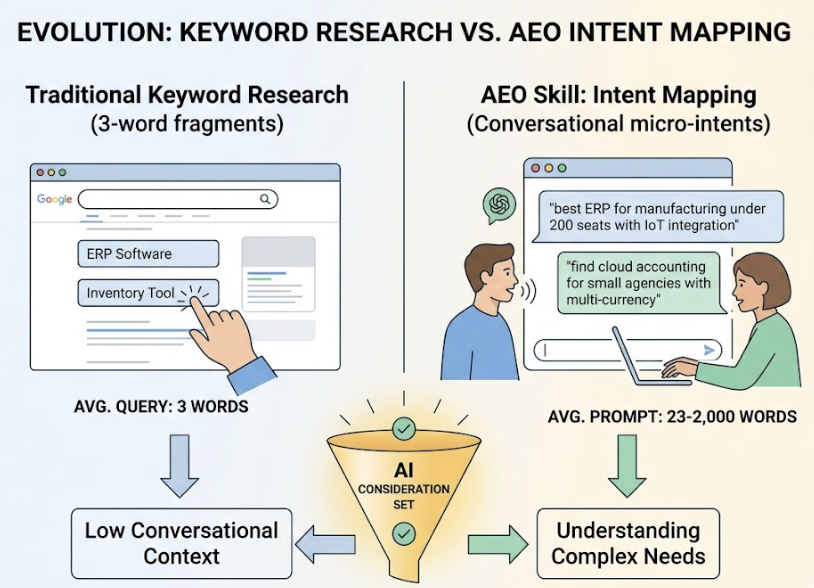
Prompt intent mapping. Traditional keyword research deals in 3-word fragments. The average ChatGPT prompt is 23 words long, and research-heavy prompts can exceed 2,000 words. The AEO skill here is understanding conversational micro-intents: not “ERP software,” but “best ERP for manufacturing under 200 seats.” Brands that match these specific queries enter the AI’s consideration set for high-intent threads.
Modular content architecture. AI engines don’t read your blog post for inspiration. They extract knowledge units. The core technique is called BLUF: Bottom Line Up Front. You put the direct answer in the first sentence, then back it with structured evidence. BLUF formatting alone increases citation rates by 40-60%.
Entity and citation network management. Authority in AEO isn’t just domain rating. It’s corroborated consensus across third-party sources like G2, Trustpilot, Wikidata, and LinkedIn. Entity-optimized content achieves 347% higher AI citation rates than keyword-focused content.
AI visibility monitoring. AI answers drift. Models retrain, citation patterns shift, and the description of your brand can change without warning. The AEO skill is tracking share of voice and sentiment across engines on a recurring basis, not checking once and hoping for the best.
Competitive generative analysis. AI search is relative. A competitor with a lower domain rating but clearer HTML tables and more G2 reviews can outrank you in every AI answer. Reverse-engineering why matters.
Run a Free GEO Baseline Before You Learn Anything Else
Here’s the thing most guides get wrong: they tell you to study AEO concepts first and apply them later. Flip that. Run a baseline score first, then learn with context.
A GEO (Generative Engine Optimization) score evaluates your site across four dimensions: AI bot access, structured data quality, content signals, and current presence rate in AI answers. Having this data before you start learning means every concept maps to a real number on your own scorecard.
The process takes about three minutes:
- Enter your URL into a GEO score checker. Topify offers a free baseline scan that covers ChatGPT, Gemini, Perplexity, and emerging platforms like DeepSeek.
- Review sub-scores for citability and structural integrity.
- Check the source analysis: which third-party domains are currently shaping how AI describes your brand.
For those who want to go deeper without spending a dollar, the free-tools.md reference on GitHub is a practical resource. It’s a community-maintained collection of scripts and checklists for crawlability checks, schema validation, and bot access auditing. Think of it as the AEO learner’s open-source toolbox.
Why does starting with data matter so much? Because AEO improvements are often binary. Unblocking GPTBot in your robots.txt or adding a single schema tag can immediately alter visibility. Without a baseline, you can’t tell whether your invisibility is a technical block or a content problem, and you’ll waste weeks fixing the wrong thing.
Learn to Read AI Answers Like a Search Strategist
What AI Engines Actually Cite and Why It Matters for Your AEO Skill
Once you have your baseline, the next AEO skill to build is pattern recognition in AI outputs. Stop reading AI answers for accuracy. Start analyzing them for retrieval logic.
Every AI answer has three layers worth studying:
The recommended set. Which brands get named? If yours isn’t there, that’s the first data point.
The citation mix. Which URLs appear as sources? ChatGPT distributes citations broadly: the top 10 sources account for just 18.5% of all references. Perplexity concentrates more heavily on institutional and government sources. Google AI Overviews is 18% more likely to cite user-generated content from forums like Reddit. Each engine has a citation personality.
The emotional framing. Is the AI describing your brand as “premium” or “budget-friendly”? Positive, neutral, or flagging risks? Sentiment in AI answers directly shapes buyer perception before they ever visit your site.
Here’s a practical exercise. Pick three buying-intent prompts relevant to your category (e.g., “best alternative to [your competitor]”). Run them in ChatGPT, Perplexity, and Google. For each response, write down which brands appear, which domains are cited, and the tone of the description. If your brand is absent, note whether the cited competitors have clearer data tables, more recent reviews, or more third-party press coverage.
In B2B, this exercise often reveals that 85% of a brand’s AI citations originate from Reddit, G2, and industry publications, not from the brand’s own blog. That insight alone redefines where you invest your content efforts.
Optimize One Piece of Content for AI Answers
The biggest AEO mistake at this stage? Applying surface-level edits to ten pages instead of deeply optimizing one.
AI engines reward information density and recency. A single, exhaustive page that addresses the full question cluster around a topic is more likely to become a retrieval hub than a series of thin posts. And because 50% of AI-cited content is less than 13 weeks old, freshness matters as much as depth.
Here’s the modular optimization checklist for turning one page into an AI-ready knowledge block:
Answer-first paragraph. Put a direct, 1-3 sentence definition or answer at the very top. This is the BLUF principle in action, and it’s the single highest-leverage structural change you can make.
Machine-readable data. Convert key comparisons into HTML tables. Tables get cited 2.5x more often than the same information presented as plain text.
Quantitative fact-loading. Replace qualitative adjectives with numbers. “Fast growth” becomes “improves build time by 80%.” Quantitative claims receive 40% higher citation rates than vague descriptors.
FAQ modules. Explicit question-and-answer pairs let AI assistants extract clean data chunks without needing surrounding context.
Source attribution markup. Use schema to point back to the original source of proprietary data. This gives AI the verifiable signal it needs to prioritize your page over a competitor’s unsourced claim.
One fully optimized page outperforms ten that got a quick headline rewrite. Depth beats breadth in AEO.
Set Up Ongoing Tracking to Keep Building Your AEO Skill
A one-time audit is a snapshot. A weekly tracking habit is a strategic radar.
AI recommendations shift as models retrain and new competitors enter the index. The difference between reactive and proactive AEO comes down to monitoring frequency:
| Frequency | What you catch | Impact |
|---|---|---|
| Quarterly audit | Brand mention rate at a point in time | Reactive, blind to model updates |
| Monthly check | New competitor entries | Moderate, misses rapid sentiment shifts |
| Weekly tracking | Answer drift and sentiment changes | Proactive, enables rapid content refresh |
For ongoing monitoring, Topify’s platform tracks visibility, sentiment, position, and competitor benchmarks across ChatGPT, Gemini, Perplexity, and other engines in a single dashboard. The practical benefit is that you can spot a drop in mentions and trace it to a specific source that stopped citing your brand, all without switching between tools.
Two advanced metrics worth tracking as your AEO skill matures:
Share of Voice. How dominant is your brand versus competitors for specific intent-based prompts? This is the AEO equivalent of rank tracking.
AI-referred conversion rate. Traffic from AI engines often converts 2.5x to 3x better than traditional organic search because the lead arrives pre-qualified by the AI’s synthesis. That makes even small gains in AI visibility disproportionately valuable.
The recommended cadence: 30 minutes per week reviewing your AI visibility dashboard. That’s less time than most teams spend on a single SEO standup meeting.
3 Mistakes That Stall Your AEO Skill Growth
The “Google-only” blind spot. Ranking well on Google doesn’t mean AI engines see you. Research shows that 73% of websites in Google’s top 3 organic results don’t appear in Gemini’s AI Overviews for the same query. AEO requires semantic clarity and third-party consensus that traditional SEO often skips entirely.
Optimizing without a baseline. Starting an AEO program without a GEO score is like running ads without a pixel. You can’t tell if your invisibility is caused by a technical crawl block (GPTBot blocked in robots.txt) or an authority gap (zero mentions on G2 or Reddit). Fixing the wrong problem wastes months.
Treating AEO as an isolated channel. AEO isn’t a silo. It’s the answer layer for your entire brand. The teams that get results integrate AEO into PR (third-party mentions), product marketing (attribute clarity), and customer success (review generation). Disconnected signals create inconsistent narratives, and inconsistent narratives cause AI engines to drop citations.
Conclusion
The path from “I don’t know what AEO is” to “I run weekly visibility audits” is shorter than most marketers think. It starts with a three-minute baseline scan, builds through structured content optimization, and matures into a continuous monitoring habit.
AEO skills are cumulative. Every piece of structured content you publish, every third-party review you earn, and every entity signal you reinforce compounds across every AI engine simultaneously. The brands that start building this skill set now will own the citation layer before the competition even enters the conversation.
Your first move: run a free GEO baseline score and find out exactly where you stand. The data will tell you what to fix first.
FAQ
Q: What is an AEO skill and why does it matter?
A: An AEO skill is the ability to structure digital content so AI systems like ChatGPT and Perplexity can extract, cite, and recommend your brand. It matters because AI-powered search now handles an estimated 15% of all search interactions, and that share is growing fast. Brands that aren’t optimized for AI answers are becoming invisible in the modern discovery funnel.
Q: How long does it take to build a basic AEO skill set?
A: A working foundation takes roughly 8-12 weeks of focused effort: baseline auditing, content restructuring, and initial entity optimization. Measurable citation growth typically appears after 4-6 months of consistent work and third-party authority building.
Q: Can I learn AEO without a technical background?
A: Yes. The core of AEO is structural writing (BLUF formatting) and authority management (PR, reviews, entity signals). Tools like Topify automate the technical analysis, so marketers can focus on content strategy and competitive positioning without writing code.
Q: What free tools can I use to start learning AEO?
A: The Topify GEO Score Checker provides a free baseline scan of your site’s AI visibility and technical readiness. The free-tools.md repository on GitHub is a community-maintained collection of scripts and checklists for bot access auditing, schema validation, and crawlability checks.

