

Your SEO skill set looks solid on paper. You know keyword research, backlink strategy, meta-tag optimization, Core Web Vitals. Five years ago, that checklist covered everything a search professional needed.
Then ChatGPT started answering your target queries before users ever saw a blue link. Perplexity began citing sources you’d never heard of. Google’s AI Overviews started collapsing ten results into one synthesized paragraph. And 60% of Google searches now end without a single click.
The skills that got you here won’t get you there. The gap between what traditional SEO rewards and what AEO (Answer Engine Optimization) demands is specific, measurable, and fixable. But you have to see it first.
SEO Skills That Don’t Transfer to AEO
Not every SEO skill loses value in the AI search era. But several core practices that defined the last decade of optimization are now either irrelevant or actively harmful to AI visibility.
Keyword density is the most obvious casualty. Large language models don’t count keywords the way Google’s early algorithms did. They process semantic embeddings and verify claims against training data. The Princeton KDD 2024 study on generative engine optimization tested nine content tactics across 10,000 queries and found that keyword stuffing had a negligible or negative impact on AI citation rates.
Content padding is even worse. Writing 3,000 words when 1,200 would do used to signal “comprehensiveness” to Google. For AI engines, it signals noise. Generative systems seek the highest information density per token to fit their context windows. Padding dilutes that density, and the model moves on to a more concise source.
CTR-hook meta descriptions are losing their audience. Traditional SEO treated the meta description as a sales pitch: withhold the answer, tease the click. AI engines do the opposite. They prioritize content that gives the answer upfront, because their job is to synthesize a response, not to drive traffic to your site. Analysts project that click-through rates will drop 25% to 61% in categories where AI overviews appear.
Backlink profiles still matter for Google indexing. But for AI citation, the correlation is weakening fast. Research suggests that brand mentions on third-party platforms like Reddit, Wikipedia, and G2 now correlate three times more strongly with AI visibility than traditional backlinks. An SEO professional who spends 80% of their time on link building is investing in a depreciating asset.
The AEO Skill Stack AI Search Actually Rewards
AEO isn’t a rebrand of SEO. It’s a different skill set built on four pillars: citability, schema markup for AI, crawler access management, and structured authority. Each one requires capabilities that most SEO practitioners haven’t developed yet.
Citability: The AEO Skill Most SEOs Haven’t Built
Citability is the structural and semantic readiness of a content passage to be extracted, summarized, and cited by a generative engine. It’s not the same as readability. A passage can score perfectly on Flesch-Kincaid and still be invisible to ChatGPT because the information isn’t self-contained.
The numbers are specific. The optimal passage length for AI extraction falls between 134 and 167 words. That range maps to the chunking strategies most RAG (Retrieval-Augmented Generation) architectures use to slice content into segments that fit within LLM context windows. Passages in that range need to stand alone, meaning a reader (or a model) should understand them without needing surrounding paragraphs.
What makes a passage citable? Three things the Princeton study quantified. Adding expert quotations boosted AI visibility by 41%. Adding statistics increased it by 37% to 40%. Citing credible sources lifted it by 30% to 40%. The pattern is clear: AI engines reward evidence-based content, not opinion-based content.
There’s also the “answer-first” requirement. Content with a cosine similarity score of 0.88 or higher to the user’s query is 7.3 times more likely to be cited. In practice, that means putting the direct answer in the first 40 to 60 words of each section, a formatting style known as BLUF (Bottom Line Up Front).
Most SEO content does the opposite. It builds to the answer, saving it for the end to maximize time-on-page. That structure is a citability killer.
Schema Markup for AI, Not Just for Rich Snippets
Traditional SEO practitioners use schema to earn star ratings and event cards in Google results. AEO practitioners use schema for something more fundamental: AI grounding.
FAQPage schema is the clearest example. It pre-formats content as question-answer pairs, which is exactly how AI systems prefer to extract information. Pages with properly implemented FAQPage schema achieve a 41% citation rate compared to 15% for pages without it. That’s not a marginal improvement. That’s a 2.7x multiplier.
Here’s the trap most SEOs fall into: minimally populated schema. Dropping a generic Article schema with just a headline and date feels like checking a box. But research shows that generic schema can actually underperform having no schema at all, 41.6% vs 59.8% citation rate. Incomplete structured data signals unreliability to the retrieval system.
The AEO skill here is attribute-rich implementation. Article and BlogPosting schema need full author attribution, publication dates, and topic categorization. Organization and Person schema need sameAs properties linking to Wikipedia, LinkedIn, and Wikidata. Without those links, AI systems can’t verify the entity behind the content, and unverified entities don’t get cited.
AI Crawler Access: The Skill Gap Hiding in Your robots.txt
Most SEO professionals have configured robots.txt exactly once: to block duplicate pages and staging environments. AEO requires an entirely different approach, because the list of relevant crawlers has expanded to over 14 distinct user-agents in 2026.
| Crawler | Operator | What It Does |
|---|---|---|
| GPTBot | OpenAI | Model training, parametric knowledge |
| OAI-SearchBot | OpenAI | Powers ChatGPT Search results |
| ChatGPT-User | OpenAI | Real-time browsing for users |
| ClaudeBot | Anthropic | Training and search for Claude |
| PerplexityBot | Perplexity | Retrieval for citation-heavy answers |
| Google-Extended | Gemini training data | |
| Applebot-Extended | Apple | Apple Intelligence and Siri |
Many websites block all AI bots by default, often without realizing it. That single misconfiguration makes the entire domain invisible to AI-powered search. The AEO skill is strategic access control: allowing retrieval bots (OAI-SearchBot, PerplexityBot) that drive citations while making informed decisions about training bots based on your content strategy.
The emerging llms.txt standard adds another layer. Placing a structured summary at your domain root gives language models an authoritative overview without forcing them to crawl and interpret every page. It reduces the interpretive burden and increases citation accuracy. Most SEO practitioners haven’t heard of it.
AEO Skill vs. SEO Skill: A Side-by-Side Breakdown
The differences aren’t subtle. Here’s how the two skill sets compare across the dimensions that matter most.
| Dimension | Traditional SEO Skill | AEO Skill |
|---|---|---|
| Primary Goal | Improve SERP rankings to drive clicks | Win citations and mentions in AI answers |
| Content Strategy | Keyword density, word count targets, CTR hooks | Citability, fact density, BLUF formatting |
| Technical Focus | Sitemap.xml, Core Web Vitals, HTML tags | robots.txt (AI bots), llms.txt, SSR, JSON-LD |
| Authority Model | Backlinks, Domain Authority | Entity consensus, third-party mentions |
| Query Target | 3-4 word keywords with search volume | 23-80 word prompts, “dark” sub-queries |
| Optimization Unit | Page-level relevance | Passage-level and chunk-level relevance |
| Key Metrics | Clicks, rank position, GSC traffic | Citation frequency, sentiment, share of voice |
| Optimization Cycle | Quarterly or semi-annual reviews | Weekly monitoring, AI answers drift constantly |
One dimension deserves extra attention. Traditional SEO targets 3 to 4 word keywords that show up in tools like Semrush. AEO targets prompts that are 23 to 80 words long, and the AI engine itself generates 8 to 12 parallel sub-queries behind the scenes to build its answer. Analysts estimate that 88% of this fan-out surface consists of “dark queries” with zero volume in traditional keyword tools. If you’re only optimizing for keywords you can see, you’re missing the majority of the AI discovery surface.
How to Diagnose Your AEO Skill Gaps with Free Tools
Knowing the gap exists is step one. Quantifying it is step two.
The disconnect between Google rankings and AI citations makes self-diagnosis tricky. Studies show that only 11% to 12% of domains cited by ChatGPT also appear in the top 10 organic results for the same query. Roughly 90% of ChatGPT citations come from pages ranked at position 21 or lower. Your Google Search Console data won’t tell you where you stand in AI search.
For a quick technical audit, the GEO free tools reference maintained on GitHub provides community-curated scripts and checklists for crawlability checks, schema validation, and AI bot access reviews. It’s a solid starting point for identifying whether your invisibility is a technical block or a content structure problem.
For a more comprehensive diagnosis, Topify‘s GEO Score Checker evaluates brand visibility across the full AI ecosystem: ChatGPT, Gemini, Perplexity, DeepSeek, and Doubao. It breaks the score into four dimensions (AI bot access, structured data, content signals, and current presence rate) and delivers a prioritized action feed showing which fixes move the score fastest.
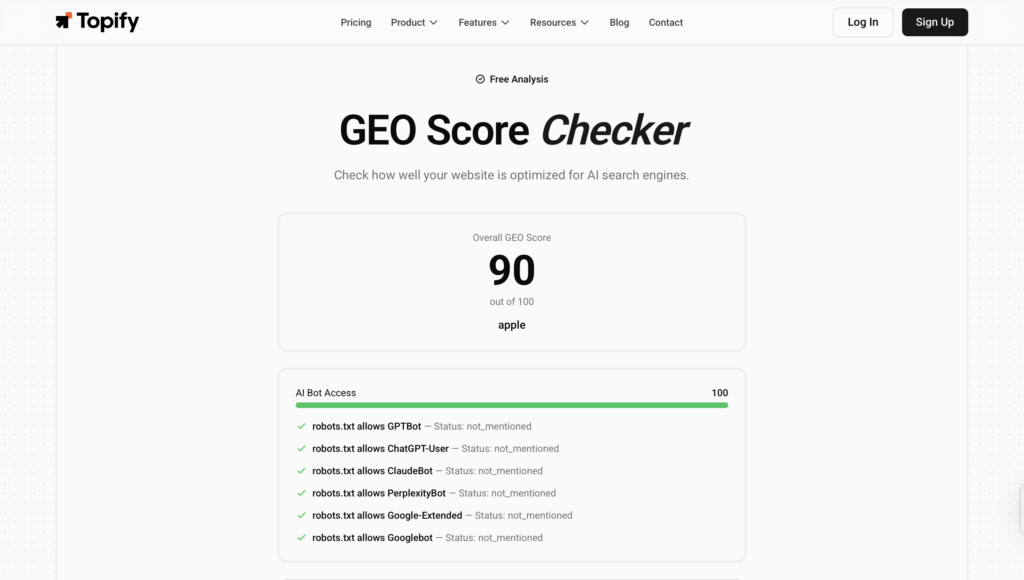
That’s the key difference between a GEO Score and a traditional SEO audit. An SEO audit tells you whether your site follows best practices. A GEO Score tells you whether AI systems are actually citing you, and if they’re not, it tells you exactly why.
For teams that need ongoing monitoring, Topify’s platform tracks seven core metrics (visibility, sentiment, position, volume, mentions, intent, and CVR) across multiple AI platforms. The Source Analysis feature identifies the exact domains AI engines cite when answering queries in your category. If a competitor is getting cited from a Reddit thread you didn’t know existed, that’s where you’ll find it.
From Diagnosis to Action: Building Your AEO Skill Set
Bridging the gap works best as a phased approach. Trying to do everything at once leads to scattered effort and unclear results.
Phase 1: Fix the technical foundation. Audit your robots.txt and explicitly allow OAI-SearchBot, PerplexityBot, and ClaudeBot. Confirm your site uses server-side rendering so AI crawlers that don’t execute JavaScript can actually read your content. Deploy an llms.txt file at your domain root. These are the lowest-effort, highest-impact changes, and they cost nothing.
Phase 2: Restructure content for citability. Rewrite key pages using the 134-167 word self-contained passage model. Apply BLUF formatting so every section leads with the direct answer. Enrich content with original statistics, comparison tables, and expert quotations. Implement attribute-rich FAQPage, Article, and Person schema with sameAs links to Wikipedia, LinkedIn, and Wikidata.
Phase 3: Build structured authority. Earn mentions on the platforms AI engines trust most: Reddit, G2, Wikipedia, YouTube. YouTube mentions show a particularly strong correlation (~0.737) with AI citations. Use Topify‘s Competitor Monitoring to identify where rivals are getting cited and where your brand is absent. Close those gaps systematically.
The cycle doesn’t end. AI answers drift weekly. New prompts emerge. Competitors adjust. The AEO skill that separates professionals from amateurs is the discipline of continuous monitoring, not the one-time audit.
Conclusion
The AEO skill gap isn’t theoretical. It’s measurable in citation rates, schema coverage, crawler access, and entity presence. Every dimension in the comparison table above represents a specific capability that traditional SEO training didn’t cover.
The good news: the gap is fixable, and the sequence is clear. Start with a free GEO Score check to quantify where you stand. Fix technical access first. Restructure content for citability second. Build structured authority third. The practitioners who close this gap now will own the discovery layer for the next decade of search.
FAQ
What is the difference between AEO and SEO skills?
SEO skills focus on ranking links through keyword targeting and backlinks. AEO skills focus on earning citations in synthesized AI answers through passage-level citability, fact density, evidence-based content, and entity consensus across the web. The optimization unit shifts from the page to the passage.
Do I need to learn AEO if I already know SEO?
Yes. While 76% of Google AI Overview citations come from top-10 rankings, only 11% of ChatGPT citations do. For AI-first platforms like ChatGPT and Perplexity, traditional SEO rankings are a poor predictor of visibility. 90% of ChatGPT citations come from outside the top 20 Google results.
What’s the most important AEO skill to learn first?
Citability is the foundational content skill. Learning to structure self-contained “answer capsules” in the 134-167 word range with BLUF (Bottom Line Up Front) formatting ensures AI models can extract and cite your information. After that, schema markup and AI crawler configuration are the next priorities.
Can free tools help me assess my AEO readiness?
Yes. The GEO free tools reference on GitHub provides community-maintained scripts for crawlability and schema checks. For a more comprehensive audit, Topify’s GEO Score Checker evaluates brand visibility across ChatGPT, Gemini, Perplexity, DeepSeek, and Doubao, with a prioritized action plan.

