

Most marketing teams start vetting a GEO agency by asking how many AI platforms it covers. That question gets a confident answer almost every time, because reciting a list of engines takes no real expertise. The harder question, the one that actually separates agencies who understand retrieval from agencies that renamed their SEO deck, rarely comes up in the first meeting. By the time a brand notices the difference, three or four months of retainer fees are already gone, and the report on file still doesn’t say whether ChatGPT mentions the brand any more often than it did on day one.
Most GEO Agency Reports Can’t Survive a Second Look
A typical GEO agency report reads like a status update. It lists content published, audits completed, and a general sense that “AI visibility is trending up.” What it usually skips is a number you could check yourself.
That gap isn’t rare. 78% of marketers aren’t tracking AI visibility at all, which means most brands paying a GEO agency have no independent baseline to compare that agency’s claims against. The report becomes the only version of reality anyone sees.
That’s the real risk. Not that the agency is doing nothing, but that nobody outside the agency can confirm what it’s actually doing.
Why So Many GEO Agencies Are Just Rebranded SEO Shops
The GEO agency market grew fast, and speed attracted opportunists. The global GEO services market reached roughly $1.48 billion in 2026, and a large share of the agencies chasing that budget are traditional SEO shops that added a service page.
The data backs this up in an unflattering way. Across the agency ecosystem, 54.8% of agencies fold GEO into their existing SEO retainers rather than offer it as its own defined service, while only 27.1% treat it as standalone work with its own methodology and deliverables.
Folding GEO into an SEO retainer isn’t automatically dishonest. SEO and GEO share real overlap, and a lot of what earns citations also helps rankings. The problem shows up when an agency can’t explain what changed in its process to account for how generative engines actually select and cite sources.

That’s the tell. If a GEO agency’s deliverables still look like keyword density reports and backlink counts with “AI Overviews” pasted on top, the methodology never changed, only the label did.
What a Real GEO Agency Should Be Able to Prove
A competent GEO agency should be able to answer a handful of specific questions without stalling. Vague, confident answers are the exact pattern that lets weak agencies survive a sales call.
Ask for a before-and-after citation baseline across specific engines, not a general trend line. A real agency samples the actual prompts your buyers type into ChatGPT, Perplexity, and Gemini, records who gets cited today, and treats that as the number every later report gets measured against.
Ask how their process differs by platform. Different engines pull from different sources and weigh authority signals differently, so an answer that treats “AI search” as one undifferentiated channel is a shortcut, not expertise.
Ask what happens when a citation drops. A methodology-driven agency can trace a mention loss back to a specific source that stopped citing you or a competitor that displaced you in a specific answer. An activity-driven agency will point to more blog posts instead.
Ask about entity and schema work too. Structured data and entity clarity are part of how a generative engine decides what a page means and whether it’s safe to cite. An agency that treats schema as a separate technical task for someone else to handle usually hasn’t done the retrieval-side work that makes GEO different from SEO in the first place.
None of this is academic. Nearly half of B2B buyers now say AI is part of how they find vendors, which means an agency’s inability to show real citation movement isn’t just a reporting gap. It’s a direct hit to pipeline.
You Don’t Need a Better GEO Agency. You Need Independent Data.
Here’s the uncomfortable part: even a genuinely skilled GEO agency benefits from a client who can check its work.
Academic research on what actually moves AI citations backs up why this matters. A Princeton and Georgia Tech studyfound that citing external sources lifted visibility by up to 115% for lower-ranked content, a concrete, measurable effect that any legitimate GEO strategy should be able to reproduce and show you, not just claim.
This is where an independent layer of data changes the relationship. Topify tracks brand visibility, sentiment, position, and citation sources across ChatGPT, Gemini, Perplexity, and other major AI platforms directly, which means you don’t have to take an agency’s monthly PDF as the only source of truth.
In practice, that looks like pulling up your own citation history before a quarterly review call and checking whether it matches the story your agency is telling. If your agency claims a content push increased mentions in a category, Topify’s citation tracking lets you trace exactly which sources AI platforms are pulling from and confirm whether your brand’s presence actually moved. If it claims you’re outranking a competitor in AI recommendations, competitor benchmarking shows you that comparison directly instead of asking you to trust a slide.
This works whether you keep the agency, replace it, or decide to run GEO in-house. The point isn’t to eliminate agencies. It’s to stop being the only party in the relationship who can’t see the underlying numbers.
What This Looks Like When You Actually Check
Picture a mid-size SaaS brand paying a retainer to a GEO agency that reports monthly on “AI visibility improvements.” The reports read well. Mentions of momentum, content shipped, audits completed.
When the marketing lead pulls an independent citation baseline, two outcomes are equally common. Sometimes the number confirms the story: mentions in category-specific prompts did climb, and the agency’s work holds up under scrutiny. Other times the baseline shows almost no movement across three months of prompts, revealing that the agency’s reports described activity, not outcomes.
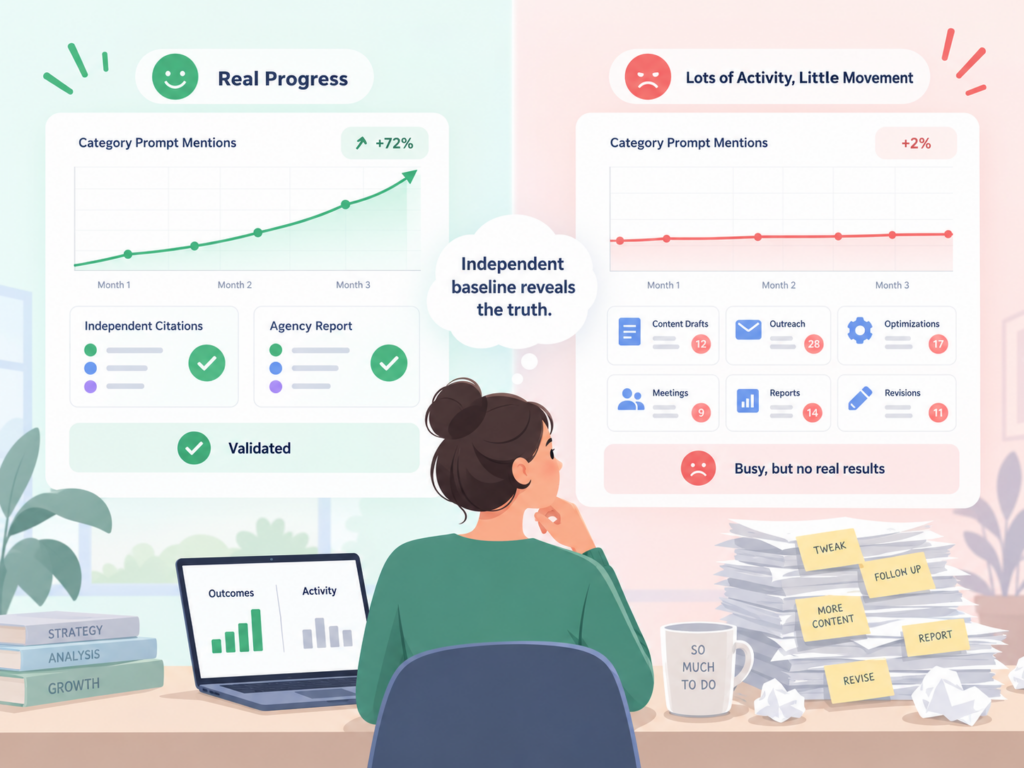
Either way, the brand walks into its next agency conversation with a fact instead of a feeling. That single shift, from trusting the report to checking the report, changes what an agency relationship actually holds anyone accountable for.
It also changes the tone of the conversation itself. A team that shows up with its own citation numbers isn’t asking an agency to justify its invoice in the abstract. It’s asking about one specific, shared dataset, which tends to shorten the meeting and sharpen the answers on both sides.
How to Start Vetting Your GEO Agency This Week
You don’t need a new agency to start this process. You need three things in place before your next check-in.
First, pull your own baseline. Run 20 to 30 of the prompts your buyers are most likely to type into ChatGPT and Perplexity, and record who gets mentioned today, independent of anything an agency has told you.
Second, bring specific questions to your next agency call, not general ones. Ask which sources are currently cited when your category comes up, and ask them to name the platform-by-platform differences in their approach rather than describing “AI optimization” as one thing.
Third, set a cadence for comparing your baseline against their next report. If the two stories match, you’ve found a GEO agency worth keeping. If they don’t, you’ve found that out before another quarter of budget goes toward activity nobody can verify.
Conclusion
The GEO agency market is young enough that credentials don’t mean much yet, and confident-sounding methodology is cheap to fake in a sales call. The only reliable filter is proof you can check yourself: a real citation baseline, a platform-specific process, and a report that survives comparison against independent data. Whether you keep your current agency, switch, or bring GEO in-house, that habit of checking is what actually protects the budget.
FAQ
Q: How much should a GEO agency cost?
A: Pricing varies widely by scope, from a few thousand dollars a month for a single-service engagement to five-figure monthly retainers at agencies bundling GEO with full-service SEO and content. Price alone doesn’t signal competence, since rebranded SEO shops charge premium rates too.
Q: How long before GEO results show up?
A: Timelines differ by platform. Perplexity mentions often shift within a few weeks of a content or schema change, while ChatGPT citation changes typically take 60 to 180 days because of how its training and retrieval process works. Any agency promising results across all platforms in 30 days is overpromising.
Q: Can I do GEO without an agency?
A: Yes. Many in-house marketing and SEO teams run GEO themselves using tools that track citations, sentiment, and competitor positioning across AI platforms, which removes the reporting-gap problem entirely since the team sees the raw data directly.
Q: What’s the biggest red flag when evaluating a GEO agency?
A: A guarantee of specific rankings or citations. Nobody controls what a large language model chooses to cite, so any agency promising a fixed outcome on a fixed timeline is selling confidence, not methodology.

