

It’s Friday afternoon and your team is still cross-checking ChatGPT mentions for client number eight. Client number nine already messaged asking where this week’s report is. Nobody planned for this. Somewhere between client three and client eight, the process that worked fine stopped working, and nobody noticed until the backlog showed up.
That moment is where most GEO agencies end up. Not because they’re bad at generative engine optimization. Because the operations behind it never got redesigned for what happens after client number five.
Why GEO Agencies Hit a Wall Around Client Number Five
Demand for GEO services isn’t slowing down. Searches for the term geo agency have jumped 2,300% year over year, according to LLM Pulse, and brands are actively looking for someone to handle this for them.
That’s good news for the agency’s growth. It’s less good news for the ops team.
The first four clients usually run on a shared spreadsheet, a couple of manual ChatGPT checks each week, and whoever on the team has bandwidth that day. That setup holds together through sheer effort, not process. Past client five, the math stops working. Each new account adds its own tracking sheet, its own reporting cadence, and its own private definition of what “visibility” even means.
The agency didn’t get worse at GEO. It just never built a system that assumes there will be a client number twenty.
This is also why so many agencies now treat GEO the way they once treated SEO: as a service line that only survives past a handful of accounts if it’s built on shared infrastructure, not individual effort.
The Real Cost of Manual GEO Reporting
Manual, multi-platform reporting isn’t just tedious. It’s expensive in ways that don’t show up on the invoice.
Constantly switching between ChatGPT, Perplexity, Gemini, and whatever spreadsheet holds last week’s numbers eats into the workday. Context switching between separate tools alone consumes close to 9% of an employee’s time, translating to an estimated $10,000 to $11,000 in lost productivity per employee each year.
Past roughly 15 to 20 manually reported clients, assembling reports can eat a full work-week a month, according to a multi-client SEO maturity assessment. That’s a week of billable time spent copying numbers instead of doing the work clients are actually paying for.
The inconsistency compounds the time cost. When each client’s data lives in a different tool with a different tracking method, mentions counted one way for client A and another way for client B start to disagree with each other. Clients notice. Trust erodes before anyone explains why.
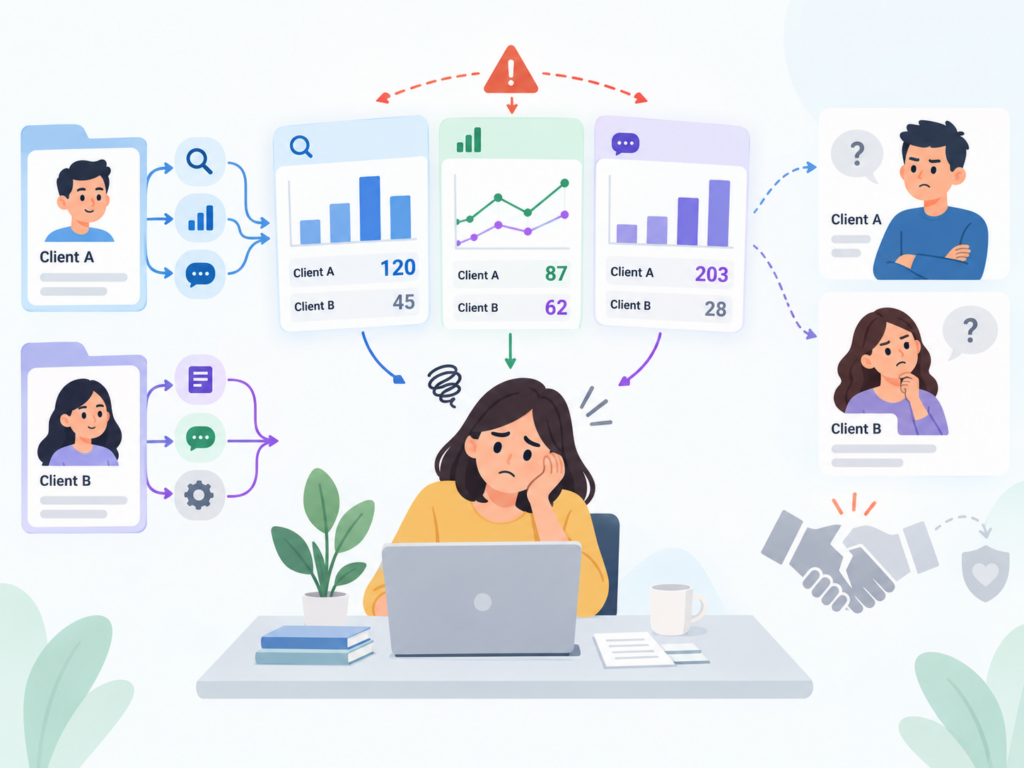
That’s the gap most agencies don’t see until a client asks about it directly.
Tracking a single client across five AI engines already means checking dozens of prompts by hand every week. As Superlines has pointed out, fifty tracked keywords across five engines works out to 250 manual searches weekly for one account alone. Multiply that by a real client roster and the arithmetic explains why margins disappear before the strategy work even starts.
What a Scalable GEO Agency Workflow Actually Looks Like
A workflow that survives past client twenty usually rests on three layers: one shared metric framework, one dashboard that spans every account, and one onboarding process that doesn’t change client to client.
The framework matters most. If visibility means something different for every client’s spreadsheet, nothing rolls up into a portfolio view, and account managers can’t spot patterns across their book of business. A single set of metrics, tracked the same way for every client, is what turns a pile of individual reports into an actual operation instead of a collection of side projects.
Onboarding is the second piece agencies skip. Client one through five typically get a careful kickoff. Client twelve often gets a rushed call because the team is mid-report for someone else. Nobody decides to lower the bar. It erodes one skipped step at a time, and by client twenty the onboarding checklist that used to take a week takes an afternoon, with gaps nobody catches until a report comes back wrong.
Building One Dashboard Instead of Ten Spreadsheets
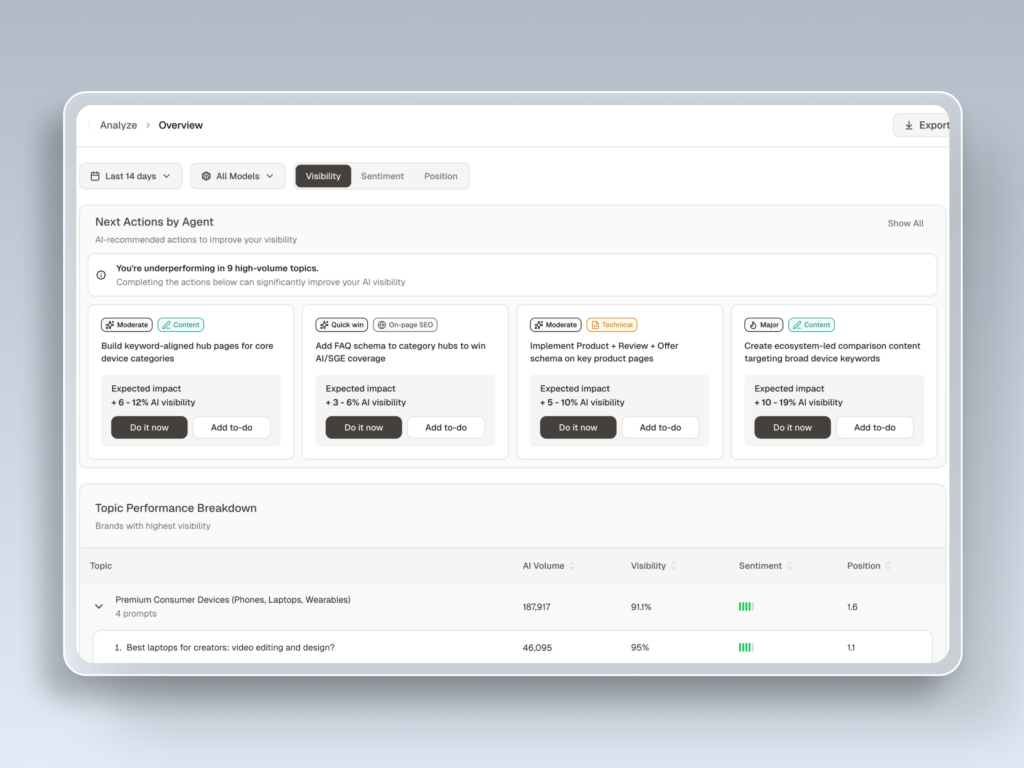
This is where a platform like Topify changes the math. Its Comprehensive GEO Analytics tracks seven metrics, covering visibility, sentiment, position, volume, mentions, intent, and CVR, across every major AI engine from a single dashboard. Instead of ten spreadsheets speaking ten different languages, the whole client roster reports through the same seven numbers.
Topify’s own use case for agencies lays out the problem plainly. Clients start asking why competitors show up in ChatGPT and Gemini while they don’t, and checking each platform by hand for every account is impossible to maintain once the roster grows past a handful of names. A shared dashboard is what turns that answer into something repeatable instead of a one-off scramble every time a client asks.
Automated reporting tools built for agency use can cut the time spent compiling performance data by up to 75%. That reclaimed time is what goes back into the strategic work clients are actually billed for, not the assembly work behind it.
The plan structure matters here too. An agency running four accounts and one running twenty need different amounts of tracking capacity, not a different tool. Topify’s tiers scale from 4 projects and 4 seats on its Basic plan up to 8 projects and 10 seats on Pro, with custom project and seat limits on Enterprise, so the same dashboard can grow with the client roster instead of forcing a tool switch halfway through the year.
Where Automation Should Replace Manual Work, and Where It Shouldn’t
Not every part of a GEO engagement should run on autopilot. Data collection should. Judgment shouldn’t.
Pulling AI visibility numbers across five engines for fifty tracked prompts a week is a mechanical task, the kind that’s identical whether it’s client two or client twenty-two. Doing it by hand doesn’t scale, and it doesn’t need a strategist’s time to do it well.
Topify’s One-Click Execution is built for exactly that layer. State the goal in plain English, review the proposed strategy, and deploy it without a manual workflow sitting behind every step.
What still needs a person is the interpretation. Why did a client’s sentiment score drop three points this month. Which competitor started showing up in a high-value prompt cluster, and does that change the content plan for next quarter. Automation should shrink your reporting time. It shouldn’t replace your judgment.
Signs Your GEO Agency Is Scaling the Wrong Way
A few patterns tend to show up before an agency admits it has an operations problem, not a headcount problem.
Every new client requires hiring someone new, instead of adding capacity to existing tools and processes. Report formats differ by account because each one was built ad hoc rather than off a shared template. Team members can’t say with confidence who still has access to which client’s accounts after someone leaves. And most tellingly, nobody on the team can answer a simple question: across the whole client roster, is AI visibility trending up or down this quarter.
Agencies commonly hit a ceiling somewhere between ten and twenty clients, where each new account creates about as much operational stress as it generates in revenue, based on findings from Agency Dashboard. Past that point, growth stops paying for itself, no matter how good the underlying strategy is.
The unit economics get worse before they get better, too. Per-client GEO tooling costs that look manageable at five accounts can break down once a roster grows into the dozens, which is exactly why the shared-dashboard model matters more as the client count climbs, not less.
Retention risk follows the same curve. Clients rarely leave because an agency’s GEO strategy was wrong. They leave because reporting went quiet, questions took too long to answer, or a competitor’s mention started showing up in an AI answer with no explanation attached. None of that requires better strategists to fix. It requires a system that catches the drop the same week it happens, for every client, not just the ones who complain first.
Conclusion
Running GEO for multiple clients without losing your mind isn’t about working harder or hiring faster. It’s about deciding, before client number five shows up, that every account will run through the same metrics, the same dashboard, and the same onboarding checklist.
Agencies that make that call early spend their time on strategy instead of spreadsheets. The ones that don’t spend client number twenty’s onboarding call apologizing for a report that’s already late.
FAQ
How many clients can a GEO agency manage with one tool?
It depends more on the workflow than the headcount. Agencies running a shared dashboard and standardized reporting typically manage far more accounts per team member than agencies still tracking each client by hand.
What’s the biggest operational mistake agencies make when scaling GEO services?
Treating each new client as a one-off setup instead of plugging them into a repeatable system. That’s usually what causes reporting time to balloon and quality to slip once the roster passes ten or fifteen accounts.
Do GEO agency tools replace the need for strategists?
No. Tools handle data collection and reporting at scale. Strategy, client communication, and reading what the numbers actually mean still need a person on the account.
Is GEO agency demand still growing in 2026?
Yes. Search interest in the term has grown sharply over the past year, and brands increasingly expect their agency to already have an answer for how visible they are in AI search.

