

You spent two years earning your position as the answer ChatGPT gives when someone asks about your category. Then a teammate sends you a screenshot: the organic response still cites your brand, but directly below it sits a Sponsored card. It belongs to your closest competitor, and it’s the last thing the user sees before deciding where to click.
That card cost them a few dollars. Your citation took years. And right now, most brands have no idea how often this is happening on their own queries.
Your Brand Got Cited. Your Competitor Got the Click.
ChatGPT ads went live on February 9, 2026, and they created a placement structure that didn’t exist anywhere in search before. The organic answer, where citations live, is generated by the model based on the sources it trusts. The Sponsored slot, a chat_card format with a title, description, image, and link, is a paid position that appears below the answer, visually separated and clearly labeled.
Here’s the part that matters: both can appear in the same response window. Your brand can be the organic authority in the answer text while a competitor occupies the paid real estate underneath it. In classic search, ads and organic results competed on the same page but in familiar, well-understood zones. In ChatGPT, the answer is singular and authoritative, and the Sponsored card is the only other commercial element on screen.
That makes it a “last look” position. The user reads an answer that mentions you, then scrolls past it into a card that pitches someone else.
The reach is uneven, though, and that unevenness shapes the whole strategy. Ads only appear for logged-in users on the Free and Go tiers. Plus, Pro, Business, and Enterprise subscribers never see them. For high-value professional users, organic citation is the only visibility that exists.
How ChatGPT Ads Actually Target Your Queries
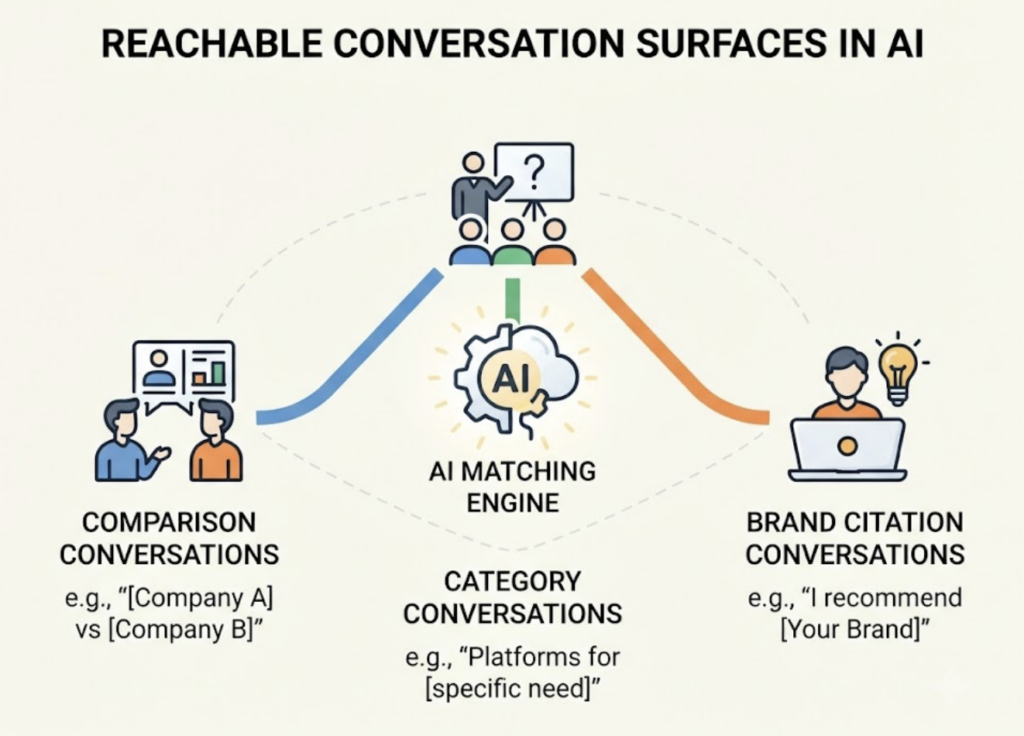
ChatGPT ads don’t use keyword bidding the way Google Ads does. Advertisers provide “context hints,” free-form semantic descriptions of the buyer moments where their product is relevant. OpenAI’s model then runs an embedding match between the live conversation and those hints.
In practice, this means a competitor doesn’t need to bid on your brand name. They describe the situation your customers are in (“a marketing team evaluating AI visibility platforms”) and the matching engine does the rest. Category conversations, comparison conversations, and yes, conversations that organically cite your brand are all reachable surface.
The economics changed fast, too. What launched as an enterprise-only channel became accessible to any competitor with a credit card in about three months:
| Timeline | Access model | Pricing |
|---|---|---|
| February 2026 | Managed pilot, $200K minimum spend | $60 CPM |
| May 2026 | Self-serve Ads Manager, no minimum | ~$25 CPM, $3 to $5 CPC floors |
Penetration followed the same curve. Independent tracking measured Sponsored placements in 26.5% of ChatGPT responses globally by late May, with the US at roughly 49%. By July 2026, US penetration had stabilized around 51% of responses. Among Free and Go users, the only ones eligible to see ads, the real exposure rate runs higher than the headline number.
Bottom line: about half of the US responses on your priority queries can now carry a paid placement, and anyone can buy it.
Why Organic Citations Still Decide the Answer
OpenAI’s policy on this is explicit. Ads do not influence the answers ChatGPT gives, conversations stay private from advertisers, and the model’s decision to cite a source is independent of ad spend. A competitor can rent the slot next to your citation. They can’t pay to delete the citation itself.
That distinction is the strategic core of this whole shift. Sponsored buys the position beside the answer. Cited wins the answer.
The two also carry different trust weights. Early industry data suggests AI-native ads tend to draw more skepticism than classic search ads, and research from IAB in January 2026 flagged rising Gen Z skepticism toward AI-delivered ads specifically. A brand that leans on paid cards without an organic citation behind it is renting attention from an audience that’s already suspicious of the format.
And then there’s the segmentation problem. Because paid tiers stay ad-free, ChatGPT is effectively two channels wearing one interface. The Free and Go audience sees a hybrid of organic and paid. The subscriber audience, which skews toward professional and enterprise users, sees organic only. If your buyers are on the paid tiers, no amount of ad spend from anyone reaches them. Citations are the entire game there.
The Defense Problem: You Can’t See Who’s Buying Your Queries
Google Ads has a Transparency Center. ChatGPT has nothing comparable. There’s no AI Ad Library where you can look up which competitors are running context hints that overlap your branded or category queries.
Manual checking doesn’t work either, and the reason is structural. If your team checks ChatGPT from company accounts, those are almost certainly Plus or Business seats, and paid seats never render ads. Your marketing team can audit your queries weekly and see a clean, ad-free interface while half of the Free-tier responses on those same queries carry a competitor’s card. The interface your team sees is not the interface your market sees.
That’s the visibility illusion, and it’s why competitor ad activity on AI surfaces tends to go undetected until pipeline numbers move.
Closing the gap requires monitoring at the prompt level, from the ad-eligible side of the experience, continuously rather than in periodic spot checks. Which is a data problem, not a diligence problem.
Building a Sponsored-Proof Visibility Strategy
The defense framework has three layers: see what’s happening on your queries, understand why the AI answers the way it does, then harden the organic position that ads can’t buy.
The monitoring layer comes first because everything else depends on it. This is where a platform like Topify fits. Its Competitor Monitoring tracks which brands surface on your target prompts across ChatGPT, Perplexity, and Google AI Overviews, and how their position shifts over time, so a new entrant on your branded queries shows up in your data instead of in a customer’s screenshot. Visibility Tracking runs the same prompts continuously and scores your brand’s presence across seven metrics including visibility, position, and sentiment. In practice, it’s the first time a monthly report can answer the question leadership is now asking: “Is anyone moving in on the queries where we’re cited, and is our citation holding?”
The diagnostic layer is Source Analysis, which reverse-engineers the exact domains and URLs AI platforms cite when they construct answers in your category. This is where content gaps become visible. If ChatGPT cites a third-party review site instead of your own comparison page, that’s a specific, fixable weakness, not a vague “we should do more GEO.”
The consolidation layer is the actual defense. Since ads sit beside organic answers rather than replacing them, the strongest countermeasure to a competitor’s Sponsored card is a citation position too established to displace: deep topical authority, clean structured data, and coverage of the sources AI already trusts. Tracking your AI search visibility week over week tells you whether that footprint is compounding or eroding.
You can start with a baseline in an afternoon: load your branded and top category prompts, let the system establish current positions, and set alerts for new competitor appearances.
When Buying ChatGPT Ads Yourself Makes Sense
Not every brand should counter-bid, and the decision framework is fairly clean.
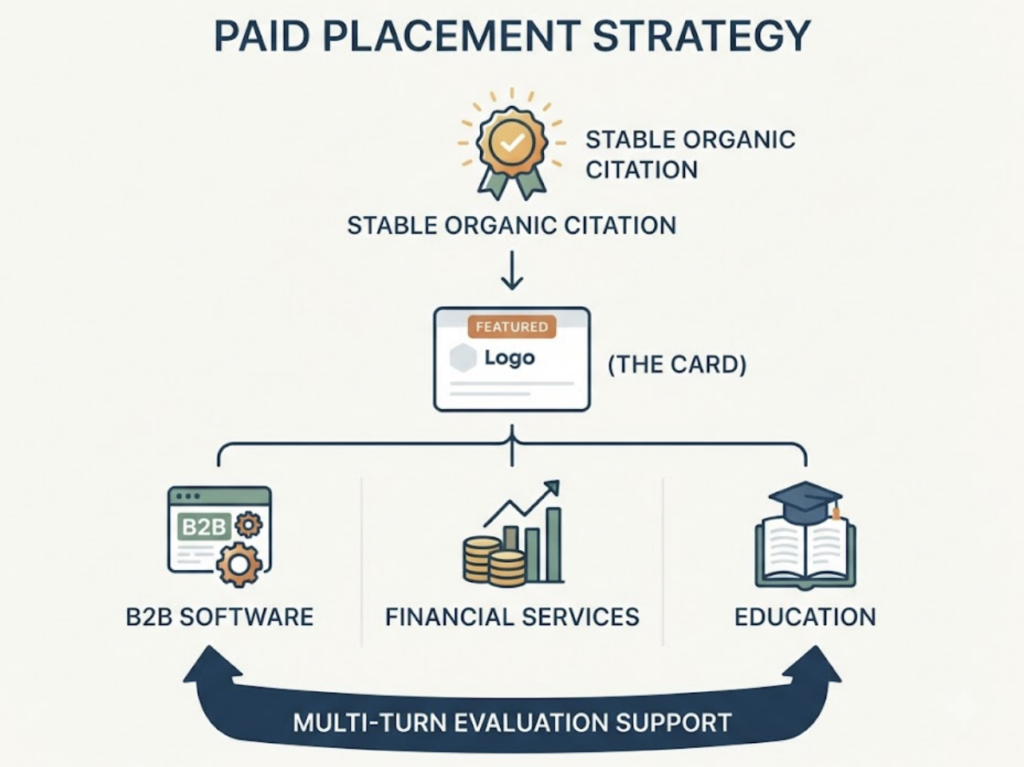
Paid placement works best as category defense on high-intent queries where your organic citation is already stable. The card reinforces a recommendation the model is already making, and the formats favor complex-decision categories like B2B software, financial services, and education, where users are working through multi-turn evaluations.
The inverse case is the trap. If your brand is absent from the organic answer, buying the Sponsored slot tends to convert poorly, because the card is pitching a brand the AI just declined to recommend. The external research on this is blunt: conversion on a sponsored placement drops significantly when the model hasn’t already established the brand as a relevant organic answer. Fix the citation problem first. Ads amplify an organic position; they don’t substitute for one.
There’s also the audience math from earlier. Every dollar spent on ChatGPT ads reaches Free and Go users only. If your ICP lives on Plus or Enterprise seats, that budget belongs in content and citation work, not in the auction.
Conclusion
Sponsored is a rented position. Cited is an earned one. The February 2026 launch of ChatGPT ads didn’t collapse that distinction, it sharpened it: competitors can now buy their way next to your answer for a few dollars a click, but they still can’t buy their way into it.
The immediate move isn’t a media plan. It’s a monitoring baseline: know which prompts matter, who appears on them today, which sources drive the citations, and get alerted when either side of the equation changes. Once you can see the board, the paid-versus-organic budget question mostly answers itself.
FAQ
Q: Do ChatGPT ads influence the answers ChatGPT gives?
A: No. OpenAI states that ads don’t affect organic responses, and citations are determined independently of ad spend. Sponsored cards appear below the answer, clearly labeled and visually separated.
Q: Can competitors run ads on my branded queries in ChatGPT?
A: Effectively yes. ChatGPT ads use semantic “context hints” rather than keyword bidding, so a competitor describing your category’s buyer moments can surface on conversations that mention or cite your brand.
Q: Who sees ChatGPT ads and who doesn’t?
A: Only logged-in users on the Free and Go tiers see ads. Plus, Pro, Business, Enterprise, and Edu accounts are ad-free, which makes organic citations the only way to reach those subscriber segments.
Q: How do I know if a competitor is buying ads on queries where my brand is cited?
A: There’s no public AI ad library, and paid-tier accounts never render ads, so manual self-checks miss the activity. Prompt-level monitoring tools that track competitor appearances across AI platforms are currently the reliable way to detect it.

