
A publisher has room for one new call to action below every article. The design team proposes a Search profile badge. The audience team wants an Add to Preferred Sources button. Both involve Google, both ask for reader action, and both can affect future discovery, but they do different jobs.
The wrong choice creates a use-case mismatch. Search Profile vs Preferred Sources is an identity-led versus source-led decision, not a cosmetic one. Compare the audience goal, eligibility, implementation, and measurement before deciding whether to promote one feature or both.
Search Profile vs Preferred Sources Asks Readers to Do Different Things
The simplest comparison begins with the user’s action.
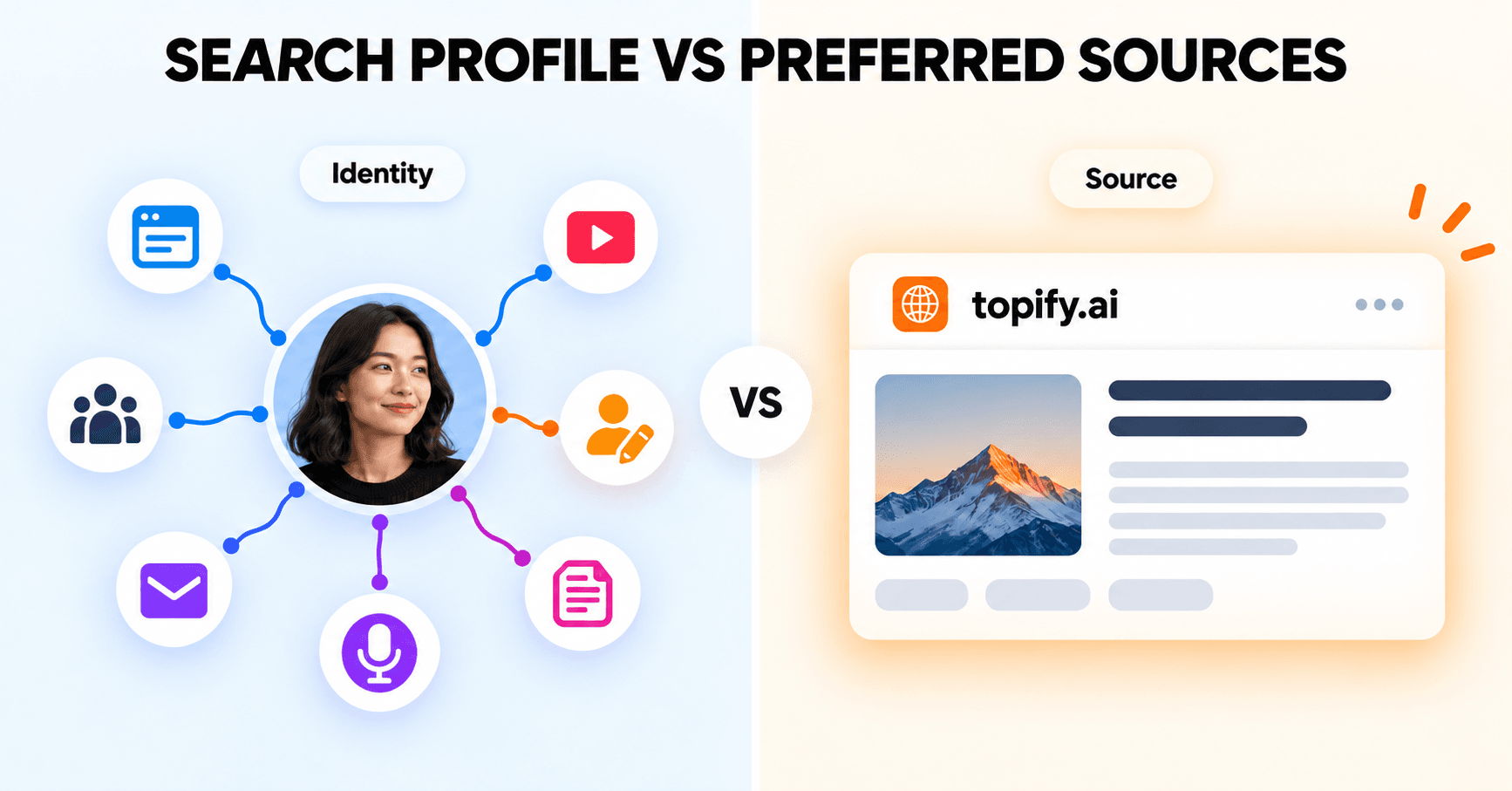
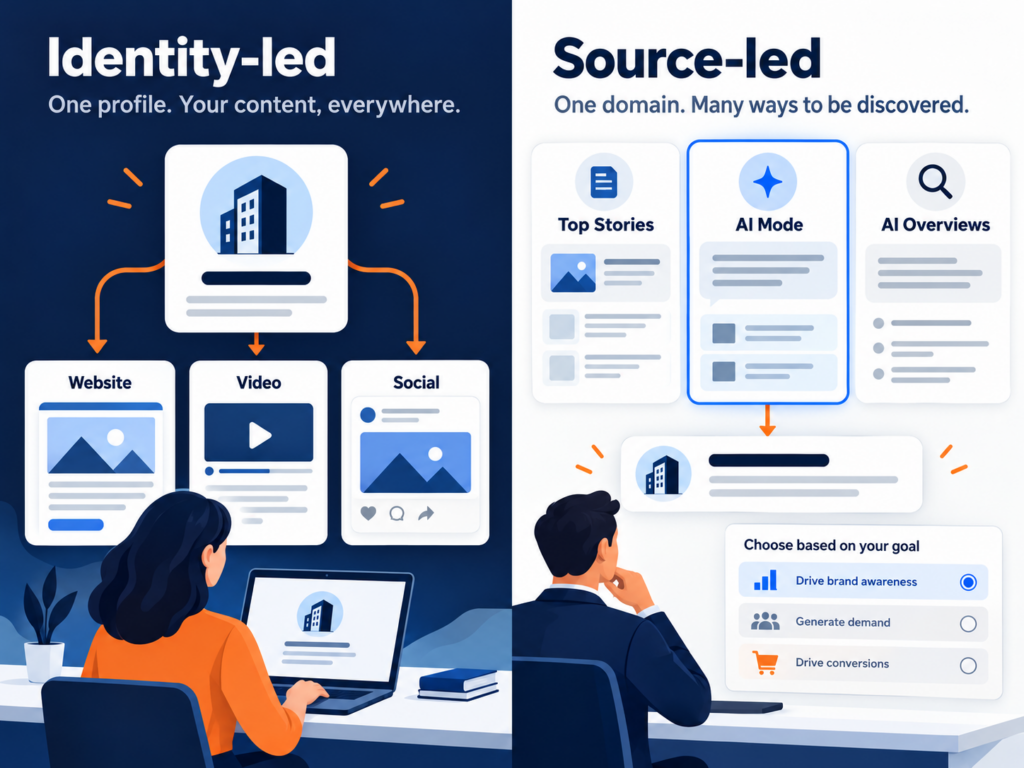
A Search profile asks the reader to find and follow a profile that connects content across channels. Google’s Search profile guidance says following can make linked content more likely to appear for that reader in Discover.
Preferred Sources asks the reader to select a domain or subdomain as a favored publication in Google Search. Google’s Preferred Sources documentation says the site’s content is more likely to appear in Top Stories for that user and may receive a preferred badge in AI Mode and AI Overviews.
One is identity-led. The other is source-led.
Do not label the buttons with generic copy such as “Follow us” when the destination and outcome differ. The reader should know whether they are following a cross-channel profile or choosing a site as a source preference.
Search Profile Organizes a Publisher’s Distributed Identity
Search Profile is useful when the publisher’s content is spread across a website, video platforms, social networks, newsletters, and creator accounts. The profile gives those channels one discoverable destination.
The implementation is straightforward after the profile is claimed. Google provides badge assets, an HTML link pattern, and a text-link option. Publishers must still review connected accounts and maintain identity consistency.
Best-fit goals include:
- helping readers verify official channels;
- consolidating creator or publisher identity;
- encouraging a profile follow relationship;
- supporting discovery of linked content in Discover for followers.
The feature is less suitable when the publisher has no claimed profile, the connected channels are outdated, or the primary objective is to influence source selection in Top Stories and supported generative Search surfaces.
Preferred Sources Influences Source Selection Experiences
Preferred Sources is designed around a website. Google says domain-level and subdomain-level sites can be eligible, while a subdirectory such as example.com/blog is not eligible on its own.
For Top Stories, Google documents global availability across languages where Search is available. Preferred Sources can also appear in AI Mode and AI Overviews in languages and locales where those features exist, provided the site is included in generative AI Search features through Search Console.
Publishers can use a recommended JavaScript button, a more advanced JavaScript implementation, or a deeplink. The standard button automatically localizes and returns the user to the page after the selection flow.
Best-fit goals include:
- building a direct site-level preference with loyal readers;
- increasing the chance of preferred treatment in Top Stories for those users;
- receiving a preferred badge in supported AI Mode and AI Overview experiences;
- promoting a domain or subdomain rather than a cross-channel identity.
Selection still does not guarantee that every article appears. The feature expresses a user’s preference inside supported experiences.
Compare Eligibility, Placement, and Expected Outcomes
| Decision area | Search Profile | Preferred Sources |
|---|---|---|
| Primary object | Publisher or creator profile | Domain or subdomain |
| User action | Follow the profile | Select the site as a preferred source |
| Content scope | Linked website and social content | Eligible content from the chosen site |
| Documented surface | Search profile and Discover relationship | Top Stories, plus supported AI Mode and AI Overviews |
| Prerequisite | Claimed Search profile | Eligible domain or subdomain in source preferences tool |
| Basic implementation | Badge or text link to profile URL | JavaScript button, custom SDK, or deeplink |
| Best placement | Bylines, creator pages, channel directory | Articles, newsletters, loyalty prompts, publication pages |
| Main measurement | Badge click, profile visit, follow, cross-channel engagement | Button completion, source selection, preferred badges, relevant Search performance |
| Key limitation | No general ranking guarantee | User-specific preference, not guaranteed inclusion |
The table points to a portfolio decision, not a universal winner. A creator-led publisher may prioritize Search Profile. A news publication with a loyal site audience may prioritize Preferred Sources. A multi-channel newsroom may use both with a clear hierarchy.
Avoid Badge Competition and Visual Confusion
Two Google-related buttons beside social follows, newsletter signup, login, and sharing controls can overwhelm the reader. Each action needs a clear label and hierarchy.
Google’s Search profile guidance addresses the paired case. When both badges appear, it recommends using the higher-emphasis Search profile button with its label, and not using the Super G icon alone for the profile next to the Preferred Sources badge.
Choose placement by intent:
- put Search Profile near the publisher or author identity;
- put Preferred Sources near publication loyalty prompts or article follow modules;
- avoid stacking both before a reader has consumed any content;
- test mobile wrapping, focus order, and touch-target size;
- preserve Google’s official assets and required interaction flow.
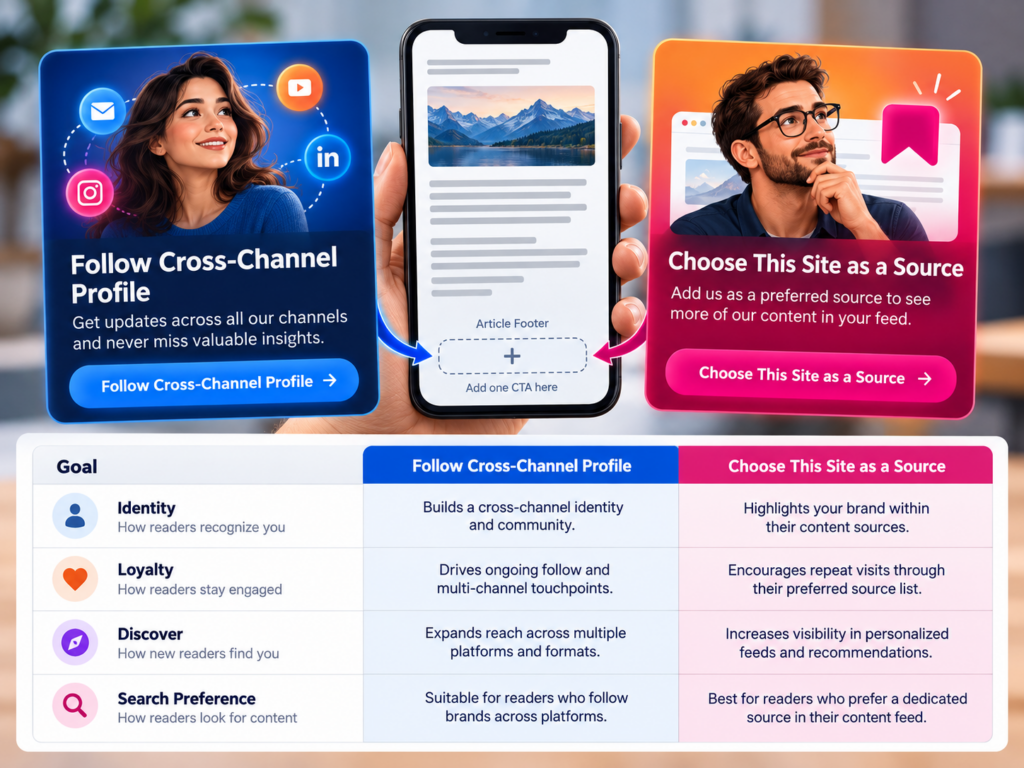
Use plain explanatory copy around the buttons. “Follow our cross-channel profile” and “Add this site to Preferred Sources” make the distinction clearer than two visual badges alone.
If the design can support only one call to action, prioritize the business goal with the most direct audience value, not the feature with the newest announcement.
Design a Measurement Plan Without Overclaiming Lift
Measure each feature according to the action it creates. Do not combine both into one “Google followers” metric.
For Search Profile, track on-site badge views and clicks, profile engagement where available, and changes in repeat or Discover traffic as observations. For Preferred Sources, track button starts and completions where the implementation exposes them, user-support questions, and relevant Search visibility.
Neither path supports a simple causal claim from badge installation to ranking. Content quality, publication frequency, topic demand, feature availability, personalization, and platform changes all influence outcomes.
Topify can add an answer-level observation layer. Teams can monitor a fixed set of branded and category prompts, note whether the domain receives a preferred badge where observable, and compare citations or mentions over time. This cannot reveal an individual user’s private preference or prove that the button caused an answer.
Use three reporting columns: action completed, downstream observation, and causal confidence. This keeps audience adoption separate from performance interpretation.
Choose by Publisher Goal
Choose Search Profile first when the central problem is fragmented identity. It fits creators, multi-channel publishers, and brands that need readers to verify official content across several platforms.
Choose Preferred Sources first when the main objective is a site-level loyalty action inside supported Google Search experiences. It fits publications with an established domain audience and enough engineering or CMS control to implement the button or deeplink.
Use both when the audience understands the distinction and the design provides a clear hierarchy. A publication might promote Preferred Sources on articles while placing Search Profile on the organization and author pages.
Before launch, test the full user journey on mobile and desktop. Confirm eligibility, destination, return flow, accessibility, localization, and analytics. Review the implementation after Google updates either feature.
The right decision is the one that gives a reader a meaningful action with an honest expected outcome.
Conclusion
Search Profile and Preferred Sources are not interchangeable badges. Search Profile consolidates a publisher or creator identity across web and social channels, while Preferred Sources lets a reader choose a domain or subdomain as a favored publication in supported Search experiences.
Start with the audience relationship you want to build. Use profile placement for identity and cross-channel discovery, and publication placement for source preference. If you use both, separate the language, visual hierarchy, and measurement. Neither feature guarantees ranking or inclusion. Their value comes from making a reader’s preference more explicit in the part of Google’s ecosystem each feature is designed to serve.
FAQ
What is the difference between Search Profile and Preferred Sources?
Search Profile is a followable identity that connects web and social content. Preferred Sources is a user selection that favors an eligible domain or subdomain in supported Search experiences.
Can a website use both badges?
Yes. Google provides guidance for using them together. Keep the labels and hierarchy clear so readers understand the two actions.
Does Preferred Sources affect AI Overviews?
Google says preferred content can be highlighted with a preferred badge in AI Mode and AI Overviews where those features and the site’s eligibility are available.
Which badge should publishers promote first?
Choose Search Profile for identity consolidation and cross-channel follow goals. Choose Preferred Sources for a site-level loyalty action in Top Stories and supported generative Search experiences.