

AI search attribution has to work with that missing middle. Citations, recommendations, referral sessions, branded demand, and revenue live in different systems and at different levels of certainty. The goal is not to force them into a perfect user journey. It is to create a defensible evidence chain that shows where AI visibility influenced discovery, evaluation, and action.
AI Search Moves Influence Upstream of the Click
Traditional web attribution begins when a person arrives. AI search often shapes the decision before that event by summarizing options, comparing requirements, or validating a claim within the answer itself.
Microsoft describes this as a distributed conversion journey in its AI search conversion guidance. Visibility, citations, query refinement, and answer inclusion can influence preference before the site visit. The eventual click may happen later, from a different query or device.
This does not make attribution impossible. It changes the unit of analysis. Instead of asking “which single channel caused the conversion?” ask “which observable signals support influence at each stage, and how confident are we?”
Use four stages:
- Discovery: the brand or content appears in a relevant answer.
- Evaluation: the answer recommends, compares, cites, or describes the brand.
- Visit: the person reaches an owned property through a traceable or untraceable path.
- Outcome: the person completes a meaningful event, enters pipeline, purchases, subscribes, or returns.
Attribution improves when every metric is assigned to one stage rather than treated as a substitute for revenue.
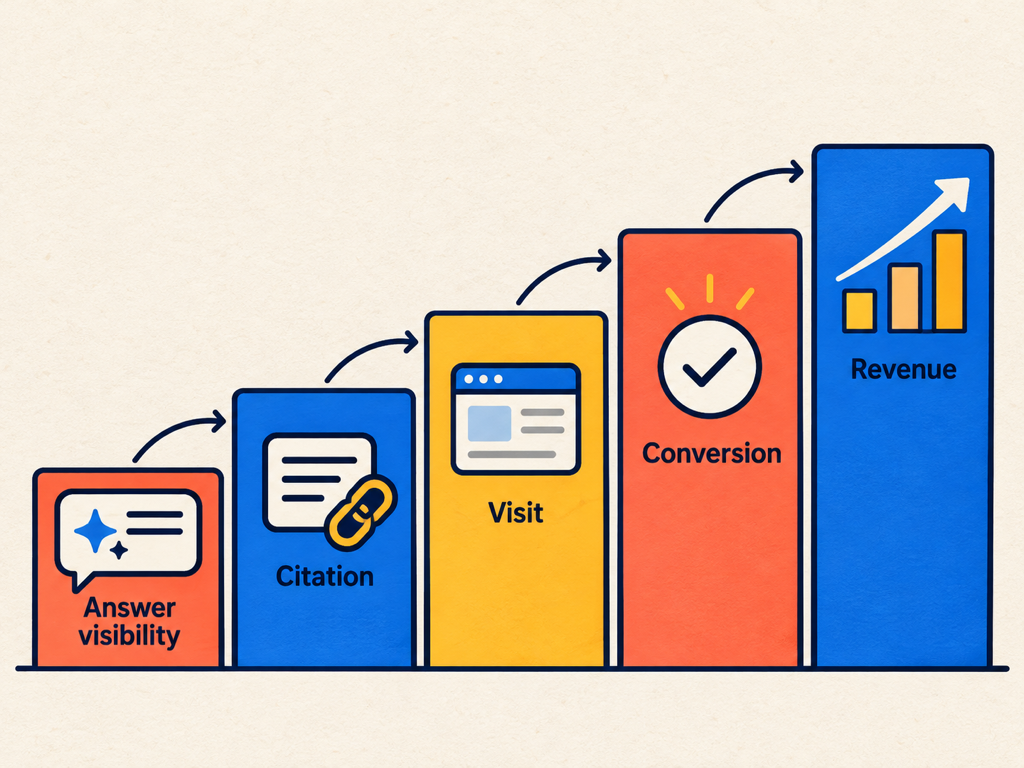
Build an Evidence Ladder Instead of One Master Score
A master AI ROI score looks convenient but usually mixes incompatible denominators. Prompt visibility is based on a controlled sample. Citations may be aggregated by a platform. Sessions reflect only traceable visits. Revenue is observed at the account or transaction level.
Keep the evidence separate and connect it with explicit assumptions.
| Evidence layer | Example metric | What it supports | Confidence limit |
|---|---|---|---|
| Answer visibility | Mention rate, recommendation rate, position | Presence in relevant AI decisions | Depends on prompt sample and execution conditions |
| Source participation | Citations, cited pages, citation share | Content used as supporting evidence | Does not prove brand preference or clicks |
| Demand response | Branded search, direct visits, self-reported discovery | Possible awareness or recall effect | Several channels can create the same movement |
| Traceable traffic | AI Assistant sessions, provider UTM parameters | Observable visits from AI sources | Misses zero-click, copied, and cross-device journeys |
| On-site behavior | Engaged sessions, product views, demo starts | Quality and intent after arrival | Does not reveal all prior influence |
| Business outcome | Qualified pipeline, purchase, subscription, revenue | Commercial value | Attribution model determines assigned credit |
An executive report can summarize the ladder, but analysts should retain the raw layers. A result is stronger when two or more independent systems support the same direction.
Define the Decision and Conversion Before Collecting Data
Attribution design should begin with the decision the report will change. A content team deciding what to publish needs topic, prompt, citation, and landing-page evidence. A growth leader deciding budget allocation needs qualified conversions, value, cost, and confidence. A publisher needs subscriptions, engagement depth, return visits, and recirculation.
Select one primary outcome and two or three supporting events. Mark those events consistently in analytics and downstream systems. Google’s GA4 conversion reporting guidance distinguishes raw event counts from conversion reports that assign credit using an attribution model.
Document the lookback window and model. A 30-day last-click report and a 90-day data-driven report will not produce the same credit. Changing the model mid-quarter creates a methodology break that should be annotated.
For long sales cycles, extend the evidence chain into CRM stages. Preserve original source, recent source, self-reported discovery, relevant content touched, opportunity creation, and closed value where policy permits. Do not overwrite one field every time a new visit occurs.
Instrument the Clickable Portion Correctly
GA4 now includes an AI Assistant channel for recognized sources such as ChatGPT, Gemini, DeepSeek, Copilot, and Grok. Google’s definition excludes AI Overviews and AI Mode. OpenAI also says ChatGPT search links carry utm_source=chatgpt.com for referral tracking.
Preserve session source, medium, landing page, campaign parameters, and key-event data. Validate redirects, consent flows, cross-domain settings, and payment or authentication handoffs. A broken redirect can erase the source before the first page event.
Analyze user, session, and event scope deliberately. Google’s BigQuery attribution documentation exposes first-user, session, and event-level traffic records. First-user scope answers acquisition. Session scope answers visit behavior. Event scope supports conversion credit.
Do not combine the three in one unlabeled trend.
Add Answer and Citation Data Before the Click
The upstream layer requires two kinds of observation. First-party platform reports can show aggregated citations or generative impressions. Controlled prompt monitoring can show the answer content, brand framing, source set, and competitors for a defined sample.
Freeze the prompt universe for the measurement period. Include informational, comparison, risk, use-case, and purchase prompts that correspond to real buyer decisions. Record platform, market, language, date, and repetitions.
Topify can provide this answer-level monitoring layer. Use it to track mentions, recommendations, position, competitors, and citations across the selected prompts. Do not present the sample as total market demand. It is a controlled observation set designed to detect change in important decisions.
Map monitored prompts to funnel stage and destination content. A recommendation improvement for low-value educational prompts should not receive the same business weight as improvement in a vendor shortlist or requirements comparison.
Use Three Attribution Views, Not One Winner
Run three complementary views:
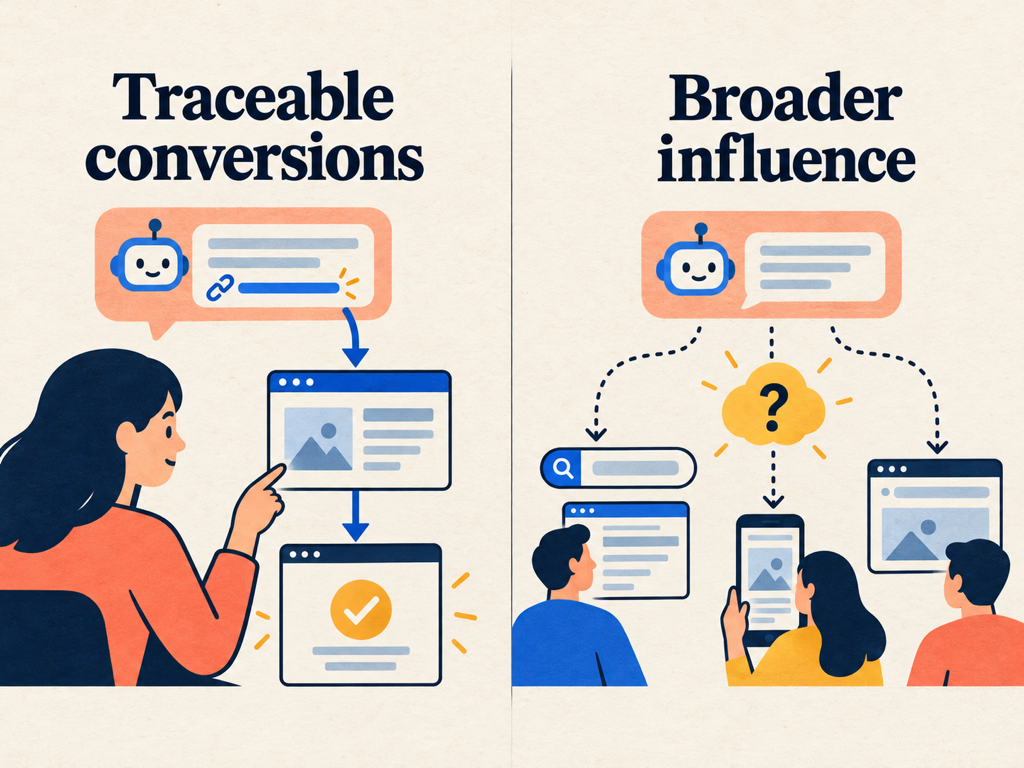
Traceable referral view. Assign outcomes to sessions with recognized AI sources or campaign parameters. This is the most observable view and the smallest representation of influence.
Assisted journey view. Examine paths in which AI referrals appear before later channels, using the property’s configured attribution model and lookback window. This can show participation without awarding full credit.
Influence study. Compare changes in answer visibility and citations with branded demand, direct visits, self-reported discovery, and business outcomes. Use matched markets, pages, or time periods when feasible.
The three views should not be added together. They overlap. Report them as a range of evidence, with traceable conversions as the floor and carefully designed influence estimates as a broader but less certain view.
Design Tests That Improve Causal Confidence
Simple before-and-after charts are vulnerable to seasonality, campaigns, product changes, and platform updates. Improve confidence with a comparison group.
Choose similar topics, markets, or page groups. Apply the AI-search intervention to one group while holding the other steady. The intervention might be new original data, clearer comparison content, updated product truth, better source evidence, or improved crawl eligibility.
Measure answer visibility, citations, traceable traffic, and the selected business outcome before and after. Record other events that could affect the result.
The test will not create laboratory certainty because AI systems and demand continue to change. It can still produce stronger evidence than a single trend line.
Use confidence labels:
- High: comparable groups, stable instrumentation, repeated answer movement, traffic or demand response, and aligned business outcomes.
- Medium: consistent movement across several layers but no strong control.
- Low: small sample, one volatile platform, methodology changes, or timing alone.
Calculate Value Without Double Counting
Start with the traceable floor. Multiply qualified conversions or transactions from recognized AI sessions by verified value, then subtract direct program cost when calculating return.
For assisted journeys, use the credit assigned by the chosen analytics model rather than adding full revenue again. For influence studies, report incremental outcome differences separately and explain the design. Do not stack traceable, assisted, and estimated influence values into one total.
Include content, tooling, analyst time, engineering, and media cost where applicable. AI-search programs often share assets with SEO, product marketing, PR, and documentation. Declare the allocation rule instead of claiming all content cost or all content value belongs to one channel.
A useful finance table contains observed revenue, attributed revenue, estimated incremental value, cost, and confidence. The categories reveal the uncertainty instead of hiding it inside a precise ROI percentage.
Create a Monthly Attribution Narrative
A monthly review should answer five questions:
- Where did answer visibility or citation participation change?
- Which decision intents and pages drove the movement?
- Did recognized AI traffic and key events change?
- Did branded demand, self-reported discovery, pipeline, or revenue move in the same direction?
- What alternative explanation remains strongest?
Write the conclusion in evidence order. Begin with what was observed, then state the supported inference, confidence, and next test. Avoid claiming that a citation caused revenue when the analysis only shows temporal alignment.
Version the prompt set, analytics rules, CRM fields, and attribution model. Method changes belong on the same timeline as content and platform changes.
Conclusion
AI search attribution cannot reconstruct every conversation that influenced a buyer. It can build a credible chain from answer visibility and citations to observable visits, on-site behavior, and business outcomes. That chain becomes useful when each signal retains its own denominator and confidence limit.
Begin with a defined decision and conversion. Instrument recognizable AI referrals, freeze an answer-monitoring sample, connect the systems by intent and time period, and use traceable, assisted, and influence views side by side. Then improve confidence through comparison groups and repeated observations. The best attribution model is not the one that awards AI the most credit. It is the one that helps the team make the next investment without claiming more certainty than the evidence supports.
FAQ
What is AI search attribution?
AI search attribution is the process of connecting AI answer visibility, citations, referrals, on-site behavior, and business outcomes while documenting uncertainty and overlap.
Can GA4 measure zero-click AI influence?
No. GA4 can measure recognized visits and attributed events, but it cannot observe an answer impression that produces no site visit.
Should AI search receive full credit for assisted conversions?
Not automatically. Use the property’s attribution model and report assisted credit separately from traceable last-click or direct referral value.
How can a team improve causal confidence?
Use stable instrumentation, frozen prompt samples, comparable periods, matched topic or market groups, repeated observations, and multiple independent evidence layers.

