A restaurant manager sees three reservations attributed to an online provider and assumes ChatGPT visibility is improving. The marketing team runs one prompt, does not see the venue, and reaches the opposite conclusion. Both observations can be true because they measure different stages of a conversational booking journey.
Restaurant visibility before a ChatGPT booking includes whether the venue enters the answer, where it appears, which attributes are attached to it, whether a reservation option is shown, and whether the user completes the provider flow. A useful scorecard preserves those stages instead of forcing them into one conversion number.
Define the funnel before choosing metrics
Start with six observable stages: eligible prompt, restaurant mention, shortlist position, provider or time displayed, booking-flow entry, and provider confirmation. Each stage has a different system of record and a different failure mode.
ChatGPT can help users find reservations based on location, date, time, party size, and preferences, according to OpenAI’s current help documentation. The result can change when any of those inputs changes. The measurement design must therefore retain prompt context.
| Funnel stage | Recommended metric | Main data source | Key limitation |
|---|---|---|---|
| Eligibility | Supported runs divided by planned runs | Test log | Product availability can change |
| Discovery | Mention rate | Answer captures | A mention is not a booking option |
| Consideration | Median position and sentiment | Answer captures | Position is not a click |
| Availability | Provider or slot display rate | Answer captures and provider data | Inventory changes quickly |
| Handoff | Booking-flow entries | Provider analytics | Referrer detail may be incomplete |
| Confirmation | Confirmed reservations | Provider system | Attribution to the exact answer may be unavailable |
Build a prompt panel that reflects dining demand
Divide prompts into stable intent groups: cuisine, neighborhood, occasion, dietary need, budget, atmosphere, landmark, party size, and branded lookup. Use natural combinations rather than repeating one keyword with minor wording changes.
Include control prompts for markets the restaurant does not serve and for attributes it does not offer. Controls help reveal over-broad or incorrect recommendations. Keep a core panel unchanged for trend measurement and a smaller exploratory panel for new behavior.
Record the plan or account type, model, device, location context, precise-location permission, date, time, and party size. OpenAI notes that reservation search is limited to eligible consumer plans and supported models, so a Work or managed workspace test may not represent the consumer feature.
Establish a repeated baseline
One answer is a screenshot, not a baseline. Run the core prompt panel across several comparable days and time windows before changing content or provider configuration. Repeat important prompts because answer composition and live availability vary.
Capture the complete answer, restaurant mentions, order, descriptive language, citations, provider name, available times, and booking links. Note when the restaurant is absent because no table is available versus absent despite inventory.
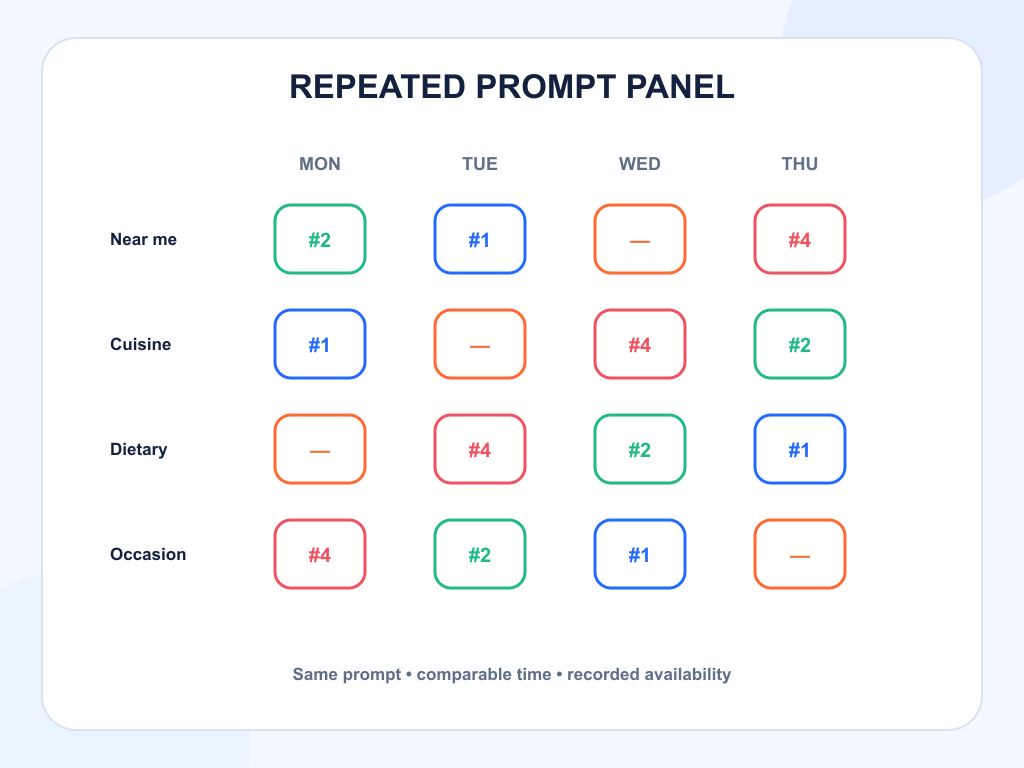
Use medians and ranges where possible. Do not report the best observed position as the normal experience.
Separate visibility from availability
A venue can have strong mention visibility and weak slot display because inventory is closed. It can also show availability when the user searches by name while failing to enter non-branded discovery prompts. Those are different problems.
Create a two-axis view:
- High visibility, high availability: protect accuracy and monitor conversion.
- High visibility, low availability: review shifts, pacing, holds, and capacity.
- Low visibility, high availability: improve entity consistency, evidence, and prompt relevance.
- Low visibility, low availability: fix operations and discovery in sequence rather than changing both at once.
This view stops marketing from blaming content for an inventory decision and stops operations from treating discovery as a table-management issue.
Track source and narrative quality
A restaurant mention can still be unhelpful when the answer assigns the wrong neighborhood, price, cuisine, or atmosphere. Add an accuracy field for the claims that drive selection. Classify each as correct, incomplete, outdated, or unsupported.
Record the sources used in the answer. Official pages may support menus and policies, provider pages may support current availability, and independent reviews may support atmosphere or reputation. The goal is not to make every answer cite the restaurant’s own site. It is to identify which evidence shapes the decision and where incorrect claims originate.
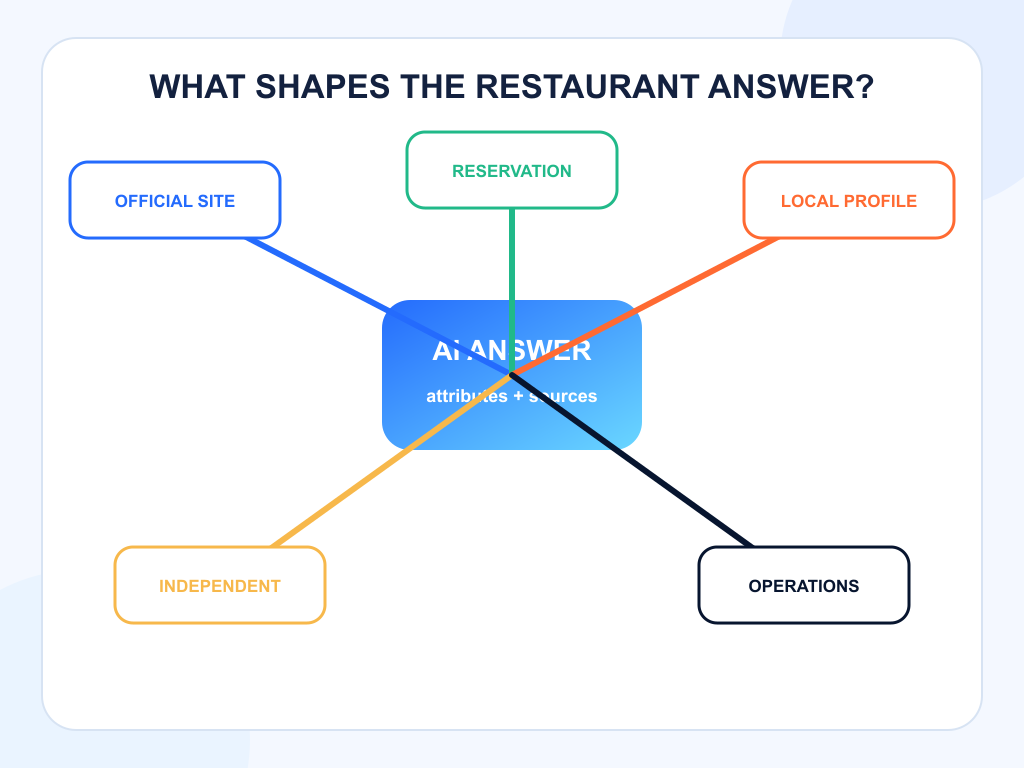
Prioritize corrections that change a diner’s decision, such as dietary support, location, opening status, or price level.
Join answer observations to provider data carefully
Use the reservation platform as the record for inventory, booking-flow events, and confirmed reservations. Preserve shift, party-size, and channel context where available. Compare changes over equivalent service periods rather than mixing weekday lunch with weekend dinner.
Attribution may remain incomplete. OpenAI explains that bookings can finish inside a supported flow or continue with a provider, and ChatGPT does not store, modify, or display an existing reservation after confirmation. A confirmed provider booking does not always carry the exact prompt or answer that preceded it.
Use directional language when identity is missing. “Bookings rose during a period of higher ChatGPT mention rate” is safer than “ChatGPT caused every incremental reservation.”
Design tests that change one layer at a time
Choose one intervention per test window: correct provider hours, open a shift, improve a dietary page, clarify private-dining capacity, or repair crawler access. Record the deployment time and expected stage of impact.
Availability interventions should affect slot display before they affect discovery. Content and entity corrections may require recrawl and may change description or mention rate. Third-party review activity should not be manipulated; monitor it as an external factor.
Keep a control group of prompts unrelated to the intervention. If every category moves at once, the cause may be a product or model change rather than the restaurant update.
Use Topify for the pre-click observation layer
Topify can organize repeated restaurant prompts and convert the answer layer into structured visibility, position, sentiment, and source trends. In AI search analytics, group prompts by market, cuisine, occasion, and party need, then compare the restaurant with the competitors appearing in the same answers. The related article AI Search Visibility: What It Is and Why It Matters explains why these pre-click metrics differ from website analytics.
Topify should remain one part of the measurement stack. Pair it with provider availability and confirmed reservations, and retain raw answer captures for qualitative review. The trade-off is probabilistic evidence: even a well-designed panel observes representative answers rather than every diner interaction.
Report a stage-based scorecard
Create a weekly view with mention rate, median position, accurate-attribute rate, provider display rate, slot display rate, booking-flow entries, and confirmed reservations. Add inventory availability as a denominator so a closed book does not look like a discovery failure.
Annotate content changes, provider incidents, holidays, local events, menu launches, and major model updates. Show confidence limits or sample size beside every percentage. A 50% mention rate from two runs should not sit beside a 50% rate from two hundred runs without context.
Review the scorecard with marketing and operations together. The handoff between recommendation and reservable inventory crosses both teams.
Set alert thresholds that respect normal variation
Alerts should respond to durable movement, not one answer. Trigger review when mention rate, median position, factual accuracy, or provider display changes across a defined number of comparable runs. Use a separate operational alert when inventory unexpectedly drops to zero for an active shift.
Route each alert with evidence: affected prompts, markets, service windows, answer captures, provider status, and the last known change. Marketing can investigate narrative and source shifts while operations checks inventory and pacing. This division shortens diagnosis without separating the shared funnel.
Revisit thresholds after holidays, seasonal menu changes, or model releases. Normal variation is not constant throughout the year.
Conclusion
Restaurant visibility before a ChatGPT booking is a staged system, not one conversion metric. Mention, position, narrative accuracy, provider display, live availability, handoff, and confirmation each require separate evidence. A missing result becomes actionable only after the team locates the stage that failed.
Build a repeated prompt baseline, join it to provider inventory, and test one intervention at a time. Topify’s AI search analytics can measure the pre-click answer layer while the reservation platform verifies availability and confirmed bookings.
FAQ
What is the first metric a restaurant should track?
Start with mention rate across a stable, representative prompt panel. Then add position, description accuracy, and provider display.
How many prompt runs are enough?
There is no universal number. Use repeated runs across the main markets, intents, and service windows, and always report the sample size.
Can confirmed reservations be attributed directly to ChatGPT?
Sometimes provider analytics may expose useful channel evidence, but exact prompt-level attribution can be incomplete. Report the level of certainty you actually have.
Why include inventory as a denominator?
A restaurant cannot show a bookable slot when no supported inventory is available. The denominator prevents an operations decision from being mislabeled as a visibility loss.