A restaurant can have open tables at 7:00 p.m. and still fail to appear when a diner asks ChatGPT for dinner nearby. The missing result does not immediately prove a ranking problem. The request may resolve to a different location, a provider may not expose availability for that restaurant, the party size may not fit, or the user’s preferences may describe another venue more closely.
ChatGPT reservation search combines conversational intent, location, restaurant information, live provider availability, and a booking handoff. Restaurants need to understand those stages before changing menus, profiles, or websites in response to one missing result.
Reservation search begins with a constrained request
OpenAI says diners can specify location, date, time, party size, cuisine, budget, dietary needs, and atmosphere. ChatGPT may also use approximate IP location or optional device location for local results. Each constraint can change the candidate set.
A request for “Italian near me tonight” is not equivalent to “quiet Italian restaurant in SoHo tomorrow at 8 for six people.” The second query contains geography, occasion, time, party size, cuisine, and atmosphere. A restaurant may fit the cuisine but fail availability or location.
Build a prompt map that reflects real dining decisions rather than one broad category phrase.
| Prompt dimension | Example | What it can change |
|---|---|---|
| Geography | neighborhood, city, near a venue | Candidate area and provider coverage |
| Time | tonight, Friday at 8 | Live availability |
| Party size | two, six, private group | Eligible inventory |
| Cuisine | ramen, vegan tasting menu | Relevance set |
| Budget | under $50, special occasion | Price fit |
| Need | wheelchair access, outdoor seating | Attribute fit and evidence requirements |
Provider coverage determines whether a booking path exists
OpenAI’s reservation-search documentation names OpenTable, Resy, and Yelp. OpenTable reservation availability is global, Resy is supported in the United States, and Yelp is supported in the United States and Canada. Availability still varies by restaurant and location.
That means a venue can be well known yet have no visible Reserve button for a particular query. OpenAI says reservation times and Reserve appear only when a supported provider has information for the restaurant. A restaurant should first confirm its provider relationship, market coverage, venue status, and bookable inventory.
Provider presence is necessary for the booking layer, but it does not guarantee that a restaurant will be recommended for every relevant prompt.
Discovery, availability, and booking are separate stages
The system can mention a restaurant without showing a time. It can show a time that disappears before confirmation. It can also hand the user to a provider to complete the booking. OpenAI notes that availability can change and that the reservation is confirmed only after the provider completes the flow.
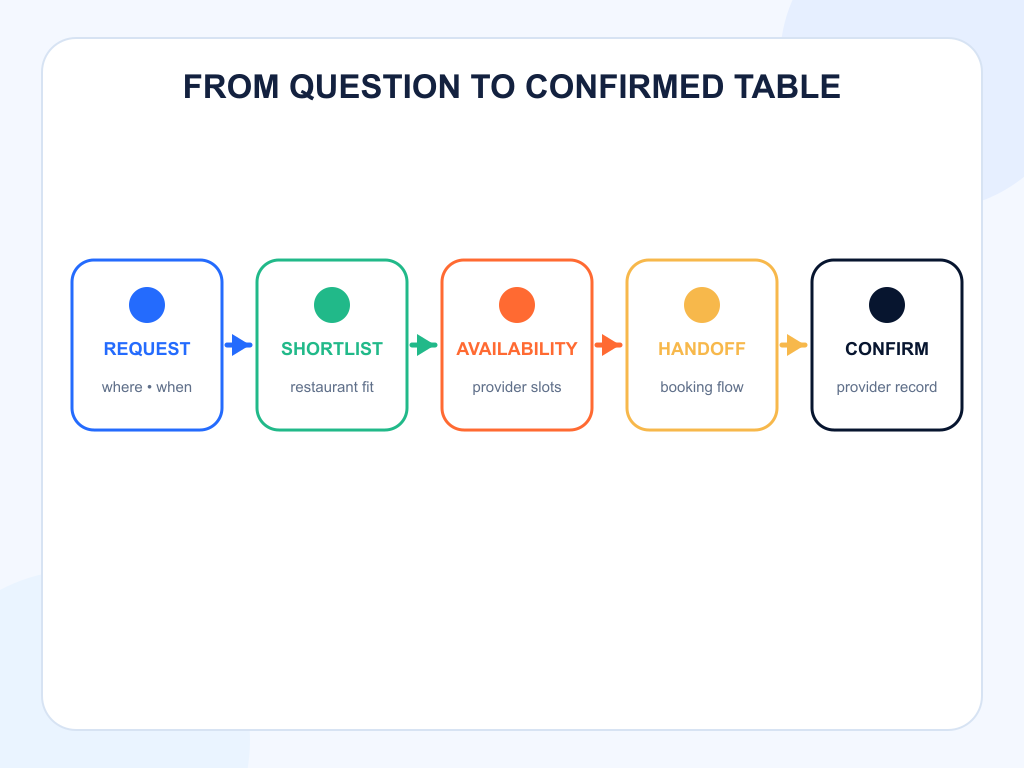
Measure each stage separately:
- Was the restaurant mentioned?
- Was it positioned prominently in the shortlist?
- Did the answer show a supported provider or available time?
- Did the user enter the booking flow?
- Did the provider confirm the reservation?
Collapsing the stages into “ChatGPT bookings” hides where the loss occurs.
Restaurant data must agree across surfaces
ChatGPT does not publish a restaurant-ranking formula. Restaurants should avoid treating one field or schema type as a guaranteed lever. The safer goal is factual consistency across the official site, reservation provider, major local profiles, menus, and independent coverage.
Check the venue name, address, phone, cuisine, price level, hours, menu, booking URL, accessibility information, and service options. Verify that the provider shows the correct venue and live shift. Resy’s partner documentation, for example, explains that online availability depends on table inventory and pacing.
Inconsistent data creates two problems. It can make the restaurant a weaker fit for a constrained prompt, and it can send a diner to a page where the promised details do not match.
Availability is an operational input, not a static SEO field
Reservation inventory changes by shift, table configuration, pacing, holds, and party size. A restaurant with no visible slot at the requested time may correctly disappear from a booking-oriented answer even though its profile is complete.
Audit availability with operations staff. Confirm which tables are online, which shifts are active, how large parties are handled, and whether special experiences have separate inventory. Do not open inventory merely to influence visibility if the restaurant cannot serve the resulting demand.
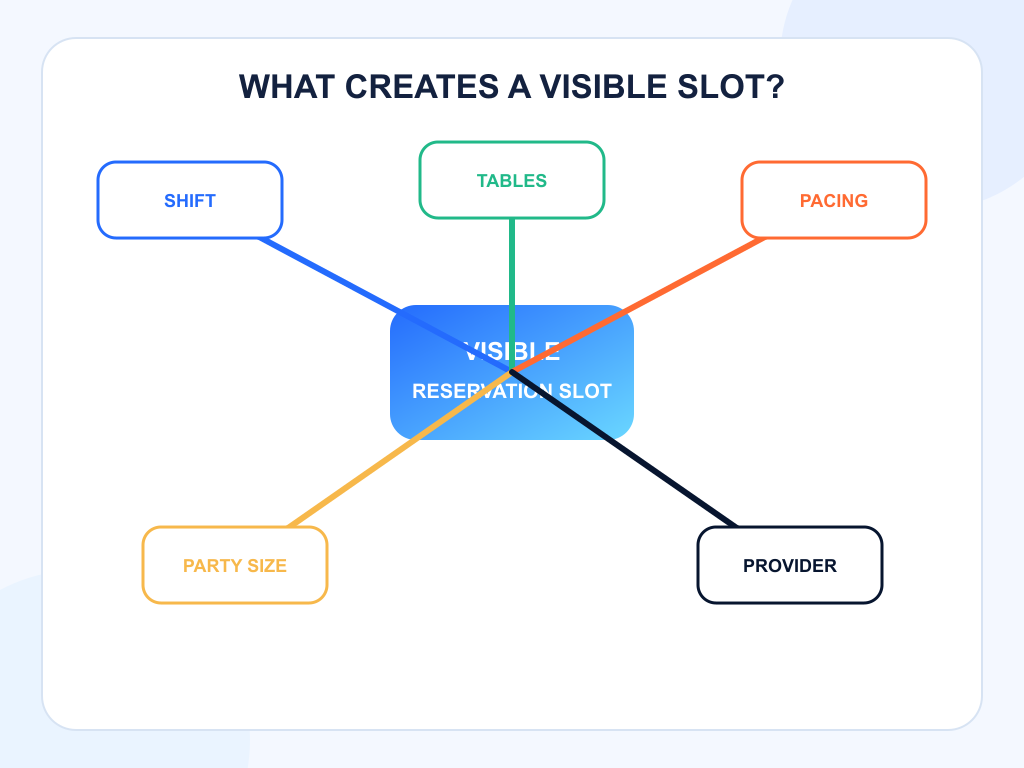
Track availability gaps as operational causes, not content failures.
Build pages that support the decision before the booking
The official restaurant site still matters because diners ask questions that provider cards may not fully answer. Create stable, crawlable pages for menus, dietary accommodations, private dining, accessibility, parking, outdoor seating, dress expectations, and neighborhood context. Keep facts specific and current.
Allow OAI-SearchBot when appearing in ChatGPT search is part of the discovery strategy, and confirm that the CDN allows OpenAI’s published IP ranges. OpenAI says search placement is not guaranteed even when access is available.
Use clear headings and visible text. A detail hidden only inside an image or interactive widget can be harder to verify. Link the reservation provider from the relevant venue page so a diner can move from evidence to action.
Test prompts by market, intent, and time
Create a grid rather than a single spot check. Include branded and non-branded prompts, nearby landmarks, cuisine variants, budget levels, dietary needs, occasions, party sizes, and time windows. Test on the consumer surfaces where reservation search is supported; OpenAI says it is not available in ChatGPT Work, Business, Enterprise, or Edu plans.
Run the same core prompts repeatedly because availability and generated answers vary. Preserve the full response, location context, model surface, time, mentioned restaurants, position, cited sources, provider, and displayed slots.
Topify can organize the discovery side of this test with prompt groups and multi-region AI search analytics. Monitor whether the restaurant appears, where it is positioned, how it is described, and which sources support the answer. Use AI Search Visibility: What It Is and Why It Matters as the measurement foundation. Topify does not replace the provider’s reservation ledger, so join answer observations to provider bookings and availability data rather than claiming one system sees the entire funnel.
Diagnose the missing result in order
When a restaurant does not appear, check the narrowest cause first:
- Is the feature available on the user’s plan, model, device, and market?
- Does a supported provider have current information for the restaurant?
- Is there inventory for the requested time and party size?
- Does the restaurant fit the location and stated preferences?
- Are official and third-party facts consistent?
- Is the official site accessible to search crawlers?
- Does the restaurant appear across repeated prompts rather than one run?
This sequence prevents a team from rewriting the website when the actual issue is a closed shift or unsupported provider.
Assign each failure to the team that can fix it
Restaurant discovery crosses marketing, operations, and provider support. Marketing owns official descriptions, local profiles, crawlable pages, and prompt monitoring. Operations owns shifts, table inventory, pacing, party-size policies, and service capacity. Provider support owns venue mapping, account status, booking-flow errors, and platform-specific data issues.
Create a shared issue record with the exact prompt, location, time, party size, screenshot, provider state, and expected result. A message saying “we are missing from ChatGPT” is too broad to route. The same venue can be correctly absent for a party of eight and incorrectly described for a party of two.
Close the issue only after the affected stage is rechecked. A corrected website fact may require recrawl. A provider configuration may need propagation time. A reopened shift should be verified with a bookable test that does not consume or block real inventory unnecessarily.
Conclusion
ChatGPT reservation search is a chain: intent, location, restaurant relevance, provider coverage, live availability, booking handoff, and provider confirmation. A restaurant can succeed at one stage and fail at the next, so visibility and reservations must be measured separately.
Begin with a provider and data audit, then build a prompt grid that reflects real dining decisions. Use Topify’s AI search analytics to observe mentions, positions, and sources, and use reservation-platform data to verify whether availability and confirmed bookings follow.
FAQ
Which reservation providers work with ChatGPT?
OpenAI currently names OpenTable, Resy, and Yelp, with availability differing by country, restaurant, and location.
Does joining a supported provider guarantee a ChatGPT recommendation?
No. Provider data can enable reservation availability, but it does not guarantee recommendation or placement for a prompt.
Why might a restaurant appear without a Reserve button?
The provider may not have information or inventory for that restaurant, time, party size, or location. Feature eligibility can also vary by account and model.
Can restaurant schema guarantee visibility?
No. Structured data can improve clarity on supported surfaces, but ChatGPT does not publish a guaranteed ranking formula for restaurant recommendations.