A page receives twice as many AI citations after an update. That sounds like lift until the denominator changes. Perhaps the platform began showing more citations overall, a news cycle expanded demand, or one unrelated query generated most of the increase. Measuring AI citation lift requires more than subtracting two counts. The team needs a baseline, a defined treatment, a stable prompt or query universe, comparable windows, and evidence about which pages and answers changed. The goal is not a perfect causal estimate from an imperfect system. It is a repeatable readout that states what moved, what did not, and how confident the next decision should be.
Define Lift Before Collecting the Result
Choose the primary unit. It may be treated-page citation rate across a controlled prompt set, citations per supported grounding query, or citation share within a stable pool. Write the formula and scope before the update.
For a prompt sample, a simple measure is:
Citation inclusion rate = answers citing a treated URL ÷ eligible answers in the fixed prompt sample
For an aggregated platform report, use the platform’s own definitions and keep raw counts. Do not merge incompatible denominators from different systems.
Record secondary outcomes separately: unique cited pages, brand mention rate, recommendation rate, position, sentiment, referral visits, and conversion.
Build a Baseline That Captures Variability
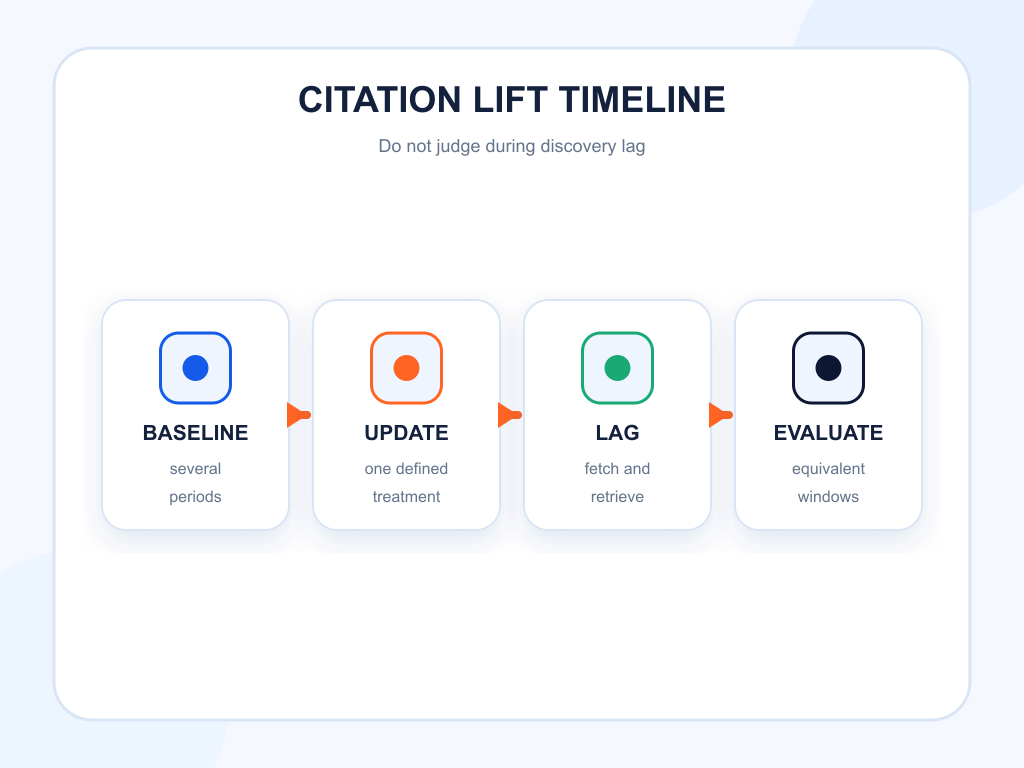
Collect several complete periods before deployment. One day or one run cannot show normal variance. Store dates, platform, locale, prompt group, model or product version when available, citations, answer text, and page URL.
Calculate the mean, median, range, and concentration of citations across pages and prompts. Note whether the metric is stable, trending, or highly volatile. A strong baseline lets the team distinguish a treatment effect from an existing direction.
Select matched control pages or prompt groups when possible. They provide context for market-wide and platform-wide changes.
Freeze the Treated Pages and Prompt Universe
List every treated URL and exact content change. Do not add successful pages after seeing the result. Freeze the evaluation prompts and their intent groups. Keep direct brand prompts separate from non-branded evaluation and informational prompts.
If using Bing’s grounding data, record the topic, query, page, and selected date window. Grounding queries are a sample and may not reproduce the user’s original wording. That limitation belongs in the report.
| Metric | Direct meaning | Required denominator | Confirming evidence | What not to claim |
|---|---|---|---|---|
| Citation count | Displayed source citations | None | Page and query distribution | Users, rank, or traffic |
| Citation inclusion rate | Share of eligible answers citing the page | Fixed eligible answer set | Repeated prompt results | Entire market share |
| Citation Share | Site portion of observed citation pool | All displayed citations for scope | Raw numerator and pool size | Brand recommendation share |
| Brand mention rate | Answers naming the brand | Fixed answer sample | Wording and position | Source authority |
| Referral sessions | Measured visits from known sources | Trackable sessions | Landing-page and quality metrics | Zero-click influence |
| Conversion | Recorded business action | Eligible users or sessions | Funnel and attribution evidence | Full causal value of AI exposure |
Wait for Discovery Before Judging
The updated content must be fetched and become available to retrieval systems. Monitor indexing and access. Submission through IndexNow or a sitemap can notify engines, but acceptance does not prove citation eligibility or use.
Define a lag period and exclude it from the main comparison. The length depends on the platform, crawl behavior, site authority, and update type. Record the first observed retrieval or citation of the updated page when possible.
Avoid repeated edits during the window. If a factual correction is necessary, document it and treat the result as a changed experiment.
Compare Equivalent Windows and Denominators
Use the same duration, weekdays, locale, platform, and prompt mix. Compare current performance against both the immediate baseline and matched controls. If seasonality matters, add a relevant historical comparison.
Keep numerator and denominator beside every rate. If citations increase from 20 to 30 while eligible answers double from 100 to 200, inclusion falls from 20 percent to 15 percent. Raw growth and relative lift tell different stories.
Microsoft’s Compare feature can show period overlays, but Microsoft notes that model changes, demand, freshness, and the open web all affect citation activity. A visual comparison begins the diagnosis; it does not finish it.
Inspect Where the Lift Came From
Break the change down by page, prompt, topic, intent, platform, and source role. Determine whether lift is broad or concentrated. A single prompt repeatedly citing one page can create a large aggregate movement without expanding the site’s useful coverage.
Read the answers. Was the page used to define a term, support a statistic, compare products, or justify a recommendation? The same citation count can carry different strategic value.
Inspect displacement as well. A new treated-page citation may replace another first-party page rather than add source presence. That can still be beneficial if the new page is more accurate, but it is not net expansion.
Pair Citation Lift With Brand and Outcome Metrics
Topify can track controlled prompts across AI engines and show brand mentions, position, sentiment, competitors, and cited sources. Use it to understand whether source lift changed the answer, not just the link set.
Then review referral and conversion data. Some AI exposure is zero-click, so the absence of sessions does not erase source value. It does limit what can be claimed about commercial impact.
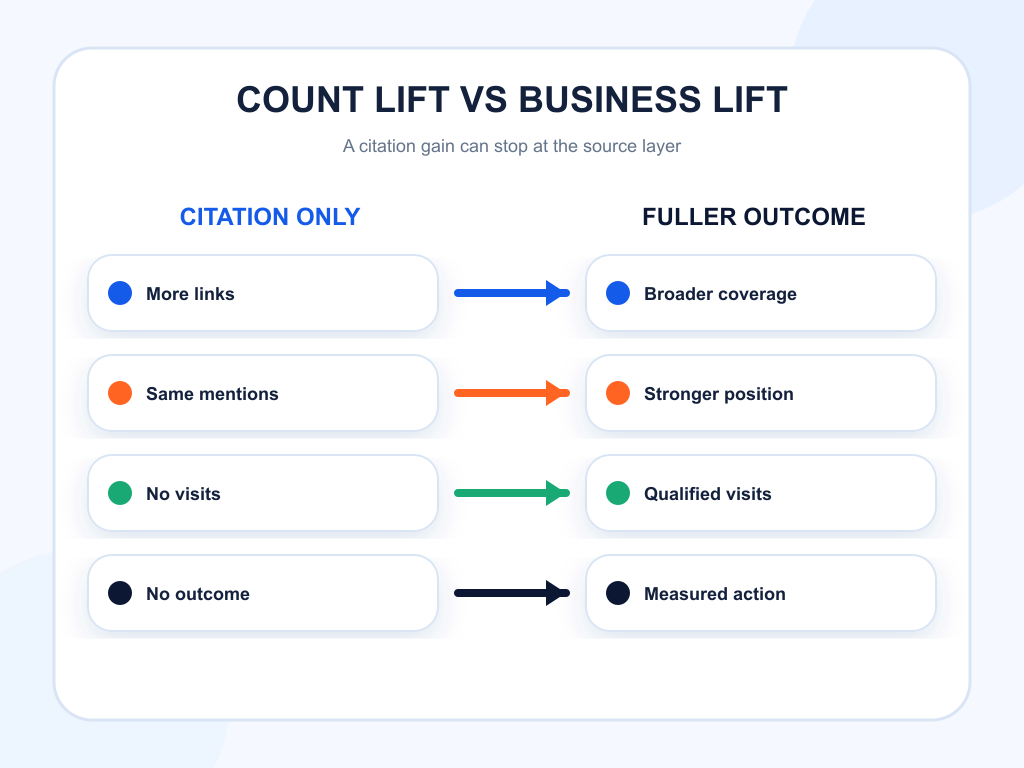
Create a layered readout:
- Did treated pages gain citations?
- Did brand inclusion or recommendation quality change?
- Did qualified visits or assisted behavior change?
- Did a business outcome change?
Do not skip directly from the first layer to the fourth.
Express Lift With a Confidence Note
Report absolute change, relative change, sample size, variability, concentration, control movement, and known external events. If appropriate, calculate an interval or use a resampling method, but do not hide a small sample behind complex statistics.
Use plain-language confidence labels with criteria. High confidence may require consistent direction across most blocks, stable controls, sufficient observations, and no major platform event. Medium confidence may indicate positive movement with some concentration or limited duration. Low confidence may indicate one prompt, one page, or a simultaneous model update.
The label should influence the action. High confidence can support rollout. Medium confidence supports replication. Low confidence supports more observation, not a case study.
Decide Keep, Extend, Replicate, or Revert
Choose the decision rule before reading the result. Keep a treatment that improves the primary outcome without harming guardrails. Extend it when the effect is broad but incomplete. Replicate it in another matched group when the signal is promising but uncertain. Revert when quality, eligibility, sentiment, or conversion degrades.
An inconclusive result should close with a specific reason: insufficient observations, unstable denominator, overlapping changes, or no measurable effect. That record prevents the team from turning the same weak result into evidence later.
Report absolute and relative change together. Moving from one citation to two is a 100 percent increase, but the absolute gain is one. Moving from 100 to 120 is a 20 percent increase and adds twenty citations. Both views matter, especially when prompt groups differ in size or baseline visibility. Include the denominator and the number of observation opportunities so readers can see whether a dramatic percentage rests on a tiny sample.
Also separate new citations from redistributed citations. If one updated page gains visibility while another owned page loses the same queries, the domain total may be flat even though page ownership improved. That can be a successful consolidation if the new owner is more accurate and maintainable. Conversely, a domain-level increase concentrated in an irrelevant page may be strategically weak. Review the cited URL, claim, and answer context before assigning business meaning to the lift.
Finally, note the cost of the intervention. A five percent gain from a focused factual update may be more repeatable than a larger gain from rebuilding an entire section. Measurement should help decide what to do next, not just certify that a line moved upward.
Conclusion
To measure AI citation lift, define the metric and denominator first, establish a multi-period baseline, freeze treated pages and prompts, allow for discovery lag, and compare equivalent windows. Break the change down by page, intent, platform, and source role, then connect source movement to brand representation and business outcomes without collapsing the stages. Report variability, concentration, controls, and external events in a confidence note. The strongest result is not the biggest percentage. It is the one that another reviewer can reproduce, challenge, and use to choose whether the treatment should be kept, replicated, extended, or reversed.
FAQ
What is AI citation lift?
It is the change in how often selected pages or a domain are cited within a defined AI-answer or grounding-query scope after an intervention.
Should lift be measured with counts or rates?
Use both. Counts show volume, while rates show change relative to an eligible answer or citation pool.
How long should teams wait after updating content?
Wait long enough for the page to be fetched and observed in retrieval, then collect complete comparable periods. The required lag varies by platform and site.
Does citation lift mean revenue increased?
No. Citation, brand representation, visits, and conversions are separate layers. Revenue requires its own attribution and outcome evidence.