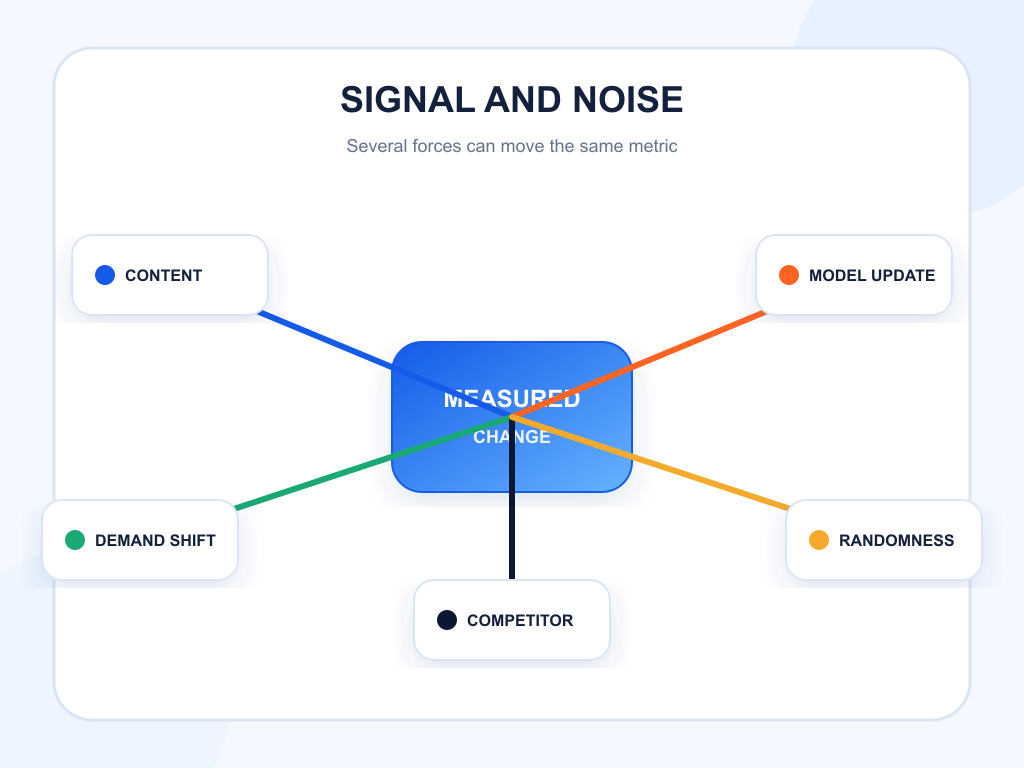
A citation chart rises after a content update, and the team declares a win. The conclusion may be right, but the chart cannot prove it. AI answers change with model updates, retrieval behavior, prompt mix, competing pages, seasonality, and ordinary randomness. Indexing and reporting also introduce delays. A defensible AI search experiment design does not remove that uncertainty. It limits alternative explanations by changing one coherent factor, using comparable controls, holding the observation process stable, and deciding in advance what result would count. The result is slower than a screenshot victory and far more useful for choosing the next investment.
Start With One Falsifiable Hypothesis
Write the hypothesis before editing the page. It should name the treatment, target, expected direction, and measurement window. For example: “Adding a sourced comparison table to three product-category guides will increase their citation inclusion for the matched evaluation prompt group over eight weeks, without reducing organic eligibility or reader conversion.”
This is better than “make the pages more AI friendly.” It can fail. A useful experiment needs that possibility.
Choose one primary outcome, such as citation inclusion rate for treated pages. Add guardrails for brand sentiment, organic clicks, conversion, errors, and page quality. Do not let a secondary metric replace the primary one after the result arrives.
Choose a Treatment the Team Can Describe
Change one coherent feature. It may be a new evidence table, clearer answer-first section, updated first-party data, stronger author attribution, or corrected entity facts. Avoid changing the title, layout, schema, internal links, sources, and entire body at once.
The treatment must be repeatable across a small page set. Record exactly what changed, when it shipped, who reviewed it, and which URLs received it. Save the prior version so unexpected damage can be reversed.
Google’s website-testing guidance warns against cloaking and recommends correct canonical handling for test URLs. Content tests should remain honest for users and crawlers. Do not serve a hidden “AI version” to bots.
| Experimental element | Recommended specification | Example |
|---|---|---|
| Hypothesis | Treatment, target, direction, window | Sourced table increases citation inclusion in eight weeks |
| Treatment unit | Stable page or coherent page group | Three comparison guides |
| Control | Matched pages without the change | Three similar guides in another category |
| Prompt block | Fixed intent and constraint groups | Evaluation, pricing, and implementation prompts |
| Primary metric | One predeclared outcome | Treated-page citation inclusion rate |
| Guardrails | Metrics that must not degrade | Organic eligibility, sentiment, conversion |
| Stopping rule | Minimum window and review condition | Evaluate after indexing plus six complete weeks |
Use Matched Controls When Randomization Is Impractical
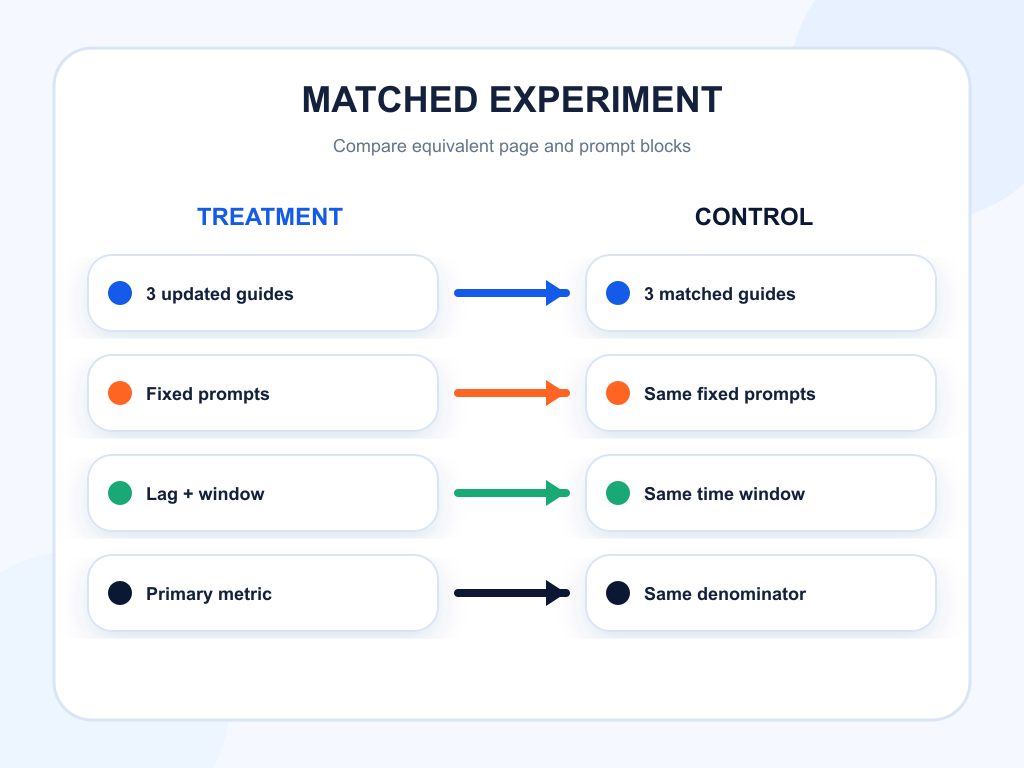
Random assignment is difficult for published content because each URL has its own history, authority, links, and audience. A matched control can still improve interpretation. Choose pages with similar intent, age, baseline citations, organic visibility, format, and business role.
Blocking reduces known nuisance variation. The NIST experimental-design handbook describes block designs as a way to account for nuisance factors. In AI-search testing, useful blocks can include platform, prompt intent, geography, brand status, and page type.
Compare treatment and control movement within the same blocks. If all pages rise after a model release, the general shift is less likely to be caused by the treatment. If treated pages improve while closely matched controls remain flat, the hypothesis becomes more plausible.
Freeze the Prompt Sample and Execution Conditions
Prompt portfolios drift when teams add new phrases after seeing results. Freeze the evaluation sample before launch. Include direct, indirect, informational, commercial, and negative cases where relevant. Keep platform, locale, account state, and timing as consistent as the tools allow.
Run enough repeated observations to estimate variability. One prompt once is a screenshot, not a baseline. Use the same repetition policy for treatment and control. Store full answers, citations, dates, and execution metadata so changes can be audited.
Do not claim that a fixed sample represents the entire market. It represents the defined decision space. Coverage and stability matter more than pretending the universe is complete.
Allow for Discovery and Model Lag
Content changes need to be crawled, indexed, and retrieved before they can influence an answer. Different platforms refresh at different rates. Set a lag period during which results are collected but not judged.
Use IndexNow or ordinary indexing mechanisms where appropriate, but do not treat successful submission as proof of indexing or citation. Check whether the updated page is publicly accessible and whether the visible content and metadata match the intended treatment.
Avoid changing the treated pages again during the measurement window unless there is a factual or safety problem. If another update is required, record it and decide whether to restart, extend, or exclude the affected unit.
Compare Equivalent Time Windows
Microsoft’s AI Performance Compare can overlay previous periods, but Microsoft cautions that citation activity changes with user behavior, models, freshness, and the web. Equivalent dates are necessary but not sufficient for causality.
Compare complete windows of the same duration and day mix. Note launches, campaigns, news events, outages, platform releases, and reporting changes. For seasonal topics, compare against both the preceding period and a relevant historical window where available.
Analyze counts and denominators. A citation rate can rise because the treated pages gained citations, because total opportunities fell, or both. Keep raw observations beside percentages.
Separate Citation, Mention, and Business Outcomes
A page can gain citations without the brand gaining recommendations. A brand can gain recommendations through third-party sources while its domain citations remain flat. A click can rise without any change in answer position because the citation wording improved.
Report each layer separately:
- Source layer: treated page citations and source share.
- Answer layer: brand mentions, position, recommendation, and sentiment.
- Visit layer: qualified referral or assisted traffic.
- Outcome layer: signup, lead, purchase, retention, or another business event.
Topify can monitor the answer and source layers for a controlled prompt set. Analytics and product systems must supply visits and outcomes. A test can be successful at one layer and neutral at another.
Predefine the Decision Rule
Decide what happens after the window. A clear rule might be: extend the treatment if the primary metric improves directionally in most blocks and no guardrail degrades; revert if a critical guardrail fails; replicate if the result is promising but unstable; stop if the effect is indistinguishable from control.
Do not demand statistical significance from a sample too small to provide it. Report effect direction, variability, sample size, and confidence limits where appropriate. Label an inconclusive result as inconclusive.
The cost of false confidence is repeated rollout of a tactic that did not work. The value of a null result is preventing that waste.
Keep an Experiment Ledger
Maintain one record containing the hypothesis, pages, controls, prompts, baseline, treatment, deployment time, lag, exclusions, platform events, metrics, result, and decision. Link to snapshots or diffs of the content.
Review experiments as a portfolio. Repeated gains from clearer evidence across several categories are more credible than one isolated spike. Repeated failures can reveal that the treatment, measurement, or assumed mechanism is wrong.
Use the ledger to stop rediscovering the same lesson. It should also record experiments that were planned but rejected because the pages, controls, or sample could not support a useful conclusion.
Preserve an experiment ledger even when the result is null. Record the hypothesis, treatment pages, control pages, prompt set, observation window, model or surface, exclusions, and final interpretation. A null result can show that the proposed mechanism was weak, the lag was longer than expected, or the sample could not distinguish the effect. Without the ledger, teams tend to repeat the same test or selectively remember only positive movements. With it, later experiments can change one assumption at a time and build cumulative knowledge.
Conclusion
AI search experiment design is the discipline of reducing avoidable uncertainty. State one falsifiable hypothesis, apply one coherent treatment, choose matched controls, freeze the prompt sample, allow for discovery lag, and compare equivalent windows. Keep citation, brand, visit, and business outcomes separate, with guardrails that protect the user and the site’s existing search performance. Then apply a predeclared decision rule and document the result, including null or inconclusive findings. Start with a small set of comparable pages. A modest experiment that the team can explain is more valuable than a broad rollout justified by a chart that happened to move upward.
FAQ
Can AI-search content changes be A/B tested?
They can be tested, but classic random user assignment is often impractical. Matched page controls, blocked prompt groups, and stable observation conditions improve interpretation.
How many prompts are needed?
There is no universal number. Use enough prompts and repetitions to represent the defined decision space and estimate variability, while keeping the sample stable.
How long should an experiment run?
The window must include discovery and indexing lag plus enough complete observations to distinguish a durable pattern from ordinary volatility.
Does a citation increase prove the content change worked?
No. It is evidence consistent with the hypothesis. Controls, denominators, platform events, and repeated results determine how strong the inference can be.