A brand can look visible across hundreds of AI answers while depending on one fragile source. The same review article may support most recommendations. One documentation page may carry nearly all first-party citations. One engine may account for the apparent success. Aggregate counts hide that dependence until the page changes, the domain loses eligibility, or the model refreshes its source pool. AI citation source concentration measures how much visibility rests on a small number of pages, domains, source types, or platforms. The point is not to maximize diversity at any cost. It is to know whether a healthy-looking total can survive the loss of its largest contributor.
Concentration Is the Shape Behind the Total
Start with a defined citation pool: a stable prompt set, topic, intent group, platform, and period. Count every displayed source and assign it to a URL, domain, source type, and engine. Then calculate the share held by the leading contributors.
Simple measures are useful:
- Top-one share: citations from the largest contributor divided by all citations.
- Top-five share: citations from the five largest contributors divided by all citations.
- Unique contributor count: pages or domains represented in the pool.
- Cross-engine overlap: contributors repeated across platforms.
These are descriptive statistics. They do not define a universal safe threshold. A regulated niche may appropriately rely on a few authoritative sources, while a consumer category may need broader evidence.
Measure Four Concentration Layers
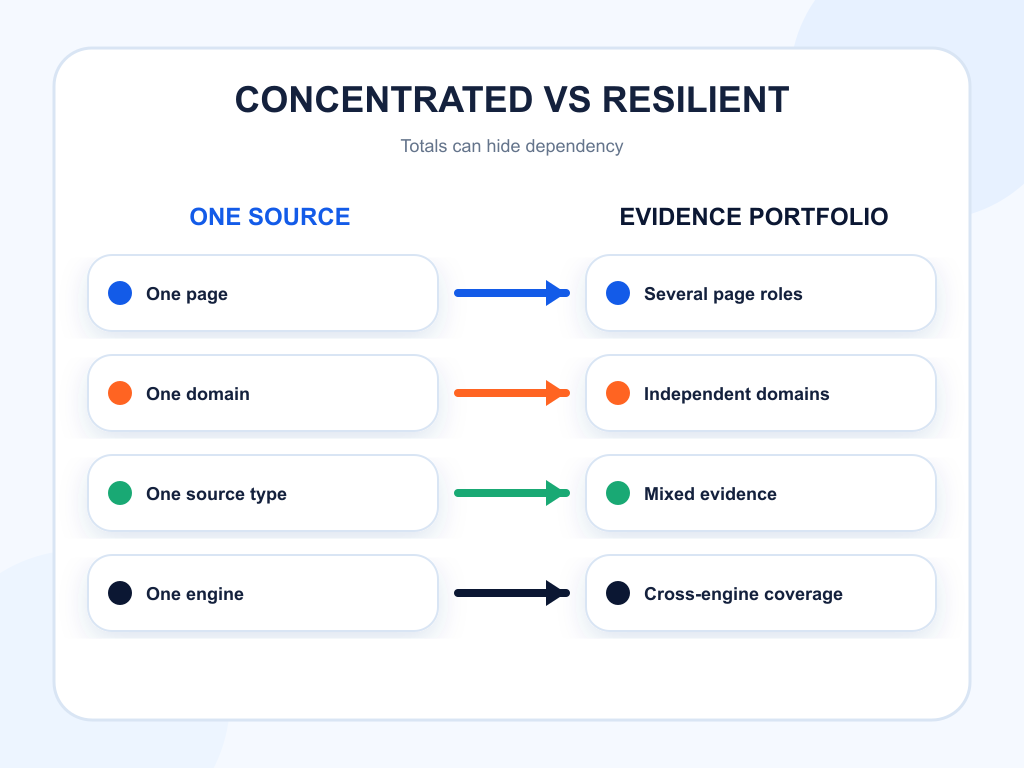
Page concentration shows whether one URL carries the domain. Domain concentration shows whether one publisher carries the brand narrative. Source-type concentration shows whether evidence comes almost entirely from reviews, forums, owned pages, news, documentation, or research. Engine concentration shows whether visibility exists on one platform but disappears elsewhere.
| Concentration layer | Warning pattern | Business risk | First response |
|---|---|---|---|
| Page | One URL supplies most first-party citations | Update, redirect, or eligibility loss collapses presence | Refresh, support, and build complementary assets |
| Domain | One third-party site supports most recommendations | Editorial or policy change removes validation | Earn independent evidence from credible alternatives |
| Source type | Nearly all citations come from one format | Narrative lacks balance or decision coverage | Add missing evidence roles, not duplicate mentions |
| Engine | One platform produces most positive visibility | Market view is mistaken for cross-platform strength | Measure and diagnose each engine separately |
| Topic | Citations cluster in one low-value theme | Strong totals hide weak commercial relevance | Rebalance toward high-fit decisions |
Page Concentration Can Be Strength or Fragility
A definitive research page may deserve to lead citations. The risk appears when it has no support, is hard to maintain, or serves several intents poorly. Inspect the page’s freshness, source quality, canonical status, internal links, author ownership, and business role.
Compare the top page with the next tier. If no other URL can answer adjacent needs, build complementary evidence rather than cloning the winner. A definition page, implementation guide, data report, and decision comparison can support the same topic through distinct jobs.
Track redirects and consolidations. Removing an obsolete page may temporarily increase concentration on the correct canonical asset, which can be healthy. Interpret the metric with the content architecture.
Domain Concentration Exposes Narrative Dependence
Brands are often recommended through third-party sources. One respected review site can create substantial visibility, but the relationship is outside the brand’s control. The page can change, rankings can shift, or the publisher can remove the brand.
Read what the dominant domain actually supports. Does it validate product capability, price, reputation, safety, or category leadership? Map the claim to alternative credible sources. The goal is not to repeat identical promotional language across the web. It is to make important claims independently verifiable.
Avoid manufacturing low-quality mentions. Ten thin syndication pages do not create the resilience of two strong independent sources.
Source-Type Concentration Hides Evidence Gaps
A brand cited only in its own documentation may be accurate but lack independent validation. A brand cited only in forums may have strong community presence but weak canonical facts. A brand cited only in review sites may be visible for comparisons but absent from technical or support answers.
Classify sources by role: first-party facts, independent testing, expert explanation, user experience, official standards, news, and commercial review. Then compare the distribution with the decision the answer must support.
Different claims need different evidence. Availability and current features belong on official pages. Comparative performance benefits from independent testing. Usage constraints may need both documentation and real-world experience.
Cross-Engine Concentration Requires Separate Baselines
Do not blend ChatGPT, Gemini, Perplexity, Copilot, and AI Overviews into one denominator without showing the components. Each platform has different retrieval, citation, presentation, and geography. A strong overall count may come almost entirely from one engine.
Topify can monitor selected prompts across platforms and expose cited domains and brand representation. Use platform-level views first, then calculate overlap. A source repeated across several engines may be influential, but its loss also creates correlated risk.
Keep first-party Bing metrics separate from sampled answer monitoring. Bing AI Performance reports Microsoft-supported citation activity; a controlled Topify prompt set answers a different question.
Add Relevance and Sentiment to the Risk Model
High concentration is not equally risky in every context. Weight the analysis by topic fit, intent, answer position, sentiment, and conversion value. Losing a dominant source for a low-value informational theme may matter less than losing the only positive commercial comparison.
Create a risk score with transparent components:
- Contributor share.
- Business value of the affected prompt or topic.
- Control over the source.
- Freshness and update risk.
- Cross-engine dependence.
- Availability of substitutes.
Keep the original measures visible. A composite prioritizes review; it does not replace diagnosis.
Run Loss Simulations
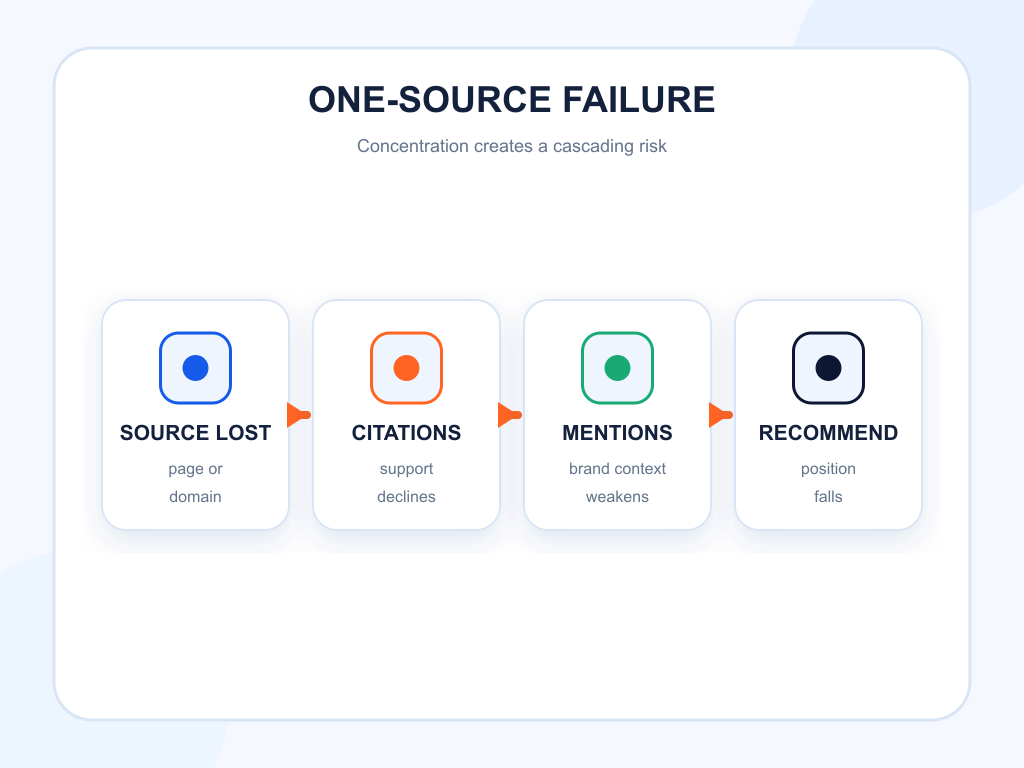
Remove the top page or domain from the dataset and recalculate visibility. Repeat for the top five contributors and for the dominant source type. This does not predict model behavior, but it shows structural dependence.
Ask operational questions. If the top first-party page were redirected tomorrow, which page would replace it? If the leading review changed its conclusion, which independent evidence would remain? If one engine stopped citing forums, would the brand still appear?
Use the simulation to prioritize maintenance, distribution, and content architecture. It is more actionable than reporting a concentration percentage alone.
Monitor Concentration With Change Logs
Review monthly and after major events: product launches, migrations, model updates, publisher changes, or content pruning. Record the top contributors, their shares, source roles, and notable answer changes.
Do not treat every increase as negative. A new authoritative study can legitimately dominate for a period. The concern is persistent dependence without a maintenance plan or substitute evidence.
Set alerts for sharp contributor loss, not only total citation decline. Aggregate citations may remain flat while the underlying portfolio becomes riskier.
Use scenario tests to make the metric operational. Recalculate visibility after removing the leading URL, leading external domain, and leading source type. Then repeat the exercise by model or answer surface. The resulting drop estimates dependency rather than predicting an actual outage. It shows which single loss would most change the evidence portfolio and where maintenance or diversification deserves attention first.
Interpret the scenarios with context. A standards body may appropriately dominate a narrow technical claim, while one affiliate article dominating all commercial comparisons is a different risk. First-party documentation may be the correct source for current product limits, but independent validation should support performance and comparative claims. Concentration is not automatically a defect. It becomes risky when the dominant source is unstable, poorly matched to the claim, outside the team’s influence, or carrying several evidence roles that should be independent.
Assign a response owner for each material dependency. Editorial teams can strengthen alternative owned pages, communications teams can provide verifiable data to qualified third parties, and product teams can improve primary documentation. Track whether the portfolio gains independent, relevant sources rather than merely collecting more mentions. A source that repeats another page without adding authority does little to reduce practical dependency.
Conclusion
AI citation source concentration reveals whether visibility is broad or dependent on a few contributors. Measure top-one and top-five shares across pages, domains, source types, topics, and engines. Then add relevance, sentiment, control, freshness, and substitute evidence to determine actual risk. A dominant source can be valuable; the problem is dependence that the team cannot see or maintain. Run loss simulations, strengthen complementary evidence roles, and monitor contributor changes alongside totals. The goal is not maximum diversity. It is a citation portfolio that remains accurate and useful when one important page, publisher, or platform changes.
FAQ
What is AI citation source concentration?
It is the share of observed AI citations accounted for by a small number of pages, domains, source types, topics, or engines.
Is high concentration always bad?
No. Authoritative sources may appropriately dominate. Risk depends on business value, control, freshness, substitute evidence, and cross-engine dependence.
How can concentration be measured?
Start with top-one share, top-five share, unique contributor counts, source-type distribution, and cross-engine overlap within a defined pool.
How often should source concentration be reviewed?
Review monthly and after migrations, product changes, model updates, publisher changes, or large citation movements.