
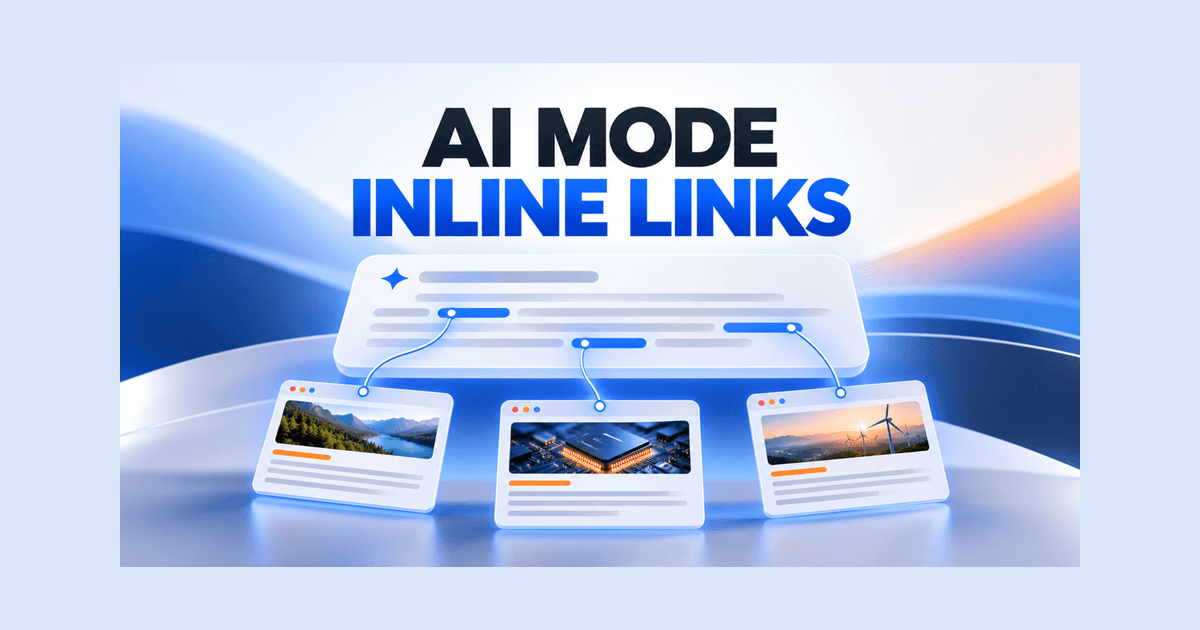
An AI answer can mention a topic without giving the source a meaningful path to the reader. That tension has shaped publisher concerns since AI Overviews and AI Mode began changing the search journey. Google is now adjusting the interface. On October 15, 2026, the company said AI Mode inline links would appear more frequently and higher in responses, alongside tests for official website links and a broader rollout of article carousels. The opportunity is real, but there is no special markup that guarantees placement. Publishers need pages that are eligible, specific, current, and useful at the exact moment a source is needed.
What Changed in Google AI Mode
Google’s October 2026 AI Search update described several link-focused changes. Inline links are intended to appear more often and higher in AI Mode responses. Google is also testing a dedicated section for official website links, expanding article carousels for timely topics, and making creator and publisher names clickable in some contexts.
These are interface and discovery changes, not a new ranking formula. Google did not announce an application process for inline citations or a special schema that forces an answer to cite a page. Its AI features documentation continues to say that pages need to be indexed and eligible to appear with a snippet. The same foundational search practices still apply.
The practical shift is that more answer passages may contain a direct route to a supporting source. A page must still compete to become that source, and the link must match the part of the response the user wants to explore.
| AI Mode placement | User need | Publisher preparation |
|---|---|---|
| Inline link | Verify or deepen one answer point | Create a precise, self-contained supporting passage |
| Official website section | Reach the authoritative source for a task | Build a clear first-party task page |
| Article carousel | Explore timely reporting or related coverage | Publish current articles with strong images and context |
| Creator or publisher link | Understand who produced the source | Maintain consistent, visible identity and profile signals |
Start With the Query Fan-Out, Not One Keyword
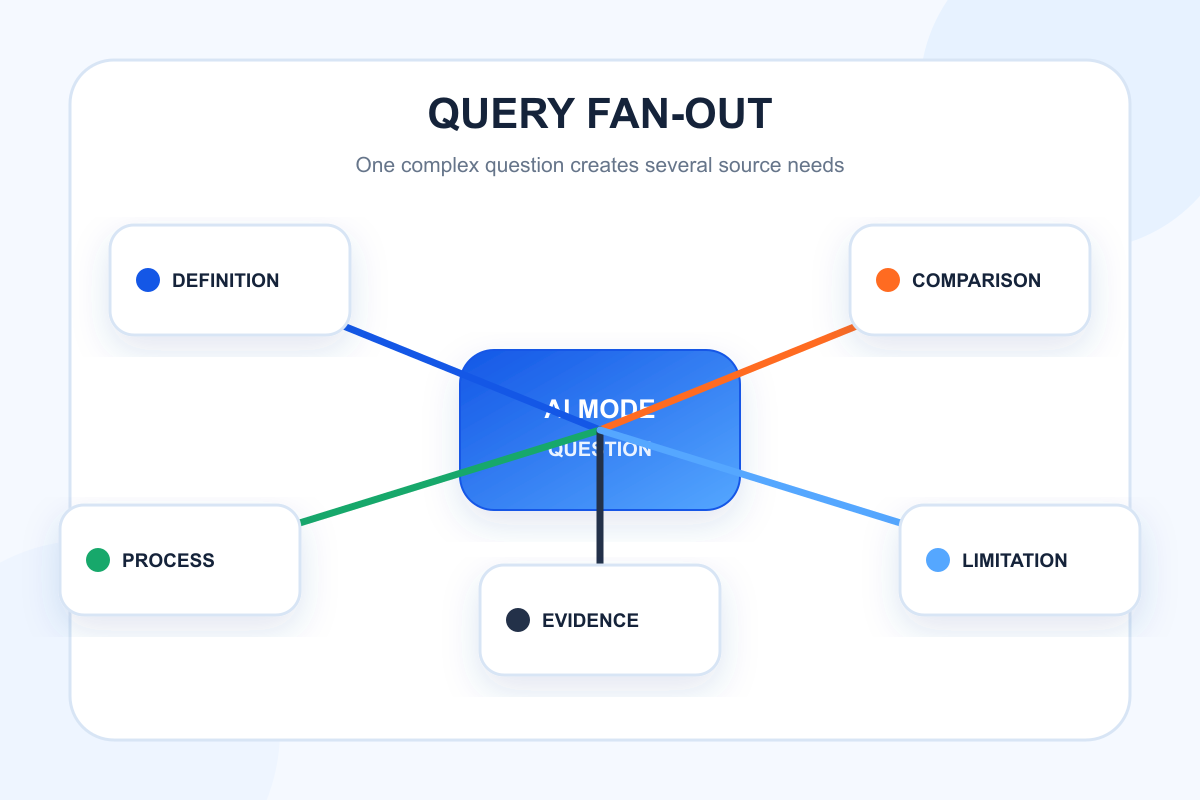
Google explains that AI Mode and AI Overviews may use a query fan-out technique, issuing multiple related searches across subtopics and data sources. A single user question can therefore create several opportunities for a page to contribute.
Consider “How do I measure whether my brand appears in AI answers?” The response may need definitions, platform differences, a method for choosing prompts, tracking examples, citation analysis, and reporting advice. A generic page targeting “AI visibility” may be too broad to support any one passage well. A focused section on citation share, however, could support the part of the answer about source frequency.
Map the question into likely subneeds:
- What the user is trying to decide or complete.
- Which concepts require definition.
- Which steps require first-party instructions.
- Which claims require evidence.
- Which alternatives or constraints need comparison.
Build content that gives each important subneed a clear answer. This is not permission to create dozens of thin pages for trivial variations. It is a reason to organize one strong page around the real decision structure behind the query.
Write Source-Ready Passages
An inline link is useful when it gives the reader a clear reason to leave the answer and inspect the source. Write passages that stand on their own without losing the page’s larger context.
A source-ready passage usually includes:
- A direct answer in the first sentence.
- The entity, product, or process named explicitly.
- A small amount of evidence or reasoning.
- Any essential condition, date, or limitation.
- A natural path to deeper detail on the page.
For example, a weak paragraph might say, “This approach improves results and should be reviewed regularly.” It does not identify the approach, the result, or the review trigger. A stronger paragraph might say, “Measure AI citation share by dividing a brand’s cited appearances by all cited brand appearances in the same tracked prompt set. Keep the prompt set and measurement window stable so trend comparisons remain meaningful.”
The stronger version is easier to retrieve because it connects the metric, calculation, and condition. It is also more useful to the person who clicks.
Preserve the Technical Eligibility Basics
Google states that no special technical requirement is needed for AI features beyond standard Search eligibility. The page must be crawlable, indexed, and eligible to appear with a snippet. That simple statement covers several failure points.
Confirm that robots rules do not block Googlebot, the page returns a successful status, the canonical points to the intended URL, and important text is available in rendered HTML. Use internal links so the page is discoverable from the site structure. Avoid restrictive preview controls if the business expects content to support Search answer features.
Structured data should match visible page content. It can help Google understand eligible content types, but it does not create a general “AI Mode citation” entitlement. Keep images and videos accessible and relevant. For commerce or local information, maintain current Merchant Center and Business Profile data where applicable.
Topify’s AI Crawler Robots.txt guide can help teams reason about crawler access across AI systems, while Google’s documentation remains the authority for Google Search eligibility.
Make Evidence and Ownership Easy to Verify
AI answers often combine material from several sources. A page is more useful when readers and systems can quickly understand who produced it, when it was updated, and why its claims are credible.
Show a meaningful byline or responsible organization. Link to an author, company, methodology, or data source where appropriate. Use visible publication and modification dates only when they reflect real editorial events. Cite primary evidence close to the claim it supports. If an observation comes from your own dataset, explain the sample, time period, and method.
First-party pages have an additional advantage when the question concerns the organization’s own product, policy, pricing, or instructions. Make that ownership explicit without filling every paragraph with brand language. A clear product name, canonical company identity, and consistent factual description are usually more useful than promotional repetition.
Measure Placement as a Two-Step Outcome
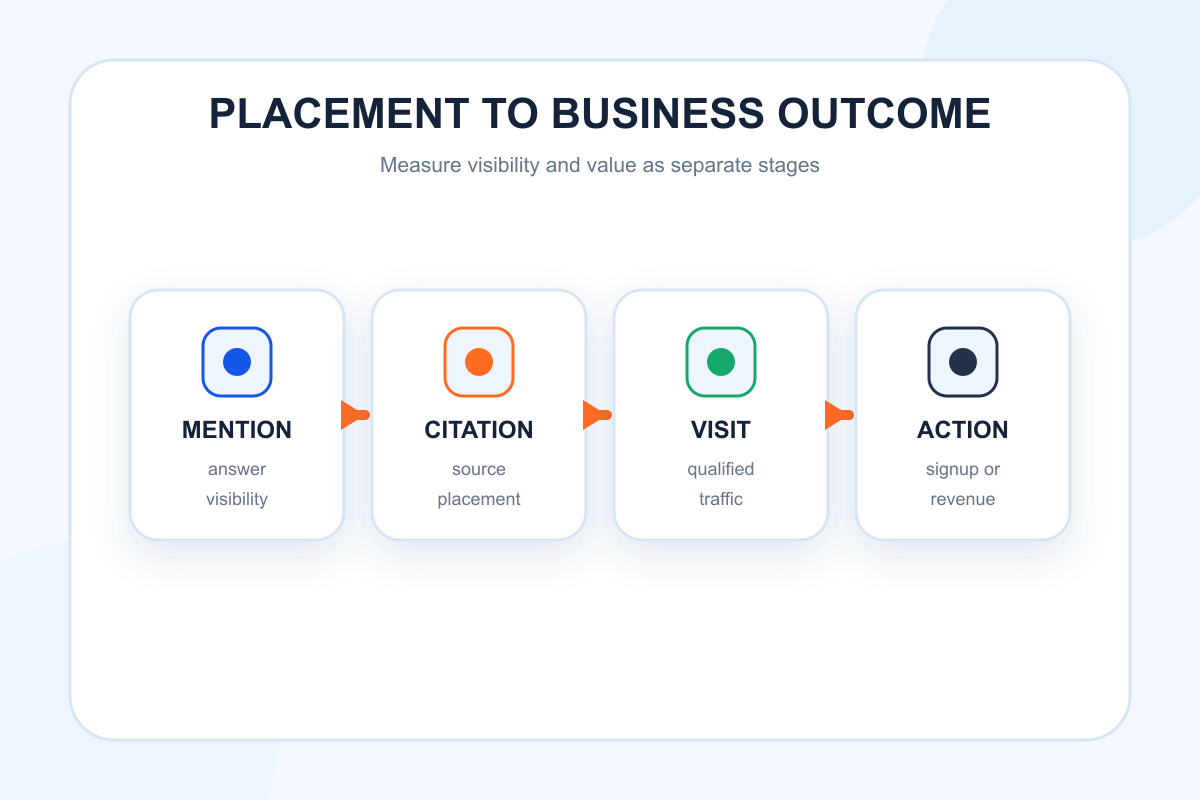
AI visibility and traffic are different outcomes. First determine whether the page or domain appears as a source for a stable set of prompts. Then determine whether that placement generates qualified visits or downstream action.
Track at least:
- Prompt-level brand mentions.
- Prompt-level source citations.
- The cited URL and passage topic.
- Placement type when observable.
- Referral sessions or landing-page visits.
- Engaged visits and relevant conversions.
Topify’s AI Search Analytics and AI Citation Analysis are designed to examine visibility and source patterns across AI answers. Pair those observations with first-party analytics. A cited page with little traffic may still influence brand recognition, while a small number of high-intent clicks may create substantial value.
Build a Practical Optimization Workflow
Choose a small set of commercially and editorially important questions. Record current answer composition and cited sources. Decompose each question into subneeds, then map the existing pages that could support them. Look for three kinds of gap: no eligible page, an eligible page with a weak passage, or a strong passage that lacks technical discoverability.
Prioritize improvements based on user value and source fit. Rewrite the answer section, strengthen evidence, improve internal linking, and repair eligibility issues. Recheck the same prompts on a consistent schedule. Avoid drawing conclusions from one query or one day because AI-generated responses can vary.
When a page begins earning citations, inspect which section appears relevant. Strengthen the surrounding experience for the reader who clicks. The landing page should deliver the promised detail quickly instead of forcing the visitor through an unrelated overview.
Conclusion
Google AI Mode inline links create more visible opportunities for publishers, but they do not replace the fundamentals of source quality. Build pages around real subneeds, write precise passages, preserve crawling and snippet eligibility, make evidence easy to verify, and measure citation separately from traffic. The winning page is not the one that imitates an AI answer. It is the one that gives the answer a credible reason to send the reader deeper.
FAQ
What are Google AI Mode inline links?
They are clickable source links placed within an AI Mode response near the statement or topic they support.
Is there special schema for earning an AI Mode inline link?
Google does not document special AI Mode citation schema. Standard Search eligibility and accurate structured data that matches visible content remain relevant.
Does an AI Mode citation guarantee referral traffic?
No. A citation creates a path to the source, but user intent, placement, wording, and page relevance affect whether a person clicks.
How should publishers measure AI Mode link performance?
Track prompt-level mentions and cited URLs, then connect observable referral traffic to engagement and business outcomes in first-party analytics.