
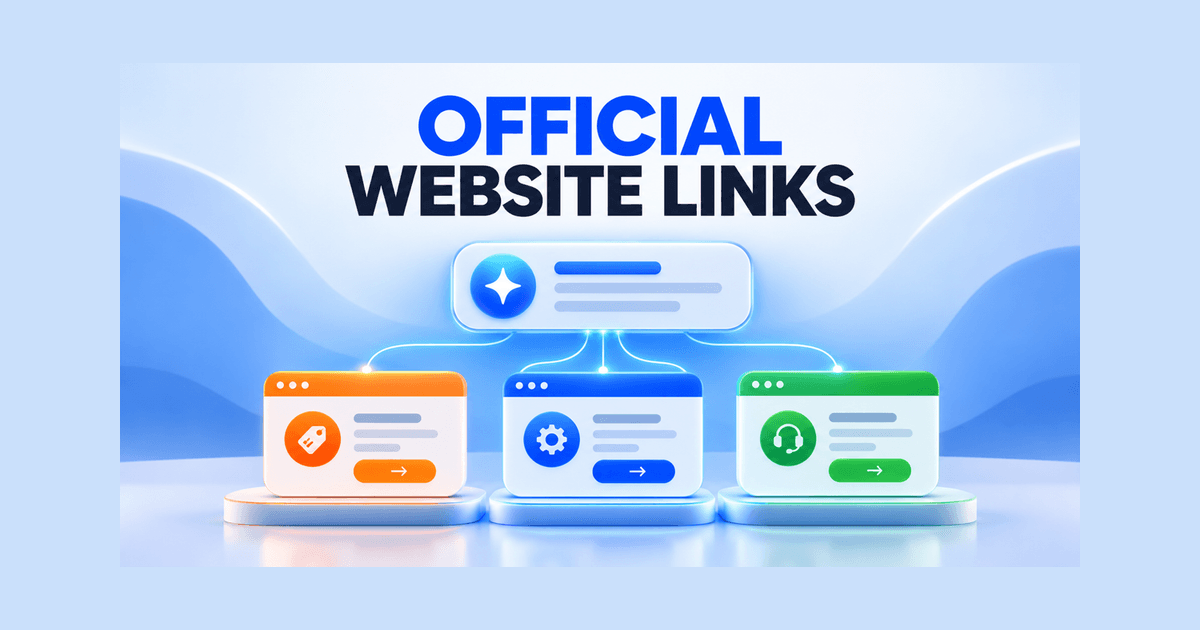
People often use AI search to reach an official action, not merely to read a summary. They want to download a product, check an eligibility rule, find a support process, compare plan details, or understand a policy from the organization responsible for it. Google said in October 2026 that it was testing dedicated official website links in AI Mode, with contextual descriptions to help users reach the right first-party destination. Brands cannot force inclusion, but they can make official pages easier to identify and more useful for exact tasks. That work begins with page purpose, ownership, internal structure, and factual maintenance.
Understand the Official-Link Opportunity
Google’s AI Search link update describes a test that places official website links in a dedicated section of some AI Mode responses. The links may include context about what the user can accomplish on each destination.
This differs from a general inline citation. An inline link may support a factual statement from any credible source. An official link is valuable when the first party controls the definitive information or action. Examples include product documentation, pricing, account access, application steps, support policies, store locators, and downloads.
Google does not provide a submission form or guaranteed markup for this placement. Its AI features documentation still points publishers to normal Search eligibility and foundational SEO. The controllable objective is to make the correct first-party URL unmistakable and useful.
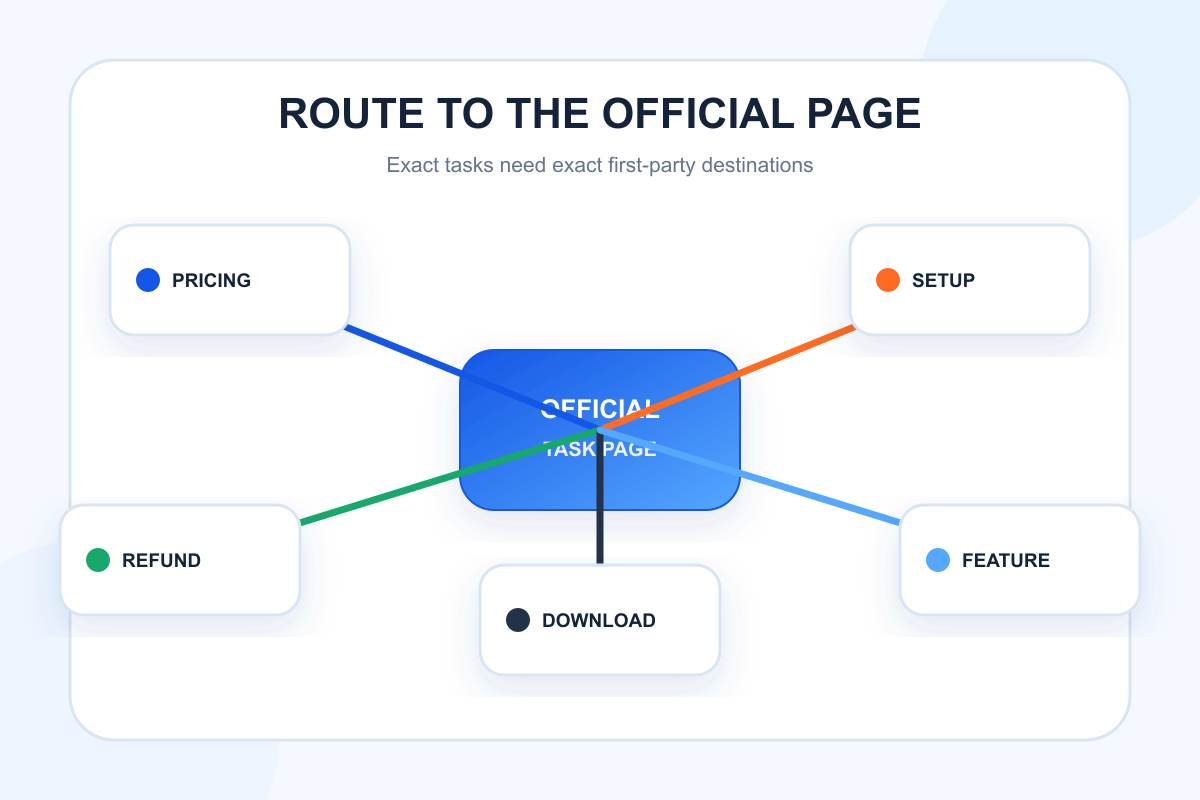
Build One Page Around One Exact Task
Many corporate sites distribute one task across several vague pages. A user searching for “cancel Acme subscription” may encounter a marketing page, a generic help center, an account portal, and an outdated support article. Even if all belong to the official domain, the best destination is unclear.
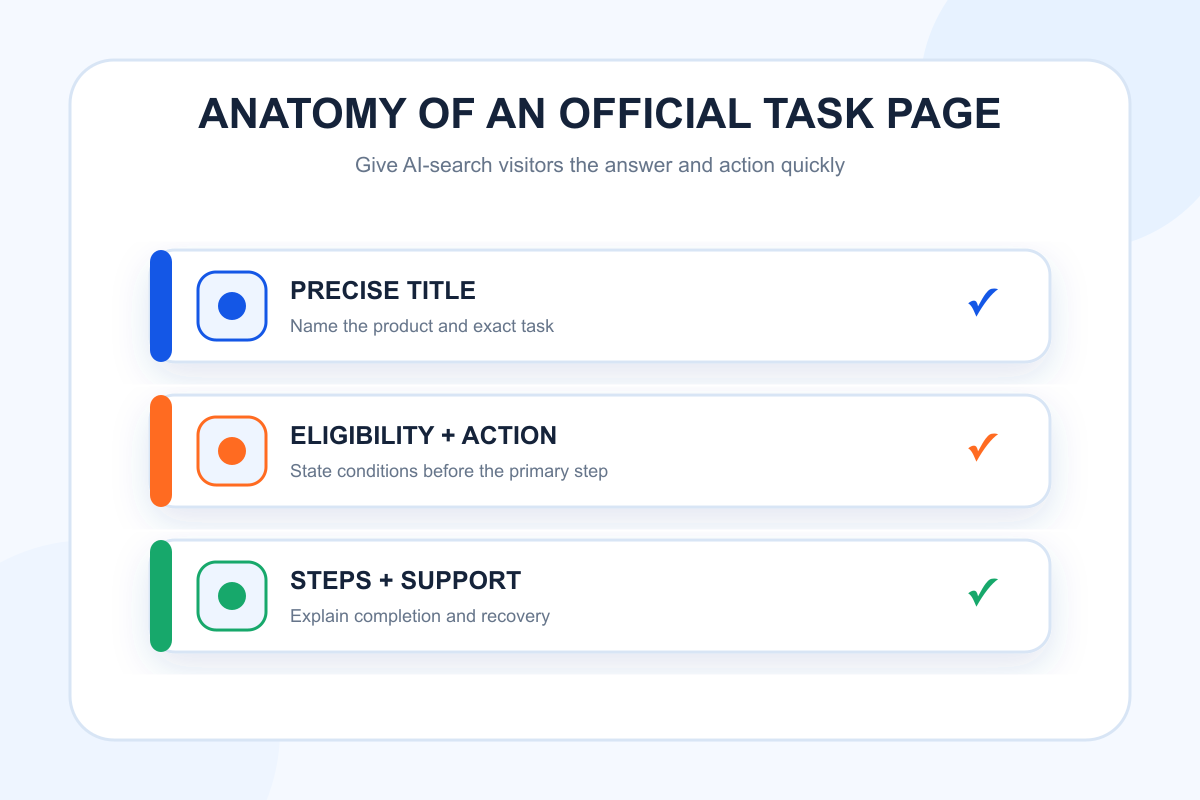
Create a canonical task page that answers the exact need. Its title, heading, introduction, and primary action should use the same nouns and verbs a user would use. State prerequisites, steps, limitations, and expected outcomes. If sign-in is required, explain what happens before redirecting the user.
| User task | Weak official destination | Strong official destination |
|---|---|---|
| Check plan price | Homepage with promotional banner | Current pricing page with plan comparison |
| Connect an integration | Generic integrations index | Setup guide for the named integration |
| Request a refund | Broad support homepage | Refund policy and request steps |
| Download software | Product overview | Versioned download page with requirements |
| Verify a feature | Old press release | Maintained feature or documentation page |
Do not create a separate thin page for every phrasing. Consolidate requests that share the same task and keep one authoritative URL current.
Make Official Ownership Explicit
The page should clearly belong to the organization responsible for the product, policy, or service. Use a consistent company and product name, secure canonical domain, accurate organization information, and links to relevant legal or support pages. Avoid microsites whose ownership is difficult to understand unless they are clearly connected to the primary brand.
Visible authorship should match the content type. A product documentation page may be owned by the company or documentation team. A research article may benefit from a named expert and methodology. A policy should identify the responsible organization and effective date.
Structured data can help describe an Organization, Product, SoftwareApplication, Article, or other eligible entity when it matches the visible page. It should not claim relationships that users cannot verify. Consistency across the page, schema, site navigation, and external profiles reduces ambiguity.
Use Context-Rich Titles and Internal Links
An exact task page should be easy to discover from the site itself. Link to it from the relevant product page, documentation hierarchy, support index, and other related tasks. Use descriptive anchor text such as “export your AI visibility report” instead of “learn more.”
The page title and H1 should identify the product and task. A heading like “Export Reports” may work inside an app, but a public page benefits from “Export a Topify AI Visibility Report.” The explicit entity helps users and systems distinguish the action from similar features on other sites.
Breadcrumbs, table-of-contents links, and clear information architecture provide additional context. Avoid orphan pages accessible only through an internal search form. If the page is essential enough to answer a public task, it should have a stable place in the public site structure.
Keep Facts and Actions Current
Official status is not useful when the page is obsolete. Assign ownership for prices, supported regions, software versions, eligibility rules, contact paths, and screenshots. Show dates when recency affects the decision, but do not update a date without reviewing the underlying content.
Create a maintenance register with the page URL, responsible team, critical facts, source system, last verified date, and next review trigger. High-impact pages such as pricing, security, legal policies, and downloads should have event-based updates in addition to scheduled reviews.
Topify’s Knowledge Freshness Checker can help teams identify potentially stale knowledge signals. The page owner must still verify the fact against the authoritative internal system before making a change.
Design the Destination for the AI Search Visitor
An AI Mode visitor may arrive after receiving a summary. The page should quickly provide the official detail or action that the answer could not complete.
Place the essential information near the top: eligibility, current value, required input, or first step. Use a clear primary action. Preserve supporting detail for users who need confidence before acting. Do not make the visitor repeat the entire discovery journey through a generic homepage.
If the action requires authentication, keep public instructions available where security permits. Explain why sign-in is necessary and where the user will land. If a task is unavailable in a region or plan, say so before the user invests effort.
Accessibility and performance matter because the official link is only helpful if the page works. Test mobile layout, keyboard navigation, form labels, error states, and slow connections. Maintain functional URLs when redesigning. If a URL must change, redirect it directly to the equivalent task rather than to the homepage.
Measure Whether Official Pages Are Reachable
Start with a set of exact tasks that matter to customers. Test branded and unbranded phrasings in AI Mode and traditional Search. Record which official URL appears, whether an unofficial or outdated page competes, and whether the destination completes the task.
Measure three layers:
- Discovery: the official page is indexed and appears for the task.
- Selection: the official page is cited or linked from the relevant answer.
- Completion: visitors successfully perform the intended action.
Use Search Console and first-party analytics where available for Search and site behavior. Use an AI visibility platform to monitor prompt-level source patterns. Topify’s AI Search Analytics can support repeatable monitoring across AI answer environments, while product analytics should measure task completion.
Do not interpret every missing official link as a page defect. The feature may not appear for every query, locale, or account, and AI responses can vary. Look for repeated patterns across a controlled prompt set.
Create an Official-Page Governance Loop
Assign each important task to a source-of-truth page and owner. Review duplicate pages, retire obsolete instructions, and redirect old URLs carefully. When product behavior changes, update documentation, support copy, structured data, and navigation together.
Collect failed site searches, support escalations, and AI prompt patterns to identify tasks that lack a strong official destination. Prioritize tasks with high user impact, legal sensitivity, or commercial value. The best governance program reduces ambiguity for customers before it improves any search surface.
Conclusion
Official website links in AI Mode reward a quality brands should already value: making the authoritative destination for a task obvious. Build one strong page per meaningful task, name the entity and action clearly, connect it through internal links, keep the facts current, and design for completion after the click. Google decides when an official section appears, but brands decide whether their first-party pages deserve to be the destination.
FAQ
What are official website links in AI Mode?
They are first-party links Google is testing in a dedicated AI Mode section to help users reach authoritative pages for relevant tasks or information.
Can a business submit a URL for this placement?
Google has not documented a special submission process for the feature. Pages still need to meet normal Search crawling, indexing, and snippet eligibility requirements.
Should every customer question get a separate page?
No. Create a separate page when the task, intent, and destination are genuinely distinct. Consolidate wording variants that lead to the same action.
How can a brand prove a page is official?
Use a consistent canonical domain, clear company and product identity, accurate organization information, coherent internal links, and visible ownership that matches the page’s purpose.