

Your team’s dashboard says you’re ranking on page one for your category’s biggest keyword. Then someone pastes a screenshot of ChatGPT recommending three competitors, and your brand isn’t one of them. Both things are true at the same time. A rank tracker and a GEO visibility checker are built to answer two different questions, and mixing them up is why so many teams feel blindsided the first time they actually look.
What a Rank Tracker Actually Answers
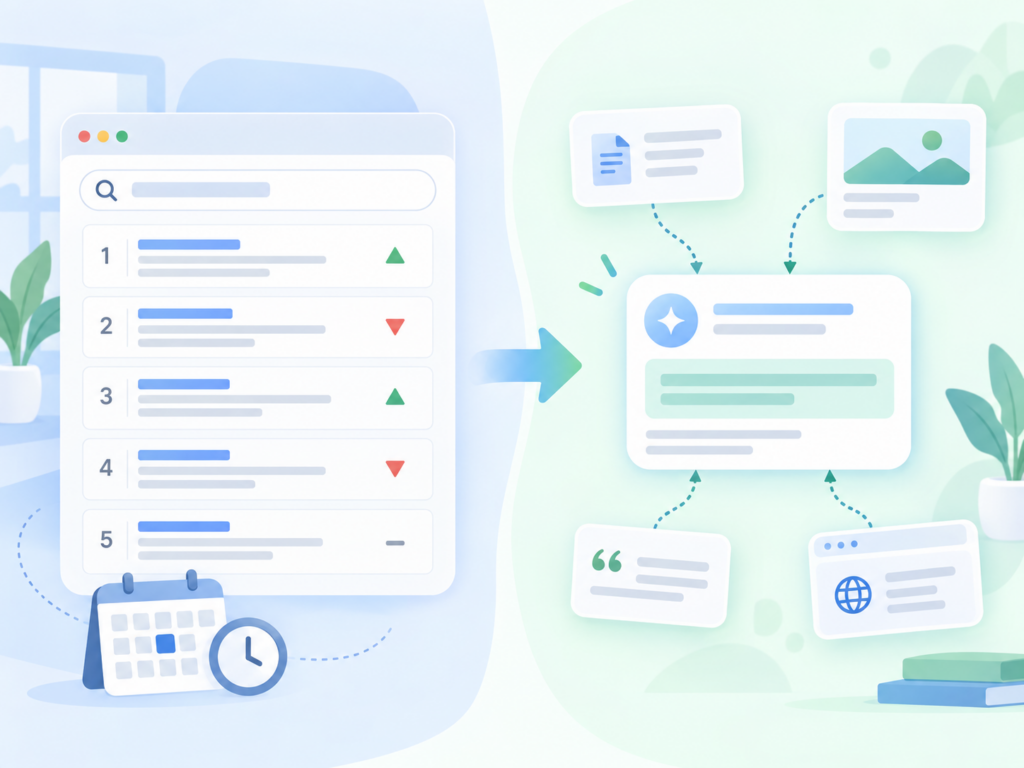
A rank tracker checks where a specific URL sits for a defined list of keywords inside Google’s organic results, refreshed daily or weekly depending on the plan. It’s built around one assumption: that a search results page is a stable, ordered list, and your job is to climb it.
That assumption answers a narrow but useful question: where do we sit on page one for the terms we’ve chosen to watch? For years, that number was a fair proxy for visibility, because ranking well and getting seen were basically the same thing.
They aren’t anymore. The overlap between what shows up in Google’s AI Overviews and what ranks in the organic top ten has dropped sharply, from roughly three-quarters down to somewhere between 17% and 54%, depending on the query set. A page one ranking no longer guarantees you show up where the answer actually gets read.
Most rank trackers were built during an era when a search results page was a fixed grid, and a single crawl a day was enough to catch any real movement. That design still works well for its original job: telling a content team whether a new page is gaining or losing ground against a defined competitor set. It just wasn’t designed to look inside an AI-generated answer, because that answer isn’t a ranked list at all.
What a GEO Visibility Checker Actually Answers
A GEO visibility checker runs a different test entirely. Instead of tracking a position, it evaluates whether a brand gets mentioned, cited, or recommended when AI platforms answer a question, looking at signals like bot accessibility, structured data, and content that AI models can parse and trust.
The question it answers is closer to: does AI bring us up at all, and how often? That’s a probabilistic outcome, not a fixed slot on a list. Repeated prompt runs on the same topic rarely return the same brand lineup in the same order, and fewer than 1 in 1,000 prompt runs produce an identical result. Rank, in the traditional sense, isn’t really the mechanism at play.
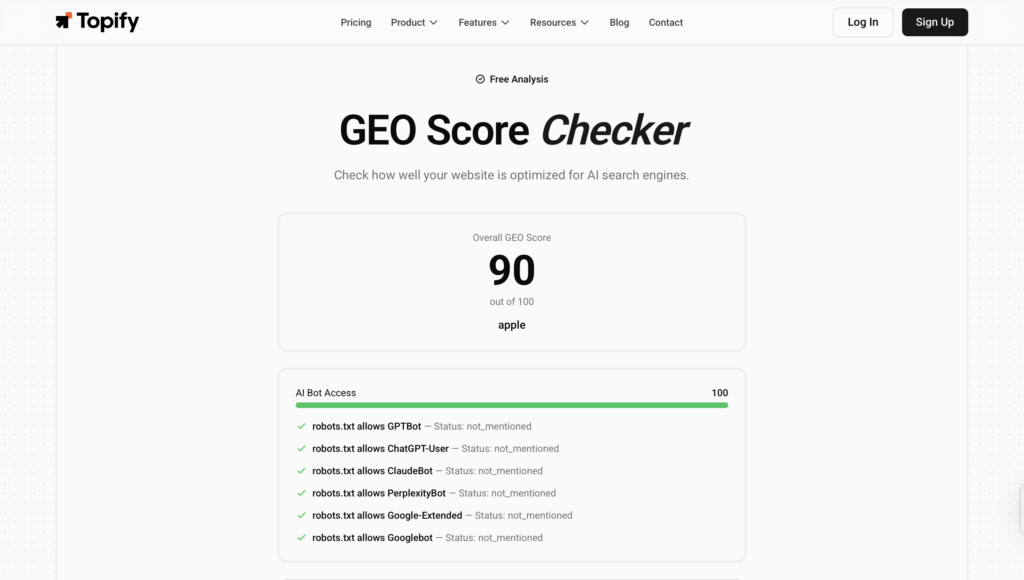
You can check where your own site currently stands using Topify’s free GEO Score Checker, which takes under a minute and needs no signup. It’s worth running before deciding whether ongoing tracking is even necessary for your brand.
The signals it’s reading are also different from a standard SEO checklist. Branded web mentions correlate far more strongly with AI Overview appearances than backlinks do, 0.664 compared with 0.218. That’s a meaningfully different set of levers than the ones most rank-tracking dashboards were ever built to show.
A GEO score typically rolls up four separate signal groups rather than one number: whether AI crawlers and bots can actually access your pages, whether structured data exists for models to parse, whether the content itself answers the kind of question an AI would be asked, and how often your brand actually turns up across a sample of AI-generated answers. A weak result in any one group can drag the whole score down, even if the other three look fine, which is exactly why a single Google ranking can’t stand in for it.
Side by Side: What Each Tool Actually Measures
The clearest way to see the difference is to put both tools next to each other.
| Rank Tracker | GEO Visibility Checker | |
|---|---|---|
| Core question | Where do we rank for this keyword? | Does AI mention or recommend us at all? |
| Data source | Google’s organic search results | ChatGPT, Perplexity, Gemini, Google AI Overviews, and similar |
| Primary metric | Position, from #1 to #100 | Visibility score, citation rate, sentiment |
| Update cadence | Daily or weekly | One-time snapshot or continuous, depending on the tool |
| What a good result means | You appear near the top of a results page | Your brand shows up inside the answer itself |
Neither column replaces the other. A brand can rank first for its category and still be absent from every AI-generated answer on the same topic, and the reverse happens too.
Why Teams End Up Needing Both
Most teams still budget for only one side of that table. Only 14% of marketers currently track AI and LLM citation visibility, even though 43% already name AI search optimization as a core priority for the year.
That gap between priority and practice is where visibility quietly leaks away.
Teams that only run a rank tracker often miss the leak entirely, because the traffic numbers can look fine while brand credit disappears underneath them. A large share of AI brand mentions are what’s known as ghost citations, links that point to your site without naming your brand, and that pattern shows up in an estimated 73% of AI citations. You get the click. You don’t get remembered as the source.
The opposite failure happens too. A team that runs one GEO check, sees a decent score, and stops there has no way to tell whether that score is improving, slipping, or getting overtaken by a competitor’s last content push. A snapshot is a fact about today. It isn’t a trend line.
Picture a mid-size SaaS brand with stable page one rankings for its core keywords and a rank tracker dashboard that’s stayed green for months. Nobody on the team has a reason to look elsewhere. Then a competitor ships a round of structured FAQ content, starts showing up in ChatGPT’s answers for the exact category the brand thought it owned, and the first sign of trouble isn’t a ranking drop at all. It’s a sales rep noticing that a prospect mentioned a competitor’s name first, on a call where the brand’s own website ranked higher in Google the whole time.
From a One-Time Score to Ongoing Tracking
Once a GEO Score Checker confirms there’s a real gap worth closing, the next question is whether the work is actually paying off week over week. A single snapshot can’t answer that, because it has no memory of what your score looked like last month.
This is the point where teams typically move from a free, point-in-time check to a dashboard that tracks visibility, sentiment, position, and citation source over time, across every major AI platform at once, rather than re-running a manual check on a recurring calendar reminder. Topify’s Comprehensive GEO Analytics is built for exactly that handoff: the same four signals the free checker samples once, monitored continuously, with alerts when a competitor starts showing up where you used to.
The upgrade tends to pay for itself fast. Visitors who arrive through an AI citation convert at roughly 14.2% compared with 2.8% for standard search traffic, which means losing that channel quietly costs more than losing an equivalent amount of organic search traffic would.
Conclusion
A rank tracker and a GEO visibility checker were never meant to compete with each other. One tells you where you stand in a list of blue links. The other tells you whether an AI system chose to mention you at all. If your team only has an answer to the first question, run a free GEO score check this week and see how the second one looks.
FAQ
Q: Is a GEO visibility checker the same thing as a rank tracker?
A: No. A rank tracker measures your position in Google’s organic results for chosen keywords. A GEO visibility checker measures whether AI platforms mention, cite, or recommend your brand when answering a related question, which is a separate signal entirely.
Q: Can I just use my existing rank tracker to cover AI search too?
A: Not fully. Some rank tracking platforms have added AI monitoring modules, but the underlying data source and metric are different from organic rank data, so a standalone GEO check still catches gaps a rank tracker’s dashboard won’t surface.
Q: How often should I check my GEO visibility score?
A: A one-time check is a useful starting point, but AI answers shift as models update and competitors publish new content. Teams that treat AI visibility as a real channel typically move to continuous tracking rather than checking manually once and moving on.
Q: What does a GEO visibility checker actually measure?
A: It typically evaluates a mix of signals, including whether AI crawlers can access and parse your site, whether your content includes structured data AI models can read, and how often your brand appears across sampled AI-generated answers.

