


A traveler opens ChatGPT and types: “Best boutique hotels in Barcelona near the metro with rooftop terrace.” The model responds in seconds with five specific recommendations, complete with neighborhood context and price ranges. Your property checks every box. It doesn’t appear.
This isn’t a review problem or a pricing problem. It’s a visibility problem at the technical layer where AI decides which brands exist and which ones don’t. Topify’s research across hospitality brands consistently shows that the gap between a hotel’s actual guest experience and its AI discoverability is wider than in almost any other industry. A property with thousands of five-star reviews can score below 30 on AI readiness simply because the signals AI models need to find it were never configured.
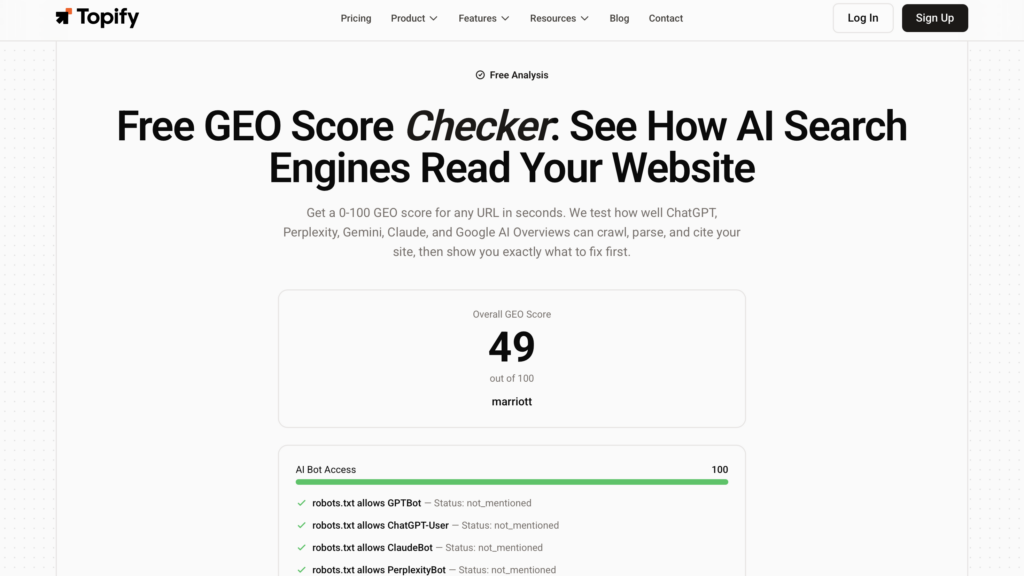
The GEO Score Checker measures exactly where those signal failures happen, across four dimensions that determine whether AI trip planners can see, understand, trust, and recommend your property.
✅ Free ⚡ Results in 60 seconds 🔒 No signup required
GEO Score Checker
The Four Numbers That Tell You Why AI Skips Your Hotel
AI trip planners don’t browse your website the way a guest does. They parse technical signals, structured data, authority markers, and cross-platform citation patterns. The GEO Score Checker translates those signals into four scores, each tied to a specific layer of AI discoverability.
| Score Dimension | What It Measures | Travel & Hospitality Impact |
|---|---|---|
| Bot Access | Whether AI crawlers can reach your website | Hotels using pre-2020 robots.txt templates often block GPTBot and ClaudeBot without knowing it, making the property invisible to ChatGPT and Claude trip planning |
| Structured Data | Whether AI can parse your property attributes | Without Hotel-specific schema (room types, amenities, star rating, geo coordinates), AI can’t match your property to queries like “family-friendly hotel near Central Park with pool” |
| Content Signals | Whether AI considers your content authoritative | Guest reviews, editorial mentions in travel publications, and destination guide citations build the trust signals AI models weigh before recommending a property |
| Visibility Score | How often your brand appears across AI platforms | A hotel might surface in Perplexity but be absent from ChatGPT and Gemini, creating a fragmented presence that undercuts booking potential |
Here’s how each dimension plays out in real hospitality scenarios.
Your Website Says “No Guests Allowed” to AI Crawlers
A four-star resort in Bali runs a modern, visually rich website built on a JavaScript-heavy framework. The site loads beautifully for human visitors. But the robots.txt file, copied from a developer template years ago, blocks GPTBot, ClaudeBot, and PerplexityBot. When a traveler asks any AI assistant for Bali resort recommendations, this property simply doesn’t exist in the answer pool.
A low Bot Access score in hospitality often traces back to this exact scenario. The fix is straightforward, but you can’t fix what you don’t measure.
AI Can’t Tell a Boutique Hotel from a Bed-and-Breakfast
Many hotel websites implement only generic LocalBusiness schema rather than the specific Hotel or LodgingBusiness type. That means AI models can see a business name and address but can’t parse room types, amenity lists, star ratings, check-in times, or price ranges. When a traveler asks for “a quiet hotel in Kyoto with onsen and garden view under $300,” the model needs structured property data to make that match. Hotels without it get skipped in favor of those whose schema speaks the model’s language.
A Structured Data score below 40 typically means the property’s website is treating AI the way a brochure treats a reader: lots of atmosphere, very little parseable fact.
Strong Reviews, Weak Authority Signals
A boutique hotel in Lisbon has 2,000 reviews averaging 4.8 stars on Google. But its website contains no FAQ content, no destination guides, no editorial coverage mentions, and no third-party citations beyond OTA listings. The Content Signals score reflects this gap. AI models don’t just count reviews. They look for corroborating evidence across independent sources: travel blog mentions, media features, destination authority content, and structured FAQ responses that match how travelers actually phrase questions.
One feature in a respected travel publication creates more AI visibility signal than dozens of website updates.
Run a Check in 60 Seconds
- Go to the GEO Score Checker
- Enter your hotel brand name or domain
- Get four dimension scores in under a minute
- Compare dimensions to identify your weakest signal layer
The score tells you where AI trip planners lose sight of your property and which layer needs attention first.
What Travelers Actually Ask AI Before They Book
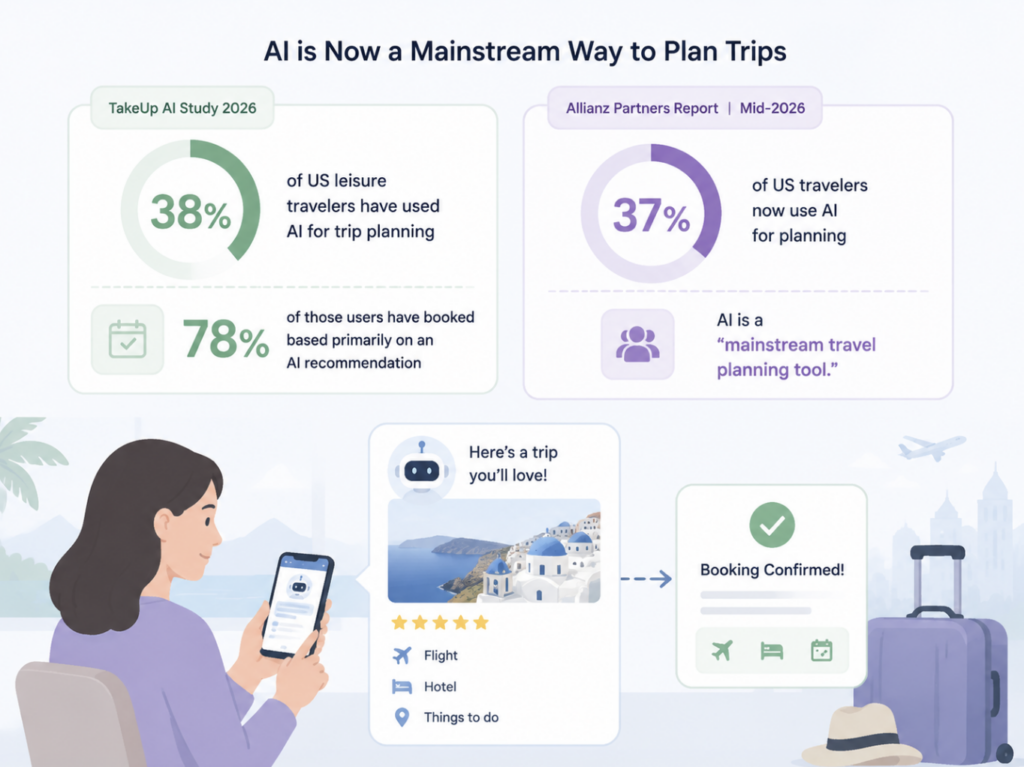
The shift in traveler behavior is measurable. A 2026 TakeUp AI study found that 38% of surveyed US leisure travelers have used AI for trip planning, and 78% of those users have booked based primarily on an AI recommendation. Allianz Partners reported in mid-2026 that 37% of US travelers now use AI for planning, calling it a “mainstream travel planning tool.”
These travelers aren’t typing keywords. They’re describing experiences.
| AI Prompt Example | Platform | Search Intent | What It Reveals |
|---|---|---|---|
| “Plan a 5-day family trip to Orlando with hotel near theme parks under $200/night” | ChatGPT | Full itinerary with budget-constrained lodging | AI must match property attributes (location, price, family amenities) from structured data |
| “Best luxury resorts in the Maldives with overwater villas and all-inclusive packages” | Perplexity | High-end comparison shopping | AI pulls from editorial sources, schema-enriched property pages, and review aggregators |
| “Recommend a quiet hotel in Tokyo for a solo business traveler near Shinjuku station” | Gemini | Hyper-local, persona-specific match | Without geo coordinates and amenity-level schema, properties outside the AI’s data set get excluded |
| “Where should I stay in Lisbon for a romantic anniversary weekend?” | ChatGPT | Experience-driven, emotionally framed | AI leans on editorial coverage, curated lists, and sentiment-rich review data to generate recommendations |
| “Compare boutique hotels vs Airbnb in Tulum for a group of 6” | Perplexity | Format comparison with group sizing | Hotels without clear occupancy data and group-friendly amenity schema lose to vacation rental platforms with better structured listings |
The pattern across these prompts is consistent. Travelers give AI a complex, multi-attribute query. The model assembles an answer from whichever brands have the structured, authoritative, crawlable data to fill it. Brands that don’t surface in these answers lose the booking opportunity before the traveler even knows they exist.
Three GEO Blind Spots That Cost Hotels Direct Bookings
Blind Spot 1: The Robots.txt Time Capsule
OpenAI operates three separate crawlers: GPTBot (training data), OAI-SearchBot (real-time ChatGPT search), and ChatGPT-User (user-initiated browsing). Anthropic runs ClaudeBot and Claude-SearchBot. Perplexity has PerplexityBot. Google uses Google-Extended for Gemini training, and Googlebot itself feeds AI Overviews.
Most hotel websites were last audited for crawler access before any of these bots existed. A RevPARGenius study found that 94.3% of hotel websites are invisible to AI search. A significant portion of those have robots.txt files that inadvertently block AI crawlers, sometimes because a developer template from 2018 disallowed everything except Googlebot and Bingbot.
Blocking real-time retrieval crawlers is, in 2026, self-imposed invisibility.
Blind Spot 2: Schema That Stops at the Lobby
AI models process hotel data through a hierarchy: Thing > Place > LocalBusiness > LodgingBusiness > Hotel. Each level adds specificity. A property marked only as LocalBusiness gives AI a name and an address. A property marked as Hotel with full schema gives AI room types, amenity arrays, star ratings, check-in/check-out times, price ranges, aggregate ratings, and geo coordinates.
Research from the hospitality GEO space shows that 79% of hotel links in Google AI Mode point to Google Business Profile, and GBP data is directly enriched by Schema.org markup from hotel websites. Hotels with incomplete schema have weaker entity signals and get bypassed by AI models assembling travel recommendations.
The gap between LocalBusiness and Hotel schema is the gap between being a pin on a map and being a bookable recommendation.
Blind Spot 3: The OTA Proxy Problem
Here’s the paradox. Hotels invest heavily in OTA listings: Booking.com, Expedia, TripAdvisor. Those OTAs implement rich structured data at scale. AI models love that data. But when Lighthouse’s 2026 study showed that AI has become a primary channel for hotel discovery, it also revealed a distribution shift. Booking.com and Expedia are already embedded in ChatGPT’s app ecosystem. Radisson and Motel 6 launched dedicated ChatGPT apps in July 2026.
For hotels without their own AI-ready infrastructure, the OTA becomes the proxy. AI recommends the property, but routes the booking through the OTA. The hotel pays commission on a guest it should have captured directly. The brand gets mentioned, but the direct booking link never appears.
A strong Visibility Score on the GEO Score Checker doesn’t just mean your brand name shows up in AI answers. It means the AI links to your domain, not an intermediary’s.
Where Low Scores Typically Trace Back
| Hospitality Scenario | GEO Score Signal | Common Root Cause | Action Direction |
|---|---|---|---|
| Property never appears in ChatGPT travel queries | Bot Access: below 30 | robots.txt blocks GPTBot, OAI-SearchBot, or Bingbot (ChatGPT’s search substrate) | Audit and update crawler permissions |
| AI recommends competitors with fewer reviews | Structured Data: below 40 | Website uses LocalBusiness schema instead of Hotel; missing amenity, room, and rating markup | Implement full Hotel schema with JSON-LD |
| Brand appears on Perplexity but not ChatGPT or Gemini | Visibility Score: uneven across platforms | Inconsistent entity data across Google Business Profile, OTA listings, and website | Align NAP data and brand entity across all surfaces |
| AI links to OTA listing instead of hotel website | Content Signals: below 50 | Hotel website lacks FAQ content, destination guides, and editorial mentions that build direct-link authority | Publish authoritative, crawlable content on the hotel domain |
From a One-Time Score to Continuous GEO Monitoring
A GEO Score Checker result tells you where your hotel stands right now. But AI visibility in travel isn’t static. Models update their training data, new competitors launch schema-optimized websites, OTA algorithms shift, and seasonal travel patterns change which prompts travelers use. A property that scores well in January might drop by summer if a competitor publishes a better-structured destination guide or earns a feature in a major travel publication.
That’s where the snapshot ends and continuous tracking begins.
| Capability | Free GEO Score Checker | Topify Platform |
|---|---|---|
| Check frequency | One-time snapshot | Continuous monitoring |
| Dimensions tracked | 4 GEO scores | Full GEO analytics + sentiment + citations |
| Historical trends | None | Full trend history with alerts |
| Competitor benchmarking | Not included | Real-time competitor tracking |
| Platform breakdown | Aggregated | Per-platform (ChatGPT, Perplexity, Gemini, AI Overviews) |
| Optimization actions | Directional guidance | Specific, prioritized execution steps |
Comprehensive GEO Analytics tracks all four GEO dimensions over time, across every major AI platform, with competitor benchmarking and actionable optimization priorities. For hospitality brands managing visibility across multiple properties or destinations, the platform turns a one-time diagnosis into ongoing competitive intelligence.
You can start a free trial with no credit card required, or review pricing to find the tier that fits your portfolio.
Conclusion
AI trip planning has moved from novelty to mainstream. Nearly four in ten US travelers now start with an AI assistant, and the majority of those who do book based on what the AI recommends. The hotels that appear in those answers aren’t necessarily the best properties. They’re the ones whose technical signals, structured data, content authority, and cross-platform visibility are configured for AI discoverability.
Start with a baseline. Run your property through the GEO Score Checker and see which of the four dimensions is holding you back. From there, you can fix crawler access issues with Topify’s AI Robots Checker, verify whether AI models have current information about your brand using the Knowledge Freshness Checker, and get a cross-platform snapshot with the AI Visibility Report.
Frequently Asked Questions
Why does my hotel have thousands of great reviews but still score low on the GEO Score Checker?
Reviews contribute to Content Signals, but they’re only one input. AI models also weigh structured schema markup, crawler accessibility, editorial third-party mentions, and entity consistency across platforms. A property with excellent reviews but blocked AI crawlers or missing Hotel schema will score low because the model can’t access or parse the evidence it needs to recommend you.
Can OTA listings substitute for optimizing my own hotel website for AI visibility?
OTA listings help, but they create a dependency. AI models often pull structured data from OTAs and link to the OTA booking page rather than your direct site. That means you pay commission on bookings AI could have sent directly. Optimizing your own domain with proper Hotel schema, open crawler access, and authoritative content builds direct-link equity that OTAs can’t replace.
How is GEO different from traditional hotel SEO?
Traditional SEO optimizes for keyword rankings on Google’s search results page. GEO optimizes for inclusion in AI-generated answers across ChatGPT, Perplexity, Gemini, and Google AI Overviews. The ranking factors overlap (structured data, authority signals) but GEO adds crawler permissions for AI bots, cross-platform visibility tracking, and content structured for conversational query matching. The GEO Score Checker measures these AI-specific dimensions directly.
Do large hotel chains have an inherent advantage in AI visibility over independent properties?
Chains benefit from higher baseline brand recognition in AI training data, but the technical signals that drive real-time AI recommendations are property-level: schema markup, crawler access, review sentiment, and local editorial mentions. An independent hotel with properly implemented Hotel schema and strong destination authority content can outperform a chain property that relies solely on brand recognition without maintaining its technical AI infrastructure.
Read More:

