

A shopper opens ChatGPT and types: “best wireless earbuds under $100 for working out.” Three brands come back. Yours isn’t one of them. Your product has 4.7 stars, competitive pricing, and a page-one Google ranking. None of that mattered. The AI built its recommendation list from a completely different set of signals, and your store didn’t send the right ones.
This isn’t a product problem. It’s a GEO problem: your website’s technical signals aren’t structured for how AI systems discover and recommend products. The GEO Score Checker measures exactly where that breakdown happens, scoring your site across four dimensions that determine whether AI shopping assistants include you or skip you.
✅ Free ⚡ Results in 60 seconds 🔒 No signup required
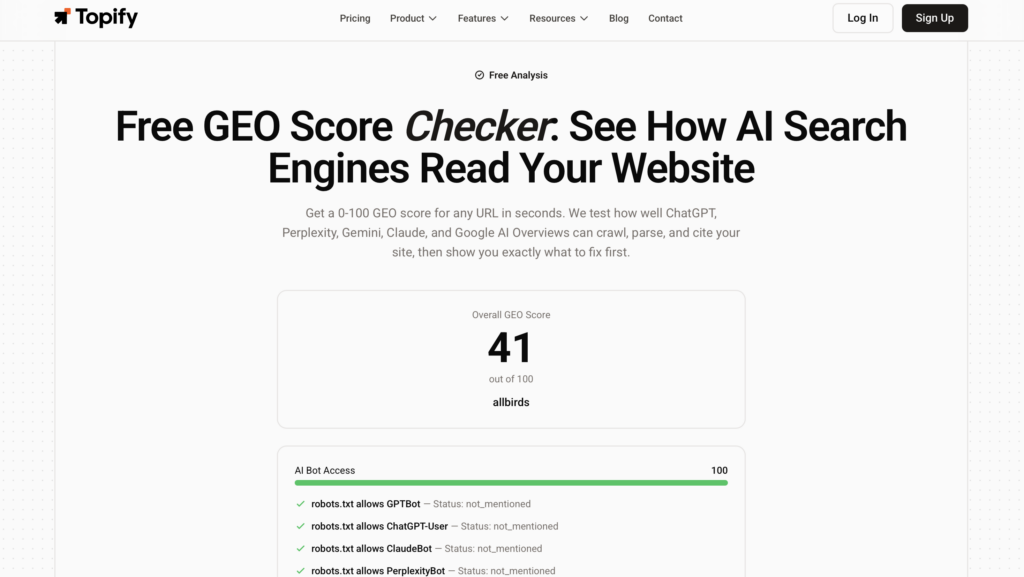
GEO Score Checker
The Four Numbers That Decide Whether AI Recommends Your Products
AI shopping platforms don’t browse your store the way a human does. They evaluate four distinct signal layers before deciding whether to surface your brand in a recommendation. The GEO Score Checker translates those layers into scores you can act on.
| Score Dimension | What It Measures | Retail / E-Commerce Impact |
|---|---|---|
| Bot Access | Whether AI crawlers can reach your product pages | If GPTBot or PerplexityBot is blocked in your robots.txt, your entire catalog is invisible to ChatGPT Shopping and Perplexity Buy |
| Structured Data | Whether AI can parse your product attributes | Incomplete Product schema (missing GTIN, return policy, shipping details) means AI can’t confidently compare your products against competitors |
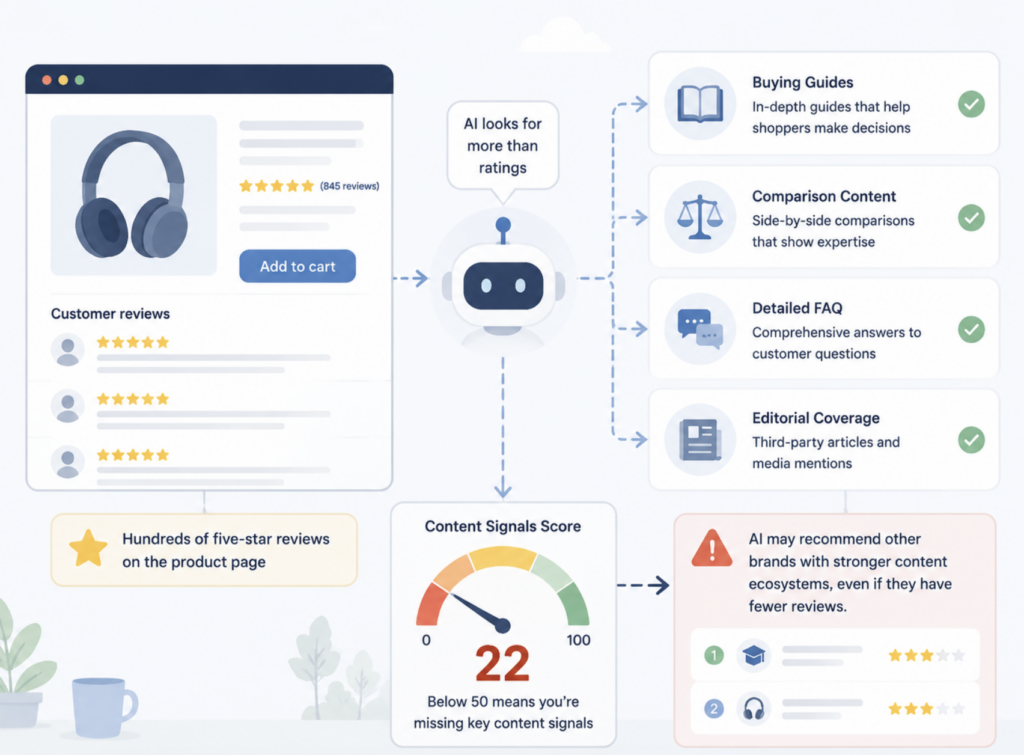
| Content Signals | Whether AI considers your content authoritative | Thin product descriptions, missing buying guides, and absent FAQ content reduce your authority score for purchase-intent queries |
| Visibility Score | How often your brand appears in AI answers | Measures actual presence across ChatGPT, Perplexity, Gemini, and Google AI Overviews for relevant shopping queries |
Each dimension scores 0-100. A score below 40 in any single dimension typically means AI platforms will skip your products for that category of shopping query entirely.
When AI Crawlers Can’t Reach Your Product Pages
A mid-size apparel brand ranks in Google’s top three for “best linen shirts for summer.” But their Shopify theme’s default robots.txt blocks OAI-SearchBot. Result: zero presence in ChatGPT Shopping, regardless of how strong their SEO is. The Bot Access score catches this instantly.
For e-commerce stores, blocking an AI crawler isn’t a minor technical issue. It’s a binary switch. Either your product pages are in the AI’s index, or they don’t exist.
When Your Product Data Doesn’t Speak AI’s Language
AI shopping assistants don’t just read your product title and price. They parse structured data fields: brand object, GTIN, availability status, return policy, shipping details, aggregate ratings. Research from 2026 shows that 65% of pages cited by AI systems include structured data, and AI parsing success drops from 94% to 23% when schema is rendered through client-side JavaScript instead of static HTML.
Most e-commerce platforms ship with incomplete Product schema out of the box. The Structured Data score flags exactly which fields are missing or misconfigured.
When Strong Reviews Don’t Translate to AI Authority
Your product page has hundreds of five-star reviews. But AI systems weigh more than just aggregate ratings. They look for buying guides, comparison content, detailed FAQ sections, and editorial coverage that positions your brand as an authority in its category. A Content Signals score below 50 often means your store relies on product pages alone, without the surrounding content ecosystem that AI uses to validate recommendations.
Your product page has hundreds of five-star reviews. But AI systems weigh more than just aggregate ratings. They look for buying guides, comparison content, detailed FAQ sections, and editorial coverage that positions your brand as an authority in its category. A Content Signals score below 50 often means your store relies on product pages alone, without the surrounding content ecosystem that AI uses to validate recommendations.
Here’s how to run your check:
- Go to the GEO Score Checker
- Enter your brand name or domain
- Get your four-dimension score breakdown in 60 seconds
- Identify your weakest dimension and prioritize fixes there first
What Shoppers Ask AI Before They Add to Cart
The way consumers research products has fundamentally shifted. Recent data from MarTech shows that 46% of AI users now start purchase research on a standalone AI platform, up from 25% in 2024. Traditional search as a starting point dropped from 43% to 24% over the same period.
That shift means your brand’s consideration set is being formed inside AI conversations, not on search results pages.
| AI Prompt Example | Platform | Search Intent | What It Reveals |
|---|---|---|---|
| “Best running shoes for flat feet under $150” | ChatGPT | Product comparison with constraints | AI builds a shortlist of 3-5 brands. Missing brands lose the sale before any website visit. |
| “Compare Dyson V15 vs Shark Stratos for pet hair” | Perplexity | Head-to-head evaluation | AI cites product specs from structured data. Incomplete schema means your product gets a weaker comparison card. |
| “What’s the best moisturizer for sensitive skin” | Gemini | Category discovery | AI pulls from buying guides and editorial reviews. Brands without supporting content get skipped. |
| “Affordable standing desk with good reviews” | ChatGPT | Budget-conscious purchase | AI filters by price, ratings, and availability. Missing Offer schema fields disqualify products from the recommendation. |
| “Is the Stanley tumbler worth it or are there better alternatives” | Perplexity | Brand-specific alternative search | AI compares your product against a named competitor. Low Visibility Score means you won’t show up as the alternative. |
These aren’t hypothetical queries. Product.ai’s 2026 Trust in AI Commerce Report found that 43% of U.S. online shoppers used AI for product research in the past 90 days.
The brands that AI recommends in these conversations capture buyers before a single ad impression runs. The brands it skips never entered the consideration set.
Three Blind Spots That Cost E-Commerce Brands AI Shelf Space
Retail brands often assume that strong Google rankings translate to AI visibility. They don’t. AI shopping assistants evaluate products through a different lens, and three specific technical gaps account for most of the missed recommendations.
Incomplete Product Schema Erodes AI Confidence
AI shopping platforms need structured data fields that most e-commerce stores don’t provide. Name, image, and price aren’t enough anymore. In 2026, AI systems expect a complete Product schema including brand as a nested object, GTIN or MPN, availability with exact ISO values, return policy, shipping details, and aggregate ratings with review counts.
When fields are missing, AI doesn’t display an error. It just recommends a competitor whose data is complete. Your Structured Data score quantifies this gap.
Platform Fragmentation Creates Invisible Revenue Leaks
A home goods brand might appear consistently in Perplexity Shopping results but be completely absent from ChatGPT’s product recommendations. Each AI platform uses different data sources, different ranking logic, and different merchant integrations. ChatGPT surfaces products through Shopify Catalog integration. Perplexity pulls from web content with visible citations. Google AI Overviews favor pages with strong domain authority and existing top-five rankings.
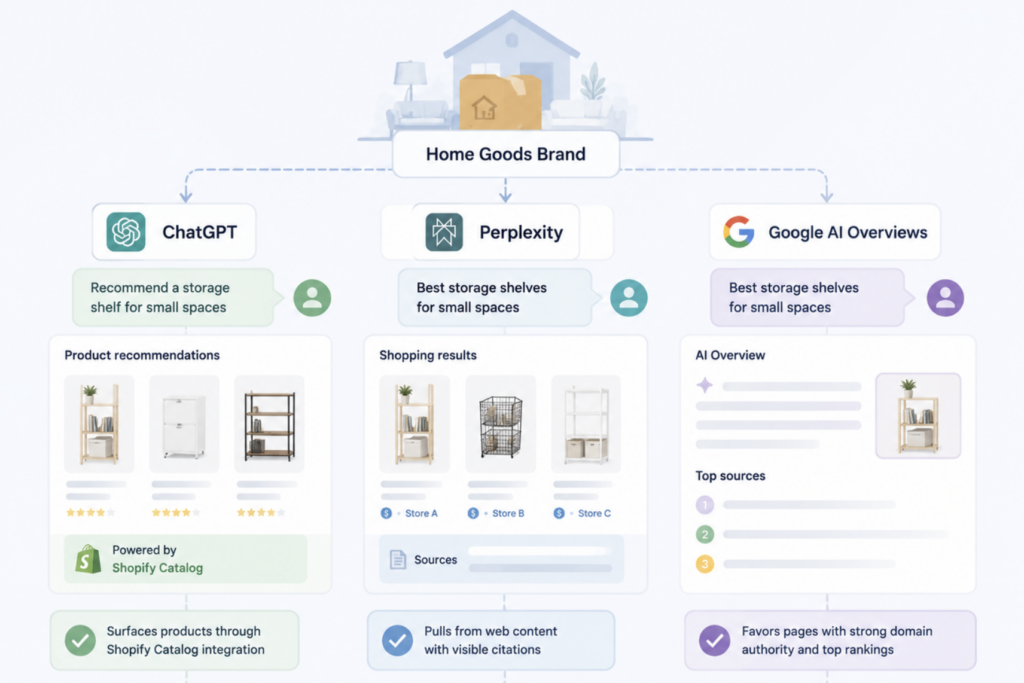
Being visible on one platform doesn’t mean you’re visible on all of them. And since AI-referred shoppers convert at rates 4-5x higher than traditional organic visitors, each platform gap represents a measurable revenue loss.
JavaScript-Rendered Schema Is Invisible to AI Crawlers
Here’s the thing: AI crawlers don’t execute JavaScript. If your product schema loads through client-side rendering, AI systems never parse it. Static HTML with server-side rendered JSON-LD achieves a 94% AI parsing success rate. JavaScript-rendered schema drops to 23%. For e-commerce brands running headless storefronts or heavy client-side frameworks, this single technical issue can make an entire product catalog invisible to AI discovery.
The Bot Access and Structured Data dimensions of your GEO score together reveal whether this is happening to your store.
From a One-Time Score to Continuous AI Shelf Monitoring
Running the GEO Score Checker gives you a clear snapshot of where your store stands right now. But AI shopping algorithms update continuously. Your competitors are optimizing their schema, publishing buying guides, and unblocking AI crawlers. A score from today doesn’t tell you whether you’re gaining or losing ground next month.
That’s where Topify’s platform picks up. Comprehensive GEO Analytics tracks all four GEO dimensions over time, across every major AI shopping platform.
| Capability | Free GEO Score Checker | Topify Platform |
|---|---|---|
| Check frequency | One-time snapshot | Continuous monitoring |
| Dimensions tracked | 4 GEO scores | Full GEO analytics + sentiment + citations |
| Historical trends | None | Full trend history with alerts |
| Competitor benchmarking | Not included | Real-time competitor tracking |
| Platform breakdown | Aggregated | Per-platform (ChatGPT, Perplexity, Gemini, AI Overviews) |
| Optimization actions | Directional guidance | Specific, prioritized execution steps |
A single score tells you where you stand. Continuous monitoring tells you which direction you’re moving, and whether your competitors are pulling ahead.
You can start a free trial with no credit card required, or check pricing to find the plan that fits your catalog size.
Conclusion
AI shopping assistants are forming consumer shortlists before your website gets a single visit. If your product pages can’t be crawled, your schema can’t be parsed, or your content doesn’t signal authority, you won’t make the list. That’s not a branding failure. It’s a technical signal gap you can measure and fix.
Start with your GEO Score Checker results. Find your weakest dimension. Fix the technical foundation first (bot access, structured data), then build the content signals that earn AI trust.
For deeper diagnostics, the AI Robots Checker helps you audit exactly which AI crawlers your robots.txt is blocking, and the Knowledge Freshness Checker shows whether AI models are working with outdated information about your brand. If you want a cross-platform snapshot before committing to ongoing monitoring, the AI Visibility Report gives you a quick read on where your brand currently appears.
Frequently Asked Questions
Why does my product rank on Google but not appear in AI shopping recommendations?
Google rankings are based on backlinks, domain authority, and keyword relevance. AI shopping assistants use a different signal set: structured product schema, AI crawler access, content authority, and cross-platform citation patterns. A page-one Google ranking doesn’t automatically translate to AI visibility. The GEO Score Checker measures the four dimensions AI actually evaluates.
What’s the most common reason e-commerce brands score low on GEO?
Incomplete Product schema is the single most frequent issue. Most e-commerce platforms ship with basic schema that covers name, image, and price, but omits fields AI systems now expect: GTIN, return policy, shipping details, and properly nested brand objects. Fixing schema alone often produces the fastest improvement in AI recommendation rates.
Does GEO replace SEO for online stores?
No. GEO and SEO target different discovery channels, and both drive revenue. SEO earns organic Google rankings. GEO earns inclusion in AI-generated product recommendations on ChatGPT, Perplexity, Gemini, and Google AI Overviews. Strong SEO builds the domain authority that supports GEO, so the two reinforce each other.
How often should I check my e-commerce GEO score?
Run the free checker after any major site change: platform migration, theme update, robots.txt edit, or schema overhaul. For ongoing tracking across product launches and seasonal campaigns, Comprehensive GEO Analytics provides continuous monitoring with alerts when scores shift.
Read More:

