

A CHRO at a 2,000-person financial services firm opens ChatGPT and types: “What are the best mid-market HR outsourcing providers for compliance-heavy industries?” Within seconds, she gets a shortlist of three vendors with reasoning attached. Your brand isn’t one of them.
You have the case studies. You have the compliance documentation. You have a thought leadership library that took years to build. But AI didn’t read any of it — not because the content wasn’t good, but because the technical signals that tell AI platforms “this source is authoritative” were never there.
That’s the gap the GEO Score Checker was built to surface.
✅ Free ⚡ Results in 60 seconds 🔒 No signup required
GEO Score Checker
HR Buyers Ask AI First. Your Brand Isn’t Always in the Answer.
The vendor discovery process in HR tech has shifted faster than most marketing teams realize. According to Forrester’s 2026 Buyers’ Journey Survey, the proportion of buyers using AI in their purchase process reached 94% in 2026, and generative AI ranked as the top research source — ahead of vendor websites, peer referrals, and product experts.
HR and HRO buyers aren’t an exception. CHROs, HR Operations leads, and Procurement Managers are typing specific, high-intent questions into ChatGPT, Perplexity, and Gemini before they ever visit a vendor’s website. By the time a buyer fills out a contact form, an AI-assembled shortlist has already filtered the consideration set.
If your HR tech brand isn’t visible in those AI-generated answers, you’re not in the room before the conversation starts.
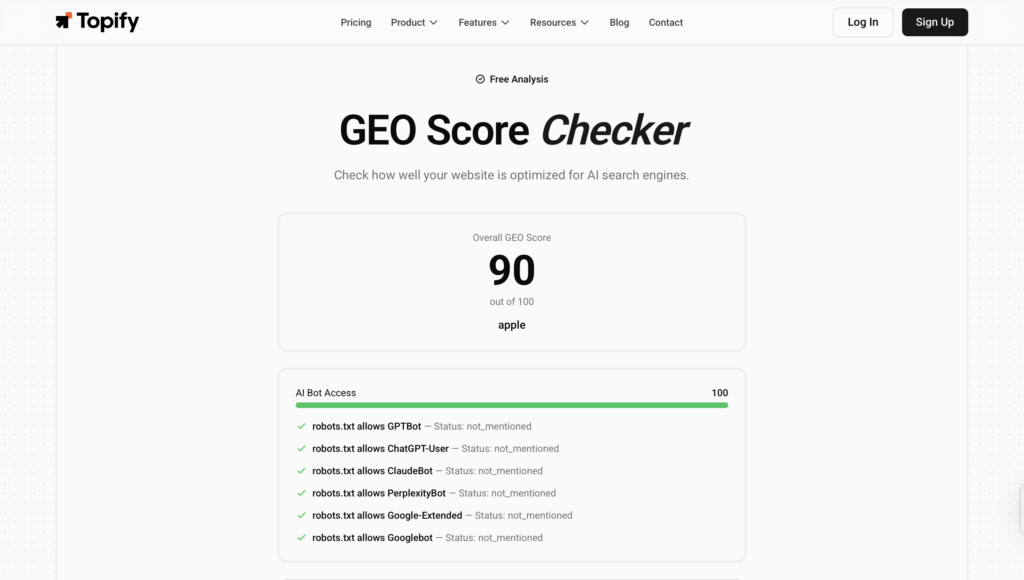
The painful part: most HR tech and HRO providers have no idea where they stand. They’ve never measured their AI visibility with any precision. The GEO Score Checker changes that in 60 seconds — giving you a 0-100 composite score built from four dimensions that directly predict whether AI platforms recommend you or skip you.
The Four GEO Scores That Reveal Your HR Tech Brand’s AI Blind Spots
The checker evaluates your site across four dimensions. Each one maps directly to a failure mode that’s common in HR tech content.
| Score Dimension | What It Measures | HR Tech / HRO Impact |
|---|---|---|
| Bot Access | Can AI crawlers (GPTBot, ClaudeBot, PerplexityBot) actually access your site? | Compliance microsites, gated resource hubs, and subdomain structures commonly block AI bots while passing standard SEO audits |
| Structured Data | Does your content have Schema markup and JSON-LD that tells AI what it means? | HR tech product pages and service descriptions often lack Service, FAQPage, and Organization schema — so AI can’t interpret your offering |
| Content Signals | Does AI treat your content as authoritative? | Deep compliance guides and white papers signal expertise to humans but often aren’t formatted for semantic AI indexing |
| Visibility Score | How often does your brand appear across ChatGPT, Perplexity, Gemini, and AI Overviews? | HR tech brands frequently appear in one platform’s results but are absent from others — a cross-platform gap that’s invisible until you measure it |
Score benchmarks: 0-40 means AI is essentially unable to identify or recommend your brand; 41-60 is baseline visibility with competitors holding clear advantage; 61-80 is solid but with room to close the gap; 81-100 means AI actively surfaces your brand.
When Your Compliance Documentation Blocks the Crawlers Reading It
Many HR outsourcing firms build dedicated compliance hubs — dedicated subdomains or gated portals housing their EU AI Act guidance, EEOC compliance frameworks, and pay transparency documentation. These sections are exactly what a compliance-focused buyer wants to see. They’re also frequently misconfigured in robots.txt to block AI crawlers.
The result: a Bot Access score below 30. AI platforms can’t read the content that would make your brand look credible. The content exists; the visibility doesn’t.
When Your Case Studies Earn Trust but Not AI Citations
HR tech case studies tend to follow a predictable structure: client background, challenge, solution, results. Human readers find this persuasive. AI citation engines look for something different — structured claims, quantified outcomes with proper markup, and semantic context that connects the case study to a specific service category.
Without CaseStudy or Article schema, without JSON-LD that ties a result (“reduced time-to-hire by 34%”) to a specific HR function, the content is readable but not citable. Content Signals scores in the 30-45 range often trace back to exactly this pattern.
When You Rank in Perplexity but Disappear in ChatGPT
Perplexity rewards structured, source-heavy content — the kind of material HR tech firms already produce. ChatGPT’s recommendation engine weights something different: brand recall signals, third-party mentions, and the density of authoritative external citations pointing to your domain.
A Visibility Score in the checker’s aggregate reflects both. An HR outsourcing firm might score 65 on Perplexity-style visibility and 28 on ChatGPT-style brand mention frequency. The composite score tells you there’s a platform gap; the dimension breakdown tells you where to fix it.
How to Run Your Check
- Go to GEO Score Checker
- Enter your brand name or domain
- Get your four-dimension score in under 60 seconds
- Identify your lowest-scoring dimension — that’s your highest-priority gap
What HR and HRO Buyers Actually Type Into AI Platforms
The prompts below reflect real decision-stage queries from HR tech and HRO buyers. These aren’t awareness queries — they’re evaluation-stage questions where AI is assembling a shortlist.
| AI Prompt Example | Platform | Search Intent | What It Reveals |
|---|---|---|---|
| “Best HR outsourcing providers for mid-market companies with multi-state compliance needs” | ChatGPT | Vendor shortlisting | Tests brand recall and third-party mention density |
| “Which HR tech platforms have strong payroll and benefits integration for 500-2,000 employees?” | Perplexity | Feature comparison | Rewards structured product schema and citable feature claims |
| “What should I look for in an HRO provider for a company scaling from 300 to 1,000 employees?” | Gemini | Criteria-setting | Surfaces content authority and educational depth signals |
| “Compare HR outsourcing vs. in-house HR for a fintech company with EU operations” | ChatGPT | Decision-framing | Tests whether your content appears in multi-format citations |
| “Which HRIS vendors are compliant with the EU AI Act requirements for HR processes?” | Perplexity | Compliance filtering | Directly tests structured compliance content and schema markup |
| “Top HR tech companies for manufacturing workforce management 2026” | AI Overviews | Category discovery | Rewards entity authority and consistent cross-platform presence |
According to Forrester’s 2026 research, twice as many buyers named generative AI as their most meaningful research source compared to any other — outranking vendor websites and sales representatives. In HR tech, where procurement cycles can stretch six to twelve months, early AI visibility determines whether your brand gets evaluated at all.
Your brand’s absence from these answers isn’t a content problem. It’s a GEO signal problem.
Why HR Tech Content Consistently Scores Below Expectations
HR tech and HRO firms tend to produce a large volume of genuinely valuable content: compliance guides, workforce analytics reports, implementation case studies, and regulatory update bulletins. The irony is that this content type is particularly prone to low GEO scores.
Here’s why.
Compliance-heavy content is written for legal rigor, not AI consumption. A 40-page EU AI Act readiness guide with dense footnotes and careful qualifications signals credibility to a human reader and a procurement committee. To an AI crawler, it looks like an unstructured wall of text with no FAQPage schema, no HowTo markup, and no JSON-LD connecting the document to a specific service category. Content Signals scores for this content tend to land in the 30-45 range — not because the content isn’t authoritative, but because it’s never been formatted for AI to interpret that authority.
There’s a second pattern specific to HR outsourcing providers. HRO firms often rely on client trust and referral pipelines built over years. Their web presence is secondary to their relationship-based sales motion. As a result, their domains tend to have thin structured data, minimal third-party citation infrastructure, and — critically — no consistent entity presence across the third-party publications AI platforms treat as authoritative sources.
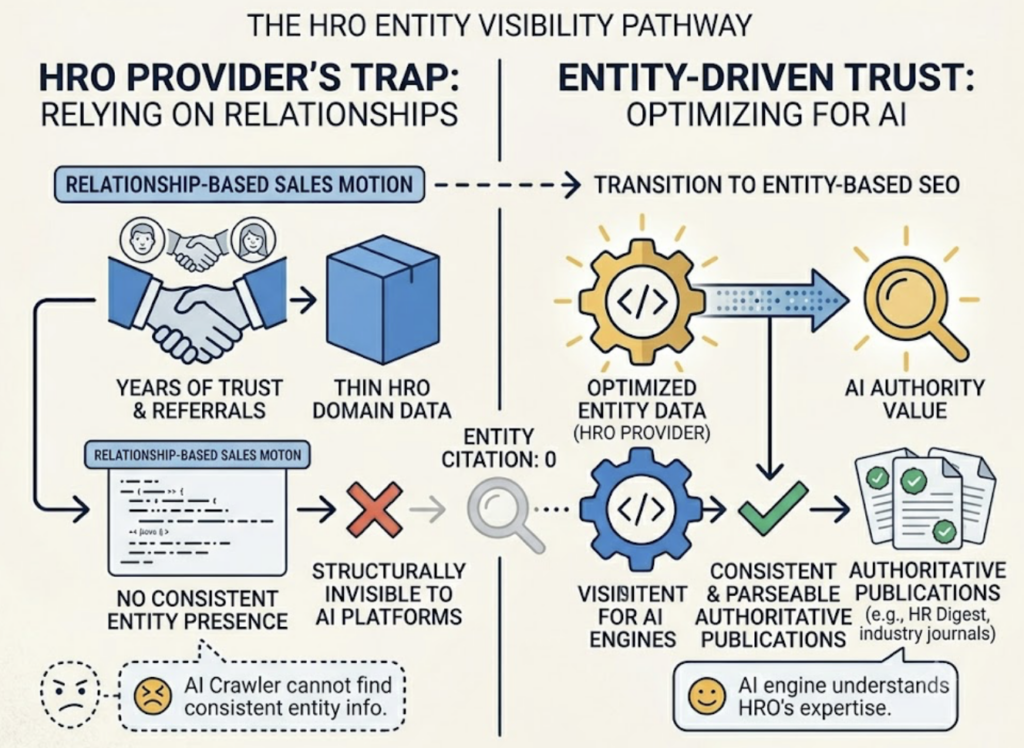
Ahrefs’ analysis of ChatGPT citation behavior found that 65.3% of ChatGPT’s top-cited pages come from domains with DR80 or higher. HRO providers sitting at DR40-55 with thin external citation profiles face a structural disadvantage in AI-generated shortlists that no amount of content volume will fix.
The GEO Score Checker surfaces these gaps across all four dimensions in a single run. The Bot Access score tells you if your site is even reachable. The Structured Data score tells you if AI understands what you offer. The Content Signals score tells you if your content is being treated as authoritative. And the Visibility Score tells you where you’re winning and where you’re invisible across platforms.
That’s the diagnostic picture most HR tech marketing teams have never had.
From a One-Time Score to Continuous GEO Monitoring
The GEO Score Checker gives you an accurate snapshot of where your AI visibility stands today. That snapshot is genuinely useful — most HR tech brands discover at least one dimension below 40 on their first run.
But GEO signals aren’t static. A competitor publishes a well-structured compliance guide. A new AI model update shifts how ChatGPT weights brand mentions. Your structured data gets overwritten in a CMS migration. Any of these changes your score without you knowing.
That’s where Comprehensive GEO Analytics from Topify closes the gap.
| Capability | Free GEO Score Checker | Topify Platform |
|---|---|---|
| Check frequency | One-time snapshot | Continuous monitoring |
| Dimensions tracked | 4 GEO scores | Full GEO analytics + sentiment + citations |
| Historical trends | None | Full trend history with alerts |
| Competitor benchmarking | Not included | Real-time competitor tracking |
| Platform breakdown | Aggregated | Per-platform (ChatGPT, Perplexity, Gemini, AI Overviews) |
| Optimization actions | Directional guidance | Specific, prioritized execution steps |
The checker tells you where you stand. The platform tracks which direction you’re moving — and flags when a competitor’s score starts climbing.
For HR tech and HRO firms operating on long sales cycles, that trajectory visibility matters. A CHRO who doesn’t see your brand in an AI answer today may run the same query in three months. The question is whether you’ve closed the gap by then.
Topify’s Standard plan starts at $199/month with a 7-day free trial, no credit card required. See the full breakdown on the pricing page.
Conclusion
HR tech and HRO buyers are building their vendor shortlists in AI platforms before your sales team hears their name. Your compliance documentation, your case studies, your thought leadership library — none of it converts to AI visibility unless the underlying GEO signals are in place.
Start with the data. Run your domain through the GEO Score Checker and find out which of the four dimensions is holding your AI visibility back.
If your Bot Access score is low, the AI Robots Checker helps you trace the exact robots.txt configuration blocking your crawlers. If your Content Signals score needs work, the Brand Authority Checker surfaces the entity authority gaps that are limiting AI citations. And if you want a full cross-platform picture before you start optimizing, the AI Visibility Report gives you a structured baseline across ChatGPT, Perplexity, Gemini, and AI Overviews.
Frequently Asked Questions
What is a GEO score and why does it matter for HR tech companies?
A GEO score (Generative Engine Optimization score) is a 0-100 composite measure of how well your website is configured for AI platforms to find, read, and recommend your brand. For HR tech and HRO companies, it matters because buyers are now using ChatGPT, Perplexity, and Gemini to shortlist vendors before visiting any website. A low GEO score means your brand is filtered out before the evaluation even begins.
Why would an HR outsourcing provider score low on Bot Access if their SEO is healthy?
Standard SEO audits check whether Googlebot can crawl your site — they don’t check for AI-specific crawlers like GPTBot, ClaudeBot, or PerplexityBot. Many HR firms have robots.txt rules that block these bots explicitly or accidentally, particularly on compliance resource hubs and gated content subdomains. You can pass a standard technical SEO audit and still score below 30 on Bot Access.
How is a GEO score different from a Google search ranking?
Google rankings reflect where your pages appear in a list of links. A GEO score reflects whether AI platforms treat your brand as a trustworthy, citable source when synthesizing answers. The two don’t move together. An HR tech firm can hold strong Google rankings for competitive keywords while being entirely absent from AI-generated vendor shortlists — because the signals AI engines weight (structured data, entity authority, cross-platform citation frequency) are different from what Google’s ranking algorithm prioritizes.
What’s typically the lowest-scoring dimension for HR tech and HRO websites?
Content Signals is the most commonly underperforming dimension in this space. HR firms produce substantial content — compliance guides, white papers, case studies — but it’s almost never formatted for AI semantic indexing. No FAQPage or HowTo schema, no JSON-LD connecting service descriptions to specific HR functions, no structured citations tying outcomes to service categories. The content is authoritative; the markup that tells AI it’s authoritative is missing.
How often should an HR tech brand re-run its GEO score check?
At minimum, after any major site change: CMS migrations, content hub redesigns, new subdomain launches, or significant robots.txt updates. In practice, GEO signals shift whenever a competitor publishes well-structured content, when AI model updates change citation weighting, or when third-party publications that reference your brand get indexed or removed. A one-time check gives you a baseline. Continuous monitoring — available through Topify’s platform — is what tells you whether that baseline is improving or eroding.
Read More:

