

A prospective client needs help with an IRS audit. They open ChatGPT and type: “Which accounting firms specialize in IRS audit representation for real estate investors in Austin?” A list of three firms appears. Yours isn’t one of them.
It’s not because your firm lacks the expertise. It’s because your website was built for Google crawlers from 2015, not the AI engines clients use in 2026.
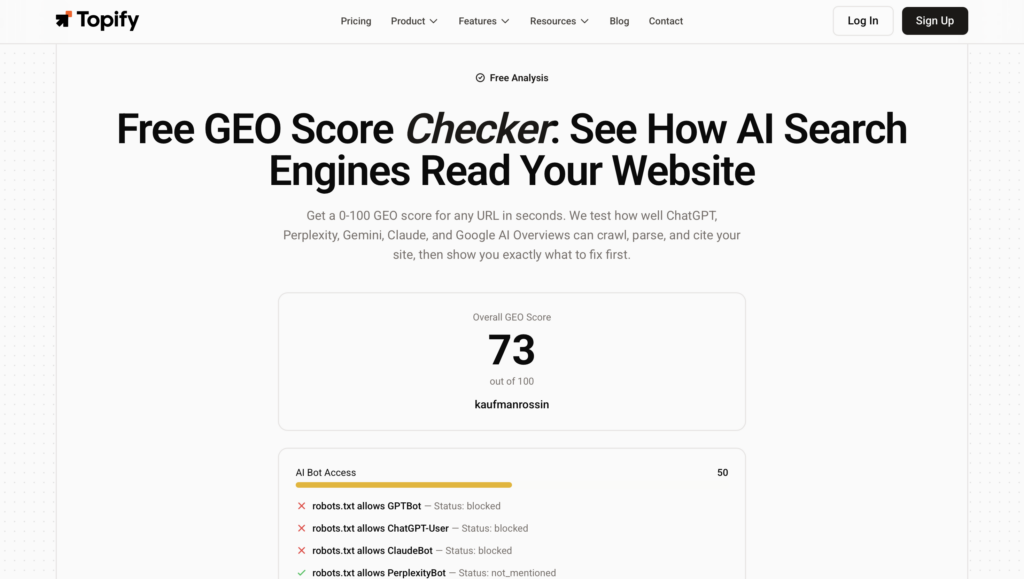
That gap is measurable. Topify’s GEO Score Checker runs a free diagnostic on your firm’s website and returns four scores that explain exactly why AI platforms skip your credentials, even when those credentials are real and strong.
✅ Free ⚡ Results in 60 seconds 🔒 No signup required
GEO Score Checker
Your Credentials Are Invisible. Here’s What the GEO Checker Finds.
Most CPA and tax advisory firms have earned genuine authority: state licenses, AICPA membership, IRS Enrolled Agent designations, decades of client work in specific niches. That authority matters to clients. It matters to AI engines too, but only when it’s machine-readable.
Here’s where most firms discover the problem.
Scenario 1 — CPA License Buried in a Partner Bio
A firm’s managing partner has 20 years of experience in international tax treaties. The bio page lists her CPA license number, her credentials, and her publication history. It’s all there.
But the page has no structured data markup. GPTBot crawls it, sees unformatted text, and can’t parse which terms are credentials versus descriptive copy. The AI moves on to a competitor whose simpler site has clean JSON-LD schema. According to research tracking AI recommendations for accounting firms in 2026, firms recommended by ChatGPT share one consistent trait: entity data that AI crawlers can read without guessing.
Scenario 2 — Tax Specialty Pages Blocking AI Crawlers
A mid-size firm rebuilt its website in 2023. The developer added Disallow: / for several bots to improve page speed. One of those bots was GPTBot. The firm’s entire practice area content, including detailed pages on R&D tax credits, estate planning, and multistate nexus issues, became invisible to ChatGPT.
Bot Access is the first GEO score the checker evaluates. A score below 30 here means no amount of content quality will save your AI visibility.
Scenario 3 — Strong Google Presence, Zero ChatGPT Visibility
This is the most common pattern in accounting. A firm ranks on page one of Google for “small business CPA Chicago.” Their Google Business Profile has 80 reviews. But when clients ask Perplexity or ChatGPT for CPA recommendations, the firm doesn’t appear.
Google rankings and AI recommendations are built on different signals. Google indexes pages. AI engines recommend entities. Those are two different technical problems.
The Four GEO Scores That Expose Your Firm’s AI Blind Spots
Run your firm’s website through the GEO Score Checker and you’ll get four scores. Here’s what each one means in the context of accounting and tax services.
| Score Dimension | What It Measures | Accounting & Tax Impact |
|---|---|---|
| Bot Access | Whether AI crawlers (GPTBot, ClaudeBot, PerplexityBot) can access your site | Credential pages, practice area content, and team bios are only useful if AI can read them |
| Structured Data | Quality of schema markup and JSON-LD on your site | CPA credentials, service types, and AccountingService schema determine whether AI understands your firm’s specializations |
| Content Signals | Depth and authority of your written content | FAQ pages answering IRS audit questions, tax planning guides, and niche specialty content signal E-E-A-T to AI |
| Visibility Score | How often your brand appears in AI platform responses | Measures whether ChatGPT, Perplexity, Gemini, and Google AI Overviews are actively recommending your firm |
Score benchmarks to keep in mind:
- 0-40: AI effectively can’t identify or recommend your firm
- 41-60: Basic visibility, but most competitors with structured data have a clear edge
- 61-80: Good foundation, meaningful gaps remain
- 81-100: AI has a strong basis to recommend you proactively
How to run the check:
- Go to the GEO Score Checker
- Enter your firm’s domain name
- Get four scores within 60 seconds
- Identify your weakest dimension, that’s your starting point
Most accounting firms find their lowest score in Structured Data. It’s the most fixable, and it’s the one with the most direct connection to whether AI understands what your firm actually does.
How Clients Actually Use AI to Find a Tax Advisor
Clients aren’t typing “CPA near me” into Google anymore, or not exclusively. A growing share are asking AI full questions and booking whoever gets named in the answer.
The prompts they use carry high commercial intent. They’re specific, service-focused, and often include niche qualifiers that favor specialized firms.
| AI Prompt Example | Platform | Search Intent | What It Reveals |
|---|---|---|---|
| “Best CPA for S-corp tax planning in Denver” | ChatGPT | Service + location + entity type | Firms with entity-specific content and local schema get named; generalist sites don’t |
| “Who handles IRS audit representation for real estate investors?” | Perplexity | Niche specialty + problem type | Content authority in that niche is the deciding factor |
| “Compare tax advisory firms for cross-border US-UK income” | Gemini | Multi-country expertise | Structured credential data and published international tax content drive recommendations |
| “Which accounting firm is best for startup equity compensation?” | ChatGPT | Industry-specific financial complexity | Firms with case studies, published guides, or schema-tagged service pages win |
| “Find me a bookkeeping service for e-commerce businesses under $5M revenue” | Perplexity | Industry + size qualifier | Service page specificity and crawlable pricing/scope content determine visibility |
If your firm handles any of these queries in real client work but your website doesn’t answer them in structured, crawlable language, you’re not in the running.
That gap has real consequences. According to a January 2026 Deloitte study, 63% of finance organizations have deployed AI, and their clients are increasingly using AI tools to identify and hire professionals. The window to fix this is open. It won’t stay open indefinitely.
Where Accounting Firms Consistently Lose GEO Points
The accounting industry has a specific set of structural problems that make AI visibility harder than it needs to be.
Credentials exist but aren’t structured. CPA license numbers, AICPA section memberships, IRS Enrolled Agent designations, state bar admissions for tax attorneys — these are legitimate authority signals that AI engines actively look for. The problem is that most accounting firm websites have zero structured data, so those credentials exist as unformatted text that AI crawlers can’t parse as authoritative signals.
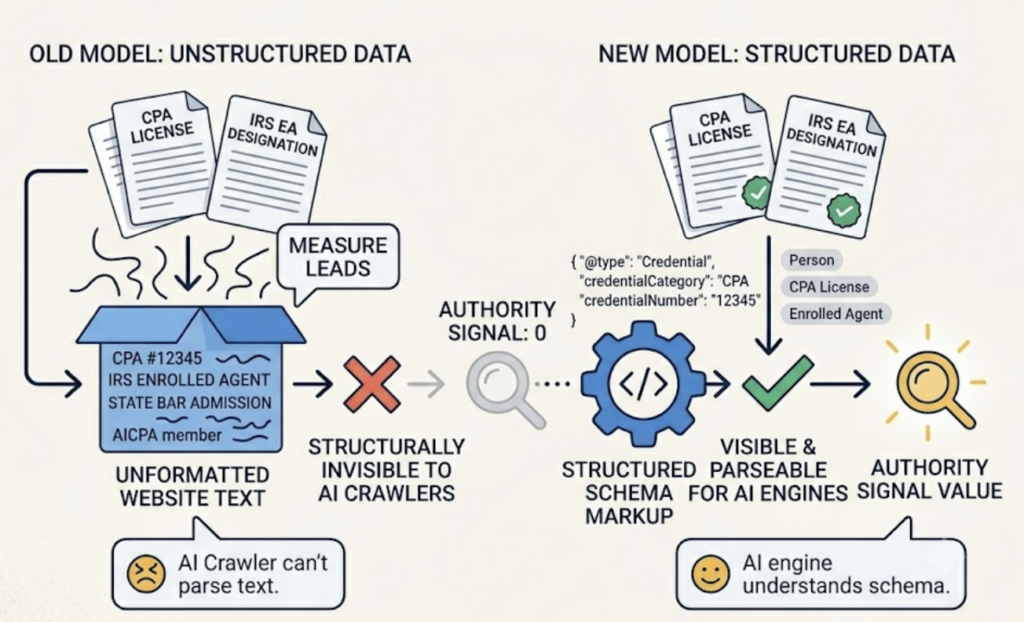
The fix isn’t complex. AccountingService schema, ProfessionalService markup, and hasCredential properties on team pages are standard JSON-LD implementations. But most firms haven’t done it.
Compliance-heavy content blocks crawlers by accident. Many tax and accounting firms added bot-blocking rules years ago for legitimate security and compliance reasons, often without realizing those same rules now prevent AI crawlers from accessing the site. A low Bot Access score in the GEO Checker is frequently the result of a robots.txt entry made in 2021 that nobody reviewed.
Content depth is shallow on the pages that matter. Tax planning is a service category where clients want to know the advisor understands their specific situation before they book a call. Thin service pages (“We handle business tax returns. Contact us for a quote.”) don’t generate Content Signal scores. Detailed, niche-specific content — written to answer the exact questions clients ask AI — does.
| Common Accounting Firm Scenario | Likely GEO Score Signal | Probable Cause | Action Direction |
|---|---|---|---|
| Firm doesn’t appear in ChatGPT searches | Bot Access: below 30 | GPTBot blocked in robots.txt | Audit robots.txt, allow AI crawlers explicitly |
| Credentials visible on site but AI ignores them | Structured Data: below 40 | No AccountingService or hasCredential schema | Add JSON-LD markup to team and service pages |
| General practice appears, not niche specialties | Content Signals: below 50 | Specialty pages lack depth and semantic structure | Build Q&A-style content for each niche practice area |
| Appears in Perplexity but not ChatGPT | Visibility Score: inconsistent | Platform-level citation gaps | Run AI Visibility Report across platforms to identify gaps |
Cross-platform inconsistency is more common than most firms realize. A firm might appear consistently in Perplexity (which weights recent web content heavily) but remain invisible in ChatGPT (which relies more on structured entity signals). That’s a platform-specific gap, not a general visibility problem, and it requires a platform-specific fix.
From a One-Time Score to Continuous Visibility Monitoring
The GEO Score Checker gives you a snapshot. Four scores, one moment in time. That’s genuinely useful for diagnosing where your firm stands right now.
The problem is that AI visibility isn’t static. A competitor updates their schema markup. A new accounting platform publishes a guide that AI starts citing. Your firm’s Content Signals drop when a batch of old blog posts stops getting indexed. These changes happen continuously, and a single score check from three months ago won’t catch them.
That’s where Topify’s Comprehensive GEO Analytics picks up. It monitors all four GEO dimensions across ChatGPT, Perplexity, Gemini, and Google AI Overviews on an ongoing basis, with historical trend data, sentiment tracking, and competitor benchmarking built in.
| Capability | Free GEO Score Checker | Topify Platform |
|---|---|---|
| Check frequency | One-time snapshot | Continuous monitoring |
| Dimensions tracked | 4 GEO scores | Full GEO analytics + sentiment + citations |
| Historical trends | None | Full trend history with alerts |
| Competitor benchmarking | Not included | Real-time competitor tracking |
| Platform breakdown | Aggregated | Per-platform (ChatGPT, Perplexity, Gemini, AI Overviews) |
| Optimization actions | Directional guidance | Specific, prioritized execution steps |
For accounting firms managing client relationships over years, not weeks, the ability to track whether AI recommendation patterns are improving or eroding over time is the difference between reactive and proactive visibility management. Start a free trial to see what your firm’s trajectory looks like, or review Topify’s pricing plans before committing.
Conclusion
Your firm’s reputation was built in conference rooms, courtrooms, and client files. AI engines don’t have access to any of that unless you structure it for them.
The starting point is understanding where your site actually stands. Run your firm through the GEO Score Checker and get four scores in under 60 seconds — no signup, no cost. The weakest number tells you where to start.
From there, tools like the AI Robots Checker can pinpoint exactly which crawlers your current robots.txt blocks, the Brand Authority Checker surfaces how AI currently perceives your firm’s expertise signals, and the Knowledge Freshness Checker shows whether AI models are working from current or outdated information about your practice.
The firms showing up in AI recommendations for high-intent accounting searches aren’t necessarily the most credentialed. They’re the ones whose credentials AI can actually read.
FAQ
What is a GEO Score for an accounting firm, and how is it calculated?
A GEO Score is a 0-100 composite rating that measures how visible and accessible your firm is to AI search engines like ChatGPT, Perplexity, and Gemini. The GEO Score Checker evaluates four dimensions: whether AI crawlers can access your site (Bot Access), whether your content is marked up in machine-readable schema (Structured Data), whether your published content carries enough topical authority (Content Signals), and whether your firm actually appears in AI-generated answers (Visibility Score). Each dimension is scored independently, so you can see exactly which layer is dragging your overall number down.
My firm ranks well on Google. Why would AI visibility be different?
Google ranks pages based on links, keywords, and on-page signals. AI engines recommend entities based on structured data, crawlability, and content authority. A firm can rank on page one of Google for “small business CPA” while being completely absent from ChatGPT recommendations for the same query. The underlying technical requirements are different. Google doesn’t need AccountingService JSON-LD schema to rank your site; ChatGPT relies on it to understand what your firm does and who it serves. That’s why many firms discover their GEO Score is low despite strong Google performance.
Which GEO Score dimension should accounting firms fix first?
It depends on your scores, but Bot Access issues are the most urgent. If AI crawlers can’t access your site, the other three scores are effectively capped regardless of how good your content or schema is. After Bot Access, Structured Data tends to produce the fastest visibility improvement in accounting specifically, because CPA credentials, AccountingService schema, and hasCredential markup are well-supported by major AI platforms. Content Signals take longer to improve but have the highest long-term impact on niche recommendations.
Does the GEO Score Checker work for small CPA firms, not just large practices?
Yes. The checker works on any domain, and firm size doesn’t determine your score. A solo practitioner with a well-structured, crawlable website that clearly signals a specialty can outscore a regional firm with a bloated, bot-blocking site. In practice, smaller firms often have an advantage here because they can update their technical setup faster without navigating internal IT approvals. The four GEO dimensions apply equally regardless of headcount.

