

You ran the GEO Score check. Got a 54. Now what?
A number without context isn’t a metric, it’s noise. The only way to know whether 54 means you’re ahead of the curve or quietly falling behind is to compare it against what’s actually happening in your industry. That’s what this benchmark report is for.
What Your GEO Score Is Actually Measuring
Before the numbers, a quick clarification: a GEO score measures your site’s content-level readiness to be ingested and cited by AI engines. It’s not a real-time tracker of whether ChatGPT mentioned you this morning. Think of it as an audit of your structural health, not a live performance report.
The score pulls from four core dimensions:
AI bot access checks whether crawlers like GPTBot, ClaudeBot, and PerplexityBot can actually reach your content. Many legacy sites unknowingly block these agents via outdated robots.txt files, or serve JavaScript-rendered pages that AI crawlers can’t parse.
Content clarity measures how well your pages are broken into self-contained, fact-dense blocks. AI engines don’t consume full pages. They retrieve chunks. A page that reads as one long wall of text has low “extractability” regardless of how well-written it is.
Authority signals track E-E-A-T indicators: verifiable statistics, original research, expert attribution. Princeton University research found that adding statistics can drive a 37% increase in AI visibility, while citing authoritative sources can lead to a 115% boost for lower-ranked pages.
Citation-friendliness assesses structured data presence, specifically JSON-LD schema, FAQPage markup, and whether the site has deployed an llms.txt file to guide AI crawlers toward priority content.
The 2026 GEO Score Scale
| Score Range | Status | What It Means |
|---|---|---|
| 0–39 | Foundational Deficiency | Critical technical gaps; AI crawlers blocked or content unparseable |
| 40–60 | Industry Average | Most sites land here; basic SEO present but not AI-optimized |
| 61–74 | Conscious Optimization | Active GEO attempts; inconsistent schema and structure |
| 75–84 | High AI Readiness | Strong E-E-A-T signals; frequent FAQ schema; RAG-friendly content |
| 85+ | Elite | Proactively designed for AI; dominant entity authority; systemic schema |
A score above 70 is considered good. Above 85 is where the leaders actually live.
To get your baseline, the Topify GEO Score Checker runs a standardized technical audit across all four pillars and maps results to actionable recommendations.
GEO Score Benchmarks by Industry in 2026
Here’s where the data gets useful. Performance varies significantly by sector, and the gap between average and leading brands tells you exactly what’s winnable.
B2B SaaS: Technical Depth, FAQ Gaps
| Metric | Benchmark |
|---|---|
| Average GEO Score | 52–58 |
| Leading Brand Score | 72–80+ |
| AI Referral Share | 2.80% (highest tracked) |
| Primary Gaps | Technical doc structure, FAQ coverage, schema completeness |
B2B SaaS companies start with an advantage: high-density informational content, which is exactly what AI engines prefer. The problem is that most of that content is written for humans scanning a features page, not for AI systems retrieving a specific answer chunk.
The brands sitting at 72+ have restructured their help centers and technical documentation to mirror conversational prompts. One common pattern: using sameAs links in schema to anchor product entities to GitHub, G2, or LinkedIn, creating a “consensus signal” that AI engines use to verify brand claims.
The most common gap at the average band (52–58)? FAQ content that answers generic questions instead of the specific, comparison-oriented questions your buyers are actually asking AI assistants.
E-commerce: Thin Pages, Weak UGC Signals
| Metric | Benchmark |
|---|---|
| Average GEO Score | 44–52 |
| Leading Brand Score | 68–76 |
| AI Overview Presence | 6.80% |
| Primary Gaps | Thin product descriptions, no comparative data, weak UGC |
E-commerce has the steepest hill to climb. Most product pages are built for visual browsing. AI agents do attribute-based retrieval. Those aren’t the same task.
Pages scoring below 61 are rarely considered by AI agents for purchase recommendations. Leading brands like Walmart and Amazon maintain high scores by combining massive user-generated content with detailed product attribute schemas. The gap for smaller retailers is specific: they don’t explain their product’s relationship to competitors. AI engines struggle to cite a product page that doesn’t tell them why to recommend it over alternatives.
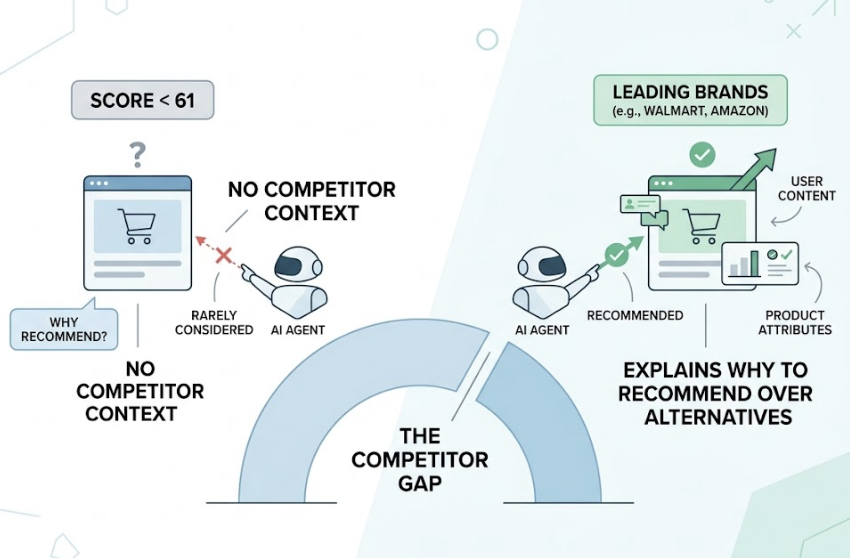
Comparison-oriented content, “X vs. Y” pages, detailed attribute breakdowns, verified review data, is what separates a 52 from a 72 in this sector.
Media and Publishing: The Citation Architecture Problem
| Metric | Benchmark |
|---|---|
| Average GEO Score | 58–65 |
| Leading Brand Score | 80–88 |
| Primary Gaps | Unstructured citations, poor AI summary friendliness |
Publishers start with a natural advantage: content density. That’s why their average scores are higher than most other sectors. But they’re increasingly penalized for what might be called disorganized citation architecture.
The primary differentiator for leading publishers is the “Bottom Line Up Front” (BLUF) writing structure. AI engines prioritize pages where the first 60 words directly answer the primary question. Many editorial teams write in the opposite direction: context, background, then the point.
The other issue is a dual-optimization trap. Teams are trying to hold traditional SEO rankings while simultaneously improving AI citation probability, and without a unified framework, both suffer.
Local Services: The Knowledge Graph Crisis
| Metric | Benchmark |
|---|---|
| Average GEO Score | 38–48 |
| Leading Brand Score | 60–70 |
| AI Overview Presence | 4.40% (lowest across sectors) |
| Primary Gaps | No structured data, thin content, missing Local Knowledge Graph signals |
Local services, legal, medical, home maintenance, consistently hold the lowest GEO scores in 2026. AI assistants frequently avoid citing local providers because their information (pricing, availability, specific expertise) isn’t provided in a verifiable, structured format.
That’s a fixable problem. Leading local brands have built what you might call “Knowledge Hubs”: pages dedicated to answering specific, non-transactional questions rooted in their market. Think “Why does tap water taste different in [City]?” rather than “Hire us for water treatment.” These pages establish local authority in AI training data in a way that a service page never will.
What Brands Scoring 85+ Are Actually Doing
Getting above 85 isn’t a volume game. It’s a structure game. These brands have stopped thinking about “writing more content” and started thinking about their site as a data layer for the generative web.
Systemic schema markup. Average sites use basic Article schema. Elite brands implement deeply nested JSON-LD across Organization, FAQPage, HowTo, and WebApplication schemas. The sameAs attribute links brand entities to Wikipedia, Wikidata, and Crunchbase, creating external verification that AI engines treat as a credibility signal.
FAQ content designed for extraction. Pages with FAQPage schema see a 3.1x higher AI citation rate compared to equivalent pages without it. The format that works: a “Question-Answer-Evidence” (QAE) structure where every answer stays under 100 words, making it easy for an LLM to chunk and synthesize without losing the core claim.
Proactive third-party authority building. Elite-scoring brands don’t rely only on their own domains. They know AI models weight earned media more heavily than owned content. Perplexity in particular draws heavily from Reddit. A substantive mention in a trusted community can serve as a 2.1x multiplier for AI citation probability. Publishing original data matters too: unique statistics can boost AI visibility by up to 40%.
Your Score Is a Snapshot. Your Strategy Needs More.
Here’s the part most GEO score reports skip: a high score doesn’t guarantee you’re actually getting cited.
The GEO score measures citability, meaning the content is formatted correctly for retrieval. Actual citations in AI answers depend on external authority, recency, and how your “information gain” compares to competitors at that specific moment. A brand can have an 85+ score and still see low citation rates if a rival has higher information density on the same topic.
AI engines are also non-deterministic. The same prompt can produce different citations at different times. That’s why the score serves as a baseline, but real-time citation tracking is the strategy.
Tracking your GEO score in isolation can also create a blind spot: your score might climb from 50 to 70, but if the industry average moves to 75 in the same window, you’ve lost relative ground while feeling like you improved. That’s the case for placing your score inside a competitive context.
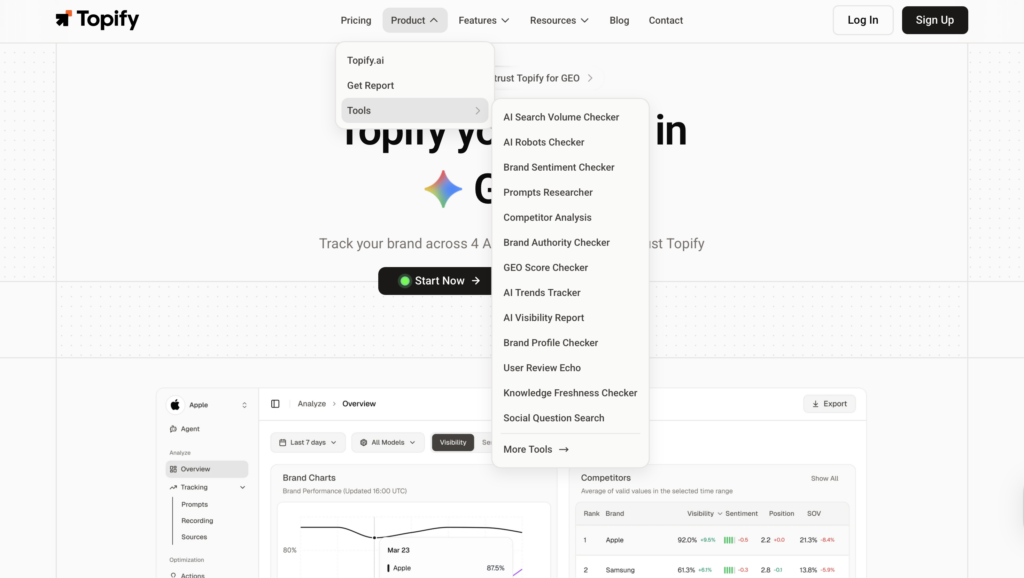
Topify’s competitor benchmarking tracks Share of Voice across ChatGPT, Gemini, and Perplexity, so you can see not just your absolute score, but how your citation frequency compares to the top brands in your category. The score tells you if you’re ready. The competitive data tells you if you’re winning.
How to Close the Gap: A 3-Step Framework
Step 1: Detect your current baseline. Start with a full technical audit using the Topify GEO Score Checker. Map where you sit against the industry benchmarks above. The audit should also surface a “Citation Gap Analysis” showing which prompts are sending users to competitors instead of you.
Step 2: Restructure for retrieval. This is less about adding keywords, more about increasing factual density. Rewrite the opening 60–100 words of key pages to lead with a direct answer (BLUF optimization). Deploy FAQPage and Organization schema with sameAs links. Use sequential H2-H3-H4 heading structures to help AI engines understand your semantic hierarchy.
Step 3: Track and iterate. AI citation data decays. Research suggests it drops to roughly 40% of its initial level within 90 days. That means a one-time optimization isn’t a strategy. Weekly monitoring of how content updates influence visibility across platforms, combined with ongoing prompt research, keeps you from falling back below your industry benchmark after a single algorithm shift.
Conclusion
Most brands are scoring somewhere between 40 and 60. That’s not a failure, it’s where the industry currently sits. But the gap between 54 and 75+ is real, and it’s not bridged by writing more. It’s bridged by structuring differently: tighter schema, BLUF formatting, FAQ content designed for extraction, and third-party authority signals that give AI engines a reason to trust your content over a competitor’s.
The score is the starting line. Use the Topify GEO Score Checker to find your baseline, then move from static readiness into active citation tracking with Topify’s competitive benchmarking to see where you actually stand in your industry’s AI search landscape.
FAQ
Q: What is a good GEO score in 2026?
A: A score above 70 is considered good, meaning your site is well-optimized and likely to be cited by AI engines. A score above 85 is excellent and characteristic of brands that have systematically designed their content for AI retrieval.
Q: How often should I check my GEO score?
A: At minimum, run a full audit monthly. High-priority pages should be reviewed weekly, since AI model updates and competitor content changes can shift citation patterns quickly. Citation data tends to decay significantly within 90 days of any optimization.
Q: Does a high GEO score guarantee AI citation?
A: No. A high score means your content is formatted correctly for retrieval. Actual citations depend on external authority, content recency, and how your information compares to competitors on a given topic. Real-time tracking is required to measure actual citation performance.
Q: Which industry has the lowest average GEO score?
A: Local services currently holds the lowest average (38–48), largely due to widespread lack of structured data and thin content that doesn’t provide the localized, verifiable signals AI engines need to confidently recommend a provider.

