A website release manager is preparing a new product template for launch. The visual review looks clean, but nobody has written down which facts must remain accessible after the deployment. The team has an audit score from last month and a deadline, with no shared rule for deciding whether the release is ready.
A GEO checker can support release verification when its findings connect to explicit acceptance criteria. The work is to define the content and technical conditions that matter, inspect them in the appropriate environment, and assign a response when they fail. A target score alone won’t tell the release team which change is safe to ship or who should investigate a regression.
Turn GEO Checker Findings Into Release Criteria
Translate each useful finding into an observable requirement. Instead of “maintain a good score,” specify that the product name, compatibility condition, and support link must remain present on the selected page. Name the artifact a reviewer will use to verify that requirement.
A release criterion should contain a subject, expected behavior, owner, and failure action. That structure connects the audit to the deployment process. It also prevents a content issue from being lost because a composite score improved elsewhere.
Google’s AI feature documentation describes technical eligibility without guaranteeing inclusion. Release acceptance should therefore cover conditions the team can inspect and control. Future citations or recommendation positions belong in subsequent observation, not in a same-day technical promise.
Use risk to select mandatory conditions. An inaccurate compatibility warning can affect a buyer decision directly. A lower-priority formatting recommendation may deserve a separate task instead of blocking the entire launch.
The release needs explicit evidence, not a ceremonial green number.
Create a Small Set of Release Fixtures
A release fixture is a stable test page plus a record of its expected content. Choose pages that exercise meaningful template behavior: ordinary content, optional fields, long tables, and a known exception. Keep the set small enough that people will actually inspect it.
Write expected facts in plain language. “The return exception appears beside the policy link” is clearer than “policy component okay.” Include the content source or owner when a missing value could originate outside the template code.
For JavaScript-driven content, record which processing stage supports the test. Google’s JavaScript SEO guidance provides a basis for checking rendered content in its search workflow. That is platform-specific evidence, rather than a universal guarantee about every automated visitor.
Keep the fixture version with the release identifier. A page that changes its expected content mid-review can create false regressions or hide real ones. Agree on the expected state before the deployment and record intentional changes separately.
The fixture set should include ownership. Engineering can verify rendering and access, content operations can verify factual completeness, and the release manager can confirm that the evidence is sufficient. One person may fill several roles, but the decisions should remain distinct.
Test Staging Without Exposing Private Content
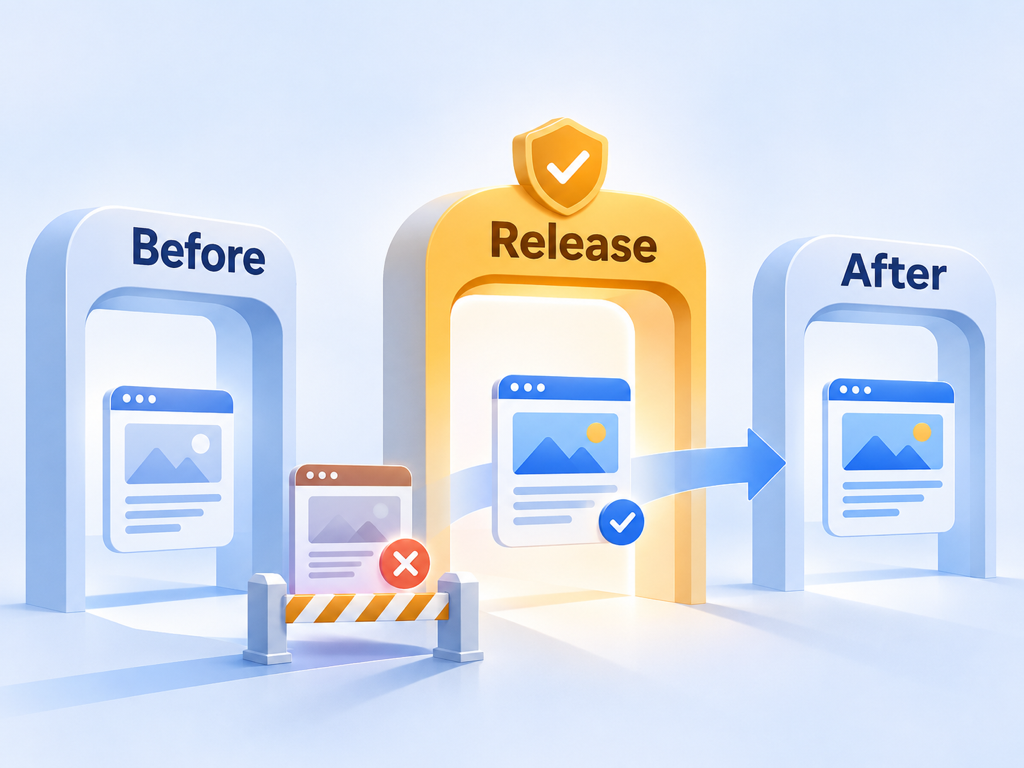
Staging can verify template behavior without proving public discoverability. A restricted environment may correctly require authentication, block crawlers, or use different infrastructure. Those protections should not be removed merely to make an audit resemble production.
Inspect what the environment can establish. Verify expected text, links, generated markup, and behavior under the available access method. Record which checks require a production observation because the staging conditions differ.
Use a clear state such as “passed in restricted staging” rather than “publicly crawlable.” The distinction prevents a later reviewer from assuming that a development test established access through the live hosting and delivery configuration.
Prepare a production verification list while the release is still reversible. Identify the exact pages and conditions to check after deployment, the people responsible, and how to distinguish a failed test from a failed page.
Avoid copying private content into public diagnostic tools without authorization. The release process can use local or controlled evidence for restricted material and defer public-access verification until the intended public version exists. The purpose is appropriate evidence for each environment, not identical testing at any cost.
Check Production After the Deployment
Production checks should confirm the deployed state, rather than repeating the staging result by assumption. Reopen the selected URLs, verify the expected content, and record the observation time. Confirm the final destination where routing or redirects changed.
Google’s URL Inspection help distinguishes live testing from indexed information. Use the relevant view for the question being asked. An older indexed state doesn’t by itself prove that the deployment failed, while a current live pass doesn’t establish that search processing is complete.
The following is an illustrative release matrix. Adapt the blocking rules to the user consequence and the team’s actual recovery options.
| Acceptance item | Before release | After release | Suggested owner | Failure response |
|---|---|---|---|---|
| Essential product facts | Expected-content fixture | Facts present on live page | Content and engineering | Investigate or revert affected change |
| Important navigation | Approved destination list | Live links reach intended pages | Engineering | Repair routing or restore prior behavior |
| Structured data consistency | Review generated fields | Compare markup with visible facts | Technical SEO | Correct inaccurate fields |
| Access to intended public pages | Document environment differences | Check live availability | Infrastructure | Investigate access configuration |
| Answer observations | Preserve prior collection context | Collect comparable later observations | Analytics | Review separately from release acceptance |
Store the completed matrix with the deployment record. It should show both successful checks and exceptions. A check skipped because of missing access needs an explicit follow-up owner, rather than a blank cell that looks like a pass.
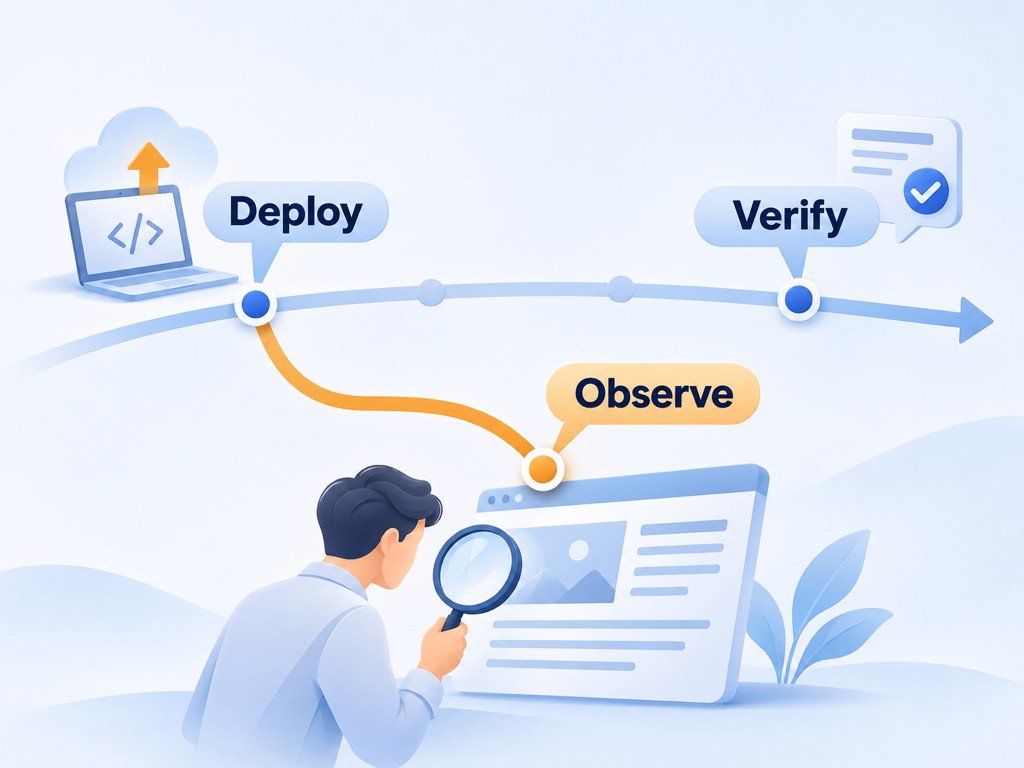
Define Rollback and Investigation Triggers
Agree on failure responses before people are under launch pressure. A rollback trigger should describe a material user or technical consequence and the change that can be reversed. An investigation trigger should describe uncertainty that needs more evidence.
For a hypothetical product release, a missing safety condition could block acceptance. A slight movement in a diagnostic total might instead require review of the underlying checks. These are examples of risk-based decisions, not universal thresholds or a prescribed scoring policy.
Separate product failures from observation failures. A timed-out diagnostic doesn’t prove that the public page is unavailable. Record the test failure, use an appropriate independent observation where possible, and avoid repeatedly retrying a paid or restricted service without authorization.
Preserve the smallest useful recovery option. A faulty template component may be reversible without reverting unrelated content updates. The acceptance record should make that distinction visible to the person deciding what to restore.
Don’t use immediate answer volatility as automatic proof of a release effect. A changed recommendation can coincide with other platform, prompt, or source changes. Technical acceptance and performance investigation should share a release identifier while retaining different evidentiary standards.
Add Topify Monitoring to the Release Record
Topify can support the public-page review through its GEO Score Checker. Enter the selected production fixture and record the relevant findings beside the expected content and deployment time. Review the specific access or content observation that matters to acceptance instead of treating a higher total as sufficient evidence that every required condition passed.
Its AI Search Analytics page describes visibility and citation tracking that can provide later context. Use comparable prompt and platform observations to investigate whether the answer layer changes after release. The fixture matrix, blocking conditions, and rollback decisions proposed here remain team-managed controls; the public pages don’t establish a native deployment acceptance system or prove that a subsequent visibility change was caused by the release.
The final record should connect each failed condition to a person and a decision time. Include what was observed, what was corrected, and what still needs search processing or further measurement. That allows the release to close operationally without erasing open analytical questions.
For a related measurement discipline, AI Citations vs. Brand Mentions: Not the Same explains why different answer signals deserve separate interpretation. Apply the same care when attaching monitoring results to a technical deployment.
Conclusion
A release check works when the team can identify the exact condition, evidence, and response. Define a small fixture set, inspect it in staging within that environment’s limits, and verify the intended public behavior after deployment. Keep exceptions visible and assign both rollback authority and investigation ownership before the deadline arrives.
Use a GEO checker inspection of the live fixture to support the acceptance record, then observe answer performance separately with consistent collection settings. Your next step is to turn one important template change into a completed release matrix. That gives the next deployment a repeatable process and prevents a broad score from standing in for facts nobody checked.
FAQ
Should a release require a minimum GEO score?
A total can be a reference, but acceptance needs specific observable conditions. Different checks can offset each other in a composite number while an important failure remains unresolved.
Can staging prove public crawler access?
Only if its conditions actually represent that access, which restricted staging often doesn’t. Record the limitation and verify the intended production behavior after deployment.
What should be checked immediately after launch?
Verify the selected live pages, essential facts, important links, and relevant access or markup conditions. Keep indexed information and later answer observations separately labeled.
Does unchanged search performance mean the release failed?
No. Technical acceptance and search selection are different outcomes. Assess the deployed conditions directly, then investigate performance using comparable observations over an appropriate period.