A technical SEO lead checks the homepage before a monthly review and gets a reassuring result. The product catalog, help center, and regional pages use different templates, but the report carries one domain-level conclusion. A developer then finds missing product details on a template that nobody tested.
A GEO checker can help inspect a page, yet the usefulness of that inspection depends on the sample around it. The operational question is how to choose pages that reveal shared failures without pretending a handful of URLs represents every state of the website. A template sampling plan makes the boundary visible and tells the team when to investigate further.
A GEO Checker Result Has a Sampling Boundary
Start by writing down exactly what was inspected. Record the submitted URL, final destination, test date, relevant environment, and the evidence returned. A domain entered into a form doesn’t automatically prove that every public path was examined.
Three units deserve separate names. A page is one URL in one observed state. A template is a reusable structure that may serve many URLs. A website contains templates, content variations, and infrastructure rules that can differ by section or market.
A passing page provides evidence about that observation. Extending the conclusion to sibling pages requires a reason: shared rendering, shared markup generation, or an identical access policy. Even then, content-dependent failures can remain outside the observation.
Google’s AI feature guidance separates technical eligibility from guaranteed inclusion. Treat a technical audit as evidence about readiness, rather than a promise that an answer engine will select the page.
State the boundary in the report header. “Six product URLs checked across two templates” is more useful than “the catalog passed.” That wording gives the next reviewer a concrete scope to reproduce and prevents a green homepage from becoming an unsupported sitewide conclusion.
Group URLs by Template and Business Risk
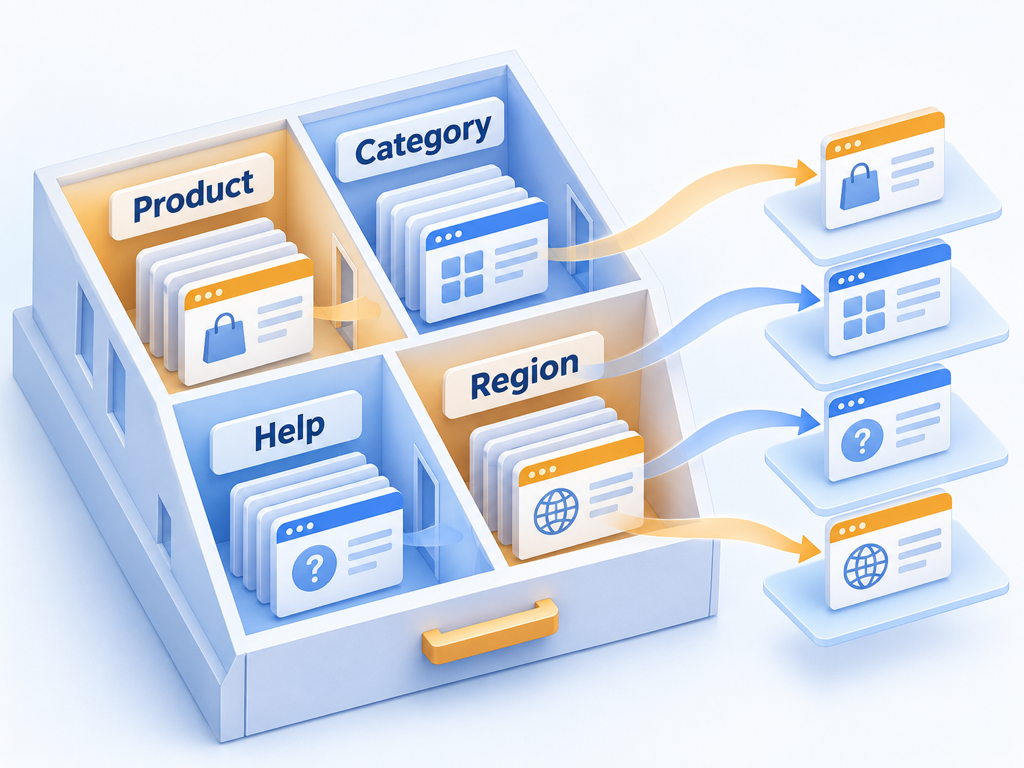
Build a sample frame before selecting URLs. Use the public inventory to group pages by the system that creates their meaningful content, rather than by folder names alone. Two paths can share a template, while one folder can contain several generations of code.
Useful groups might include product detail, product category, editorial article, help article, and regional landing page. Add a separate group when a different content source, access rule, or rendering path could change what a crawler receives.
Assign business risk independently of URL count. A small pricing section may matter more to a purchase decision than a large archive. Explain that judgment with the user task affected, such as verifying compatibility or finding a return condition.
The following is an illustrative planning sheet, not a recommended universal sample size or a measured website audit.
| Template group | Typical page | Edge case to include | Failure consequence | Expansion trigger |
|---|---|---|---|---|
| Product detail | Available core product | Missing optional field | Incomplete purchase evidence | Same field absent on a sibling |
| Category | Main category | Paginated or filtered state | Discovery paths disappear | Navigation differs across states |
| Help article | Current procedure | Long article with embedded steps | Instructions become incomplete | Rendered steps are missing |
| Regional page | Main market page | Alternate language or currency | Incorrect local information | Localized fields diverge |
Keep the number of known URLs and tested URLs alongside this sheet. A complete list of template groups is a coverage asset even when the first inspection remains small. It exposes entire sections that otherwise disappear behind a single score.
Choose Typical Pages and Known Edge Cases
Choose a typical page to establish the expected behavior, then add pages that challenge the assumptions behind that behavior. Typical means representative of the template’s normal content state, not simply the URL with the most traffic.
An edge case should test a plausible failure mechanism. A long specification table tests whether important facts survive rendering. An unavailable product tests whether the page still explains its status. A page with optional fields absent tests how the template handles incomplete source data.
Google’s JavaScript SEO documentation explains the distinction between processing and rendering. Use that distinction when choosing pages with content supplied through different code paths. A visually similar screenshot doesn’t establish that the underlying content arrived in the same way.
Document why each edge case exists. “Selected because the warranty section loads separately” supports a useful inspection. “Selected because it looked unusual” doesn’t tell another analyst what to examine or when to replace the sample.
Avoid presenting a judgment sample as statistically representative. Without a probability design and appropriate analysis, you cannot turn three passing pages into a confidence claim about thousands of pages. The immediate purpose is defect discovery and coverage of known mechanisms.
A sample should challenge the template, not flatter it.
Keep Technical Checks Separate From Answer Outcomes
Maintain two evidence layers. Technical checks describe accessible content, visible facts, markup consistency, and page behavior. Answer observations describe whether a specific platform returned the brand or linked to a page under a recorded prompt and configuration.
A shared template can plausibly explain a repeated missing field. It cannot by itself explain why an answer chose another source. The answer depends on a wider retrieval and generation process, and a technical change may not have been processed when the observation was collected.
The URL Inspection documentation distinguishes indexed information from a live test. Record which one supports a finding. A live page can look correct while the indexed version reflects an earlier state.
For each technical result, retain the observed content or a precise reference to it. For each answer result, retain the prompt, collection time, platform, and relevant excerpt. Connect the records by URL where justified, while keeping their meanings separate.
This separation changes the remediation decision. Missing content on a template belongs with engineering or content operations. An unexplained recommendation gap requires additional source and answer review. Combining both into one pass/fail status hides the uncertainty that determines the next useful action.

Expand the Sample When Failures Cluster
A failed observation should trigger a specific expansion rule. First check another URL using the same template and content condition. Then test a sibling without that condition. This helps distinguish a shared template defect from a single content-record problem.
Consider a hypothetical catalog where a warranty field is missing on one product. A second affected page suggests a broader pattern, but it still doesn’t prove every product is affected. The next useful step is to inspect the field-generation path or review a broader set of relevant records.
Preserve the initial sample when adding pages. Otherwise, a report can quietly change from “two failures among six planned pages” to “two failures among twenty pages,” concealing why the extra fourteen were inspected. Report the initial sample and investigation extension separately.
Escalate on consequence as well as recurrence. A single missing compatibility warning can deserve immediate attention even if it is rare. A cosmetic inconsistency may justify scheduled review instead. The sampling plan should support that judgment rather than replacing it with frequency alone.
Close an investigation only with a stated boundary. Identify the affected template or content condition, the correction owner, and the pages retested. Leave untested groups visibly open. That produces a useful completion record without claiming the entire site has been certified.
Connect Template Findings to a Topify Review
Topify can provide a starting inspection through its GEO Score Checker, whose public page describes URL-level input and findings across access, structured data, content signals, and visibility. Submit the selected page and preserve the returned findings beside its template group. The input to your review remains the sampling sheet, not a domain-wide assumption inferred from the form.
For the answer layer, AI Search Analytics describes visibility and citation observations that can help identify pages worth further investigation. Compare those observations with the technical records while keeping collection times and measurement units explicit. The sampling and expansion rules proposed here remain an analyst-managed workflow; this article doesn’t establish that the free checker automatically enumerates every template or validates every page state.
Use the product output to create an evidence task. Each task should name the affected page, suspected shared mechanism, observed failure, and next inspection. A total score can help orient a review, but the underlying finding must determine whether engineering, content, or measurement work comes next.
For background on interpreting an initial audit, Run a Free GEO Audit in 60 Seconds. Here’s What the Score Means provides related context. Keep that introductory score interpretation separate from the sampling claim attached to this investigation.
Conclusion
The homepage result becomes useful when the report says what it represents. Build a list of meaningful page templates, choose typical and challenging states, and record the reason for every selected URL. Keep untested groups visible so a small audit doesn’t become an accidental sitewide assurance.
Start with one important template and use the GEO Score Checker for the selected page alongside direct evidence review. When a failure appears, expand around the suspected mechanism and preserve the initial sample. The immediate deliverable is a defensible investigation boundary, an owner, and a repeatable retest, followed by separate observation of how answer engines respond over time.
FAQ
Can a homepage score represent an entire website?
Only within an explicitly justified scope. Different templates, content states, and access rules require separate evidence. A homepage inspection alone doesn’t establish their behavior.
How many pages should each template sample include?
There isn’t a universal number. Choose coverage around business risk and plausible failure mechanisms, and label judgment sampling accurately rather than attaching unsupported statistical confidence.
How should a new template enter the plan?
Add it to the inventory with an owner, expected content, and relevant edge cases. Establish a fresh baseline before treating it as covered by another template’s results.
Does a passing sample guarantee AI citations?
No. Technical eligibility and observed citation selection are different outcomes. Keep readiness checks and recorded answer observations in separate evidence layers.