

You asked three GEO agencies for a quote and got three completely different numbers, anywhere from $1,500 a month to $35,000. Then a coworker forwarded a link to a $99 dashboard that claims to track the same thing. Nobody on the sales calls explained why the gap is that wide, and nobody mentioned what happens if you pick the wrong model for your team. The confusion isn’t about whether AI search visibility matters. It’s about which approach actually gets you there without wasting six months and a chunk of budget on the wrong bet.
The Real Question Isn’t Agency or Platform. It’s What You’re Buying.
Most teams frame this as a single choice: hire people or buy software. That framing is why the decision feels harder than it should.
A GEO agency and a GEO platform solve different halves of the same problem. One produces the content, entity signals, and strategy that get you cited by AI systems. The other measures whether any of that is working, in something close to real time. Treating them as competing options is how teams end up either overpaying an agency for reporting they could get from a $99 tool, or buying a platform and then having no one to act on what it shows them.

What You Actually Get From a GEO Agency
A GEO agency is a team of people managing your AI search presence: content production, schema and entity work, competitor research, and a monthly report.
Pricing swings hard depending on scope. Small businesses running a basic GEO program typically pay $1,500 to $5,000 a month, while mid-market and enterprise engagements climb to $25,000 to $50,000 or more once you add multilingual content, competitor tracking, and dedicated account management. Project-based work, like a one-time GEO audit or migration, tends to run $5,000 to $50,000 per project, and hourly consulting lands around $50 to $300 an hour.
Here’s the thing most comparison guides skip: most GEO agencies don’t publish their prices, which is exactly why you got three wildly different quotes. Pricing gets set on the discovery call based on what you disclose about your budget and competitors, not on a fixed rate card. That’s not necessarily a red flag, but it means you’re negotiating blind unless you push for a scope breakdown before signing anything.
What You Actually Get From a GEO Platform
A GEO platform is software you log into. It crawls or samples AI answers across ChatGPT, Perplexity, Gemini, and Google AI Overviews, then shows you where your brand shows up, how it’s described, and who’s beating you.
DIY GEO tools and platforms generally cost $10 to $1,000 or more a month, a fraction of agency retainer pricing. That gap exists because a platform is selling you data and dashboards, not headcount. You still have to act on what the data tells you, whether that’s rewriting a page, fixing a schema gap, or briefing your own content team.
This is where the math starts to matter. AI Overviews now surface in roughly 48% of Google searches, and traffic that does come through an AI citation converts at a notably higher rate than a standard organic click. A platform that shows you this shift weekly, or daily, is a different tool than a monthly PDF from an agency.
GEO Agency vs. GEO Platform: Cost, Speed, and Control Side by Side
| Factor | GEO Agency | GEO Platform |
|---|---|---|
| Typical monthly cost | $1,500 to $50,000+ | $10 to $1,000+ |
| Who does the work | Agency team | Your team, using the tool |
| Data refresh | Monthly report, in most cases | Real-time or daily, depending on the tool |
| Transparency | Custom quotes, pricing rarely published | Published tiers, self-serve signup |
| Best for | Content production at scale, no internal team | Ongoing monitoring, fast iteration |
| Multi-client use | Not applicable | Common, especially for agencies managing several brands |
The trade-off is straightforward once you see it laid out. An agency buys you execution capacity. A platform buys you visibility into what’s happening, on your schedule, not theirs.
When a GEO Agency Still Makes Sense
If you have no internal team to write content, build schema, or chase entity mentions, an agency’s headcount is the actual product you’re paying for. That’s a legitimate reason to spend more.
Agencies also tend to have relationships and playbooks built from running the same GEO program across dozens of clients, which can shortcut the trial-and-error phase. If your brand operates across multiple languages or markets, the coordination overhead of managing that in-house often outweighs the premium you’d pay an agency to handle it end to end.
When a GEO Platform Is the Better Call
If you already have a marketing or content team and just lack visibility into how AI systems are describing your brand, a platform closes that gap without adding a retainer to your budget. You get the data, your team decides what to do with it.
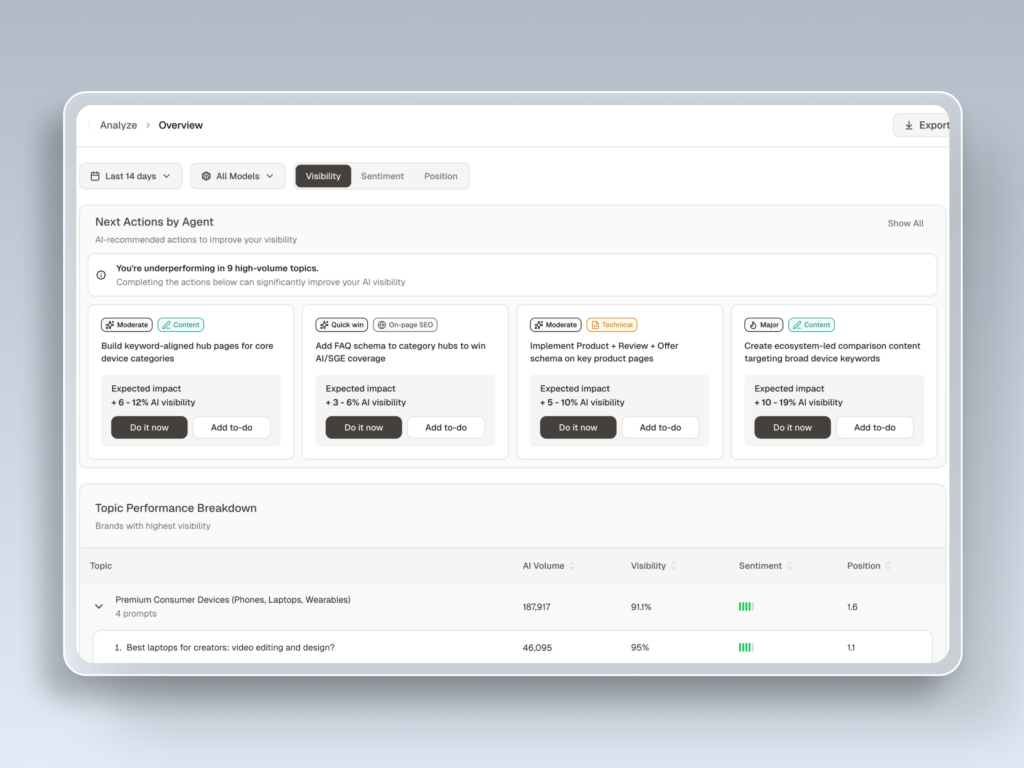
Platforms also make sense the moment you’re managing more than one brand or client. A comprehensive GEO analytics approach that pulls visibility, sentiment, position, and competitor data into a single dashboard lets a lean team monitor several accounts without hiring proportionally. For an in-house marketer, that means catching a drop in ChatGPT mentions the same week it happens instead of finding out in next month’s report. For a marketing agency, it means finally having something concrete to show a client when they ask how their AI visibility compares to a competitor’s, instead of guessing.
The one-click execution model that some platforms now offer pushes this further: you state a visibility goal in plain language, review the suggested strategy, and deploy it, which narrows some of the gap between “we have the data” and “someone acted on it.”
Why the Smartest Teams Run Both
The agency-versus-platform framing breaks down once you notice that agencies themselves are increasingly buying platforms to manage their own client reporting. A GEO agency without visibility software is running on the same guesswork it’s charging clients to eliminate.
In practice, the pairing that works looks like this: a platform handles ongoing monitoring, competitor benchmarking, and alerting, while either an internal team or an agency handles the content and technical execution that the data points to. You’re not choosing between insight and action. You’re deciding who does the action, and a platform is what tells both sides whether it’s working.
Conclusion
The decision isn’t agency versus platform. It’s whether you already have people who can act on GEO data, and how many brands or clients you need to track at once. If you have execution capacity but no visibility, start with a platform, the cost is a rounding error next to a single agency retainer. If you have visibility but no one to act on it, that’s when an agency’s headcount earns its price. Most teams that get this right end up running a platform first, then adding agency support for the specific gaps the data exposes.
FAQ
Q: Is a GEO agency worth it for a small brand?
A: Usually not as a first step. Small business GEO programs run $1,500 to $3,000 a month at the low end, and that budget often goes further on a platform plus a few hours of internal content work than on a minimal agency retainer.
Q: How much does GEO cost in 2026?
A: Tools and platforms typically run $10 to $1,000+ a month. Agency retainers range from about $1,500 a month for small businesses to $50,000+ a month for enterprise programs, depending on scope and content volume.
Q: Can I use a GEO platform without hiring an agency?
A: Yes. A platform gives you the visibility and competitor data. Whether you act on it with an internal team or bring in outside help is a separate decision, not a requirement of using the tool.
Q: What’s the difference between a GEO agency and a traditional SEO agency?
A: A traditional SEO agency optimizes for search engine rankings and backlinks. A GEO agency focuses on how AI systems like ChatGPT and Google AI Overviews cite, describe, and recommend your brand, which often calls for different content structures and entity signals than classic SEO.

