
Years of SEO checklists taught teams to add FAQPage markup to almost any question-and-answer section. That habit now needs review. Google’s documentation update log says FAQ rich results stopped showing on May 7, 2026, and the related documentation was removed in June. The change does not make every FAQ section useless, and it does not automatically require every JSON-LD block to be deleted. It does remove the primary Google Search feature many teams expected the markup to unlock. The right response is a cost-and-purpose audit: keep useful questions for people, maintain schema only when it has a supported consumer and accurate data, and stop measuring a result that no longer exists.
What Google Deprecated
Google’s Search documentation update log records that FAQ rich results stopped appearing on May 7, 2026. Google later removed the FAQ structured-data documentation in June.
This means publishers should no longer expect FAQPage markup to produce an FAQ rich result in Google Search. Older case studies, plugins, and optimization checklists may still describe the feature as active, so teams need to update their guidance and reporting.
The deprecation concerns Google’s display feature. Schema.org vocabulary can continue to exist, and other systems may interpret structured data differently. That distinction matters, but it is not a reason to preserve unused markup automatically.
Separate FAQ Content From FAQ Markup
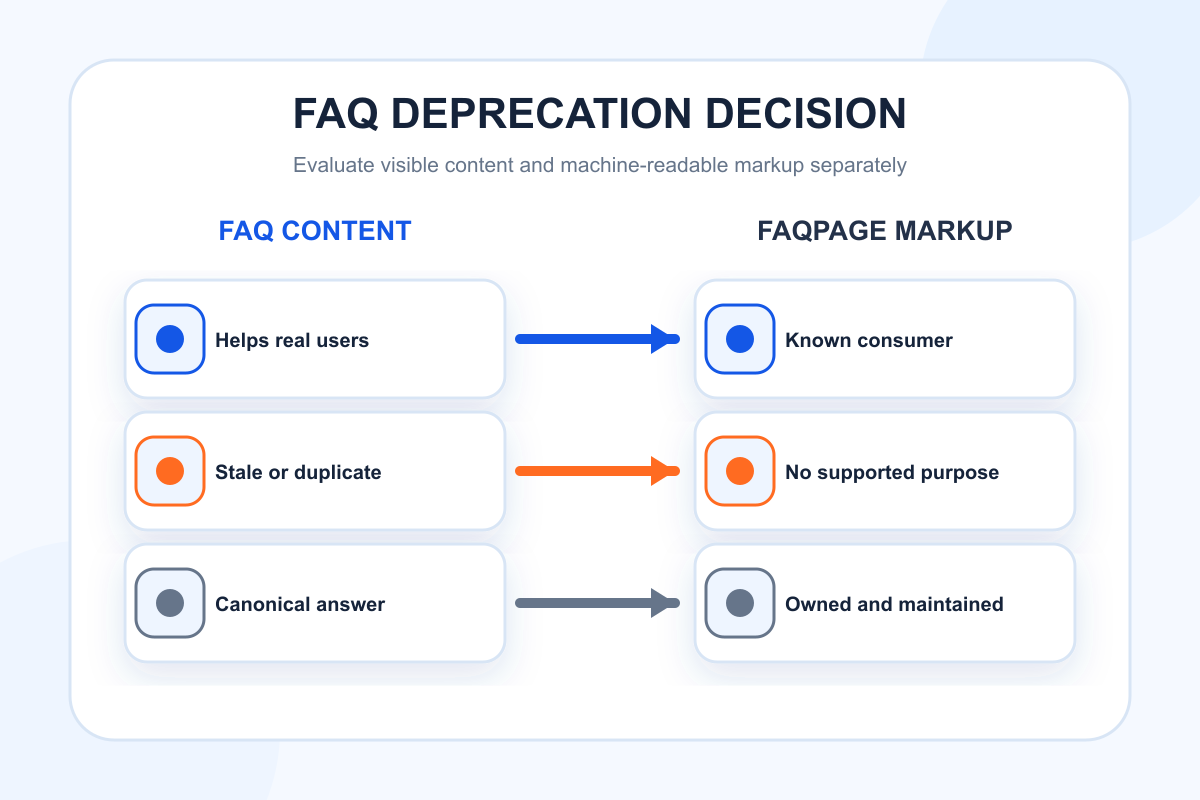
An FAQ section is visible content designed to answer recurring questions. FAQPage markup is a machine-readable description of that content. The two should be evaluated separately.
Keep the visible content when it helps a real user make a decision, complete a task, understand a limitation, or resolve a recurring concern. Rewrite or remove it when the answers are duplicated, shallow, outdated, or created only to occupy more result-page space.
Evaluate the markup based on current use:
| Situation | Visible FAQ content | FAQPage markup |
|---|---|---|
| Questions resolve real customer friction | Keep and maintain | Keep only with a documented consumer or purpose |
| Answers duplicate the main article | Consolidate into the article | Remove redundant markup |
| Content is stale or inaccurate | Correct or remove | Remove until accurate |
| Markup exists only for Google FAQ rich results | Keep content if useful | Usually remove from the maintenance scope |
| Another verified system consumes it | Keep if useful | Maintain and document the dependency |
Audit Where FAQ Schema Exists
Start with an inventory. Search templates, tag-manager injections, CMS plugins, and rendered HTML for FAQPage, Question, and acceptedAnswer. Identify which component creates the markup and which page types receive it.
Include pages that were recently migrated or redesigned. Legacy markup can survive in cached fragments, block patterns, localization templates, or third-party scripts even after the visible FAQ component has disappeared.
For each implementation, record:
- URL or template.
- Content owner.
- Markup generation source.
- Visible question-and-answer match.
- Last substantive review date.
- Known consumer or business purpose.
- Removal risk and test plan.
Template-level markup deserves special attention because one obsolete rule can affect thousands of pages. Also check cached pages, localized templates, and legacy landing-page builders. A CMS setting may appear disabled while a server-side component continues to emit JSON-LD.
Do not delete code until you understand whether another feature, application, or partner uses it. The goal is not maximum removal. It is eliminating unsupported complexity without breaking a real dependency.
Decide When to Keep the Markup
Keep FAQPage markup when the visible content is accurate and the organization has a documented reason to maintain it. A verified downstream consumer, internal knowledge pipeline, syndication requirement, or cross-platform data product may provide such a reason.
Assign an owner and validation method. The owner should know that Google FAQ rich results are no longer the expected benefit. The markup should continue to match the visible question and answer. If an answer changes, update both surfaces through the same content source when possible.
Do not retain markup because “structured data might help AI” without evidence. Machine-readable content can be useful, but a vague future benefit does not justify an unowned maintenance burden. Google says its AI search features do not require special schema beyond accurate structured data that matches the page.
Decide When to Remove It
Removal is reasonable when the markup was added solely for the discontinued Google rich result, has no known consumer, or frequently drifts from the visible page. Removing it can reduce template complexity, validation noise, deployment risk, and false expectations in reporting.
Remove the generating rule rather than manually deleting output from individual pages. Test representative URLs before and after the change. Confirm that other Article, Product, Organization, Breadcrumb, or VideoObject markup remains intact.
If a plugin controls the markup, check whether disabling the FAQ option also alters visible blocks or other schema. Back up configuration and use a staging environment. Record the decision so a future team does not reintroduce the feature from an outdated checklist.
Rewrite FAQ Content for User Value
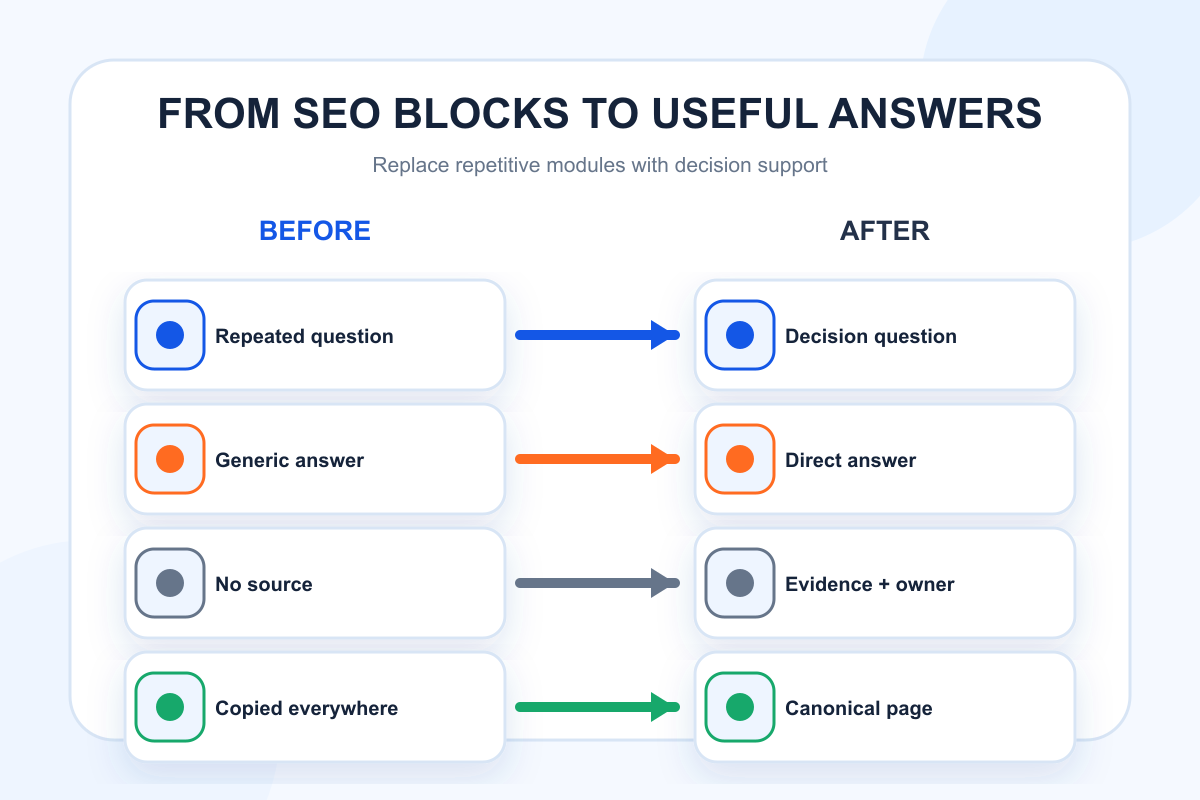
Deprecation is a useful moment to improve the visible section. Place questions close to the decision or task they support. Use the wording customers actually use. Answer directly in the first sentence, then add evidence, conditions, steps, or links.
Avoid repeating the same question across every article. Sitewide boilerplate creates duplication and often becomes stale. Product-wide questions belong on maintained product or support pages. Article-specific questions should resolve uncertainty created by that article.
Topify’s Prompt Discovery can help teams explore the questions people ask around a category. Support tickets, sales calls, on-site search, and customer interviews remain valuable sources. Combine these signals, then choose questions based on user impact rather than search volume alone.
Update Measurement and Reporting
Remove FAQ rich-result impressions, clicks, and appearance goals from current dashboards if they imply the Google feature is still active. Preserve historical data with a clear annotation for May 7, 2026 so trend reports do not confuse a product deprecation with an editorial failure.
Replace the old metric with outcomes tied to the content’s real job:
- Expansion or interaction with FAQ sections, if measured responsibly.
- Reduced support contacts for answered questions.
- Higher task completion or conversion after key answers.
- On-site search refinement.
- Organic landing performance for the page as a whole.
- Prompt-level citations or mentions where observable.
Topify’s AI Search Analytics can help measure brand and source visibility in AI answer environments. Do not attribute an AI citation to FAQPage markup without direct evidence. The answer content, page authority, source quality, and query fit may all contribute.
Create a Governance Rule for Deprecated Markup
Document three things: who decides whether deprecated schema remains, what evidence justifies it, and how often the decision is reviewed. Add deprecation checks to structured-data audits so templates do not accumulate abandoned properties.
Monitor official documentation and change logs rather than relying on third-party schema lists. When a search feature changes, update editorial guidelines, CMS defaults, QA scripts, dashboards, and stakeholder expectations together.
This governance principle extends beyond FAQ markup. Structured data is production code attached to public claims. Every type should have an owner, purpose, source of truth, and retirement path.
Conclusion
FAQ schema after rich result deprecation should be treated as a maintenance decision, not a panic deletion or speculative ranking tactic. Keep useful question-and-answer content because it serves people. Keep markup only when a current purpose and owner justify it. Remove unsupported template complexity carefully, annotate historical reporting, and measure the outcomes the content still creates. The feature ended, but the need for clear answers did not.
FAQ
Does Google still show FAQ rich results?
Google’s update log says FAQ rich results stopped showing on May 7, 2026, and the documentation was later removed.
Must every site remove FAQPage markup?
No. Review whether another verified consumer or business process uses it. Remove it when no supported purpose justifies the maintenance cost.
Can a site keep the visible FAQ section?
Yes. Useful FAQ content can still help users understand decisions, tasks, limitations, and policies even without a Google FAQ rich result.
Will FAQ schema improve AI citations?
There is no general guarantee. Google does not require special AI schema, and citation outcomes depend on broader content, source, and query factors.