
The end of Google’s FAQ rich results removes one incentive for question-and-answer content, but it does not remove the questions. Buyers still want to know whether a product fits, what it costs, how it works, where it fails, and what happens next. AI answer systems also need clear source passages that resolve specific subquestions. The mistake is to turn every page into a repetitive FAQ warehouse. Effective FAQ content for AI answers begins with real user uncertainty, answers it directly, provides evidence and limits, and places the answer where it belongs in the journey. The objective is usefulness and retrieval clarity, not a vanished visual enhancement.
Start With Questions People Actually Ask
Collect questions from support tickets, sales calls, customer interviews, community discussions, on-site search, product analytics, and AI prompt research. Preserve the user’s natural wording during collection, then group variants by intent.
For example, “Does this work in Europe?”, “Which countries are supported?”, and “Can our German team use it?” may share a regional-availability intent. The final content should answer the real decision and include any relevant conditions, rather than publishing three near-duplicate entries.
Prioritize questions using three criteria:
- Frequency: how often the uncertainty appears.
- Impact: whether the answer changes a decision or prevents failure.
- Answerability: whether the organization has a reliable source of truth.
Topify’s Prompt Discovery can help reveal category-level questions appearing in AI search. Combine that view with first-party customer evidence so the section reflects both market language and actual product friction.
Match Each Question to the Right Page
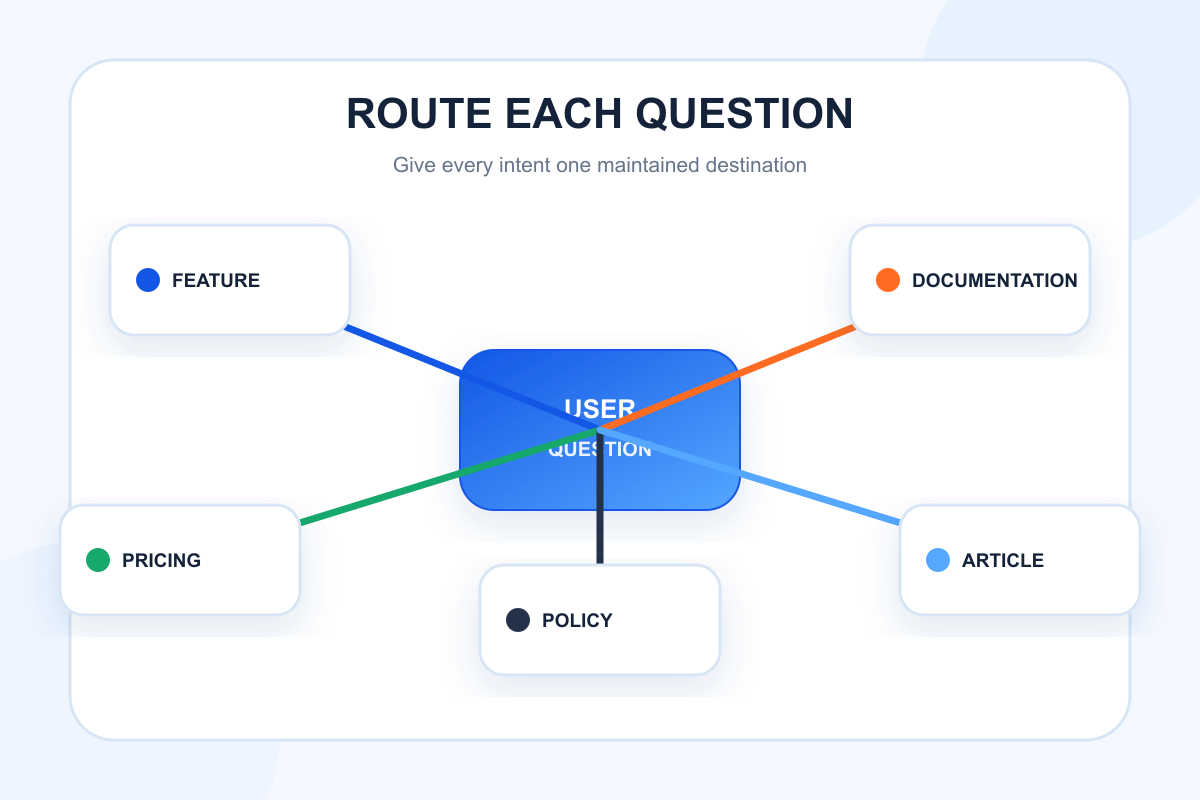
Not every question belongs at the bottom of a blog article. Put pricing questions on pricing or plan pages, implementation questions in documentation, policy questions on maintained policy pages, and article-specific questions near the relevant analysis.
| Question intent | Best destination | Maintenance owner |
|---|---|---|
| Product capability | Feature or product page | Product marketing |
| Setup or troubleshooting | Documentation or support | Product or support team |
| Price and contract | Pricing or procurement page | Revenue operations |
| Policy or eligibility | Official policy page | Legal or operations |
| Topic explanation | Article or knowledge guide | Editorial team |
This structure reduces duplicate answers and makes the authoritative source easier to identify. If several pages need the same answer, write a short contextual summary and link to the maintained source instead of copying the full block everywhere.
Write an Answer-First Passage
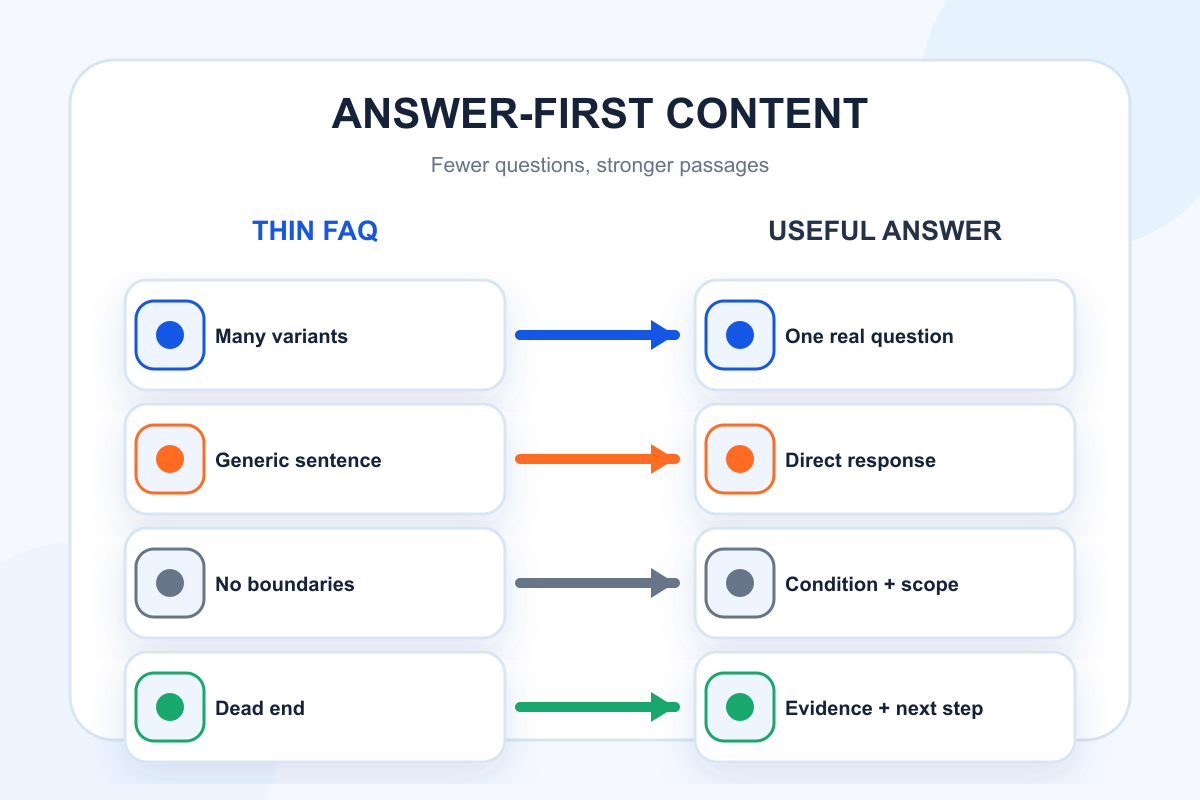
Begin with the answer, not a paragraph of setup. Name the product, entity, metric, or condition explicitly. Then add the minimum evidence, explanation, and limitation needed to make the answer trustworthy.
A reliable pattern is:
- Direct answer in one or two sentences.
- Essential condition or exception.
- Evidence, method, or source.
- Next step or deeper link.
Weak answer: “There are several factors to consider, and every situation is different.”
Stronger answer: “Topify measures AI visibility across a defined set of prompts and answer platforms. Results depend on the selected prompts, market, and measurement window, so teams should keep those inputs stable when comparing trends.”
The stronger version resolves the basic question while preserving an important limitation. It can also stand as a useful passage if retrieved outside the full page.
Add Evidence and Scope
Questions about dates, compatibility, pricing, legal rules, performance, or technical behavior need a source of truth. Link to primary documentation, identify the effective date when it matters, and separate confirmed facts from inference.
Scope is equally important. State the plan, region, platform, version, or user role to which the answer applies. Avoid universal language when the source supports only one case. If the answer changes frequently, assign an owner and update trigger.
For original data, explain the sample, collection window, and method. For comparisons, state the criteria. For recommendations, explain the circumstances under which the recommendation changes. These details make the answer more reliable for people and easier to interpret when a system extracts it.
Use Headings and Internal Links as Retrieval Cues
A descriptive question heading helps both scanning and passage-level retrieval. Prefer “Does Topify track citations by URL?” to “How does it work?” Keep the answer immediately below the question so the relationship is clear.
Use internal links to connect the concise answer to a full explanation. Anchor text should describe the destination. “See how AI citation tracking works” is more useful than “learn more.” Avoid chains where a user must open several pages to reach the official answer.
Google’s AI features documentation says that AI Overviews and AI Mode rely on standard Search eligibility and may use query fan-out across related subtopics. Clear headings and task-specific pages support a coherent site, but there is no special FAQ or AI markup that guarantees retrieval.
Avoid Thin and Repetitive FAQ Blocks
Do not add questions merely to capture long-tail variations. Ten one-sentence answers that repeat the page introduction create more noise than value. Combine overlapping questions and expand the ones that change a user’s decision.
Avoid copying a standard sitewide FAQ into every article. Repetition can create conflicting versions when facts change. It also obscures the unique purpose of the page.
Review AI-assisted drafts carefully. Generated FAQs often invent plausible limitations, repeat generic advice, or phrase questions nobody asks. Verify every factual answer and remove entries that exist only because the template expects a fixed count.
Do not hide key facts exclusively inside accordions if the implementation prevents the content from rendering or being accessible. Test keyboard interaction, focus, headings, and HTML output. A visual accordion is a presentation choice, not a substitute for semantic content.
Treat Structured Data as Optional Infrastructure
Google stopped showing FAQ rich results in May 2026 and later removed the related documentation, as recorded in the Search documentation update log. Do not add FAQPage markup expecting that Google feature.
If another verified system consumes the schema, the organization may keep it as maintained infrastructure. The markup must match visible content and should have an owner, source of truth, and test. If no active consumer exists, removing it can reduce template complexity without reducing the value of the visible answers.
The safest principle is simple: write content for the user, use structured data for a documented machine use, and do not confuse either with a guaranteed AI citation.
Measure Helpfulness and AI Visibility Separately
Measure whether the answers improve the user journey. Useful indicators include reduced support contacts, successful task completion, fewer repeated sales objections, engagement with deeper documentation, and conversion after high-impact questions.
Separately monitor whether the page or passage appears in relevant AI answers. Record the prompt, answer environment, cited URL, date, and response variation. Topify’s AI Search Analytics can help teams monitor brand and source visibility, while AI Citation Analysis can help identify which domains and pages receive citations.
Do not assume causation from a visibility change. A revised answer may help, but freshness, authority, competing sources, technical eligibility, and model behavior also influence output. Use a stable prompt set and compare trends over time.
Build a Quarterly FAQ Maintenance Loop
Each quarter, review high-impact questions against support data, product changes, and source documents. Remove questions that no longer occur, merge duplicates, update changed facts, and move answers to a more authoritative page when needed.
Maintain a simple register with the question, canonical URL, owner, source of truth, last review date, and next trigger. Product launches, price changes, policy updates, and regional expansions should trigger immediate review rather than waiting for the calendar.
This process turns FAQ content from an SEO attachment into a distributed knowledge layer. It supports customers, sales, support, search, and AI retrieval because every important answer has a maintained home.
Conclusion
FAQ content for AI answers works best when it stops behaving like a rich-result tactic. Find real questions, route each one to the right page, answer directly, provide evidence and scope, and link to the next useful action. Keep structured data only for a documented purpose and measure customer outcomes separately from AI visibility. Clear answers remain valuable even when the old search enhancement is gone.
FAQ
How long should an FAQ answer be?
Use the shortest answer that resolves the question accurately. Add conditions, evidence, and a deeper link when the decision requires them.
Should every blog article include an FAQ section?
No. Include one only when the article creates or attracts recurring questions that are not better answered elsewhere.
Does FAQ content need FAQPage schema?
No. Visible question-and-answer content can be useful without FAQPage markup, especially after Google ended FAQ rich results.
Can clear FAQ answers earn AI citations?
They may be retrieved or cited when relevant, but there is no guarantee. Source credibility, technical eligibility, competing content, and query fit also matter.