


An engineer runs a forum page through a validator and gets a clean result. The markup is syntactically correct, but it lists the publisher as the author, omits half the visible replies, and keeps a deleted post active. The page passes a tool while misrepresenting the discussion.
Discussion forum schema is useful only when it reflects the live user-generated content and its relationships. Choosing the right type, preserving authorship, synchronizing interactions, and representing edits or removals matter more than producing a large JSON-LD block. Search systems may use the markup to understand discussions, but valid schema never guarantees a feature or an AI citation.
Discussion Forum Schema Can Still Misrepresent a Discussion
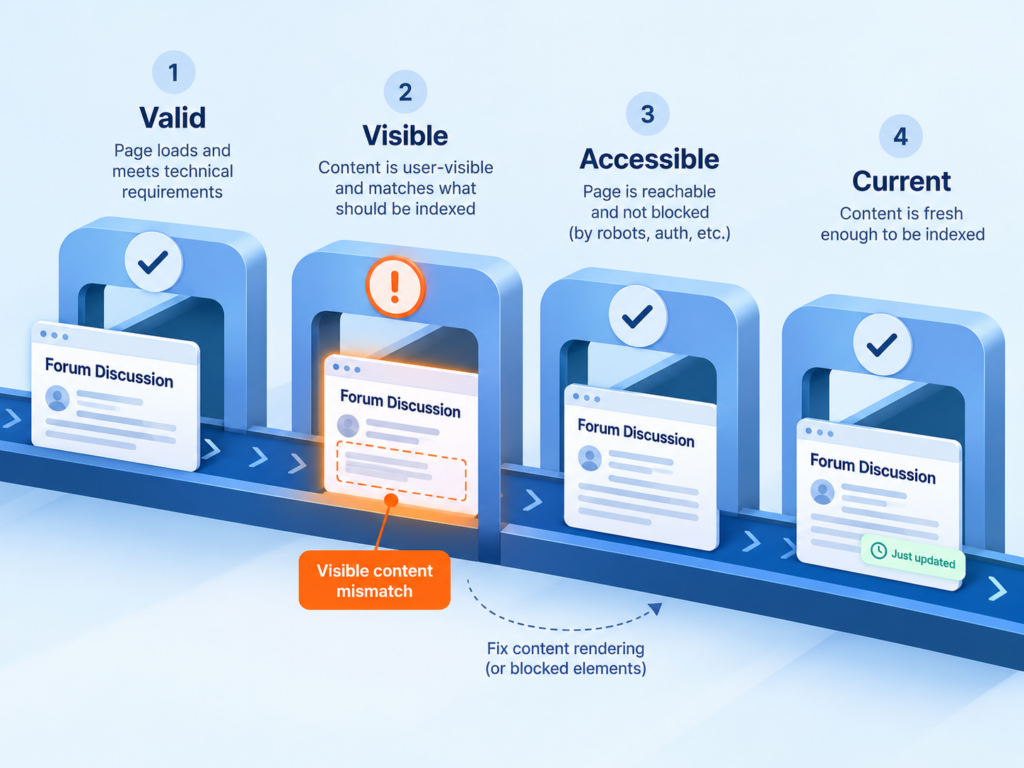
Google’s general structured data guidelines distinguish technical validity from content quality. Markup must represent visible page content, remain current, and avoid misleading or hidden information.
A forum implementation should therefore pass three tests:
- Syntax: Is the markup valid and are required properties present?
- Semantic fidelity: Does it describe the same authors, content, dates, and interactions that users see?
- State fidelity: Does it update when posts are edited, deleted, moderated, or moved?
Automated validators mainly support the first test. The second and third require comparison with the rendered page and the platform’s source of truth.
Do not use schema as a place to publish richer claims than the page. Hidden reputation scores, inferred expertise, or interaction counts that differ from the UI can create a misleading machine-readable version.
Choose DiscussionForumPosting or SocialMediaPosting by Page Type
Google says DiscussionForumPosting should describe a user-generated forum post. It should not be used for publisher-authored articles, even when those articles have comments, or for product-review pages.
SocialMediaPosting is the parent type and can fit a general social platform. Google applies the same documented requirements, while noting that most forums will find DiscussionForumPosting more appropriate.
Question-and-answer communities need another decision. When the structure is primarily a question with answers, Google recommends Q&A markup. A broad discussion that is not organized around accepted answers fits the forum type better.
| Page pattern | Likely type | Reason | Common mistake |
|---|---|---|---|
| User starts an open discussion thread | DiscussionForumPosting | Original user post anchors a conversation | Marking the publisher as author |
| General social post with replies or media | SocialMediaPosting | Social posting is the broader parent type | Treating every post as a forum thread |
| Question with community answers | Q&A markup | Page has a question-answer structure | Using forum schema and losing answer semantics |
| Publisher article with comments | Article plus supported comment modeling | Main content is publisher-authored | Marking the article as UGC |
| Product review page | Relevant review or product markup | Review intent has separate policies | Using forum schema because users wrote reviews |
Choose the type before designing the template. A wrong type cannot be fixed by adding more properties.
Represent Authors With Stable Public Profiles
Google requires an author and author.name for a forum post. It recommends author.url as a unique link to a profile page and suggests following its profile and author markup practices.
Use a stable internal account identifier to connect the post and profile. Display names can change, and two users can share the same name. The public profile URL supplies a durable relationship without exposing private account details.
Model organizations as authors only when the organization actually created the user post. Do not assign the site operator as a default author merely because the template requires a value.
When profiles are deleted or suspended, preserve authorship context according to policy. A neutral tombstone can maintain thread structure without publishing private or disputed identity details.

Update Interaction Statistics Without Breaking Trust
Google’s current DiscussionForumPosting documentation supports several interaction types, including likes, dislikes, views, comments or replies, and certain share counts for comments.
Publish only the metrics your interface actually shows and your source of truth can reproduce. A model should not infer “engagement” and select a convenient schema action without a defined mapping.
Generate visible counts, markup, and feeds from the same trusted aggregate. When spam filtering removes votes or views, update all representations through one event.
Counters need a documented refresh cadence. Real-time updates may be appropriate for small, trusted communities, while high-abuse environments may require delayed confirmation. The schema should show the trusted public state, not the raw event stream.
Do not translate a composite score into likes or views. If the platform calculates a proprietary quality score, keep it outside supported interaction properties unless the schema explicitly provides a truthful mapping.
Keep Markup Synchronized With Visible Thread State
Google requires each represented forum post and comment to include the full text when that text appears on the page. Partial excerpts in markup can distort the conversation.
For paginated discussions, model the items actually available on each page and preserve stable URLs. Do not place the full hidden thread in schema when users cannot access it from that page.
Use dateModified when a post or comment changes, rather than overwriting the original publication date. When a deleted item remains necessary for thread context, Google’s documentation supports setting creativeWorkStatus to Deleted.
AI-generated or automated forum content deserves explicit treatment. The current documentation supports digitalSourceTypevalues for content created by a trained model or a simpler algorithmic process. If the property is omitted, Google says it assumes the content is human-generated.
That creates a clear policy requirement: know whether bots or models post on the platform, preserve their identity, and label their content consistently. Do not let an automated support agent appear as an ordinary human member.
Validate Accessibility, Indexability, and Schema Together
Schema cannot rescue a page that users or crawlers cannot reach. Google recommends making the page accessible, avoiding blocking through robots.txt or noindex, and using sitemaps to communicate future changes.
Run one release checklist across the full path:
- the public page loads without an inappropriate login requirement;
- canonical URLs and pagination are correct;
- visible post, comment, and profile relationships match the markup;
- required fields are present and supported values are used;
- the final production HTML contains the expected markup;
- the page and referenced media are crawlable;
- moderation, edit, and deletion events update the markup;
- Search Console monitoring is assigned after deployment.
The AI Robots Checker from Topify can provide a quick vendor-described check of crawler directives. It does not replace direct inspection of the effective robots.txt, page-level directives, authentication, or Google’s own tools.
Measure Whether Structured UGC Becomes a Cited Source
After deployment, monitor valid and invalid items, indexing, search appearances, clicks, and average position in Search Console where the relevant reports are available. Google recommends checking after initial deployment and after significant template changes.
Add answer-level observation only as a separate layer. Citation monitoring can show whether a forum URL appears in selected AI answers and whether another source is preferred. It cannot prove that schema caused the citation.
Record the deployment date, recrawl date, feature appearance, cited URL, prompt, and competing sources. Mark observations separately from inferences.
If citations do not appear, do not add more markup blindly. Investigate content usefulness, public access, source reputation, canonicalization, answer intent, and whether the page provides first-hand information that another source lacks.
Conclusion
DiscussionForumPosting schema helps search systems interpret UGC only when the markup mirrors the real discussion. The hard work is not generating JSON-LD. It is choosing the right type, preserving authorship, mapping trusted interactions, and updating edits, deletions, moderation, and automated content consistently.
Build the model from the platform’s source of truth, validate the production output, and review visible-page fidelity alongside syntax. Keep pages accessible where public discovery is intended, and monitor outcomes without treating feature appearance or citation as guaranteed. Accurate markup gives systems a clearer description of the conversation. It does not replace the quality, authenticity, and usefulness of the conversation itself.
FAQ
What is DiscussionForumPosting schema?
It is schema.org markup supported by Google for user-generated forum posts and their authors, dates, comments, interactions, edits, and related state.
When should I use SocialMediaPosting instead?
Use it for a general social platform when that broader type better describes the content. Google applies the same requirements and says most forums will find DiscussionForumPosting more appropriate.
How should interactionStatistic be updated?
Map only supported actions to trusted public counts, generate visible and machine-readable values from the same source, and refresh them according to a documented cadence.
Does forum schema help content appear in AI answers?
It can help systems understand a page, but no official documentation guarantees an AI citation. Content quality, access, relevance, source selection, and other factors still apply.