

Your brand ranks on Google. Your content gets indexed. Your SEO team has the metrics to prove it. Then a developer in Jakarta opens DeepSeek, types in a category query, and gets a curated answer that cites three vendors. You’re not one of them.
That’s not a Google problem. That’s a DeepSeek V4 problem, and most marketing teams don’t even know it exists yet.
DeepSeek V4 Isn’t Just Another Model Upgrade
Released on April 24, 2026, DeepSeek V4 isn’t a minor iteration. It’s an architectural overhaul that moves the model from “impressive chatbot” to functional search infrastructure.
The headline change is the 1-million-token default context window, powered by a new attention mechanism called DeepSeek Sparse Attention (DSA). But what makes this matter for brand visibility isn’t the context size. It’s what the model does with it: multi-stage retrieval, real-time web crawling, and transparent reasoning traces that explain exactly which sources it trusted and why.
DeepSeek V4 comes in two variants. The V4-Pro carries 1.6 trillion total parameters with 49 billion active. The V4-Flash runs 284 billion total with 13 billion active. Both use the same DSA architecture and, critically, both are cheaper to run than every major Western competitor, which is driving enterprise adoption faster than most analysts predicted.
This isn’t a curiosity. It’s infrastructure.
The Search Engine Nobody Called a Search Engine
Here’s the thing most marketers miss: users don’t experience DeepSeek V4 as a search engine. They type a question, read an answer. But from a brand visibility standpoint, what happens in between is pure search behavior.
When a user prompts DeepSeek V4 with a category-level question, the model runs a structured multi-stage process. It decomposes the query into semantic keywords, ranks web sources by authority, crawls the selected URLs in real time, and synthesizes a response through a chain-of-thought reasoning engine. The output isn’t just an answer. It’s a recommendation.
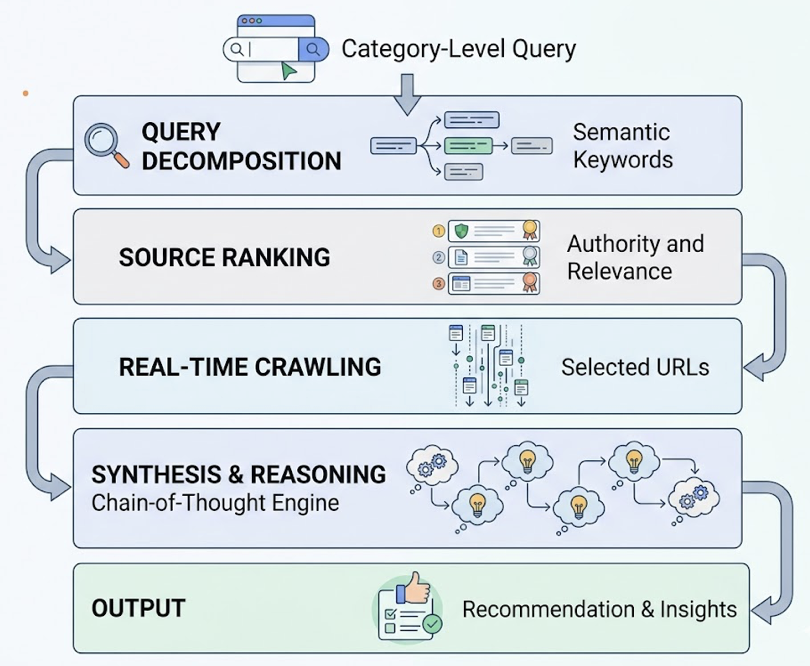
And unlike Google’s ten blue links, that recommendation is singular. There’s no page two. Either your brand appears in the reasoning trace, or it doesn’t.
That’s the new SERP. A brand’s visibility is now determined by whether it gets cited as a grounding source in an AI’s reasoning chain, not whether it ranks for a keyword.
DeepSeek V4’s Geographic Reach Changes the Visibility Math
Most Western brands still think of DeepSeek as a China-centric product. That’s already wrong.
By the end of 2025, DeepSeek had 130 million active users, with China, India, and Indonesia together accounting for 51.24% of monthly active users. Russia showed significant adoption at 9% of app downloads. Even the United States accounted for 4.34% of MAUs, and France at 3.21%.
The demographic profile is where things get serious. 44.9% of Android users and 38.7% of iOS users fall into the 18-24 age bracket. This is the next generation of technical buyers, procurement managers, and startup founders. They’re not Google-first. In many markets, they’re DeepSeek-first.
For any brand selling to global markets, particularly across Asia-Pacific, this isn’t an optional monitoring target. It’s a visibility gap that’s already costing them consideration at the top of the funnel.
What Your Brand Actually Looks Like Inside DeepSeek V4
The way DeepSeek V4 evaluates and recommends brands is fundamentally different from Western AI platforms. Understanding this changes how you think about optimization.
The model weights brand recommendations across five dimensions: relevance to the query (30%), reviews and reputation from platforms like Google and Trustpilot (25%), institutional authority from academic sites and GitHub (20%), content recency with a preference for data updated within 24 months (15%), and local grounding via regional directories (10%).
That 20% institutional authority weighting is where most brands fall short. DeepSeek draws 24.5% of its citations from government and academic sources, a rate six times higher than Western AI platforms at 4.1%. It references an average of only 211 unique domains across thousands of responses, compared to Gemini’s 2,300. And it averages 0.8 citations per response, compared to 15 for Gemini and 8.2 for Perplexity.
What this means in practice: getting one citation from a domain DeepSeek trusts is worth more than a hundred mentions on mainstream content sites. The model operates on signal authority, not signal volume.
There’s also the transparency factor. DeepSeek V4 shows users its reasoning trace. If the model considered your brand and rejected it because of “opaque pricing” or “insufficient technical documentation,” that rejection is visible. In a B2B or developer context, that’s a deal lost before a salesperson is ever involved.
The Multi-Platform Problem Nobody’s Actually Solving
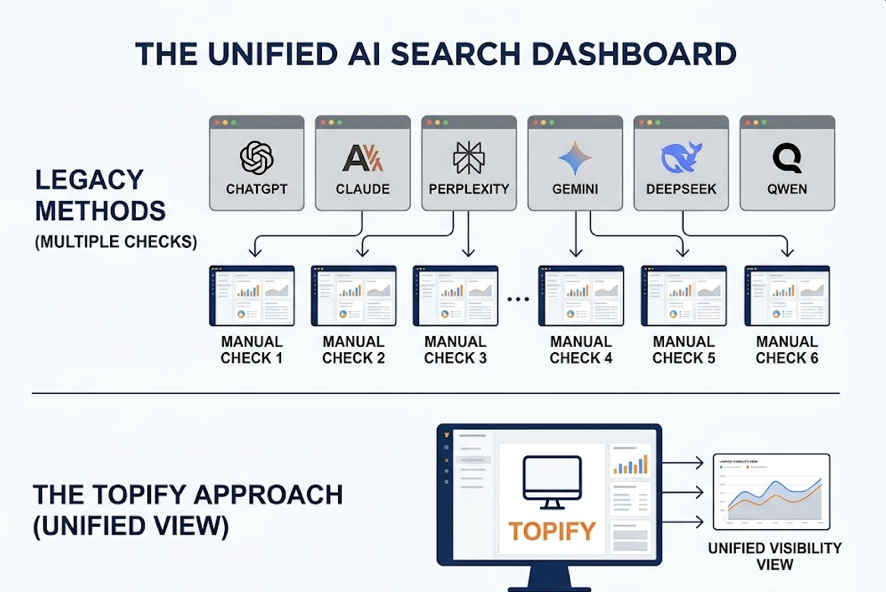
Most brand teams are barely tracking their visibility on ChatGPT. DeepSeek V4 is now the fifth or sixth AI surface that carries meaningful search traffic, each with different citation logic, different authority signals, and different geographic reach.
Managing this manually isn’t a bandwidth problem. It’s a structural impossibility.
Traditional SEO tools scrape web rankings. GEO requires simulating AI behavior to understand synthesis. A brand can rank first on Google for a target keyword and be completely absent from every AI-generated answer in that category. The metrics don’t overlap.
This is where Topify addresses a gap that legacy tools can’t fill. The platform tracks brand visibility across ChatGPT, Claude, Perplexity, Gemini, DeepSeek, and Qwen from a single dashboard, giving marketing teams a unified view of AI search performance rather than six separate manual checks.
What makes it actionable for DeepSeek specifically is the citation analysis layer. Topify reverse-engineers which exact URLs and domains DeepSeek is citing in your category, surfacing the specific third-party sources that are driving competitor recommendations. That’s the intelligence you need to run an institutional authority strategy, not just a content strategy.
The platform’s Sentiment Analysis scores brand presence from -100 to +100, flagging early-stage misrepresentations before they propagate across the open-source model ecosystem. DeepSeek’s 95.6% neutral brand mention rate sounds benign, but when the model includes a “caveat” about a brand’s technical limitations in its reasoning trace, that caveat becomes the story.
How to Build DeepSeek V4 Into Your AI Visibility Stack
The optimization playbook for DeepSeek V4 looks different from ChatGPT or Gemini. Here’s what actually moves the needle.
Refactor content for information density. DeepSeek rewards fact-heavy content and penalizes marketing language. Strip superlatives and replace them with verifiable specifications. Structure key pages in Q&A format. The model is more likely to lift structured, factual content directly into its synthesis than narrative brand copy.
Build authority on the right external platforms. Given DeepSeek’s heavy weighting of GitHub, Stack Overflow, and academic papers, brands in technical categories need presence on these domains. A white paper cited by a university research page carries more weight in DeepSeek’s citation math than a hundred blog posts on news sites.
Optimize for all three reasoning modes. DeepSeek V4 operates in Non-Think mode for routine queries and Think High or Think Max for complex due diligence. Brands that are visible in Non-Think but absent in Think Max are failing at the exact moment a technical decision-maker is doing serious evaluation. Benchmark across all three modes.
Implement machine-readable structured data. DeepSeek agents are increasingly handling queries autonomously. Clean API documentation, JSON-LD pricing tables, and entity disambiguation on platforms like GitHub Organizations reduce the risk of hallucinated pricing or misattributed features, which can propagate across the entire open-source ecosystem downstream.
Topify’s One-Click GEO Execution automates several of these fixes, generating and deploying technical updates like JSON-LD additions or technical FAQ updates directly to your site. That matters because the gap between “we know what to fix” and “we actually fixed it” is where most GEO programs stall.
What to Fix Before the Next Model Drops
DeepSeek V4 won’t be the last model to reshape the discovery landscape. The trend toward sovereign AI, where countries in South Asia and Africa prioritize open-source models over US proprietary systems, means new surfaces will keep appearing, each with their own citation logic and authority signals.
The brands that stay ahead aren’t optimizing for platforms. They’re managing knowledge graphs.
That means weekly Share of Voice reports tracking citation growth across AI platforms, not just keyword rankings. It means cross-functional coordination between PR, SEO, and community teams, because a sentiment drop on Reddit will manifest as a visibility drop in the next AI crawl. DeepSeek’s 15% recency weighting means critical landing pages and service documentation need refreshing at least every 12 months to avoid being flagged as outdated during the model’s retrieval process.
The platform fragmentation problem will get worse before tooling catches up. Right now, the brands building multi-platform tracking infrastructure have a compounding advantage. Each month of data creates a benchmark. Each benchmark makes it easier to spot drift when a model retrains.
That’s the real argument for moving now, not when DeepSeek V4 becomes impossible to ignore.
Conclusion
DeepSeek V4 launched on April 24, 2026, and within days it was handling queries for 130 million users across every major global market. From a brand visibility standpoint, that’s 130 million potential discovery moments that most marketing teams aren’t measuring, optimizing, or even monitoring.
The citation math is concentrated and institutional. The geographic reach hits exactly the markets where traditional Google SEO has always been weakest. And the model’s transparent reasoning traces mean that a negative signal doesn’t just cost you a mention. It costs you the consideration stage entirely.
The window to establish authority on DeepSeek V4 before it becomes the default discovery engine for the global technical community is still open. Get started with Topify to see where your brand stands across DeepSeek and the other major AI platforms before your competitors figure out the same question.
FAQ
Q: Is DeepSeek V4 a search engine or a chatbot?
A: It functions as both, but from a brand marketing perspective, it’s a search surface. DeepSeek V4 uses multi-stage retrieval-augmented generation to query the web, evaluate sources, and synthesize recommendations. Users experience it as a chat interface, but brands are being discovered, cited, or ignored in exactly the same way they would be in any search-driven context. The key difference is that the output is a single synthesized answer rather than a list of links, which makes citation even more consequential.
Q: Does DeepSeek V4 recommend brands differently than ChatGPT?
A: Yes, significantly. DeepSeek V4 has a strong institutional trust bias, citing government and academic sources at six times the rate of Western AI platforms. It references a much narrower domain set, around 211 unique domains, compared to Gemini’s 2,300+. It also provides transparent reasoning traces, so users can see exactly why one brand was recommended over another. This makes authority signals far more important than content volume in DeepSeek’s visibility ecosystem.
Q: How do I know if my brand appears in DeepSeek V4 answers?
A: Manual spot-checking is unreliable. DeepSeek’s responses vary by reasoning mode, geographic region, and query phrasing. Unified GEO platforms like Topify automate this by simulating thousands of prompts across multiple modes and generating a Visibility Rate and Sentiment Score specifically for DeepSeek. That’s the baseline you need before any optimization work can be scoped or measured.
Q: Is DeepSeek V4 relevant for brands outside China?
A: Absolutely. Over half of DeepSeek’s 130 million active users were located outside China by 2025, with major adoption in India, Indonesia, Russia, and the United States. The platform has become the primary AI tool for the global developer and technical community, partly because of its open-source weights and strong coding performance. For any brand serving Asia-Pacific, South Asia, or the global developer market, DeepSeek V4 is already a primary discovery surface.

