A publisher sees AI crawlers requesting original reporting, expensive research, and constantly updated reference pages. Blocking every request could reduce distribution and referral opportunities. Allowing every request for free may leave valuable content uncompensated. Charging sounds attractive, but a price on access can also make a crawler choose an easier substitute.
Cloudflare Pay Per Crawl introduces a third policy beside allow and block: charge an identified AI crawler for a successful retrieval. The technology does not decide whether charging is good for your publication. That decision depends on content scarcity, audience strategy, buyer demand, measurement maturity, and the value of downstream discovery. A decision framework should therefore begin with content economics, not the presence of a new switch in a dashboard.
Pay Per Crawl charges for successful content access
Cloudflare describes Pay Per Crawl as a mechanism that uses crawler authentication, HTTP headers, and the 402 Payment Required response. A participating crawler can discover the configured price, express willingness to pay, and receive the content with a successful response when the conditions match.
The current Cloudflare documentation says the site owner sets a per-crawl price, with a documented minimum of $0.01 per successful retrieval as of April 23, 2026. The broader product remains described as a beta in current Cloudflare materials, so availability and commercial terms should be rechecked before implementation.
A billable event is tied to successful access, not every failed attempt. Cloudflare's FAQ says error responses are not charged and that repeated successful crawls of the same paid page can each incur the configured fee. Several operational paths, including robots.txt and sitemap.xml, remain free under the documented system.
The mechanism is access pricing. It is not a license interpretation engine, a copyright ruling, or a guarantee that the buyer will cite the page.
HTTP 402 and crawler identity make the transaction possible
The access flow needs more than a user-agent string. Cloudflare's design uses Web Bot Auth and signed request information so the crawler can establish an identity. A paid URL can return 402 Payment Required with a crawler-price header. The crawler can retry with an exact-price header or send a maximum price in advance.
When the publisher's configured price fits the crawler's declared willingness to pay, the request can return 200 OK with a charge record. Cloudflare aggregates qualifying events for billing and publisher payouts according to the beta workflow.
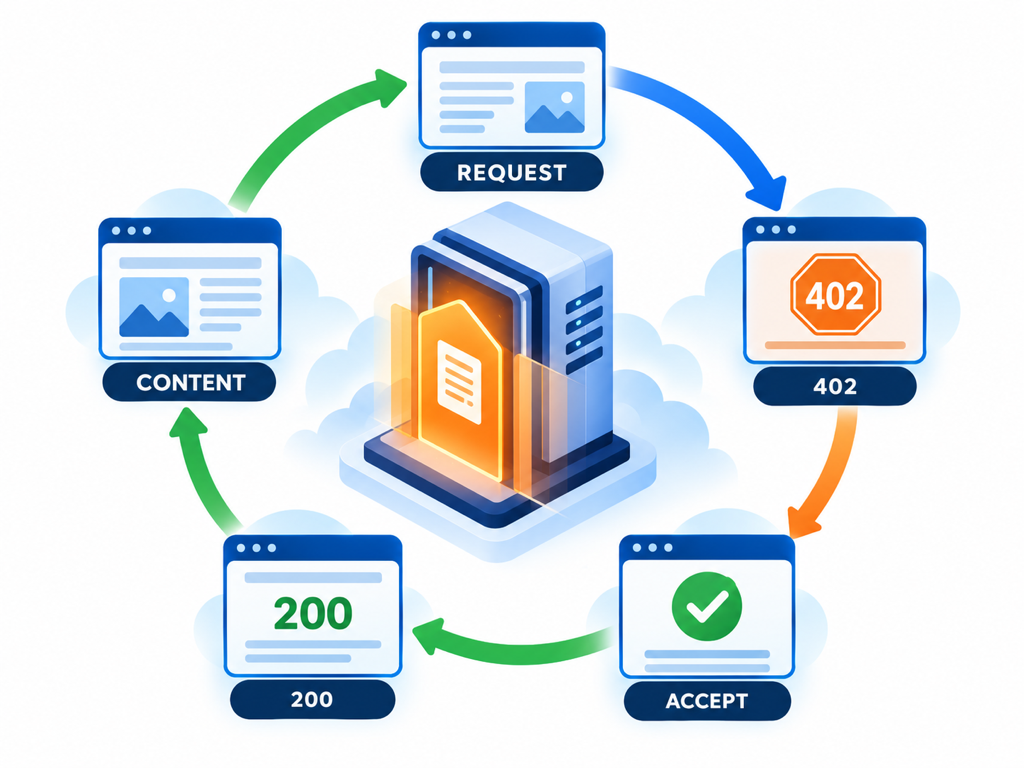
This structure solves an important coordination problem. A publisher can communicate a machine-readable access term at request time, while a crawler can enforce a spending limit without negotiating every URL by email.
It does not remove implementation questions. Publishers still need accurate bot identification, clear path rules, payout setup, monitoring, and a way to handle pages whose value differs materially from the default price.
Pay Per Crawl and Pay Per Use price different events
Cloudflare's newer Pay Per Use beta prices downstream use rather than retrieval. The buyer defines a paid use, makes an offer, reports when that use occurs, and pays through the system when the publisher accepts the terms. Cloudflare explains that Pay Per Use is intended to connect payment to the value created after fetching, while Pay Per Crawl charges for access before the crawler necessarily knows whether it will use the page.
| Model | Charged event | Publisher advantage | Buyer concern | Best-fit hypothesis |
|---|---|---|---|---|
| Free access | Successful retrieval with no fee | Maximum discovery potential | None on access price | Broad public distribution |
| Block | Request denied | Strong control | No access or evaluation | Private, risky, or non-public content |
| Pay Per Crawl | Each successful paid retrieval | Simple usage-based access revenue | Pays before knowing downstream value | Scarce, frequently useful source material |
| Pay Per Use | Defined downstream use | Payment aligns with use value | Requires reporting and accepted terms | Content used selectively in answers or recommendations |
| Direct license | Negotiated rights and access | Custom scope and economics | Slow negotiation and integration | High-value strategic relationships |
The choice is not permanent. A publisher may use free access for public service pages, charge for premium archives, and negotiate direct licenses for datasets.
Value content before assigning an access policy
Price and policy should follow content segmentation. Start with four questions.
First, how substitutable is the content? A generic definition has many free alternatives. Original data, specialist analysis, and local reporting may be harder to replace.
Second, how freshness-sensitive is it? Frequently updated prices, market data, schedules, and alerts can create recurring value, but charging every recrawl may discourage the very freshness a buyer needs.
Third, what is the audience strategy? A publication that depends on broad reach may value discovery more than direct crawler revenue. A research provider with a small, professional audience may favor tighter access and explicit licensing.
Fourth, can the organization measure downstream effects? Without a baseline for AI citations, mentions, referral traffic, and crawl volume, the publisher cannot tell whether a paid policy increased total value or merely reduced visibility.
Score content families, not isolated URLs. Policy pages, original investigations, commodity explainers, user-generated discussions, premium reports, and product documentation have different economics.
Model revenue, lost discovery, and operating cost together
The simplest forecast multiplies successful paid crawls by price. That is necessary but incomplete. A useful model also estimates how many crawlers accept the price, how often paid content receives repeat requests, what visibility may be lost when they decline, and what the program costs to administer.
Use three scenarios:
- Low acceptance: most crawlers choose substitutes, so revenue is small and visibility risk is high.
- Selective acceptance: buyers pay for distinctive sections while skipping commodity pages.
- High acceptance: valuable content receives frequent paid retrievals, increasing both revenue and dependence on the program.
Do not count a configured price as revenue. Count successful charged responses and reconcile them with payout records. Also track free crawler traffic to content outside the paid paths so policy spillover is visible.
The key metric is total content value, not crawl revenue in isolation. That value can include direct fees, subscriptions, referrals, brand exposure, licensing leads, and the avoided cost of serving unwanted traffic.
Choose allow, block, or charge by content type
A decision tree makes the trade-off explicit. Begin with whether the content is meant to be public. Private or regulated material requires access control, not crawler pricing. For public content, assess scarcity and strategic discovery value. Commodity content with high discovery value often belongs in the free tier. Scarce content with proven crawler demand is a stronger charging candidate.

Run a bounded pilot. Choose one coherent content class, preserve a comparable free class, document the initial price, and set a review date. Avoid flipping an entire domain before you understand buyer behavior.
Define exit conditions before launch. For example, pause the pilot if citation visibility falls beyond a chosen threshold without compensating revenue, if legitimate crawlers cannot authenticate reliably, or if operational disputes consume more staff time than the program earns.
Monitor downstream visibility with Topify
Cloudflare can show access activity and charging events, but a publisher also needs to know what happens in AI answers. Topify can monitor a fixed group of relevant prompts before and during a Pay Per Crawl pilot, capturing changes in brand visibility, recommendation position, sentiment, and cited sources across supported AI platforms.
Use Topify's documented Sources Analytics to compare cited-domain counts and trends for the paid content category and its free control group. Pair that view with Cloudflare's successful charged responses, declined or blocked requests, and payout data. The combined workflow supports a practical decision: keep the policy, adjust the price, move some pages back to free access, or pursue a direct license. Topify cannot observe the crawler's private purchase logic or attribute a citation loss to price alone. The related article AI Citation Share and the Three Levels of AI Visibility helps separate source exposure from brand mentions and recommendations.
Conclusion
Cloudflare Pay Per Crawl turns AI crawler access into a priceable event, but the feature is an instrument rather than a strategy. Charge where content is distinctive, public, repeatedly valuable, and supported by evidence of buyer demand. Preserve free discovery where reach and citation value exceed likely access revenue. Use blocking for material that should not be public, not as a substitute for authentication.
Pilot one content class, model acceptance and visibility risk, and reconcile successful charges with real payouts. At the same time, use Topify source monitoring to observe whether paid access changes citation behavior. The correct policy is the one that improves total content value, not simply the one with the highest configured price.
FAQ
Is Cloudflare Pay Per Crawl generally available?
Cloudflare currently describes Pay Per Crawl as a beta. Availability, eligibility, supported crawlers, and commercial details should be verified in current documentation.
Does a crawler pay for an error response?
Cloudflare's documented flow charges for successful retrievals. Error responses are not billed under the current FAQ.
Is Pay Per Crawl the same as Pay Per Use?
No. Pay Per Crawl charges for successful access. Pay Per Use is designed around a defined downstream use reported by an accepted buyer.
Will charging crawlers reduce AI citations?
It may if crawlers decline the price and choose alternative sources. Measure citations and mentions before and during a pilot rather than assuming the effect.