

Your domain authority is 72. Your top keyword holds position one. You’ve earned backlinks from TechCrunch, G2, and a dozen industry blogs. Then a prospect types “what’s the best [your category] tool?” into Claude — and gets a list of five recommendations. Your brand isn’t one of them.
That’s not an SEO failure. It’s a different problem entirely. And the gap between a strong Google presence and solid Claude AI brand visibility is wider than most marketing teams realize — because the two systems don’t share the same logic, the same inputs, or the same definition of “authority.”
Google and Claude Don’t Read the Same Playbook
Google is, at its core, a retrieval engine. It crawls, indexes, and ranks web pages based on measurable signals: backlink quality, keyword relevance, domain authority, page speed, structured data. The goal is to surface the most relevant URL for a given query. Success means ranking on page one.
Claude works differently. It doesn’t retrieve URLs — it synthesizes conclusions. Using a combination of its pre-trained parametric knowledge and real-time Retrieval-Augmented Generation (RAG), it constructs a response based on what it has learned about a topic and what it can verify in the moment. The output isn’t a list of links. It’s a recommendation.
That distinction creates a structural gap. A page optimized for Google’s crawler — tight keyword density, internal linking, clean schema markup — isn’t automatically useful to Claude’s reasoning layer. Claude is looking for something else: dense factual claims, consistent entity signals across multiple sources, and evidence that the broader internet agrees a brand is credible.
The metrics that predict Google rankings and the signals that drive Claude AI brand visibility overlap by roughly 54%. That leaves a 46% gap that no amount of traditional SEO addresses.
What Claude Actually “Sees” When Someone Asks About Your Category
Claude’s recommendations aren’t random. They emerge from two layers of knowledge working in parallel.
The first is parametric knowledge — everything Claude absorbed during pre-training. This includes structured sources like Wikipedia, archived news, industry whitepapers, Reddit threads, and books. Brands that appeared frequently and consistently in high-quality training data carry a significant advantage. Wikipedia, in particular, carries outsized weight in Claude’s authority evaluation due to its structured, human-verified format.
The second layer is real-time retrieval. When Claude searches the web to supplement its response, it doesn’t use Google. Research analysis shows that Claude’s cited results overlap with Brave Search’s top 15 organic results at a rate of 86.7%. Brave runs its own independent index, with a crawl bias toward original content over aggregator sites, and lower dependence on traditional backlink signals.
That’s a critical implication. Brands optimizing purely for Google’s index may not appear in the information layer Claude actually reads.
On top of this, Claude’s Constitutional AI framework applies a reliability filter to every source it considers. Content that appears overstated, inconsistently sourced, or commercially self-serving gets deprioritized. Brands that acknowledge limitations and trade-offs in their own content are cited at 1.7x the rate of brands that don’t — because Claude treats intellectual honesty as a proxy for credibility.
5 Reasons Your SEO Content Doesn’t Land in Claude’s Answers
Your content is optimized for keywords, not citations
Traditional SEO rewards keyword density and topical clusters. Claude’s RAG layer is looking for “atomic facts” — compact, verifiable claims that can be extracted in a 200–400 word chunk and used as supporting evidence. Keyword-heavy content often reads as noise to the extraction layer. According to Princeton’s GEO research, keyword stuffing produces a negative effect on AI citation rates — as much as -10%.
Your brand mentions live in low-authority training sources
AI citation weight follows a power-law distribution. Mentions on low-DA directories, press release distribution platforms, or unmoderated forums carry minimal signal. Claude gravitates toward what researchers have called “aristocratic domains” — Wikipedia, Reddit, YouTube, G2, Capterra, and established news publishers. If your brand’s external footprint is mostly thin citations from sources Claude doesn’t trust, your entity lacks the social consensus needed to appear in recommendations.
Competitors own the narrative in third-party review sites and forums
When Claude synthesizes a recommendation, it looks for multi-source corroboration. A competitor with fifty substantive Reddit threads, detailed G2 reviews with specific use cases, and independent comparisons from credible blogs reads as the established category leader — regardless of which brand ranks higher on Google. A single high-upvote Reddit thread with genuine detail can carry more weight for Claude’s reasoning than ten commercial backlinks from high-DA domains.
You have no presence in the sources Claude trusts most
For high-stakes queries — enterprise SaaS, B2B tools, healthcare, finance — Claude applies stricter source requirements. It looks for academic citations, government references, analyst reports, and verified industry publications. Brands whose content strategy focuses entirely on how-to tutorials and product pages don’t establish the “trust layer” Claude requires for serious recommendations.
Your structured data helps Google crawlers, not LLM reasoning
Schema.org markup, JSON-LD tags, and FAQ schema make pages eligible for Google’s rich results. Claude doesn’t read JSON-LD tags. It reads prose. When a page is structured around satisfying schema requirements rather than delivering dense, logically sequenced information, Claude’s chunking process treats it as low-signal content and moves on.
The Brands Claude Does Recommend — What They Have in Common
Tracking Claude AI brand visibility across thousands of prompts reveals a consistent pattern among brands that appear regularly. None of these characteristics are traditional SEO signals.
Semantic consistency across the full entity footprint. High-visibility brands maintain the same positioning across their own site, third-party coverage, and community mentions. If a brand is described as “lightweight CRM for SMBs” internally but as “enterprise-grade platform” on third-party sites, Claude’s entity resolution creates conflicting associations and the brand gets deprioritized.
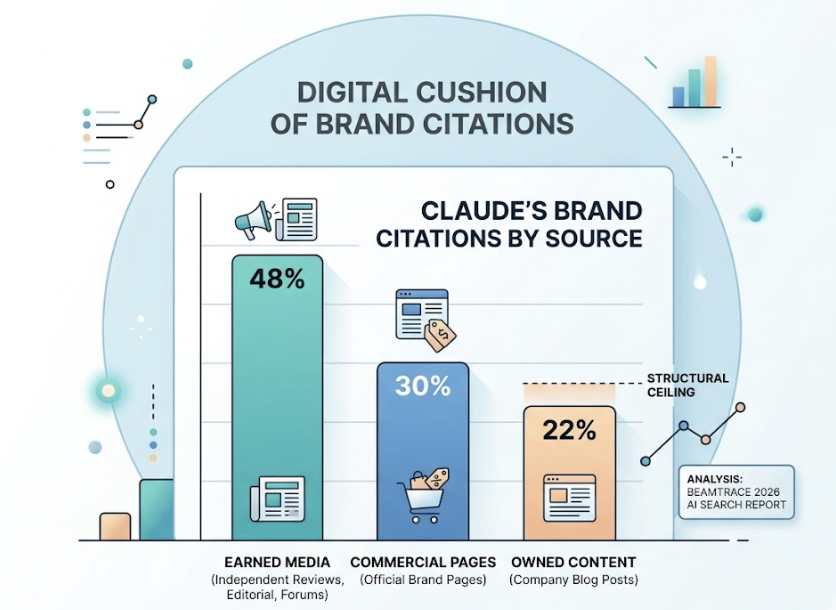
A large “digital cushion” of third-party content. The most-recommended brands have a disproportionate share of their citations coming from earned media — independent reviews, editorial coverage, forum discussions. Analysis from Beamtrace’s 2026 AI Search Report shows that third-party earned media accounts for roughly 48% of Claude’s brand citations, while official commercial pages account for about 30%, and owned blog content about 22%. Brands that rely primarily on owned content to establish their reputation face a structural ceiling.
High information density with specific, verifiable claims. The pages Claude cites most often contain precise data: conversion rates, time-to-value benchmarks, cost comparisons, customer counts. Vague superlatives (“world-class solution,” “leading platform”) contribute nothing to Claude’s reasoning. Specific figures and named evidence do.
Claude AI Brand Visibility Is a Measurable Metric, Not a Guessing Game
The phrase “AI visibility” isn’t abstract. It maps to a set of trackable metrics that brands can monitor and improve over time.
Visibility Rate measures how often a brand appears in Claude’s responses to a standardized set of category-level prompts — essentially, Share of Voice in AI answers.
Position-Adjusted Word Count (PAWC), a metric developed in Princeton’s GEO research, weights not just whether a brand is mentioned but where in the response it appears. A brand cited first in a list carries substantially more influence than one mentioned as an afterthought.
Sentiment Quotient tracks whether Claude’s mentions are neutral, positive, or flagged with caution. A brand can have high visibility but negative sentiment — which is often worse than being invisible.
Source Coverage measures what percentage of Claude’s brand citations come from third-party domains versus owned content. A 100% own-site citation rate signals that the brand’s external reputation hasn’t been established.
Topify tracks all of these metrics simultaneously across Claude, ChatGPT, Perplexity, and Gemini — running hundreds of category-level prompts at scale and mapping where brands appear, in what position, and with what sentiment. For teams that have been operating with only Google Search Console data, the gap between what they think their brand looks like and what AI systems actually say about it is often significant.
Closing the Gap: Where to Start If Claude Doesn’t Know Your Brand
Build citation-worthy content that third-party sources want to reference
The core unit of GEO content isn’t an article — it’s a claim. Each piece of content should contain proprietary data, named frameworks, or specific benchmarks that other sources would quote. Implementing a Bottom Line Up Front (BLUF) structure — where the key insight appears in the first 40–60 words of each section — dramatically improves how Claude’s RAG layer extracts and cites the content.
If your brand doesn’t have original research, commission a narrow study. A single survey with a clear finding (“72% of SEO professionals track keyword rankings but don’t monitor AI mentions”) creates a quotable data point that third-party publications will reference. Once that statistic circulates across multiple credible sites, Claude starts associating it with your brand as the originating entity.
Expand brand presence on the domains Claude trusts
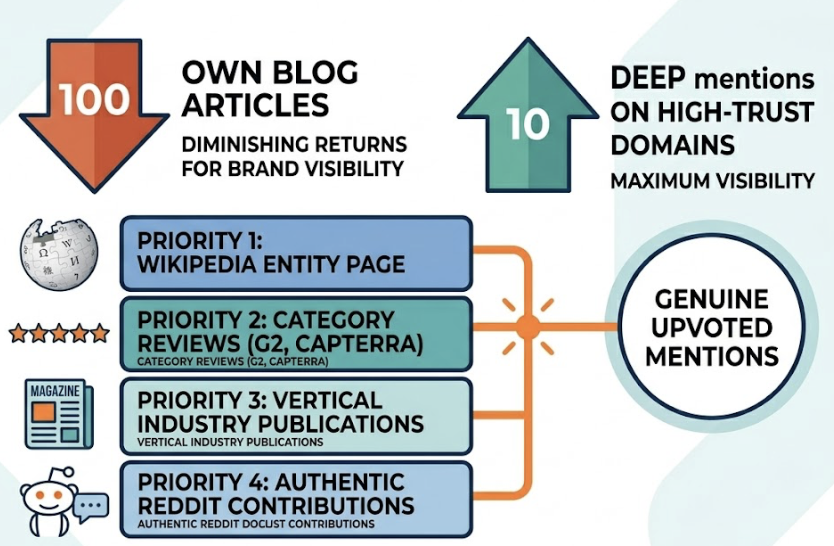
Publishing one hundred articles on your own blog produces diminishing returns for Claude AI brand visibility. Ten deep, substantive mentions on high-trust domains produce more. The priority list: Wikipedia entity pages (correct any gaps or inaccuracies in your brand’s entry), top-tier category review platforms like G2 and Capterra, vertical industry publications, and authentic Reddit contributions in relevant subreddits. The goal on Reddit isn’t marketing — it’s substantive participation that results in genuine upvoted mentions of your brand in comparison threads.
Also verify that your site is being crawled by Brave’s bots, not just Googlebot. Submitting your domain to Brave’s Web Discovery Project is a direct step toward improving indexing in the layer Claude actually queries.
Monitor who Claude recommends in your category — then close the gap systematically
This is where measurement becomes strategy. Topify’s Source Analysis feature reverse-engineers which domains Claude is citing when it recommends competitors in your category. The output is a concrete list of citation gaps: specific publications or platforms where your competitor has earned coverage and you haven’t. That’s an actionable PR and content list, not a vague directive to “build more backlinks.”
Topify’s Competitor Monitoring tracks real-time shifts in visibility and sentiment — so when a competitor’s Claude AI brand visibility spikes after a major press mention or product review, you can identify what triggered the change and respond. The platform’s One-Click Execution layer then lets you generate GEO-structured content drafts targeting those specific gaps and deploy them without a multi-week content production cycle.
The upstream question — why is Claude recommending them and not you? — now has a traceable answer.
Conclusion
Google rankings and Claude AI brand visibility solve different problems. One determines whether people can find your website when they search. The other determines whether AI systems recommend your brand when people ask for advice. In 2026, traffic from AI recommendations converts at roughly 6x the rate of standard search traffic — which means the visibility gap has direct revenue implications.
Strong SEO is still worth building. It keeps the door open when users are navigating. But GEO is what gets you into the conversation when users are asking for a recommendation and trusting AI to give them one. Both matter. Only one of them most teams are actually measuring.
Get started with Topify to see where your brand stands in Claude’s answers today.
FAQ
Q: Does good SEO automatically help with Claude AI brand visibility?
A: Partially. Research suggests roughly 54% correlation between Google rankings and Claude citation rates — meaning strong SEO does provide some lift. But the remaining 46% is driven by factors SEO doesn’t address: third-party earned media density, multi-source entity consistency, Brave Search indexing, and the kind of factual content specificity that makes your brand citable by an LLM rather than just rankable by a crawler.
Q: How often does Claude update its knowledge about brands?
A: Claude operates on two update cycles. Its parametric knowledge (baked into model weights at training) updates with new model releases — roughly every six to twelve months. Its real-time retrieval layer updates near-continuously through RAG. If a brand gets covered in a high-authority source that Brave indexes, Claude can start citing that information within hours. Newer brands with no pre-training presence need to rely heavily on this real-time layer.
Q: Can I track whether Claude mentions my brand?
A: Not with standard tools. Google Search Console doesn’t capture impressions from Claude responses. Tracking Claude AI brand visibility requires a purpose-built GEO platform that runs structured prompt sets across AI engines and measures Share of Voice, position, sentiment, and source attribution. Topify provides this across Claude, ChatGPT, Perplexity, and Gemini from a single dashboard.
Q: What’s the fastest way to improve Claude AI brand visibility?
A: Prioritize “authority node coverage” over volume. Getting a substantive brand mention in one trusted domain — a top-tier industry review publication, a high-upvote Reddit thread with genuine detail, a Wikipedia entity update — typically moves the needle faster than publishing additional owned content. Pair this with a BLUF rewrite of your core product pages so Claude’s extraction layer can actually parse and cite your key claims.

