

A practical 2026 guide to where your brand actually gets found, and what to do about each platform.
Most brands treating AI visibility as a single channel are already behind.
ChatGPT, Claude, and Perplexity don’t work the same way. They don’t pull from the same sources, they don’t serve the same users, and they don’t reward the same types of content. Treating them as interchangeable is how you end up spreading budget thin and seeing results from none of them.
Here’s what actually separates the three, and how to decide where to focus first.
Three Platforms. Three Different Users. Three Different Logics.
Before you optimize for anything, understand who’s on each platform and why they’re there.
ChatGPT has scale. It processes somewhere between 2.5 and 3 billion prompts per day, with daily active users reaching around 190 million. Users come for task execution: drafting, coding, brainstorming. The average session is 16 minutes. It’s conversational and high-frequency.
Claude skews toward depth and decision-making. Its user base sits at roughly 19 million, which sounds modest until you see that 70% of Fortune 100 companies have it embedded in their workflows. Software development, financial services, legal, and healthcare are its home turf. Users aren’t browsing. They’re analyzing.
Perplexity sits closest to a search replacement. Its 33 million monthly active users are researchers, professionals, and knowledge workers who want verified answers with visible sources. Every response comes with numbered citations. The referral traffic it drives has an average session time of 3 minutes 30 seconds and a bounce rate of just 32%.
Different platforms, different stakes.
Where Claude AI Brand Visibility Actually Comes From
Claude’s citation behavior is more conservative than any other major AI platform. That’s not a bug. It’s a direct result of Anthropic’s Constitutional AI framework, which prioritizes accuracy and harm avoidance over comprehensiveness.
Claude uses Brave Search for its web retrieval. That matters more than most brands realize. Research shows Claude’s citations overlap with Brave search results at a rate of 86.7%. If your brand doesn’t rank in Brave, it’s effectively invisible to Claude’s retrieval layer.
But search indexing is only half the story. Claude performs internal cross-validation, which means a single factual error on your site (an outdated price, a feature description that doesn’t match G2) can get your entire domain flagged as unreliable.
The content formats that earn Claude citations aren’t blog posts. Troubleshooting guides, tool and utility pages, and how-to tutorials average 5 or more citation appearances per page across 4 to 5 platforms. Standard blog articles average fewer than 1. That’s a 30 to 50x gap depending on format and depth.
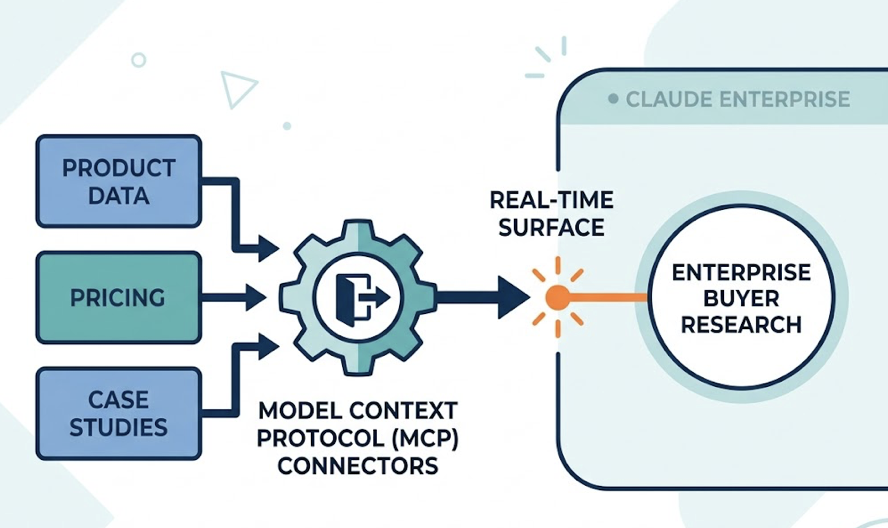
For B2B brands, there’s also a structural advantage most are ignoring. Claude Enterprise supports custom connectors via Model Context Protocol (MCP), which allows your product data, pricing, and case studies to surface in real time when an enterprise buyer is doing vendor research inside Claude. That’s not passive indexing. That’s embedded visibility.
The bottom line for Claude: depth, accuracy, and structure aren’t optional. They’re the admission ticket.
ChatGPT Still Has the Volume. But It’s Harder to Crack.
ChatGPT is where most brands want to be first. It’s also where most brands fail to show up.
Here’s the problem: ChatGPT’s recommendation logic is probabilistic and inconsistent. One study ran the same B2B software prompt 100 times and got 44 different brands mentioned across those responses. Only about 5 of them, roughly 11%, appeared in more than 80% of responses. Those brands weren’t just well-optimized. They had Wikipedia entries, thousands of third-party citations, and years of authority signals baked into ChatGPT’s pretraining data.
That’s the entity gap. New or mid-market brands often lack the historical signal density that ChatGPT needs to classify them as trustworthy. The platform doesn’t surface brands it can’t verify, and its verification logic is heavily weighted toward pretraining data from 2022 and earlier.
That said, there are real levers. ChatGPT’s search mode relies heavily on Bing, so activating Bing Webmaster Tools instant indexing is a concrete first step. Building presence on G2, Reddit, and high-authority vertical publications creates the third-party validation ChatGPT needs to start trusting you. The goal isn’t just content. It’s entity establishment.
ChatGPT is worth targeting. Just don’t expect fast wins unless you’re already a recognized name.
Perplexity Rewards Sources, Not Just Brands
Perplexity is the most transparent AI platform operating at scale today.
Its scoring system weighs three factors: factual accuracy (verified across multiple sources), recency (especially for fast-moving categories), and third-party corroboration from Reddit, forums, and specialist publications. It’s not just checking your website. It’s checking whether other credible voices confirm what your website says.
This creates a genuinely different competitive environment. A well-researched article from a niche SaaS blog can outrank a Fortune 500 landing page if it’s more accurate, more recent, and more frequently cited externally. Perplexity doesn’t have the same large-brand bias baked into its pretraining because it retrieves in real time.
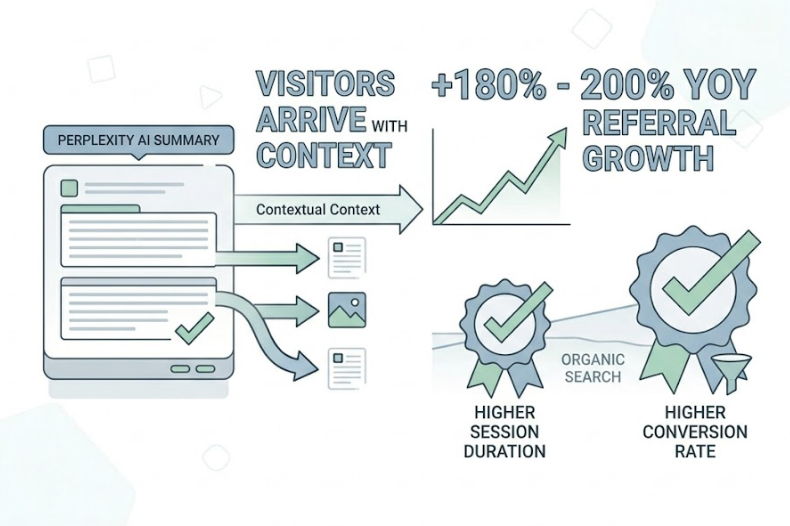
The referral traffic quality reflects this. Perplexity’s year-over-year referral traffic growth has been running at 180 to 200%. More importantly, those visitors arrive with context: they’ve already read a structured AI summary of your product or topic before clicking through. That’s why session durations and conversion rates run higher than organic search.
Plus, Perplexity’s Publisher Program launched in early 2026 added a revenue-sharing layer. When your content gets cited in an ad-supported response, you earn a cut. That’s a fundamentally different ROI model than any other AI platform offers.
For brands with strong content assets but limited authority budgets, Perplexity is the fastest path to measurable visibility.
The Priority Matrix: Which Platform Should You Go After First?
Not every brand should prioritize the same platform. Here’s how to think about it:
| Brand Type | Primary Platform | Secondary Platform | Why |
|---|---|---|---|
| B2B SaaS / Tech | Claude | Perplexity | Long decision cycles favor depth and technical validation |
| B2C / Consumer Retail | ChatGPT | Gemini | High-volume, broad awareness, emotional resonance |
| Agencies / Consultancies | ChatGPT | Claude | Speed, creative variation, structured output |
| FinTech / Healthcare | Perplexity | Claude | Fact accuracy and source transparency are non-negotiable |
| Early-stage / New Brands | Perplexity | ChatGPT Search | Real-time RAG bypasses pretraining bias against unknown brands |
The logic is consistent across all five: match the platform’s retrieval mechanism to your content strengths, not to where you think the most users are.
You Can’t Prioritize What You Can’t Measure
Here’s the thing that breaks most AI visibility strategies before they start: brands make platform decisions without any data on where they’re actually being mentioned, at what sentiment, and against which competitors.
B2B buyers complete roughly 70% of their purchase decision before talking to sales. And 89% of those buyers use generative AI tools during their research phase. If your brand isn’t in those AI-generated answers, you’re not losing the final comparison. You’re being cut before the shortlist forms.
Topify is built to close that measurement gap. It tracks brand visibility across ChatGPT, Claude, Perplexity, Gemini, and other major AI platforms simultaneously, running structured prompt sampling at scale to surface where your brand appears, how it’s described, and where competitors are outranking you.
The seven core metrics it monitors: visibility share, sentiment score, position ranking, AI search volume, mention count, intent alignment, and CVR (Conversion Visibility Rate). That’s not a dashboard of vanity metrics. It’s the data layer that tells you which platform is worth doubling down on and which is underperforming despite your content investment.
When Topify detects a visibility drop on a high-value prompt, it doesn’t just flag it. It reverse-engineers which sources are currently getting cited and surfaces specific fixes, whether that’s restructuring your above-the-fold answer, adding a comparison table, or correcting a pricing discrepancy flagged on a third-party review site.
That’s the difference between guessing and compounding.
Conclusion
Claude, ChatGPT, and Perplexity each represent a different theory of how AI should answer questions. ChatGPT bets on breadth and scale. Claude bets on depth and verification. Perplexity bets on transparency and recency.
Your brand doesn’t need to win on all three simultaneously. It needs to win first where its content strengths match the platform’s retrieval logic.
The priority matrix gives you a starting point. The data from a tool like Topify tells you whether that starting point is actually working.
Start measuring. Then prioritize.
FAQ
Is Claude AI growing faster than ChatGPT for brand mentions?
In enterprise and professional contexts, yes. Claude’s enterprise market share grew from 12% to 32% between early 2025 and late 2025. For B2B brand mentions tied to vendor evaluation, technical documentation, and compliance use cases, Claude’s growth trajectory is outpacing ChatGPT’s in those specific segments.
Does Perplexity actually drive traffic compared to ChatGPT?
It drives significantly higher-quality traffic. ChatGPT tends to be a knowledge endpoint: users get their answer and don’t click through. Perplexity’s interface is built around source attribution, and its referral traffic grew 180 to 200% year-over-year. Visitors who arrive from Perplexity typically stay over 3 minutes and convert at rates that beat organic search benchmarks.
How do I track my brand visibility across all three AI platforms at once?
Use a dedicated AI visibility platform like Topify. It runs prompt sampling across ChatGPT, Claude, and Perplexity simultaneously, calculating sentiment, mention frequency, citation source, and competitive position from a single dashboard. Manual monitoring across three platforms isn’t scalable, and the data you’d collect wouldn’t be statistically reliable.
Should smaller brands focus on one platform or spread efforts equally?
Start with Perplexity. ChatGPT and Claude both carry significant pretraining bias toward established brands. Perplexity’s real-time RAG retrieval evaluates content on current accuracy and recency, not historical authority accumulation. A well-structured, fact-dense piece published this quarter can outperform content from established brands if it’s better sourced. Build your citation footprint there first, then use those authority signals to start penetrating the other platforms.

