

Your domain authority is solid. Your keyword rankings look clean. But none of that tells you whether ChatGPT is recommending your competitor instead of you. Traditional analytics track clicks. They don’t track whether an AI engine ever considered citing your site in the first place.
That gap is what a GEO score measures, and 60% of Google searches already end without a click. For AI-native queries, that number is higher. The brands showing up in AI answers didn’t get there by accident. They fixed four specific things. This guide shows you how to find out whether your site has fixed them too.
Your Website Has an AI Readiness Problem You Can’t See in Analytics
Search engine rankings are a poor proxy for AI visibility. The two systems use fundamentally different signals.
Google rewards authority and relevance. AI engines like ChatGPT and Perplexity reward extractability: Can the crawler even access your site? Does the page structure make it easy to pull facts? Is the content dense enough with verifiable data to be worth citing? A top-ranking page that fails these checks gets ignored by AI retrieval pipelines, regardless of its domain authority.
The conversion data makes this consequential. Visitors arriving via AI referrals convert at 1.2x to 5x higher rates than organic search visitors. Claude referrals, specifically, average a 16.8% conversion rate. That’s not a metric most teams are tracking yet, which is exactly why it’s an opportunity.
What a GEO Score Actually Measures
A GEO score is a composite metric, rated on a 0-100 scale, that evaluates four distinct dimensions of AI readiness. Each dimension corresponds to a specific stage in how AI systems retrieve and cite information.
AI crawler access determines whether bots like OAI-SearchBot, PerplexityBot, and Claude-SearchBot can reach your pages at all. Many sites block these crawlers unintentionally via wildcard rules in robots.txt or through CDN-level settings in tools like Cloudflare.
Structured data measures the presence and quality of Schema.org markup. AI engines are probabilistic systems. Schema reduces ambiguity, letting the model extract facts with higher confidence. Pages with FAQ schema are weighted 40% higher in ChatGPT’s source selection.
Content signals evaluate factual density and modular readiness. Research from Princeton University found that adding statistics to a page lifts AI citation probability by up to 40%. Expert quotations add another 37%. The underlying reason: AI engines prefer verifiable specificity over qualitative claims.
Overall AI visibility tracks your current “Share of Model”—how often AI engines are actually citing or mentioning your brand across relevant queries. This is the outcome dimension. The first three are inputs; this one measures results.
Score ranges map to actionable tiers: 80-100 means you’re in the retrieval pool consistently; 50-79 signals competitive gaps; below 50 typically indicates a foundational block that’s keeping you out of AI answers entirely.
AI Crawler Access: The Gate Most Sites Leave Locked
The robots.txt file used to be simple. In 2026, it’s a governance document that controls access across a dozen distinct AI user agents.
OpenAI alone operates separate bots for training (GPTBot) and retrieval (OAI-SearchBot). The same split applies to Anthropic and Perplexity. Many webmasters blocked all AI bots during the 2023-2024 period over data privacy concerns. The problem: retrieval bots are what put you in AI answers. Blocking them means your visibility is zero by default.
The nuanced approach is selective access: allow retrieval-focused agents (OAI-SearchBot, Claude-SearchBot, PerplexityBot/1.0) while blocking training-focused ones (GPTBot, Claude-Searchbot training variants). This way your content appears in real-time AI search without contributing to model training without attribution.
Structured Data: Why Schema Markup Is Now a GEO Signal
Schema is no longer optional for AI visibility. Websites with author schema are 3x more likely to appear in AI answers than those without, because the model can trace the information to a credible entity.
The highest-impact schema types for GEO are FAQPage (maps directly to conversational AI query patterns), Article and BlogPosting (provides freshness signals that Perplexity and others weigh heavily), and Organization/Person schema (establishes E-E-A-T that AI engines use for trust signals in sensitive topic areas).
How to Check Your GEO Score in Under 2 Minutes
The Topify GEO Score Checker runs a full four-dimension audit in 10-30 seconds. No login, no setup, no credit card. You enter a domain and get an instant report.
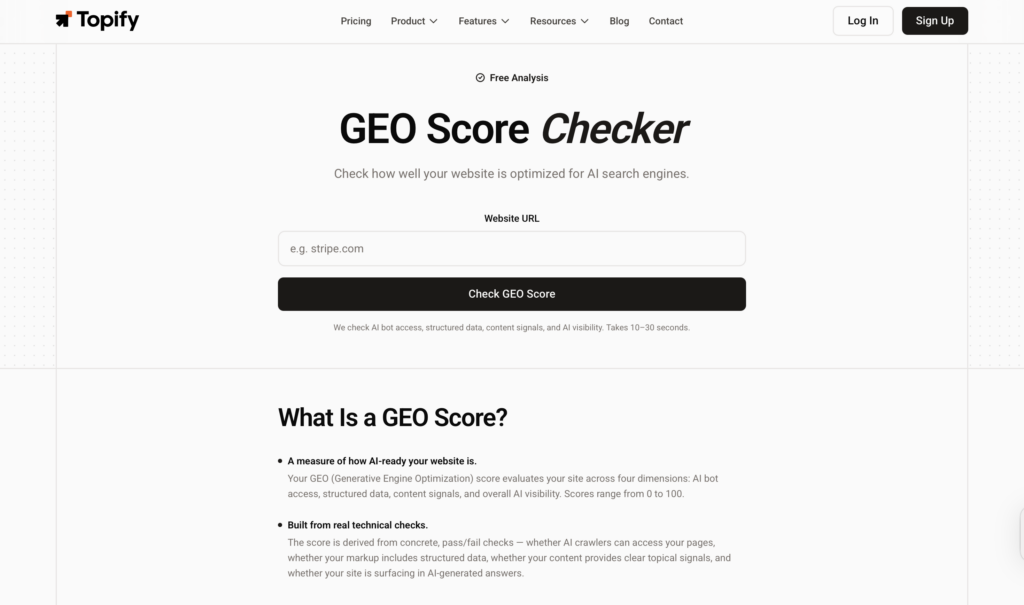
Here’s what happens when you run it:
Step 1: Enter your domain. Go to topify.ai/tools/geo-score-checker and type in any URL. You can audit your own site or a competitor’s.
Step 2: The tool fetches your page using multiple AI user agents. It simulates requests from OAI-SearchBot, GPTBot, PerplexityBot, and others to identify any blocks at the robots.txt or CDN level.
Step 3: Schema parsing runs in parallel. The checker audits for over 30 schema types, flagging missing or malformed markup that would reduce your citability.
Step 4: Content analysis evaluates factual density. The tool assesses whether your page content is structured into extractable blocks, following the “modular readiness” criteria that AI retrieval systems favor.
Step 5: A real-time visibility check pings leading LLMs to see whether your brand or domain is currently being cited for relevant keywords.
The output is a scored report across all four dimensions, with specific flags on what’s blocking or reducing your AI visibility. The whole process takes under two minutes.
One underused feature: run the same check on two or three competitors before you run it on yourself. Knowing where you sit relative to the field changes how you prioritize what to fix.
Reading Your GEO Score Report: What the Numbers Mean
The composite score tells you your overall AI readiness tier. The per-dimension scores tell you where to focus first.
A score above 80 means you’re technically sound and content-ready. The gap between good and excellent at this level is usually in content signals—more proprietary data, more attributed expert quotes, more modular formatting. Content updated within the last 30 days is twice as likely to be cited by AI platforms, so freshness maintenance matters even when the fundamentals are solid.
A score in the 50-79 range typically signals competitive gaps rather than outright blocks. You’re in the retrieval pool, but inconsistently. The most common culprits: partial schema coverage, a few AI crawlers blocked that others can access, or content that reads well but isn’t structured into extractable chunks.
Below 50 usually means something binary is wrong. Either AI crawlers can’t reach your pages, or your site has essentially no structured data, or both. This is the fastest tier to improve because the interventions are specific and low-cost.
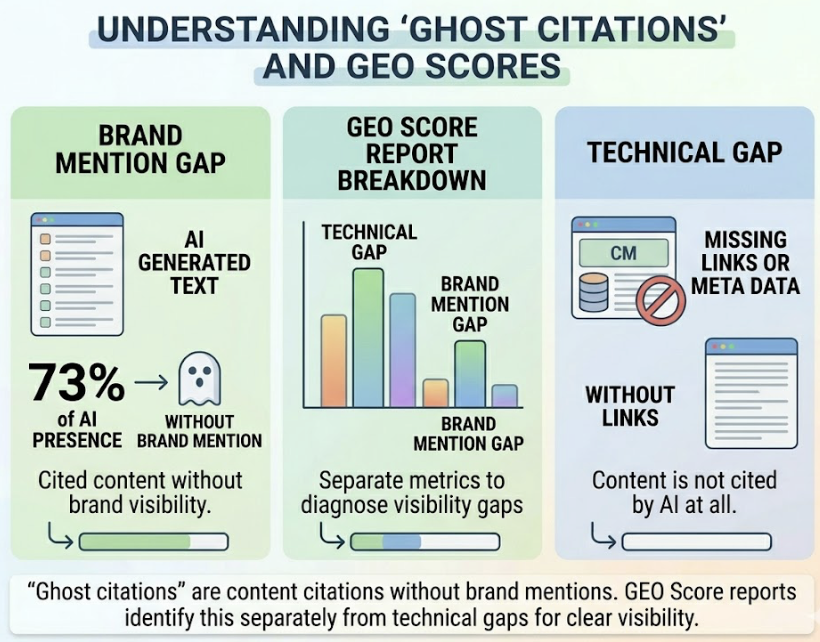
One metric worth paying attention to beyond the score: the visibility dimension specifically. Research across multiple AI platforms found that 73% of AI presence for some brands consists of citations without brand mentions. A site can be cited extensively in AI answers while the brand name never appears in the generated text. The GEO Score report surfaces this “ghost citation” problem separately, so you know whether you have a technical gap or a brand mention gap.
After Your GEO Score: 3 Actions That Actually Move the Needle
The score is a diagnosis. These are the interventions with the strongest evidence behind them.
Action 1: Fix crawler access first. This is binary. If key AI bots are blocked, your visibility is zero regardless of content quality. Update your robots.txt to explicitly allow OAI-SearchBot, Claude-SearchBot, and PerplexityBot/1.0. If you’re running Cloudflare, check whether the AI bot blocking feature was enabled during the 2023 wave of default settings—it often was. This fix costs nothing and the impact is immediate.
Action 2: Implement FAQ schema on every informational page. Schema doesn’t require a developer for most CMS platforms. Given the 40% weighting boost for FAQ schema in ChatGPT source selection, it’s the highest-return structured data investment. Pair it with Person schema for author pages to establish the E-E-A-T signals that AI systems use for trust.
Action 3: Enrich content with proprietary data. Generic content doesn’t win AI citations because AI systems already have generic knowledge in their training data. What they’re looking for in retrieval is “information gain”—data, benchmarks, or survey results they don’t already have. Embedding even one original statistic per article meaningfully shifts the citation probability. Content with 19 or more statistical data points earns nearly double the citations of content with minimal data.
Once you’ve run these fixes, the next layer of intelligence is tracking how your GEO score changes over time—and how it compares against competitors. Topify’s AI Visibility Checker gives you ongoing Share of Model monitoring across ChatGPT, Perplexity, Gemini, and others, so you’re not just checking a one-time score but watching the trend. The competitor benchmarking feature shows you where rivals are pulling ahead in AI citations before you see it in traditional traffic data.
Why Free GEO Score Tools Aren’t All the Same
Not every tool that calls itself a GEO checker is measuring the same thing. The most common limitation: single-dimension audits. A tool that only checks schema, or only checks robots.txt access, gives you a partial picture. A site can have perfect schema and still have zero AI visibility because the crawlers are blocked at the CDN level.
The ALM Corp overview of generative engine optimization notes that the GEO tool market is fragmenting into specialized niches, with significant variation in what each platform actually measures. The practical question for any free checker is: does it simulate actual AI crawler behavior, or does it check a static checklist? The former catches CDN-level blocks that the latter misses entirely.
For quick diagnostics on individual URLs, no-login tools are the right starting point. The tradeoff is depth of ongoing monitoring. A free checker tells you where you stand today. A full platform like Topify tracks how that standing shifts week over week, which competitors are gaining ground in AI answers, and which content updates are driving citation improvements.
The GEO market is projected to reach $33.7 billion by 2034. The tool landscape will consolidate around platforms that can close the loop from diagnosis to action to tracking. Knowing which layer you need—quick audit vs. continuous intelligence—is the main selection criterion.
Conclusion
A GEO score tells you something your current analytics stack can’t: whether AI systems can actually find, read, and cite your content. The Topify GEO Score Checker surfaces that information in under two minutes, with no setup required.
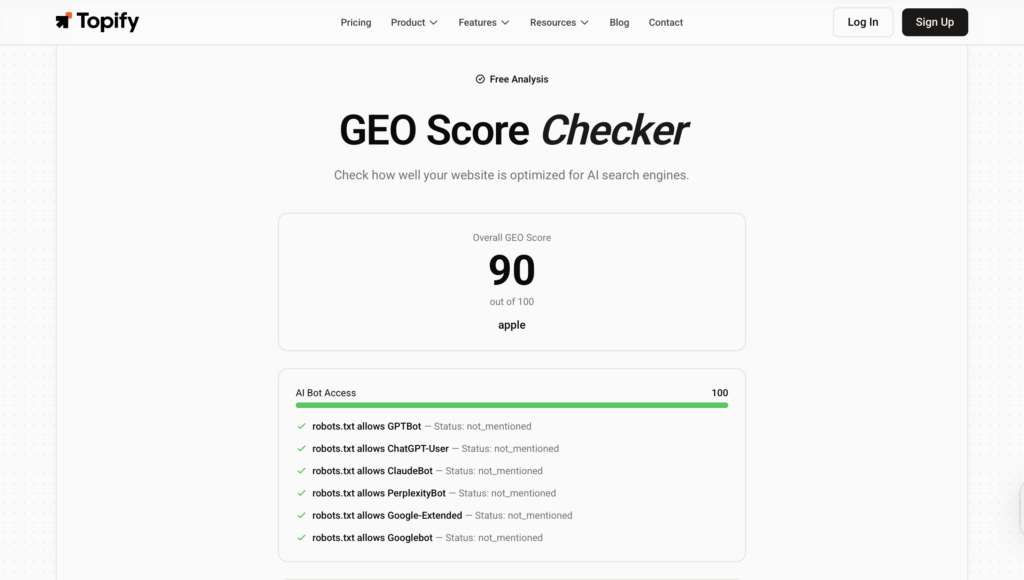
Run the check on your primary revenue-driving URLs first. Then run it on the two or three competitors you most frequently lose deals to. The gaps between those reports are your roadmap. Crawler access, schema coverage, and content factual density are all fixable. The brands that fix them now accumulate an AI citation advantage that compounds as generative search volume continues to grow.
Start with the free audit. Check your GEO score here.
FAQ
Q: What is a GEO score?
A: A GEO score is a 0-100 rating of how well your website is optimized for discovery and citation by generative AI engines like ChatGPT, Perplexity, and Google AI Overviews. It evaluates four dimensions: AI crawler access, structured data quality, content signals (factual density and modular structure), and current AI visibility (how often your brand is cited). Unlike an SEO score, it focuses on AI retrieval readiness rather than keyword rankings or backlink profiles.
Q: How is a GEO score different from an SEO score?
A: An SEO score measures ranking signals like keyword relevance, backlink authority, and page speed—factors that affect where you appear in a list of blue links. A GEO score measures whether AI systems can access, extract, and cite your content in synthesized answers. A site can score well on SEO and poorly on GEO if it blocks AI crawlers, lacks structured data, or publishes content that isn’t structured for machine extraction.
Q: Is the GEO Score Checker really free?
A: Yes. Topify’s GEO Score Checker is free to use with no registration required. You enter a domain, and the tool generates a scored report across all four AI readiness dimensions in 10-30 seconds. There’s no credit card, no trial period, and no account creation needed to see the full results.
Q: How often should I check my GEO score?
A: Run a baseline check immediately, then recheck after implementing any changes to robots.txt, schema, or content. For ongoing monitoring, a monthly cadence catches drift from platform updates or competitor improvements. If you’re actively optimizing for AI citations, weekly checks during active campaigns help you correlate content changes to visibility shifts.

