
On September 10, 2026, OpenAI launched ChatGPT for Financial Services, a version of ChatGPT Work built for investment bankers and equity researchers. It pairs GPT-6 Astra with licensed data from Daloopa, PitchBook, LSEG News, Crunchbase, and Quartr, indexed and hosted directly on OpenAI’s own infrastructure.
Morgan Stanley and Evercore helped design it. The stated goal is simple: let bankers trace every figure and claim back to a verified source, inside the chat window.
That detail matters more than the product launch itself.
What ChatGPT for Financial Services Actually Changes
Until now, ChatGPT pulled financial information the same way it pulled everything else: from whatever content it could find and rank as trustworthy, including brand websites, filings, and third-party write-ups. That’s changing.
OpenAI now indexes premium datasets in-house and is building shared sign-in integrations with S&P Capital IQ, MSCI, Dow Jones Factiva, and Moody’s, so users can access data they’re already entitled to without leaving the chat. The company also optimized MCP connectors for S&P Global and FactSet, on top of an ecosystem of more than 50 connectors including Datasite, Box, Preqin, and Intapp.
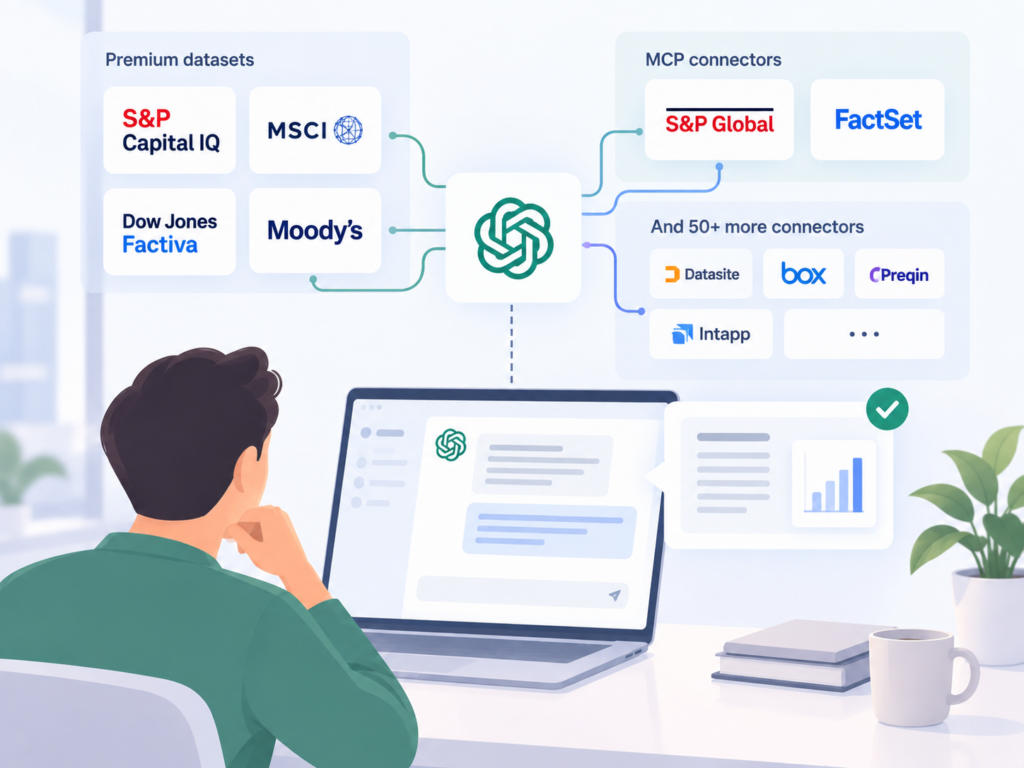
In practice, ChatGPT no longer has to guess which source is authoritative for a given financial question. It has one already built in.
Why Your Brand Is No Longer the Only Source
For the past two years, financial brands built AI visibility the same way they built SEO visibility: publish original research, structure it cleanly, and hope the model picks it up. That strategy assumed ChatGPT had a gap to fill.
That gap just got smaller.
According to Yext’s citation research, financial services brands already draw 48% of their AI citations from their own first-party website, higher than most other verticals. That’s precisely the share now competing against a dataset OpenAI licenses, hosts, and controls directly.
The practical effect isn’t that your content disappears from ChatGPT. It’s that when a licensed, structurally superior source exists for the same question, the model has less reason to reach for yours.
Who Gets Squeezed and Who Gets Boosted
Not every financial brand is affected equally. The split runs along one line: are you part of the new data supply chain, or are you still hoping to be discovered inside it.
| Position | Examples | What Changes |
|---|---|---|
| Design partners and data providers | Morgan Stanley, Evercore, Daloopa, PitchBook, LSEG, Crunchbase | Direct integration, granular citations, first-party presence inside ChatGPT’s answers |
| Entitlement-integrated platforms | S&P Capital IQ, MSCI, Dow Jones Factiva, Moody’s | Recognized through ChatGPT sign-in, access preserved without extra connectors |
| Everyone else | Independent research shops, fintech brands, wealth managers, regional banks | Competing for citation space against a dataset the model already trusts by default |
Semrush’s 2026 AI Visibility Index, which analyzed 126 million AI search prompts, found that finance is actually one of the less concentrated categories, with the top three brands holding just 41.4% of category visibility, compared to 82.9% in news and media. That’s the good news. It means there’s still open ground, but only for brands that know where the ground has moved.
The Blind Spot Most Brands Don’t See
Here’s the part most marketing teams miss: you can’t tell if you’ve lost citation share unless you’re already tracking it.
Only 16% of brands systematically track their AI search performance, based on McKinsey data cited in a recent AI search visibility analysis. And AI citations aren’t stable to begin with. Research from AirOps found that only about 30% of brands remain visible in back-to-back AI responses for the same query, meaning your position on Monday tells you very little about Wednesday.
Add a new authoritative data layer into ChatGPT, and that volatility gets worse for anyone not already inside it.
Most brand teams would find out about a citation drop the same way they’d find out about a stock price move: too late to react.
How to Check If You’re Still Being Cited
The only way to know whether ChatGPT’s new financial data layer is displacing you is to look at what it’s actually citing, prompt by prompt, before and after the rollout.
That’s the specific gap Topify‘s Source Analysis feature is built for. It tracks the exact domains and URLs AI platforms cite in their answers, so a financial brand can see whether it’s still showing up as a source for the questions that matter, or whether a licensed dataset has quietly taken its place.
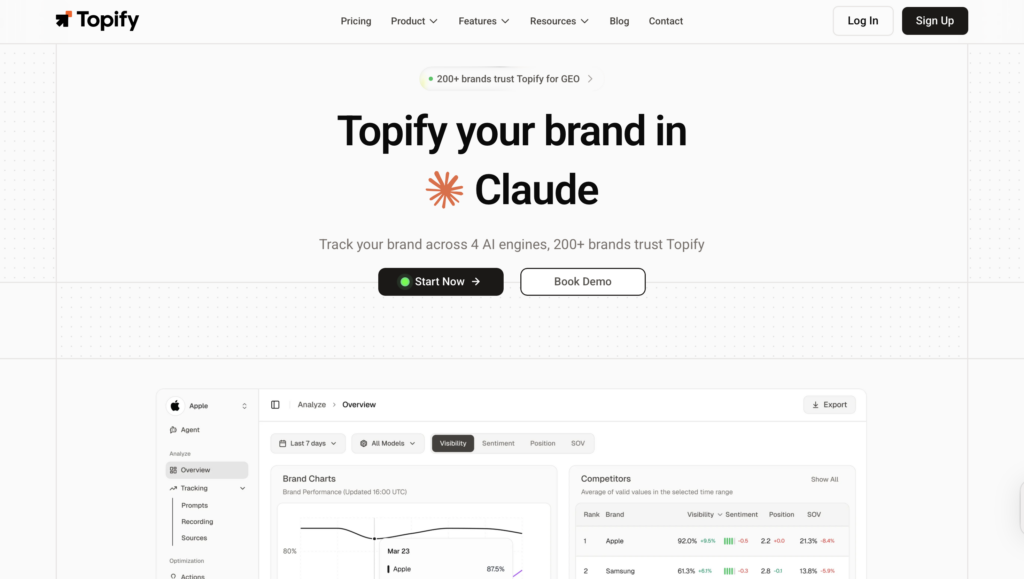
Paired with Competitor Monitoring, which benchmarks position and mention share against rivals in real time, a brand can answer three questions that used to require guesswork: Am I still cited for my core topics? Who replaced me if I’m not? And is the gap growing or shrinking month over month.
This isn’t a one-time audit. Given that AI citation share drifts on its own, at an average of 41 days per the Visionary Marketing tracker of 8,400 prompts, a launch like this one needs ongoing monitoring, not a single check the week it happens.
What Financial Brands Should Do Next
Reacting to this launch doesn’t require an enterprise data deal with OpenAI. It requires knowing exactly where you stand today and closing the gaps that are actually closeable.
- Audit your current citation footprint. Before assuming the worst, confirm which prompts still return your brand and which ones now surface OpenAI’s built-in datasets instead.
- Structure content the way the model rewards. The same Visionary Marketing study found that FAQ schema alone lifts citation rate by 38%, a lever entirely within a brand’s control regardless of what OpenAI licenses.
- Track drift, not just snapshots. A single audit tells you where you stand today. Given how often AI citations shift, that snapshot is stale within weeks.
- Watch your competitors’ response, not just your own. If a rival financial brand starts gaining ground in the same queries you used to own, that’s the earliest signal something upstream has changed.
None of this requires predicting OpenAI’s next move. It requires building a habit of checking, the same way finance teams already check market data every morning.
Conclusion
ChatGPT for Financial Services isn’t just a new product tier. It’s a structural shift in where ChatGPT gets its financial answers from, and it quietly changes the odds for every brand that isn’t part of that new supply chain.
The brands that adapt fastest won’t be the ones with the biggest content libraries. They’ll be the ones that can see, in near real time, whether they’re still part of the conversation ChatGPT is having about their industry.
FAQ
What is ChatGPT for Financial Services?
It’s a tailored version of ChatGPT Work, launched September 10, 2026, that combines GPT-6 Astra with built-in licensed financial datasets for research, financial modeling, and client materials, initially focused on investment banking and equity research.
Which data providers power ChatGPT’s financial datasets?
Daloopa, PitchBook, LSEG News, Crunchbase, and Quartr, with additional entitlement integrations planned for S&P Capital IQ, MSCI, Dow Jones Factiva, and Moody’s.
How can I tell if my brand is still cited by ChatGPT?
You need a tool that tracks the actual domains and URLs ChatGPT cites in its answers over time, not just whether your brand is mentioned by name. Mentions and citations aren’t the same signal, and tracking only one gives you an incomplete picture.
Does this affect all financial brands or only investment banks?
The initial rollout targets investment banking and equity research, but OpenAI has said it plans to expand into other financial services categories. The underlying shift, licensed data replacing open-web content as ChatGPT’s default financial source, affects any brand competing for AI visibility in finance-related queries.