


Your domain authority is 70. Your keyword rankings are solid. But when someone asks ChatGPT for a recommendation in your category, your brand doesn’t show up. Not in the top three. Not even as a footnote.
That’s the blind spot most marketing teams hit in 2026. AI search engines now handle over 2 billion queries daily across ChatGPT alone, and AI-powered platforms have captured roughly 12% to 15% of global search market share. The problem isn’t that brands lack content. It’s that the tools they’re using to measure performance weren’t built for a world where AI models synthesize answers from 2 to 7 sources and skip everything else.
Choosing the wrong AI search visibility tool means tracking the wrong signals, optimizing for metrics that don’t predict whether AI will actually recommend you. Here’s how the 10 strongest options stack up.
Most AI Search Visibility Platforms Only Track One Engine. That’s a Problem.
ChatGPT commands about 60.6% of AI search market share. But Gemini is growing at 12% quarter over quarter, Perplexity attracts a disproportionately high-income B2B research audience, and Claude AI is gaining traction in enterprise document analysis at 14% quarterly growth.
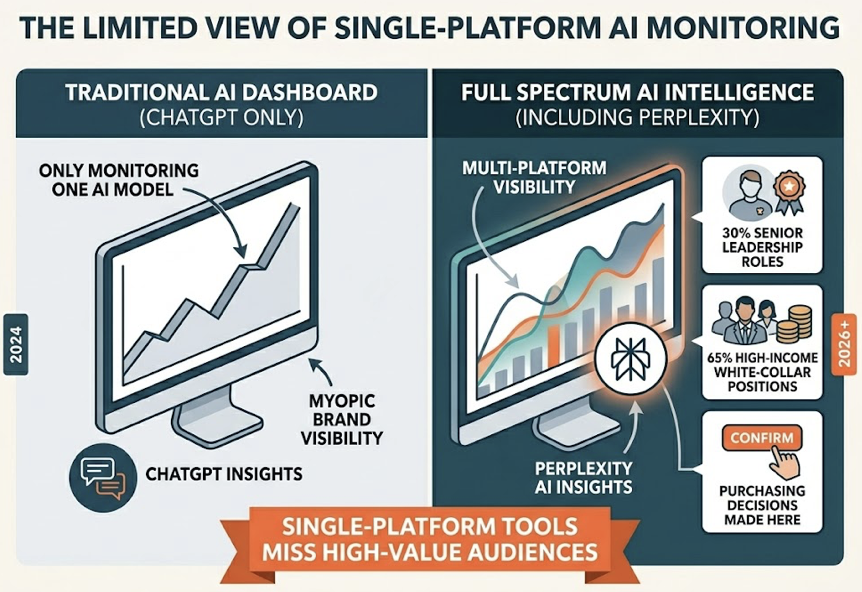
A tool that only monitors ChatGPT gives you one slice of the picture. Your brand might rank well there but remain invisible on Perplexity, where 30% of users hold senior leadership roles and 65% work in high-income white-collar positions. That’s a high-value audience making purchasing decisions based on an AI platform your dashboard doesn’t cover.
The second trap is confusing “monitoring” with “execution.” Many platforms will tell you where you’re missing. Fewer will help you fix it. Only a handful close the loop between identifying a citation gap and deploying the content update that fills it.
With that in mind, here’s how these tools compare across platform coverage, execution capability, pricing, and the specific use case each one fits.
Quick Ranking: 10 AI Search Visibility Tools at a Glance
| Rank | Tool | AI Platforms Covered | Execution Layer | Starting Price | Best For |
|---|---|---|---|---|---|
| 1 | Topify | 7+ (ChatGPT, Gemini, Perplexity, DeepSeek, Doubao, Qwen, AIO) | Yes, one-click | $99/mo | Growth teams and agencies needing end-to-end GEO |
| 2 | Semrush AI Toolkit | ChatGPT, Gemini, AIO | No | $99/mo add-on | Teams already using Semrush for SEO |
| 3 | Profound | 10+ engines | No | $99/mo | Enterprise intelligence in regulated industries |
| 4 | Peec AI | ChatGPT, Gemini, Perplexity, DeepSeek | No | $95/mo | Agencies managing multiple client accounts |
| 5 | Ahrefs Brand Radar | ChatGPT, Gemini, AIO | No | $199/mo add-on | Linking backlink activity to AI citation outcomes |
| 6 | KIME | 10 AI models | Guided tasks | €149/mo | Mid-market teams wanting broadest model coverage |
| 7 | SE Ranking | ChatGPT, Gemini, Perplexity, AIO | No | $52/mo + add-on | Agencies proving ROI through correlation data |
| 8 | Otterly AI | ChatGPT, Perplexity, Gemini | No | $29/mo | Freelancers and small brands starting GEO |
| 9 | Scrunch AI | Agent-level tracking | Technical AXP | ~$250/mo | Enterprise teams with JS-heavy sites |
| 10 | ZipTie.dev | Google AI Overviews | No | $69/mo | Brands focused on Google’s AI Overview layer |
#1 Topify: The AI Search Visibility Platform That Actually Closes the Loop
Most AI search visibility tools stop at the dashboard. They’ll show you a chart, flag a gap, and leave you to figure out what to do next. Topify is built around the opposite assumption: that the value isn’t in the data, it’s in what happens after the data.
The platform tracks seven dimensions of brand representation across 7+ AI platforms: Visibility, Sentiment, Position, Volume, Mentions, Intent, and CVR (Conversion Visibility Rate). That last metric is the one worth paying attention to. CVR integrates with GA4 and CRM data to attribute revenue directly to AI citations. Given that AI-referred visitors convert at roughly 14.2% compared to the 2.8% industry average for traditional organic search, this isn’t an academic exercise. It’s a direct revenue signal.
What separates Topify from the rest is the execution layer. The platform’s One-Click Agent Execution lets marketing teams deploy content fixes directly from the dashboard. Spotted a “best of” prompt where your competitor is cited and you’re not? Topify’s system identifies the content gap, prioritizes it by conversion potential, and generates the optimization brief. One click, and the fix is in motion.
Three capabilities make this particularly effective:
Source Analysis reverse-engineers which third-party domains (Reddit threads, media outlets, G2 reviews) are driving competitor visibility. In a world where 82% to 85% of AI citations originate from third-party pages, knowing which external sources matter is more valuable than optimizing your own site.
High-Value Prompt Discovery surfaces what Topify calls “Dark Queries,” prompts with high AI research volume but near-zero traditional keyword volume. These are the conversations happening inside ChatGPT and Perplexity that your keyword tools can’t see, and they represent first-mover opportunities.
Dynamic Competitor Benchmarking tracks your position relative to competitors across every monitored platform. When a rival secures a new citation for a prompt in your category, the system flags it and recommends the response.
The team behind the platform includes founding researchers from OpenAI and veteran Google SEO practitioners, a combination that gives Topify a technical edge in understanding how LLM crawlers interact with web content.
| Plan | Price | Prompts | AI Analyses | Projects |
|---|---|---|---|---|
| Basic | $99/mo | 100 | 9,000 | 4 |
| Pro | $199/mo | 250 | 22,500 | 8 |
| Enterprise | From $499/mo | Custom | Custom | Custom |
#2 to #5: Strong Contenders With Trade-Offs
#2 Semrush AI Visibility Toolkit
For teams already embedded in the Semrush ecosystem, the AI Visibility Toolkit offers the smoothest path to GEO integration. Its “Citation Gap” view identifies high-performing organic keywords where the brand is being ignored by AI Overviews or ChatGPT, helping prioritize which pages to update first. The limitation: it’s a generalist tool. Teams needing deep, purpose-built AI intelligence often find the specialized depth lacking compared to platforms built exclusively for generative search. Pricing starts at $99/month as a domain-level add-on, or $199/month for the bundled Semrush One Starter plan.
#3 Profound
Profound is the go-to for enterprise intelligence, particularly in regulated industries like finance and healthcare. It processes over 5 million citation analyses daily, and its “Prompt Volumes” product uses real-world panel data to estimate how many people are asking AI platforms specific questions. That demand signal is something traditional keyword tools can’t replicate. The trade-off is clear: Profound is purely a diagnostics platform. It tells you what’s wrong but provides no execution layer to fix it. Enterprise tiers run $2,000 to $5,000+ per month.
#4 Peec AI
Built by ex-Google and DeepMind engineers, Peec AI has become the default for agencies managing multiple client accounts. It offers unlimited user seats, Looker Studio integration for client-ready reporting, and source-level citation data that pinpoints exactly which third-party outlets influenced a specific AI response. Daily prompt execution captures the volatility of LLM updates in near-real time. Starter plans begin at $95/month for 50 prompts.
#5 Ahrefs Brand Radar
Ahrefs’ entry into AI visibility leverages its massive prompt database of over 250 million real queries. Brand Radar connects traditional link-building activity to AI citation outcomes, showing how new authoritative backlinks improve a brand’s mention rate over time. The drawback: it requires an existing Ahrefs subscription plus a $199/month AI add-on, making it one of the pricier options for teams not already in the Ahrefs ecosystem.
#6 to #10: Niche Picks for Specific Needs
#6 KIME
A purpose-built AI visibility command center that tracks 10 different AI models on every plan tier, giving it the broadest mid-market platform coverage. Its “Action Centre” auto-generates prioritized optimization tasks. Starting at €149/month.
#7 SE Ranking (SE Visible)
Uses direct UI-based monitoring rather than API data, capturing exactly what real users see. Strong correlation features link AI visibility growth to branded search lift in Google Search Console. AI Visibility add-on costs $71 to $276/month on top of the $52/month base.
#8 Otterly AI
The most accessible entry point for teams just beginning their GEO journey. Covers ChatGPT, Perplexity, and Gemini with a “Visibility Index” for benchmarking progress. GEO audits based on 25+ AI citability factors. Starts at $29/month.
#9 Scrunch AI
Addresses the technical side: JavaScript-heavy sites that are unreadable to AI agents. Its “Agent Experience Platform” serves a bot-friendly version of your site optimized for LLM ingestion. Essential for enterprise teams running complex single-page applications. Entry tiers start around $250 to $300/month.
#10 ZipTie.dev
The specialist for Google AI Overviews. Uses real-browser monitoring to capture authenticated Google sessions, a gap that API-based tools typically miss. Its “Success Score” integrates mentions, citations, and sentiment into a single per-prompt metric. Starter plans at $69/month.
What Your AI Search Visibility Dashboard Should Actually Show You
Not every team needs the same tool. But every team needs to evaluate the same five dimensions before committing.
Platform coverage comes first. ChatGPT alone isn’t enough. If your audience researches on Perplexity or lives inside Google’s ecosystem, you need a tool that tracks those platforms natively, not through proxies.
Data freshness matters more than you’d expect. Half of all content cited in AI responses is less than 13 weeks old. A tool that refreshes data weekly instead of daily will miss the volatility that defines AI search visibility in 2026.
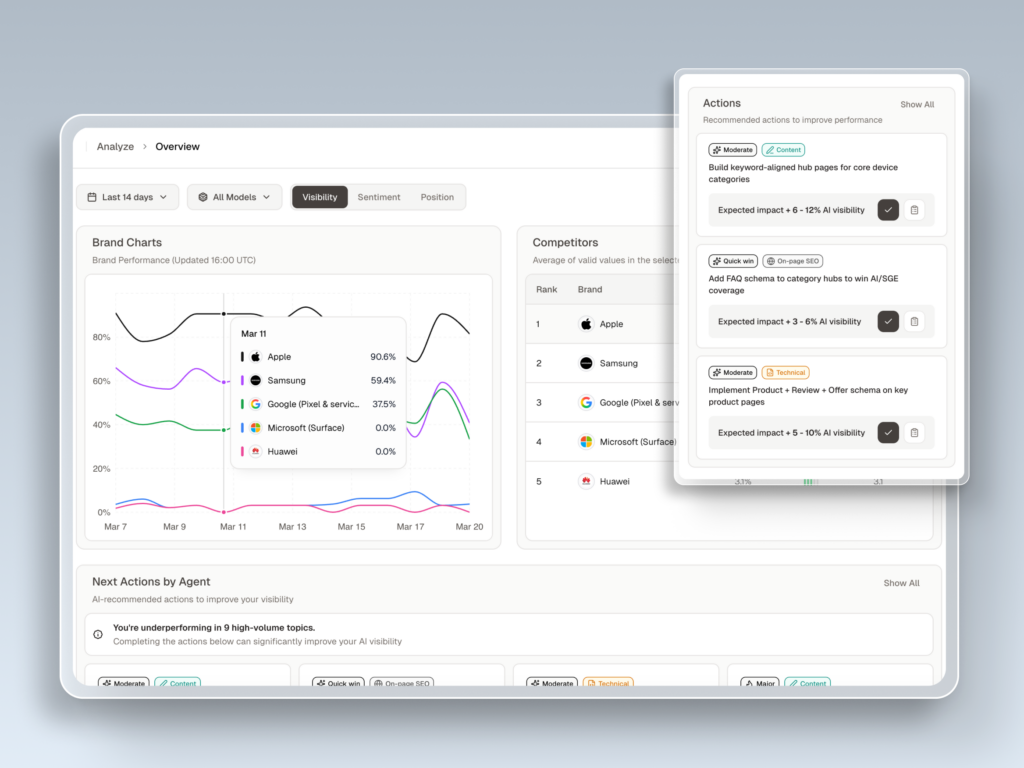
Competitor benchmarking is non-negotiable. You’re not optimizing in a vacuum. The question isn’t whether your visibility improved. It’s whether it improved relative to the brands AI is recommending instead of you.
Execution capability separates monitoring from growth. Tools that stop at “here’s your problem” create a dependency on external agencies or internal content teams to interpret and act on the data. Tools that close the loop, like Topify’s one-click execution, compress the time between insight and action.
Attribution accuracy is the hardest to evaluate but the most important for budget conversations. AI platforms typically don’t send referral data to Google Analytics. Traffic from AI recommendations gets misclassified as “direct” or “branded search.” A tool that connects citation data to downstream conversion signals (like Topify’s CVR metric) turns AI visibility from a vanity metric into a revenue metric.
Conclusion
The brands that will lead their categories by the end of 2026 aren’t the ones with the highest domain authority. They’re the ones that know, in real time, whether AI is recommending them, why or why not, and what to do about it.
For growth teams and agencies that need the full loop, from tracking to execution to attribution, Topify is the strongest starting point. For teams with tighter budgets or more specific needs, Otterly AI and ZipTie.dev offer focused entry points, while Semrush and Ahrefs serve organizations already invested in those ecosystems.
The one thing you can’t afford to do is wait. Only 30% of brands maintain consistent AI visibility across regenerations of the same query. The window to establish your position is now.
FAQ
What is AI search visibility?
AI search visibility measures how frequently and favorably your brand appears in the synthesized responses of AI platforms like ChatGPT, Perplexity, Gemini, and Google AI Overviews. Unlike traditional SEO rankings, it reflects whether AI systems actively choose to include and recommend your brand in their answers.
How do AI search visibility tools work?
Most tools simulate user prompts across multiple AI platforms, then analyze the responses to track whether your brand is mentioned, where it appears in the recommendation order, how it’s described (sentiment), and which sources the AI cited. Advanced platforms like Topify add execution layers that help you act on the data, not just view it.
What’s the difference between SEO tools and AI search visibility tools?
Traditional SEO tools measure backlink profiles, keyword rankings, and organic traffic. AI search visibility tools measure citation frequency, recommendation position, sentiment, and source attribution across generative AI engines. Around 60% of AI Overview citations come from URLs that don’t rank in the top 20 organic results, which means SEO metrics alone can’t predict your AI performance.
How much do AI search visibility tools cost?
Entry-level plans start as low as $29/month (Otterly AI) for basic monitoring. Mid-tier platforms run $99 to $245/month. Enterprise solutions with deep analytics and custom integrations range from $499 to $5,000+/month. The right budget depends on how many AI platforms you need to cover and whether you need execution capability alongside monitoring.

