

Your brand might rank #1 on Google. In ChatGPT, it might not exist.
That’s not a hypothetical. Over 60% of searches now end without a single click to an external site, and 80% of sources cited in AI-generated answers don’t overlap with the top organic results on traditional search engines. Two completely different ecosystems, running in parallel, tracked by almost no one.
That’s the gap AEO tools are built to close.
Most AEO Trackers Only Watch One AI Engine. That’s a Problem.
Here’s what most teams get wrong when they first start monitoring AI visibility: they pick one platform, usually ChatGPT, and call it covered.
It isn’t.
In 2026, the generative search market is split across at least six major engines, each with distinct recommendation logic and user bases. ChatGPT holds 60-78% of global AI search share, but Gemini is the default for anyone in the Google Workspace ecosystem. Perplexity dominates citation-heavy research queries. DeepSeek and Doubao are pulling hundreds of millions of monthly users in Asian markets. Monitoring one platform means you’re optimizing for a slice of the audience, and a shrinking one at that.
The second mistake is treating AEO as a reporting exercise. Real AEO work requires knowing why an AI recommends a competitor, not just that it does. That means URL-level citation tracking, sentiment scoring, and content gap analysis.
The tools below do both. The ones that don’t make the list only do one.
The 7 Best AEO Tools at a Glance
| Tool | AI Platforms Covered | Core Strength | Starting Price |
|---|---|---|---|
| Topify | 7+ (incl. DeepSeek, Doubao) | Full execution + 7-metric analytics | $99/mo |
| Profound | 10+ | Enterprise forensic intelligence | $499/mo |
| Goodie AI | Top 3-5 LLMs | AVI reporting + Optimization Hub | Custom |
| Scrunch AI | Top LLMs | Agency-facing prompt audits | ~$300/mo |
| Gauge | ChatGPT, Perplexity | Browser-based B2B attribution | $600/mo |
| SE Ranking (SE Visible) | ChatGPT, Perplexity, Gemini | Hybrid SEO + AEO dashboard | $99/mo add-on |
| AirOps | Content-layer | High-volume content automation | Custom |
#1 Topify: AEO as an Execution Engine, Not Just a Dashboard
Most AEO platforms stop at the data layer. Topify doesn’t.
Topify is the only platform in this list that connects diagnostic intelligence directly to content execution in a single workflow. Built by former OpenAI researchers (NeurIPS and ICLR publications) and a Fortune 500 Google SEO champion, the platform was designed from day one to bridge the gap between LLM behavior analysis and actual marketing output.
The 7-Metric Framework
Where competitors track mentions and maybe sentiment, Topify monitors seven KPIs simultaneously: Visibility (frequency of appearances), Sentiment (0-100 tone score), Position (rank within synthesized recommendations), Volume (AI search demand for your category), Mentions (explicit and indirect citations), Intent (purchase-signal alignment), and CVR (Conversion Visibility Rate, an estimate of AI referral likelihood to transact).
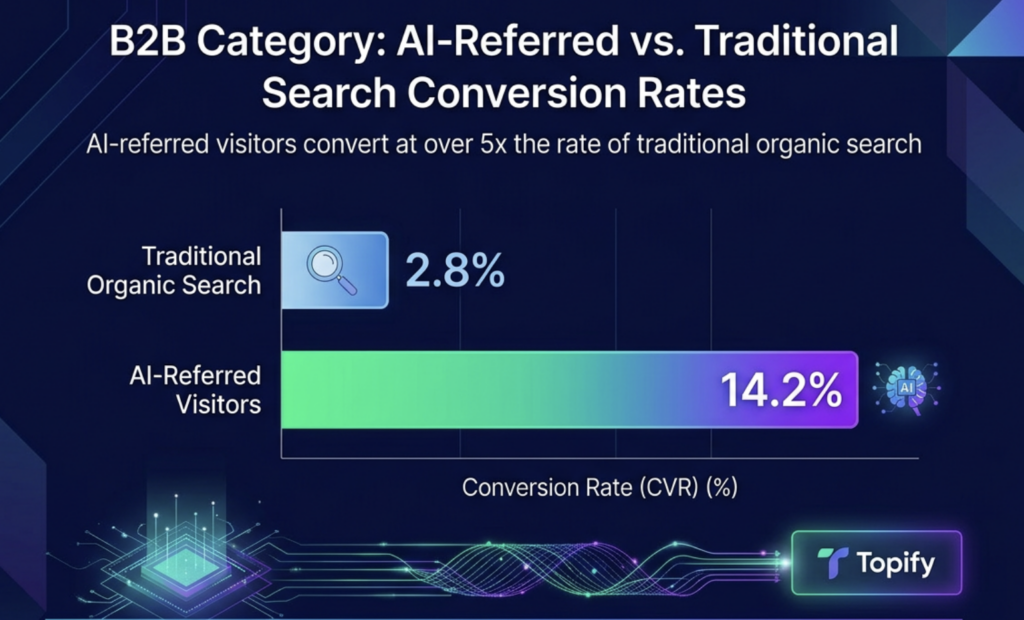
That last metric matters more than most teams realize. AI-referred visitors in B2B categories convert at 14.2%, compared to roughly 2.8% for traditional organic search. Topify’s CVR metric is built precisely to capture that high-intent traffic signal before it disappears into a zero-click result.
Source Analysis and One-Click Execution
Topify’s Source Analysis reverses-engineers which exact domains and URLs AI platforms are using for citations. You see not just whether your brand appears, but which third-party sites are feeding the AI’s understanding of your category, and where your content is losing ground to a competitor’s comparison table or FAQ structure.
Once a gap is identified, One-Click Agent Execution lets teams deploy optimized content immediately. Define the goal in plain English, review the proposed strategy, and launch. No manual workflows. No backlogs.
Platform Coverage
Topify tracks ChatGPT, Gemini, Perplexity, DeepSeek, Doubao, Qwen, and additional global platforms. That global coverage matters in 2026, where regional AI engines often outperform Western counterparts in local markets.
Who It’s Best For
Topify’s structure fits three profiles well: marketing agencies managing multiple client brands from one interface, SaaS companies whose product discovery happens almost entirely through AI recommendations, and in-house teams that need both monitoring and content execution without separate tools.
Pricing: Basic $99/mo (100 prompts, 9,000 AI answer analyses, 4 projects), Pro $199/mo (250 prompts, 22,500 analyses), Enterprise from $499/mo with multi-region tracking and dedicated account management.
#2 Profound: Forensic Intelligence for Enterprise Risk Teams
Profound is the go-to platform for large brands where data accuracy and compliance are non-negotiable requirements, not nice-to-haves.
Its architecture monitors 10+ AI platforms including Claude, Gemini, Perplexity, and Grok. The standout feature is “Query Fanouts Analysis,” which maps how a single consumer prompt (e.g., “safest family car”) branches into a chain of sub-queries as an AI reasons through an answer. For brands in regulated industries like healthcare or finance, this level of forensic depth justifies the $499/mo entry price. SOC 2 Type II and HIPAA compliance make it the default choice for legal and enterprise procurement teams.
Best for: Fortune 500 brands, regulated industries, teams with executive reporting requirements.
#3 Goodie AI: Purpose-Built for the Generative Era
Goodie AI was designed specifically for LLM-era marketing rather than being adapted from a legacy SEO suite. Its “AEO Periodic Table” framework helps teams visualize the required elements for AI visibility: structure, authority, and sentiment.
Its AI Visibility Impact (AVI) reports show exactly which pages on a brand’s website are generating citations, making resource prioritization straightforward. Goodie is a strong fit for mid-market teams that want a user-friendly, comprehensive interface without the complexity of an enterprise command center. Pricing is custom for most deployments.
Best for: Mid-market in-house teams focused on content performance attribution.
#4 Scrunch AI: Prompt-Level Diagnostics for Agencies
Originally an influencer analytics platform, Scrunch has pivoted effectively into AEO, particularly for agencies running high-volume client portfolios.
Its core differentiator is prompt-level insight: the platform shows exactly which queries are triggering brand mentions, which is essential for aligning client content calendars with real AI search behavior. The Agent Experience Platform (AXP) also audits site-level technical blockers, like restrictive robots.txt settings that prevent GPTBot from crawling content. Pricing starts at approximately $300/mo.
Best for: Digital agencies managing multiple brands, teams needing technical crawlability audits.
#5 Gauge: Browser-Based Attribution for Technical B2B
Gauge takes a stricter position on data integrity than most tools: it captures results from actual browser interfaces rather than API calls, which is the more reliable methodology. Because AI outputs are probabilistic, an API query can return results that differ from what a real user sees. Gauge eliminates that discrepancy.
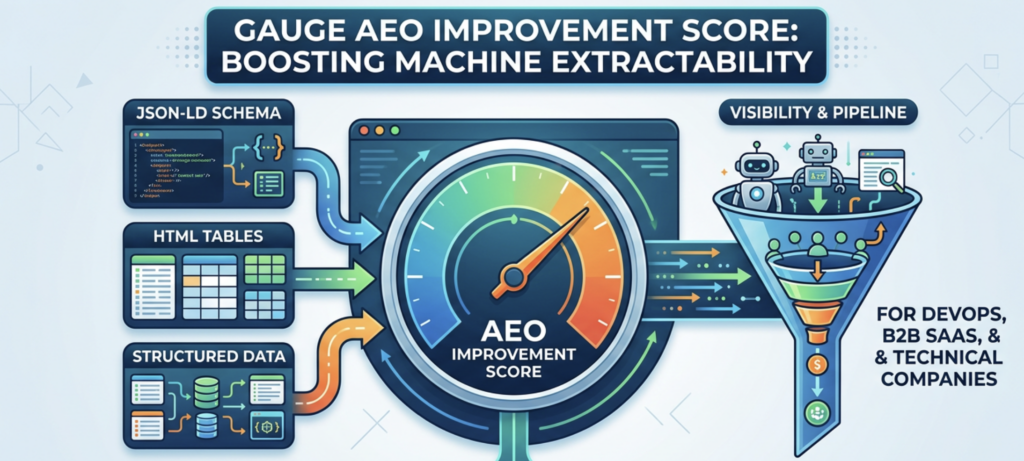
Its AEO Improvement Score measures how well a brand’s technical infrastructure (JSON-LD schema, HTML tables, structured data) supports machine extractability. For DevOps, B2B SaaS, and technical companies where visibility directly feeds pipeline, Gauge’s data-first approach is worth the $600/mo entry point.
Best for: Technical B2B brands, data teams that need conversion attribution tied to AI referrals.
#6 SE Ranking (SE Visible): The Hybrid Option for SEO Teams
SE Ranking’s SE Visible add-on is the right answer for one specific scenario: a team already running SE Ranking for SEO that wants to layer AI visibility monitoring without switching platforms.
The Visibility Score surfaces performance across ChatGPT, Perplexity, and Gemini alongside traditional organic rankings. Particularly useful for identifying “cannibalization” situations where Google AI Overviews are absorbing traffic from previously high-ranking organic pages. At $99/mo as an add-on, it’s the most affordable entry point on this list.
Best for: SEO teams extending into AEO, budget-conscious teams wanting a unified dashboard.
#7 AirOps: Scaling Content Production for Large Libraries
AirOps addresses the execution bottleneck: how do you produce and refresh the volume of content needed to stay visible across hundreds of niche AI prompts?
Its AI-powered workflows scan existing content libraries and recommend optimizations for both traditional search and AI citations at scale. The “Momentum” feature pushes recommendations across thousands of pages simultaneously. It’s less of a monitoring tool and more of a production multiplier. Pricing is custom based on workflow complexity. Content updated within the last 13 weeks is 50% more likely to be cited by generative engines, which makes AirOps’ refresh-at-scale capability directly tied to citation rates.
Best for: Large content teams, publishers, brands with extensive page libraries that need systematic AEO-aligned updates.
What to Look for Before You Pick a Platform
The clearest way to narrow down your choice is to match the tool’s core capability to your primary business objective.
If your goal is lead generation, prioritize Source Analysis and Citation Tracking. Topify and Gauge both connect citation data directly to conversion behavior.
If you’re managing brand narrative across multiple markets, Multi-Platform Monitoring and Sentiment Scoring matter more than execution features. Scrunch AI and Goodie AI both deliver that view.
If content production is the bottleneck, not data, AirOps is the more efficient investment.
One technical criterion worth insisting on regardless of tool: browser-based data capture. Because AI model outputs vary by region, user context, and randomized sampling, API-only results can misrepresent what your target audience actually sees. Platforms that run repeated, randomized prompt checks at the interface level give you a more accurate read on real AI Share of Voice.
Teams also frequently underweight competitive source intelligence. The most useful AEO insight isn’t “we’re mentioned 40% of the time.” It’s “a competitor is winning citations because their pricing page uses a structured comparison table and yours doesn’t.” That specificity is what separates tools worth paying for from dashboards that just confirm what you already suspected.
Conclusion
The shift from keyword rankings to AI citations is not a trend you can monitor from the sideline. AI referral traffic converts at rates up to 23 times higher than traditional organic search, and users arrive already past the research stage. That’s the highest-value traffic segment in 2026, and it’s largely invisible to legacy SEO tools.
The right AEO platform closes that blind spot. For most teams, especially those that need both monitoring depth and content execution in a single workflow, Topify is the most complete starting point. Its 7-metric framework, source analysis, and one-click execution cover the full cycle from “why aren’t we being recommended” to “here’s the content that fixes it.”
Pick the tool that matches your current bottleneck. If you’re not sure what that bottleneck is, an AEO audit across ChatGPT, Perplexity, and Gemini will tell you within a week.
FAQ
What’s the core difference between SEO tools and AEO platforms?
SEO tools measure “rankings” in traditional blue-link results, relying on keyword position and backlink volume. AEO platforms measure “inclusion” in AI-synthesized answers, tracking citation share, brand sentiment, and recommendation rates across engines like ChatGPT and Perplexity. The underlying logic is different: SEO is deterministic indexing; AEO is probabilistic reasoning.
How many AI platforms should a brand monitor?
At minimum, ChatGPT, Google Gemini, and Perplexity, which together represent the majority of AI search demand. For brands with global operations, adding regional platforms like Doubao and DeepSeek is necessary for consistent narrative control across linguistic markets.
Can smaller teams afford professional AEO tools?
Yes. Entry-level plans from Topify ($99/mo) and SE Visible ($99/mo add-on) provide solid baseline monitoring without enterprise-level investment. The ROI case is strong: in B2B SaaS categories, AEO programs show median ROI of 702% even in early-stage deployments.
How often should AI visibility be tracked?
Daily or weekly monitoring is the practical standard. AI model outputs are probabilistic and shift with each model update, so spot checks give you snapshots, not trends. Meaningful pattern detection requires consistent cadence.
Do AEO tools work for non-English markets?
Increasingly, yes. Platforms like Topify include multi-language tracking across global AI engines, which is essential for brands competing in markets where domestic AI models like Doubao and Qwen often outperform Western platforms in local language queries.

