

A VP of Marketing at a mid-stage SaaS company typed “best project management tool for 50-person startups” into ChatGPT last week. Her product has 4.7 stars on G2, ranks on page one of Google, and processes 10,000 active accounts. It didn’t appear in the AI’s answer. Three competitors she’d never tracked showed up instead.
That gap between Google rankings and AI recommendations is where SaaS pipeline quietly disappears. And it’s measurable.
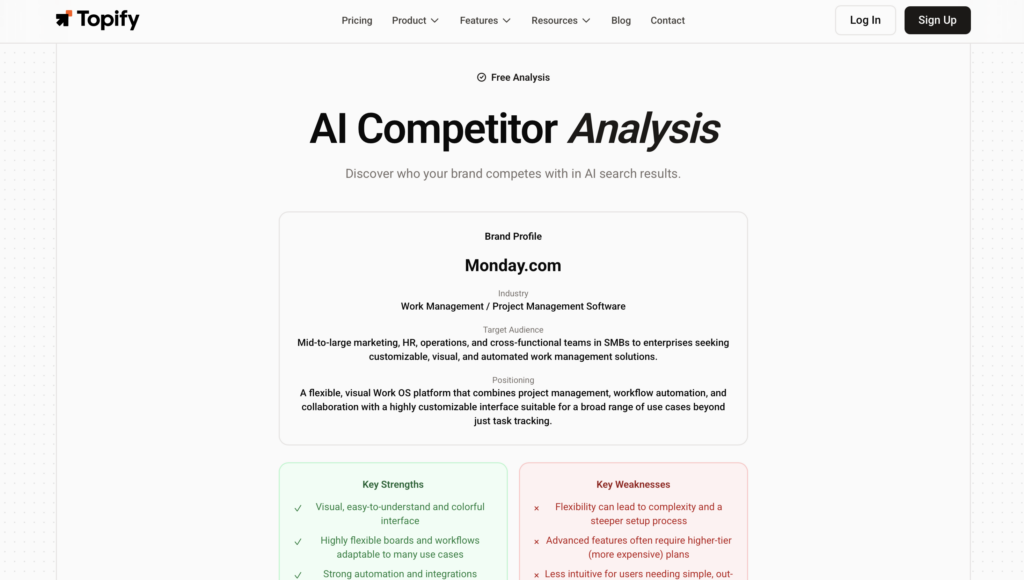
Topify‘s Competitor Analysis tool shows you exactly who AI recommends instead of you, how your positioning compares, and where the overlap sits across your category. ✅ Free ⚡ Results in 60 seconds 🔒 No signup required
AI Competitor Analysis
What AI’s Competitive Map Looks Like for Your SaaS Category
Most SaaS teams track competitors through G2 grids, analyst reports, and win/loss interviews. None of those sources reflect how AI search engines rank and recommend your category. The Competitor Analysis tool surfaces AI’s actual view of your competitive position, broken into dimensions that directly affect whether you get recommended.
The Metrics That Tell You Who’s Winning in AI Search
Each metric maps to a specific competitive dynamic SaaS brands face in AI-generated answers.
| Metric | What It Measures | What It Means for SaaS Brands |
|---|---|---|
| Competitive Overlap (0-100) | How much AI sees you and a competitor as interchangeable | Above 70: AI treats you as a direct substitute, meaning you’re competing for the same recommendation slots |
| Strengths vs Weaknesses | How AI describes each brand’s advantages and gaps | Misaligned descriptions mean AI is telling buyers the wrong story about your product |
| Market Positioning | Where AI places you in the category hierarchy | If AI positions you as “mid-market” when you serve enterprise, your ICP never sees you |
| AI Perception Summary | The narrative AI builds about your brand vs competitors | Perception gaps reveal where third-party content is shaping AI’s view more than your own messaging |
A SaaS brand might discover that AI perceives its strongest competitor as a company it doesn’t even track in its competitive intelligence deck. That’s the kind of blind spot this tool exposes.
Three Scenarios SaaS Brands Discover After Running This Check
Your real AI competitors aren’t who you think. A CRM platform tracking five known competitors discovers that AI recommends three entirely different brands, two of which are smaller startups with strong Reddit presence and third-party editorial coverage. Traditional market share doesn’t predict AI recommendations.
AI describes your strengths differently than your positioning. Your messaging emphasizes enterprise security and compliance. AI describes you as “affordable and easy to set up.” That disconnect means enterprise buyers filtering for security-first solutions never see your name. The Competitor Analysis tool surfaces exactly how AI frames your strengths versus how it frames your competitors’.
You’re visible on one platform but invisible on another. Only 11% of domains get cited by both ChatGPT and Perplexity. Your competitor might dominate ChatGPT recommendations while you own Perplexity, and neither of you knows it without checking.
How to Run Your Competitive Analysis in 60 Seconds
Step 1: Go to Competitor Analysis and enter your brand name or domain.
Step 2: The tool identifies who AI considers your competitors and scores the overlap, positioning, and perception for each.
Step 3: Review the breakdown. Look for competitors you didn’t expect, positioning mismatches, and gaps in how AI describes your strengths versus theirs.
No account needed. No credit card. You’ll have a full competitive picture in under a minute.
The Prompts SaaS Buyers Type Into AI Before They Ever Visit Your Site
94% of B2B buyers now use AI search during their purchasing process, and generative AI has surpassed vendor websites and sales reps as the most-cited information source. For SaaS, the prompts buyers type follow predictable patterns.
| AI Prompt Example | Platform | Search Intent | What It Reveals |
|---|---|---|---|
| “Best [category] software for startups” | ChatGPT | Purchase shortlist | Whether AI includes you in the top 3-5 recommendations |
| “[Your product] vs [competitor] for enterprise” | Perplexity | Head-to-head comparison | How AI frames your strengths and weaknesses against a specific rival |
| “Top alternatives to [competitor]” | Gemini | Competitive replacement | Whether you appear when buyers actively leave a competitor |
| “[Category] tools comparison 2026” | ChatGPT | Market overview | Your position in AI’s category hierarchy |
| “Most secure [category] platform for regulated industries” | Perplexity | Use-case filtering | Whether AI associates you with specific buyer requirements |
| “What do people say about [your brand] on Reddit” | Perplexity | Social proof check | How community sentiment shapes AI’s trust in your brand |
Here’s the thing: these prompts generate a shortlist of 3-5 brands. Buyers open tabs only for those brands. If you’re not on that list, your SEO, paid ads, and outbound sequences are all fighting for attention from prospects who’ve already made their shortlist without you.
Your Google Rankings and AI Recommendations Live in Different Worlds
SaaS marketing teams spend months optimizing for Google. The assumption is that ranking on page one translates to visibility everywhere buyers search. It doesn’t.
Only 12% of URLs cited by AI tools overlap with Google’s top 10 results. A SaaS company dominating Google for “best project management software” can be completely absent when a buyer asks ChatGPT the same question. The reason is structural: AI platforms pull from different source pools. ChatGPT leans on Wikipedia and established authority sites. Perplexity indexes Reddit threads and community discussions. Google AI Overviews pull from YouTube and multi-modal content.
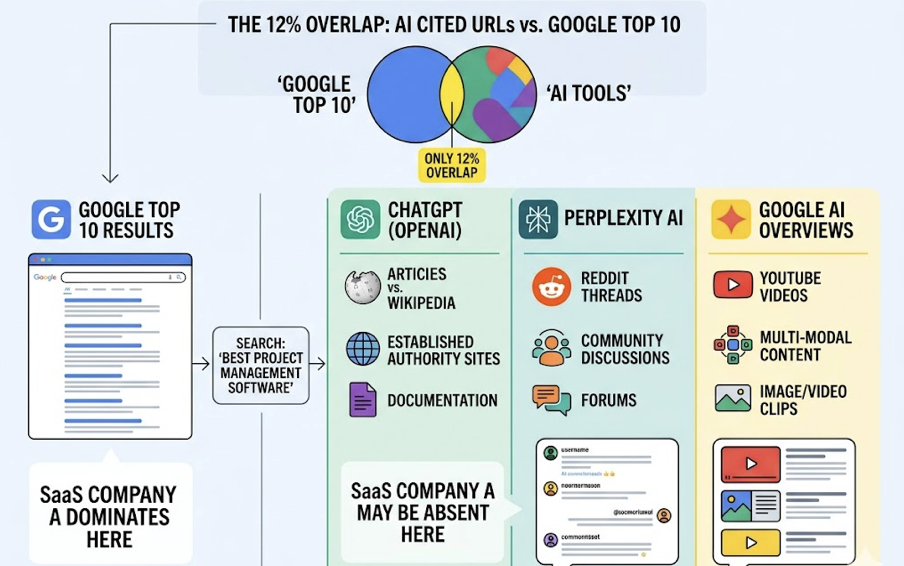
This means a competitor with a fraction of your SEO authority could outrank you in every AI-generated answer, simply because they have stronger presence on the platforms AI actually cites.
A 2026 benchmark study of 50 B2B SaaS brands across 1,400 buyer-intent prompts found an 87-point gap between the most and least visible companies in identical categories. The average score was 56.9 out of 100, and 44% of brands scored below 50. Running Topify’s free Competitor Analysis is the fastest way to see whether you’re on the winning or losing side of that gap.
AI Search Has Its Own Market Share Map, and It Doesn’t Match Yours
Traditional competitive intelligence tracks market share by revenue, customer count, or analyst rankings. AI search has its own hierarchy, and it often looks nothing like the one you’re used to.
Small SaaS brands with active Reddit communities, strong third-party editorial coverage, and structured documentation regularly outperform larger competitors in AI recommendations. 85% of brand mentions in AI-generated answers originate from third-party pages, not from brand-owned domains. 48% of citations come from community platforms like Reddit and YouTube.
That’s a different game than most SaaS marketing teams are playing. If your competitive strategy focuses on outranking rivals on Google while they’re building citation equity on Reddit and industry publications, the AI recommendations gap will keep widening.
On the flip side, this creates an opportunity. A SaaS brand that understands AI’s source preferences can build competitive visibility faster than traditional SEO timelines allow. But first, you need to know the current score. That’s what the Competitor Analysis tool delivers in a single check.
93% of SaaS Marketers Know This Matters. Only 14% Are Doing Something About It.
A 2026 survey of 169 B2B SaaS marketers found that 93% say AI search visibility is critically important. Only 14% have a mature strategy to address it.
The gap isn’t about awareness. It’s about knowing where to start.
Most teams are still measuring success with traditional SEO dashboards: rankings, impressions, organic traffic. Those metrics don’t show whether ChatGPT recommended you last week. They don’t tell you which competitors are taking your AI recommendation slots. And they don’t flag when your AI visibility drops because a model update shifted the source weights.
The lowest-cost first step is a single competitive check. Run your brand through Topify’s Competitor Analysis, see who AI recommends instead of you, and use that data to decide whether AI visibility deserves a seat at your next planning meeting. For most SaaS brands, the answer becomes obvious the moment they see the results.
One Snapshot Shows the Gap. Continuous Tracking Closes It.
The Competitor Analysis tool tells you where you stand right now. But AI recommendations shift constantly. Models update their training data, source weights change, and new competitors build citation equity every week. Only 30% of brands stay visible from one AI answer to the next, and across five consecutive runs, that drops to 20%.
Topify‘s Dynamic Competitor Benchmarking picks up where the free tool leaves off. It tracks your competitive position continuously across ChatGPT, Perplexity, Gemini, and Google AI Overviews, alerts you when a competitor gains or loses ground, and shows you the specific content changes driving the shift.
| Capability | Free Competitor Analysis | Topify Platform |
|---|---|---|
| Check frequency | One-time snapshot | Continuous daily/weekly monitoring |
| AI platforms covered | Aggregated view | Per-platform competitive breakdown |
| Historical trends | None | Full trend history with alerts |
| Competitor tracking | Current state only | Real-time shifts and ranking changes |
| Action recommendations | Manual interpretation | Specific, data-driven next steps |
| Team collaboration | Individual use | Shared dashboards with unlimited seats |
Every plan starts with a 7-day free trial, no credit card required. The Starter plan begins at $99/month.
Conclusion
SaaS buyers are building vendor shortlists inside AI search before they ever visit your website, and 44% of B2B SaaS brands are scoring below the visibility threshold where AI recommends them. The gap between traditional SEO performance and AI recommendations is real, measurable, and growing.
Start with a single check. Run your brand through Topify’s Competitor Analysis to see who AI recommends instead of you, where your positioning mismatches, and which competitors you didn’t know you had. Then decide whether continuous tracking through the Topify platform makes sense for your team.
While you’re checking your competitive position, a few other free tools can round out the picture. Topify’s GEO Score Checker evaluates whether AI crawlers can actually access and interpret your site. The AI Visibility Report shows how often your brand gets mentioned across major AI platforms. And the Brand Profile Checker reveals how AI describes your brand’s identity and where perception doesn’t match reality.
FAQ
Is the Competitor Analysis tool really free? Do I need to create an account?
Yes, it’s completely free. No signup, no credit card, no account required. Enter your brand name or domain and get your competitive breakdown in under 60 seconds.
What’s the difference between the free tool and Topify’s paid platform?
The free tool gives you a one-time snapshot of your AI competitive standing. The paid platform (starting at $99/month) tracks your competitive position continuously, sends alerts when rankings shift, and provides actionable recommendations across ChatGPT, Perplexity, Gemini, and Google AI Overviews.
How often should SaaS brands check their AI competitive position?
AI models update source weights and training data regularly, so competitive positions can shift week to week. A monthly manual check with the free tool catches major changes. For brands in crowded SaaS categories where AI recommendations directly affect pipeline, weekly or continuous tracking through the platform provides the resolution needed to respond in time.
My SaaS ranks well on Google. Do I still need to worry about AI visibility?
Yes. Only 12% of URLs cited by AI tools overlap with Google’s top 10 results. Strong Google rankings don’t predict AI recommendations. A 2026 benchmark found that 44% of B2B SaaS companies with solid traditional SEO score below 50 on AI visibility. The only way to know your actual AI competitive position is to check it directly.

