

A VP of Marketing asked Perplexity, “Which agencies are best for B2B SaaS content strategy?” The AI listed five names. Three of them were firms this VP had never heard of. Two well-known agencies with decade-long track records didn’t make the list at all.
The issue wasn’t their work quality. It was that AI didn’t recognize their authority in the category. And here’s the uncomfortable part: these invisible agencies spend their days optimizing visibility for clients. They just never checked their own.
There’s a free tool that shows you exactly who AI thinks your competitors are, and whether your brand even makes the shortlist. It takes less than a minute.
Marketing Brands Ask AI for Recommendations. Yours Might Not Be in the Answer.
89% of B2B buyers now use generative AI during purchasing research. That includes the CMOs, marketing directors, and procurement teams evaluating your agency, your platform, or your services. When they type a prompt into ChatGPT or Perplexity, the AI doesn’t return ten blue links. It returns a short, synthesized answer with three to five recommendations.
60% of Google searches already end without a click. Users get their answer from an AI overview or a conversational AI tool, and they move on. For marketing brands, this means your potential clients might form a shortlist before they ever visit your website.
The prompts driving these decisions are specific and high-intent. Here’s what marketing buyers are actually asking AI:
| AI Prompt Example | Platform | Search Intent | What It Reveals |
|---|---|---|---|
| “Best marketing agency for B2B SaaS companies” | ChatGPT | Vendor selection | Whether your agency gets recommended for your core niche |
| “Top AI marketing tools for content teams 2026” | Perplexity | Tool evaluation | If your product appears in AI’s curated list |
| “Marketing automation platform comparison mid-size” | Gemini | Purchase decision | How AI positions you against alternatives |
| “How to choose a digital marketing agency for ecommerce” | ChatGPT | Research / criteria | Whether AI cites your expertise as a decision factor |
| “SEO agency vs in-house team for startup growth” | Perplexity | Strategy evaluation | If your agency model gets recommended at all |
| “Best content marketing tools under $500/month” | Google AI Overview | Budget-filtered purchase | Whether you make the cut within specific constraints |
Each of these prompts triggers a recommendation that your potential client may act on immediately. And here’s the data that makes this urgent: users who search through LLMs convert at 4.4x the rate of those using traditional search. These aren’t casual browsers. They’re ready to buy.
The problem is that most marketing brands have no idea whether they appear in these answers, or who’s showing up instead of them.
What Topify’s Competitor Analysis Tool Reveals About Your AI Rivals
Enter Your Brand. See Who AI Puts You Up Against.
Topify‘s Competitor Analysis tool does something no traditional SEO tool can: it shows you who AI considers your competitors. Not who you think they are. Not who ranks alongside you on Google. Who AI actually puts in the same answer when a buyer asks for recommendations in your category.
Enter your brand name, and in under a minute you’ll see a list of the competitors AI associates with you, along with a comparison of strengths, weaknesses, and market positioning. No signup required. No credit card.
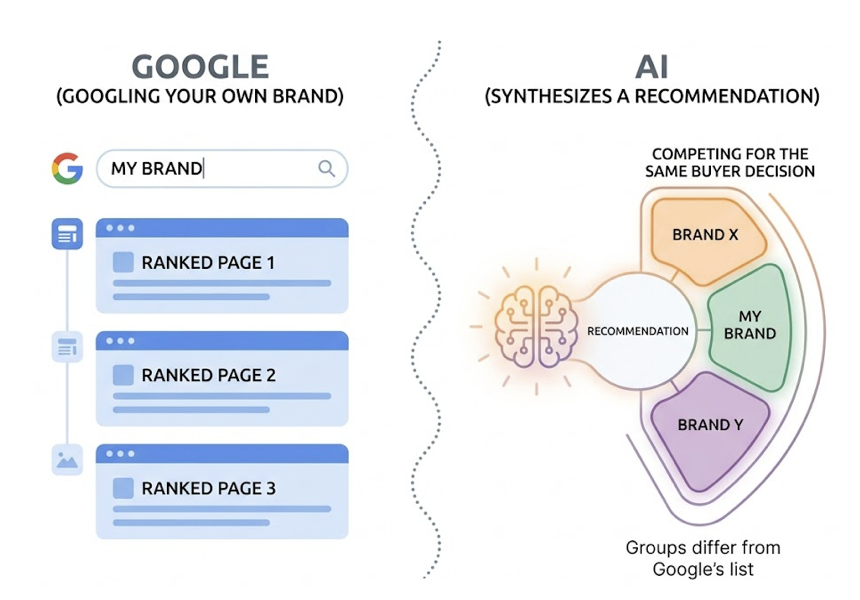
This is different from Googling your own brand. Google shows you ranked pages. AI synthesizes a recommendation. The brands it groups together in a recommendation are the ones competing for the same buyer decision, and that list often looks nothing like your Google competitive set.
Five Dimensions That Define Your AI Competitive Position
The tool breaks down your competitive standing across specific dimensions that AI uses to evaluate and compare brands. Each one maps to a real problem marketing brands face in AI search.
| Dimension | What It Measures | What It Means for Marketing Brands |
|---|---|---|
| Competitive Overlap | How closely AI associates you with specific rivals | High overlap with a weaker brand = AI may group you in a lower tier |
| Strength Comparison | Where AI sees your advantages vs. competitors | Gaps here mean AI is recommending rivals for capabilities you actually have |
| Weakness Exposure | What AI perceives as your disadvantages | AI might cite a product limitation you fixed two versions ago |
| Market Positioning | How AI categorizes your brand’s niche | Misaligned positioning = you’re competing in a category you don’t belong in |
| Recommendation Frequency | How often AI recommends you vs. alternatives | Low frequency in your core category = invisible to high-intent buyers |
A marketing agency with strong Competitive Overlap scores but low Recommendation Frequency has a specific problem: AI knows who you are and groups you with relevant competitors, but it doesn’t recommend you. That tells you the issue isn’t brand recognition. It’s trust signals, content authority, or third-party validation.
On the flip side, a MarTech company with high Recommendation Frequency but incorrect Market Positioning might be winning recommendations in the wrong category. AI might recommend your analytics platform when someone asks about email marketing, which wastes the visibility you do have.
Three Scenarios Where Marketing Brands Get Surprised
Scenario 1: The invisible incumbent. You’ve been a top-five agency in your niche for years. But when you run the Competitor Analysis, you discover AI doesn’t list you at all for your core service. Instead, it recommends three smaller firms that publish more structured, AI-readable content. Your reputation exists in the human world but not in the AI layer.
Scenario 2: The mispositioned platform. Your MarTech product is an enterprise marketing automation tool. But AI describes you as a “small business email marketing solution.” Every prompt about enterprise marketing automation returns your competitors. The tool reveals that AI’s understanding of your product is based on outdated content or misattributed reviews.
Scenario 3: The unknown rival. You’ve tracked five competitors for years. The Competitor Analysis shows a sixth brand you’ve never monitored, one that AI recommends more frequently than you in three out of four relevant prompt categories. This brand may not rank well on Google, but it dominates AI recommendations because of strong third-party citations and structured content signals.
The Marketers’ Blind Spot: Optimizing Everyone’s Visibility Except Their Own
Here’s the irony that defines this moment: 54% of US marketers plan to implement GEO within the next three to six months, but only 23% currently invest in measuring AI visibility. Marketing professionals spend their days building search strategies, optimizing content, and tracking performance for their clients or their company’s products. But when it comes to their own brand’s visibility in AI search, most are flying blind.
This isn’t a minor oversight. If you’re an agency, your prospective clients are evaluating you through AI before they ever reach your website. If you’re a MarTech company, the product managers and marketing directors who might buy your tool are asking ChatGPT for comparisons. If AI doesn’t mention you, or describes you inaccurately, you’re losing deals you never knew existed.
The fix starts with a simple diagnostic. Run your brand through the Competitor Analysis tool and see where you actually stand. Not where you assume you stand based on Google rankings or industry reputation, but where AI places you when a buyer asks for a recommendation.
AI Competitor Analysis
89% of B2B Buyers Use AI for Procurement. Your Competitors May Already Be Optimizing for It.
The data is hard to ignore. 89% of B2B buyers use generative AI during purchasing research, and AI-powered search tools captured 12-15% of global search market share by the end of 2025, up from 5-6% at the start of that year. Among younger decision-makers, the shift is even sharper: roughly 31% of Gen Z begin searches using AI platforms rather than traditional engines.
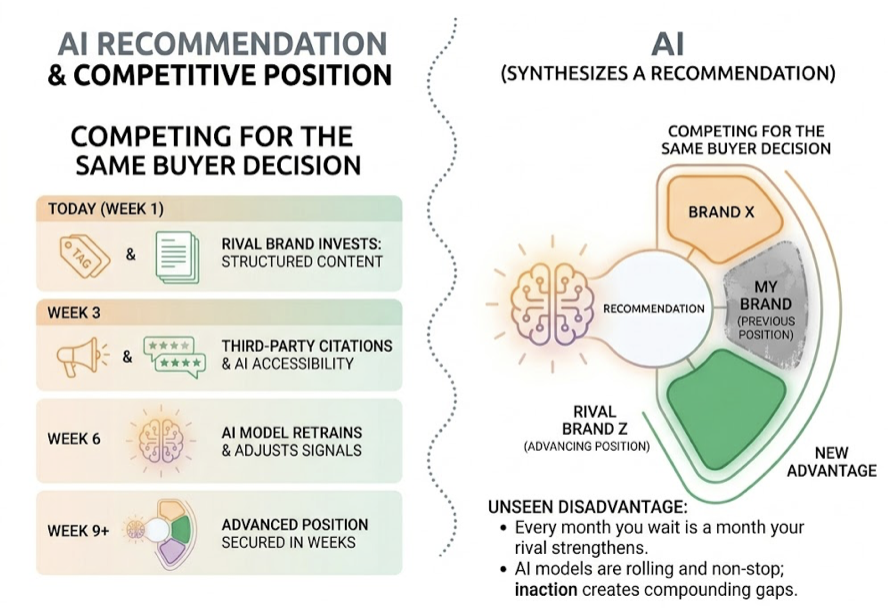
For marketing brands, this creates a compounding disadvantage. Every month you don’t know your AI competitive position is a month where a rival could be strengthening theirs. AI models update, retrain, and adjust their recommendation signals on a rolling basis. A brand that invests in structured content, third-party citations, and AI accessibility today will start showing up in recommendations within weeks, not years.
The GEO market reflects this urgency. It’s projected to grow from $848 million to $33.7 billion by 2034. The marketing teams that treat AI visibility as a core channel now, not a future experiment, will have a structural advantage that’s hard to replicate later.
Bottom line: if you don’t know who AI recommends instead of you, start with the Competitor Analysis. It takes 60 seconds and costs nothing.
One Competitive Snapshot Shows the Gap. Continuous Tracking Closes It.
Your Competitor Analysis results show you today’s AI competitive landscape. But AI recommendations aren’t static. Models retrain, new content gets indexed, and competitor brands adjust their strategies. A competitive position you hold today could shift next quarter without any change on your end.
Topify‘s platform picks up where the free tool leaves off. The Dynamic Competitor Benchmarking feature tracks your competitive position continuously across ChatGPT, Perplexity, Gemini, and Google AI Overviews. You’ll see when a new competitor enters AI recommendations in your category, when your ranking shifts, and which specific signals are driving those changes.
Here’s how the free check compares to the full platform:
| Capability | Free Competitor Analysis | Topify Platform |
|---|---|---|
| Check frequency | One-time snapshot | Continuous daily/weekly monitoring |
| AI platforms covered | Aggregated view | Per-platform breakdown (ChatGPT, Perplexity, Gemini, AI Overviews) |
| Historical trends | None | Full trend history with shift alerts |
| Competitor tracking | Current competitors only | Real-time new competitor detection |
| Action recommendations | General positioning insights | Specific, prioritized optimization steps |
| Team collaboration | Individual use | Unlimited team member seats |
Every plan starts with a 7-day free trial, no credit card required. The Starter plan begins at $99/month.
Conclusion
Marketing brands face a specific version of the AI visibility challenge: you understand search optimization better than most industries, but that expertise hasn’t translated to your own AI presence. The competitive landscape in AI search is different from Google, the stakes are rising as B2B buyers shift to AI-driven research, and the window to build a first-mover advantage is still open.
Start with the free Competitor Analysis. See who AI recommends instead of you. Then decide whether the gap is small enough to ignore or large enough to act on.
While you’re assessing your competitive position, a few other free checks can round out the picture. Topify’s AI Visibility Report shows how often your brand gets mentioned across major AI platforms. The Brand Authority Checker scores the trust signals AI uses to decide whether to recommend you. And the Prompts Researcher reveals the exact questions your potential clients are asking AI in your category.
For the full suite of diagnostic tools, visit Topify’s free tools.
FAQ
Is the Competitor Analysis tool free? Do I need to sign up? Yes, it’s completely free. Enter your brand name and get results in under a minute. No registration, no credit card, no strings attached.
What’s the difference between the free tool and Topify’s paid platform? The free tool gives you a one-time competitive snapshot. The paid platform provides continuous monitoring, historical trend data, per-platform breakdowns, new competitor alerts, and actionable optimization recommendations. Plans start at $99/month with a 7-day free trial.
How often should marketing brands check their AI competitive position? AI models update frequently, and competitor strategies evolve. A monthly check with the free tool is a reasonable starting point. For brands in highly competitive categories (agencies, MarTech, performance marketing), weekly or continuous tracking through the platform gives a meaningful edge.
Can AI visibility replace traditional SEO for marketing brands? No. AI visibility builds on strong SEO fundamentals, including structured content, technical accessibility, and domain authority. Think of it as an additional layer. Brands that rank well in traditional search often have a head start in AI recommendations, but it’s not automatic. AI evaluates different signals, and the competitive set can look entirely different.

