

A Head of HR Operations asked ChatGPT, “What’s the best HRIS for mid-market companies with global payroll and SOC 2 compliance?” The AI returned five platform recommendations. Your product, with 8,000 enterprise clients and a G2 score of 4.7, wasn’t one of them. The issue isn’t your product. It’s that AI doesn’t recognize your authority in the category.
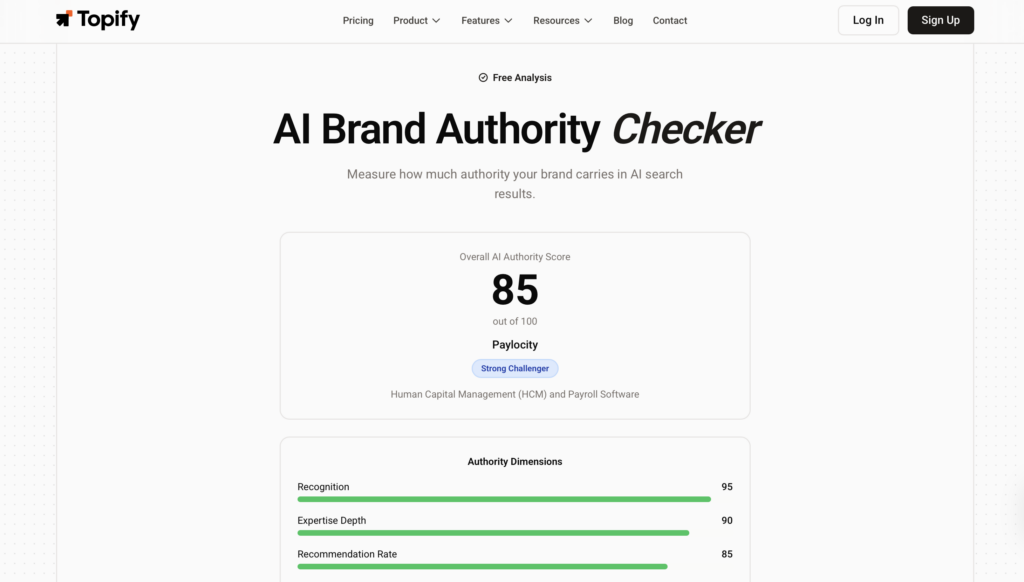
The gap is measurable, and the check takes 60 seconds. Topify‘s Brand Authority Checker scores how AI models perceive your brand’s authority across four dimensions that directly determine whether you get recommended.
✅ Free ⚡ Results in 60 seconds 🔒 No signup required
AI Brand Authority Checker
The Four Authority Scores That Decide If AI Recommends Your HR Platform
Each score maps to a specific problem HR tech brands face in AI search. Here’s the thing: AI doesn’t recommend platforms because they rank on Google. It recommends them because it trusts them. And trust, in AI’s framework, breaks down into four measurable dimensions.
What Each Metric Means for HR Tech
| Metric | What It Measures | What It Means for HR Tech Brands |
|---|---|---|
| Recognition (0-100) | How often AI identifies your brand in your category | Below 40: AI doesn’t associate you with your core sub-vertical (HRIS, ATS, HCM) |
| Expertise Depth (0-100) | How well AI understands your capabilities | Below 50: AI may misrepresent your compliance certifications or integration ecosystem |
| Recommendation Rate (0-100) | How often AI recommends you vs. alternatives | Below 30: you’re losing deals before your sales team talks to a single prospect |
| Trust Signals (0-100) | External validation AI detects (media, reviews, analyst citations) | Below 40: AI can’t find enough third-party evidence to vouch for your platform |
An HRIS vendor with a Recognition score of 80 but a Trust Signals score of 25 has a specific problem: AI knows who you are, but it doesn’t trust you enough to recommend you over platforms with stronger external validation. That’s not a branding failure. It’s a signal gap, and now you know exactly where to focus.
Industry Scenarios That Expose the Gap
Scenario 1: The invisible compliance story. Your platform holds SOC 2 Type II and supports GDPR-compliant payroll across 30 countries. But AI describes your security posture using language from two product versions ago. Your Expertise Depth score reveals why: AI hasn’t absorbed your updated compliance documentation because your site’s JS-heavy architecture blocks its crawlers.
Scenario 2: The sub-vertical mix-up. You’ve built a strong reputation in applicant tracking, but AI keeps recommending you for performance management queries you don’t target. Your Recognition score is high in the wrong category. This misclassification dilutes your authority where it actually matters.
Scenario 3: The review gap. Your G2 profile has 400 reviews, but most say “great HR software” without specifying company size, industry, or use case. AI can’t learn anything from generic praise. Your Trust Signals score reflects exactly that: high volume, low specificity.
How to Run Your Check
Go to Brand Authority Checker, enter your brand name or domain, and get your four-dimensional authority breakdown in under 60 seconds. No signup, no credit card, no strings attached.
Look at which scores are below 50 first. Those are the dimensions where AI is either ignoring you or misrepresenting you. Then cross-reference: if Recognition is high but Recommendation Rate is low, AI knows you exist but actively prefers other platforms. That’s a different fix than being invisible altogether.
HR Tech Buyers Ask AI Questions Google Can’t Handle
71% of HR technology buyers now use AI assistants during initial vendor discovery, before contacting any vendor directly. Among mid-market buyers (100-500 employees), that number climbs to 79%. These aren’t simple searches. HR tech evaluation involves multiple stakeholders: HR leadership, finance, IT, and often legal. The prompts they use reflect that complexity.
| AI Prompt Example | Platform | Buyer Intent | Authority Signal AI Looks For |
|---|---|---|---|
| “Best HRIS for mid-market companies with global payroll” | ChatGPT | Shortlisting vendors | Expertise Depth in payroll + compliance |
| “Which ATS handles high-volume recruiting at enterprise scale” | Perplexity | Capacity evaluation | Recognition in ATS sub-vertical + Trust Signals from enterprise case studies |
| “Compare performance management platforms for remote teams 2026” | Gemini | Feature comparison | Recommendation Rate + Expertise Depth in remote work features |
| “HRIS platforms with Workday integration and SOC 2 certification” | ChatGPT | Technical fit check | Trust Signals from compliance documentation + integration mentions |
| “What’s the best HR analytics tool for a 2,000-person healthcare company” | Perplexity | Industry-specific match | Recognition in analytics + Expertise Depth in healthcare vertical |
These prompts are multi-conditional. A buyer isn’t asking “best HR software.” They’re specifying company size, industry, compliance requirements, integration needs, and use case in a single question. AI’s answer depends on whether it associates your brand with enough of those conditions to recommend you. That’s not SEO. That’s authority.
Your Authority Score Doesn’t Transfer Across HR Tech Sub-Verticals
HR tech is not one market. It’s a collection of sub-verticals, each with its own AI answer ecosystem: HRIS, HCM, ATS, performance management, workforce analytics, compensation management, learning and development. Your brand authority in one sub-vertical doesn’t carry over to another.
This matters because the HR tech market is deeply fragmented. HRIS vs. HCM, ATS vs. CRM-for-recruiting, performance management vs. engagement platforms: each category has its own competitive map in AI’s recommendation engine. A platform that scores 80 in HRIS Recognition might score below 30 in workforce analytics, even if it ships both modules. AI evaluates these as separate authority domains.
On the flip side, this fragmentation creates opportunity. You don’t need to dominate every sub-vertical. You need to own the ones where your buyers are asking questions. Run your brand through the Brand Authority Checker and pay attention to which category AI places you in. If it’s not the one you’re targeting, that’s your first fix.
The Long Sales Cycle Problem: Miss the AI Answer, Miss the Entire Deal
HR tech purchases take weeks to months. A typical HRIS evaluation involves demos, compliance reviews, security assessments, and committee sign-offs. But the vendor shortlist gets formed in the first 48 hours of research.
92% of CHROs anticipate that AI will be further integrated into their workforce this year. That integration isn’t limited to internal HR processes. It extends to how HR leaders evaluate and procure the technology they use. When a CHRO or VP of People Operations opens ChatGPT to build an initial vendor list, the platforms that appear in that first answer have a structural advantage through the rest of the evaluation cycle.
The brands that don’t appear? They’re not just missing one touchpoint. They’re missing the entire deal funnel.
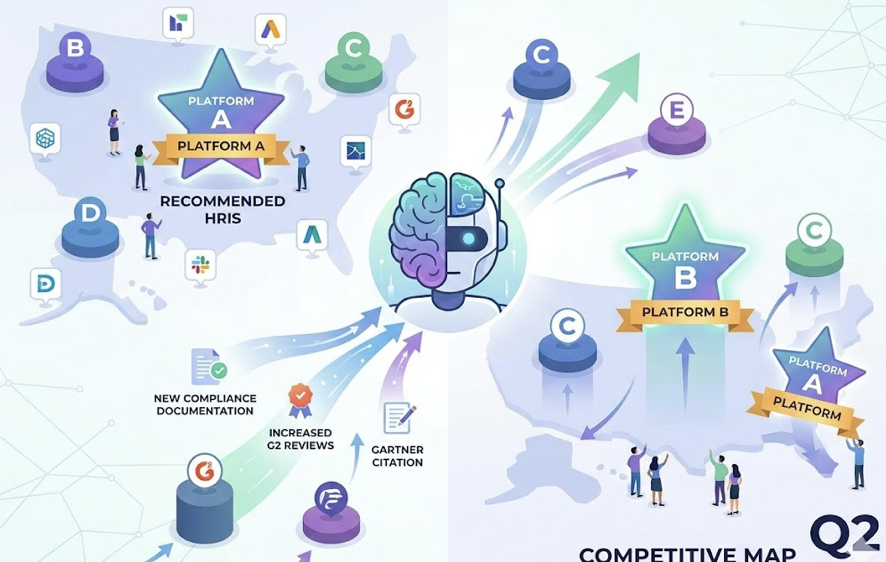
Here’s the thing: AI models update on a rolling basis. A platform that appears in ChatGPT’s HRIS recommendations in Q1 might disappear in Q2 because a competitor published better compliance documentation, earned more specific G2 reviews, or got cited in a Gartner analysis that entered the model’s training window. The competitive map in AI search isn’t static. It shifts with every model update, every new citation, every fresh review.
That’s why a one-time check isn’t a strategy. It’s a starting point.
One Score Is a Starting Point. Tracking It Over Time Is the Strategy.
Your Brand Authority Checker results tell you where you stand right now. But AI models update their training data, adjust ranking signals, and shift recommendations on a rolling basis. A score of 72 today could drop to 55 next quarter without any change on your end, simply because a competitor published a SOC 2 whitepaper that entered ChatGPT’s training window.
Topify‘s platform picks up where the free tool leaves off. The Comprehensive GEO Analytics dashboard tracks your authority, sentiment, and visibility scores continuously across ChatGPT, Perplexity, Gemini, and Google AI Overviews. You’ll see trend lines, get alerts when scores shift, and receive specific recommendations for what to fix next.
Here’s how the free check compares to the full platform:
| Capability | Free Brand Authority Checker | Topify Platform |
|---|---|---|
| Check frequency | One-time snapshot | Continuous daily/weekly monitoring |
| AI platforms covered | Aggregated score | Per-platform breakdown (ChatGPT, Perplexity, Gemini, AI Overviews) |
| Historical trends | None | Full trend history with alerts |
| Competitor tracking | Not included | Real-time competitor benchmarking |
| Sub-vertical breakdown | Single category | Authority scores per HR tech sub-vertical |
| Action recommendations | General | Specific, one-click GEO optimization |
Every plan starts with a 7-day free trial, no credit card required. The Starter plan begins at $99/month.
Conclusion
HR tech buyers are already asking AI for vendor recommendations. The question isn’t whether AI search matters for your category. It’s whether AI trusts your brand enough to recommend it when a CHRO, HR ops lead, or procurement team asks.
Start with the free Brand Authority Checker to see exactly how AI perceives your platform’s authority. Identify which of the four scores is holding you back. Then decide whether a one-time snapshot is enough or whether continuous tracking makes sense for your sales cycle.
While you’re assessing your brand authority, a few other free checks can round out the picture. Topify‘s AI Robots Checker reveals whether your site’s robots.txt is blocking AI crawlers from accessing your content. The Knowledge Freshness Checker flags outdated product information that AI models might still be citing. And the Competitor Analysistool shows how AI positions your brand relative to others in your sub-vertical.
FAQ
Is the Brand Authority Checker really free? Do I need to sign up?
Yes, it’s completely free with no signup or credit card required. Enter your brand name or domain at topify.ai/tools/brand-authority-checker and get your full authority score breakdown in about 60 seconds.
What’s the difference between the free tool and the Topify platform?
The free Brand Authority Checker gives you a one-time snapshot of your current authority scores. The Topify platform provides continuous monitoring across ChatGPT, Perplexity, Gemini, and Google AI Overviews, with historical trend data, competitor benchmarking, and specific optimization recommendations. Plans start at $99/month with a 7-day free trial.
How often should HR tech brands check their AI visibility?
At minimum, quarterly. HR tech is a fast-moving category with frequent product launches, compliance updates, and model training refreshes. If you’re in an active sales cycle or recently shipped a major feature, monthly checks are more appropriate. Continuous monitoring through the full platform catches drops before they cost you pipeline.
My brand ranks well on G2 and Google. Why would I be invisible in AI search?
AI search and traditional SEO operate on different signals. AI models weigh brand authority, expertise depth, and external trust signals differently than Google weighs backlinks and keywords. Many HR tech vendors with strong G2 profiles and Google rankings are completely absent from ChatGPT and Perplexity answers because AI can’t parse their JS-heavy sites, their compliance content is outdated, or their reviews lack the specificity AI needs to make category-level associations.

