

A CISO typed into ChatGPT: “Best XDR platform for a mid-market company with hybrid cloud workloads.” Five vendors appeared in the response. Yours wasn’t one of them. Your product has SOC 2 Type II certification, covers 50,000+ endpoints, and won a Gartner Peer Insights award last year. None of that mattered. AI didn’t recognize your authority.
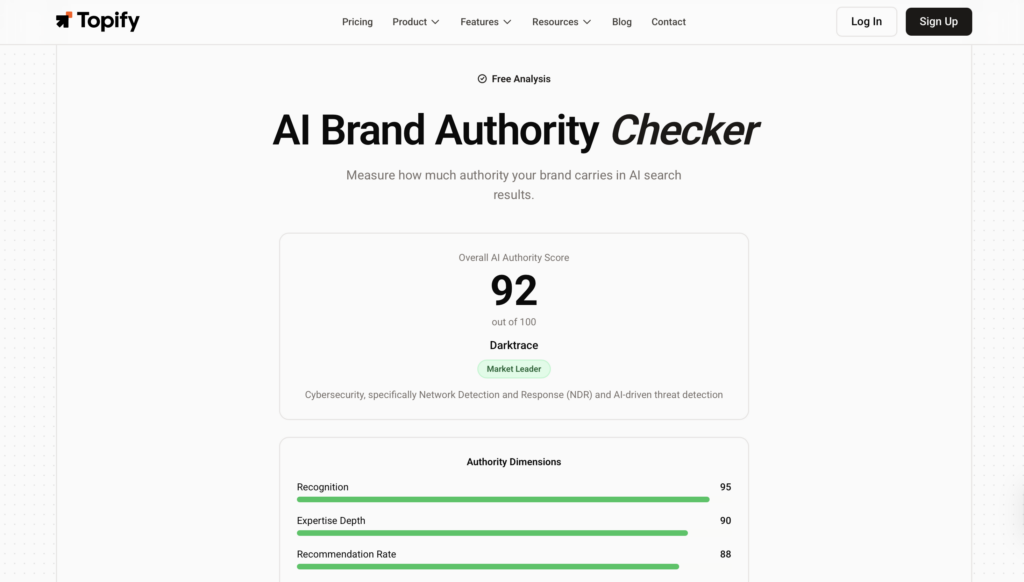
The gap is measurable, and the check takes 60 seconds. Topify‘s Brand Authority Checker scores how AI models perceive your cybersecurity brand’s authority across four dimensions that directly influence whether you get recommended or ignored.
✅ Free ⚡ Results in 60 seconds 🔒 No signup required
AI Brand Authority Checker
The Four Authority Scores That Decide Whether AI Recommends Your Security Brand
What Each Score Means for a Cybersecurity Vendor
The Brand Authority Checker breaks your AI-perceived authority into four measurable dimensions. Each one maps to a specific failure mode in cybersecurity vendor selection.
| Metric | What It Measures | What It Means for Cybersecurity Vendors |
|---|---|---|
| Recognition (0-100) | How often AI identifies your brand in your category | Below 40: AI doesn’t associate you with your core security category, even if you dominate Google rankings |
| Expertise Depth (0-100) | How well AI understands your technical capabilities | Below 50: AI may misrepresent your detection methodology, compliance certifications, or platform coverage |
| Recommendation Rate (0-100) | How often AI recommends you over alternatives | Below 30: you’re losing CISO shortlist placements to vendors AI considers more credible |
| Trust Signals (0-100) | External validation AI detects from third parties | Below 40: AI can’t find enough analyst mentions, peer reviews, or media coverage to vouch for you |
Here’s the thing. A cybersecurity vendor with a Recognition score of 80 but a Trust Signals score of 25 has a very specific problem: AI knows who you are, but doesn’t trust you enough to recommend you to a CISO evaluating options. That’s a gap you can close once you know it exists.
Three Signals That Tell You AI Doesn’t Trust Your Brand Enough to Recommend It
Not every low score means the same thing. In cybersecurity, three patterns show up repeatedly.
Pattern 1: Strong product, weak third-party coverage. Your product genuinely outperforms in independent testing, but AI models don’t see enough analyst reports, G2 reviews, or media mentions to validate that claim. The Trust Signals score exposes this.
Pattern 2: Category confusion. You’ve expanded from endpoint security into XDR and cloud security, but AI still categorizes you as an endpoint-only vendor. The Expertise Depth score catches misalignment between what you do and what AI thinks you do.
Pattern 3: Invisible to buyer-intent queries. You rank well for technical queries like “how does SIEM work” but disappear when someone asks “best SIEM for mid-market.” The Recommendation Rate score reveals whether AI includes you in purchase-decision conversations.
How to Run Your Check
Go to Brand Authority Checker, enter your brand name or domain, and get your four-dimensional authority breakdown in under 60 seconds. No signup, no credit card.
Look at which dimension scores lowest. That’s your starting point. A low Trust Signals score calls for a different fix than a low Recognition score, and knowing the difference saves months of misallocated marketing effort.
73% of Cybersecurity Vendors Get Zero AI Citations. Here’s What Their Buyers Are Actually Asking.
A 2026 benchmark analyzed 100 cybersecurity companies across six AI platforms using 250 buyer-intent prompts. The result: 73% of vendors received zero citations from ChatGPT when buyers asked for vendor recommendations in their category. Not low citations. Zero.
The prompts driving this aren’t obscure. They’re the exact questions CISOs and IT leaders type into AI every day.
| AI Prompt Example | Platform | Search Intent | What It Reveals |
|---|---|---|---|
| “Best XDR platform for mid-market companies” | ChatGPT | Purchase shortlist | Whether AI includes you in the initial vendor set |
| “CrowdStrike vs Palo Alto for endpoint protection” | Perplexity | Competitive comparison | How AI positions you against named competitors |
| “Most trusted SIEM for financial services compliance” | Gemini | Trust verification | Whether AI considers your compliance credentials credible |
| “Alternatives to CrowdStrike for cloud security” | ChatGPT | Vendor switching | Whether you appear when buyers actively seek options |
| “Best cybersecurity vendor for zero trust implementation” | Perplexity | Architecture decision | Whether AI links your brand to specific frameworks |
The concentration effect is severe. AI responses for cybersecurity queries typically cite only 2 to 7 vendors per answer. Compare that to Google’s 10 blue links. The bar for inclusion is dramatically higher, and the penalty for exclusion is total invisibility in that buyer’s research flow.
On the flip side, the vendors who do appear capture disproportionate value. AI-referred sessions convert at 5.1 times the rate of traditional organic traffic, with conversion rates reaching 14.2% compared to 2.8% from standard Google search. For cybersecurity vendors, where a single enterprise deal can exceed six figures, each missed AI citation carries real pipeline cost.
Your Google Rankings Don’t Transfer to AI. That’s the Core Problem.
One enterprise cybersecurity firm with over 50,000 monthly Google visitors received zero ChatGPT citations when buyers searched for their category. A competitor with a fraction of that organic traffic appeared consistently across multiple AI platforms.
This disconnect is structural, not accidental. 48% of ChatGPT’s top cited sources are Wikipedia, roughly 11% come from Reddit, and established tech outlets fill most of the remaining slots. Vendor-owned content, the blogs and product pages that drive traditional SEO, almost disappears in buyer-intent queries.
In practice, this means a cybersecurity brand that invested years in domain authority, backlink profiles, and keyword rankings may have built zero AI authority. The two systems evaluate credibility on different signals. Google cares about links and page structure. AI cares about whether third-party sources independently validate your claims.
The Brand Authority Checker’s Trust Signals dimension directly measures this gap. If your score is low, it tells you that AI models can’t find enough external evidence, analyst mentions, G2 reviews, Reddit discussions, media coverage, to recommend you with confidence. That’s actionable information, because the fix isn’t more blog posts. It’s more earned media.
CISOs Are Building Shortlists in AI. If You’re Not There, You Don’t Exist.
CISOs and IT leaders are using ChatGPT, Claude, and Perplexity to scope vendor shortlists, draft RFP requirements, and benchmark vendor claims before any analyst inquiry call. This isn’t a fringe behavior. 73% of B2B buyers now use AI tools like ChatGPT and Perplexity in their purchase research process.
The implication is straightforward: if AI doesn’t recommend you, you don’t make the first cut. 78% of B2B buyers only shortlist vendors they already recognize. When AI becomes the recognition layer, absence from AI responses is functionally identical to not existing in the buyer’s mind.
And the traffic numbers confirm this shift is accelerating. AI-referred sessions to B2B websites jumped 527% in the first five months of 2025 alone. Gartner predicts that organic search traffic will decline by over 50% by 2028 as buyers adopt AI-driven discovery. For cybersecurity, where purchase decisions are high-stakes and committee-driven, the evaluation starts before your sales team even knows the buyer exists.
The Window Is Closing. First Movers Lock In Citation Patterns That Compound.
AI search is still early enough that cybersecurity brands who move now can establish citation patterns that compound over time. Here’s why timing matters.
AI models learn from patterns. When a vendor consistently appears across analyst mentions, peer reviews, and structured comparison content, AI treats that vendor as a default recommendation for the category. Early citation presence creates a feedback loop: more citations lead to more visibility, which generates more third-party mentions, which reinforces the citations.
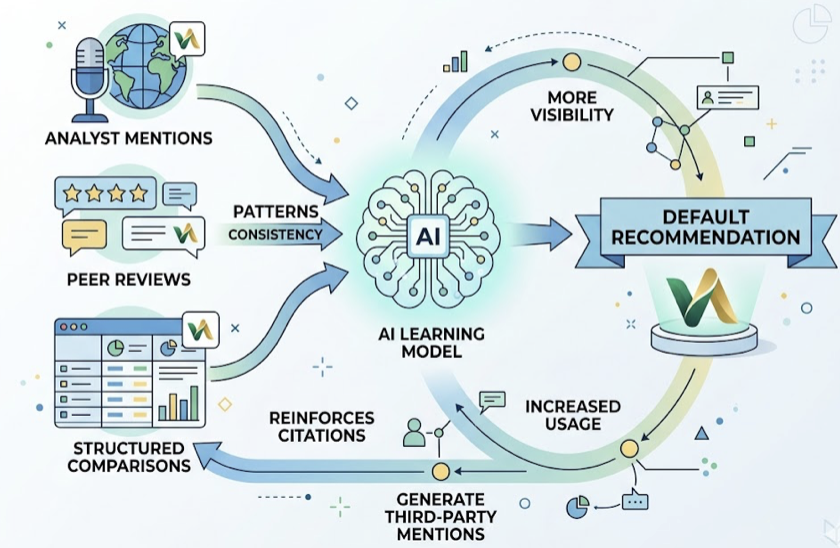
The reverse is also true. Vendors who wait will find it progressively harder to break into AI recommendations as incumbent citation patterns solidify. The window for establishing AI authority in cybersecurity is open right now, but the number of “slots” in each AI response is limited to 2 to 7 vendors.
| Signal | Current State | What It Means for Your Timing |
|---|---|---|
| AI-referred B2B traffic growth | 527% increase in 5 months (2025) | AI is already a primary discovery channel |
| B2B buyers using AI for research | 73% and rising | Majority of your buyers are already there |
| Cybersecurity vendors with zero AI citations | 73% | Most competitors haven’t moved yet |
| Organic search traffic decline forecast | 50%+ drop by 2028 (Gartner) | Traditional SEO alone won’t sustain pipeline |
| AI traffic conversion rate advantage | 5.1x over organic search | Every AI citation captured converts at higher rates |
The first step is measuring where you stand. Run your brand through the Brand Authority Checker, see which of the four dimensions needs work, and build from there.
One Authority Score Is a Starting Point. Tracking It Over Time Is the Strategy.
Your Brand Authority Checker results tell you where you stand right now. But AI models update their training data, adjust ranking signals, and shift recommendations on a rolling basis. A score of 72 today could drop to 55 next quarter without any change on your end.
Topify‘s platform picks up where the free tool leaves off. The Comprehensive GEO Analytics dashboard tracks your authority, sentiment, and visibility scores continuously across ChatGPT, Perplexity, Gemini, and Google AI Overviews. You’ll see trend lines, get alerts when scores shift, and receive specific recommendations for what to fix.
Here’s how the free check compares to the full platform:
| Capability | Free Brand Authority Checker | Topify Platform |
|---|---|---|
| Check frequency | One-time snapshot | Continuous daily/weekly monitoring |
| AI platforms covered | Aggregated score | Per-platform breakdown (ChatGPT, Perplexity, Gemini, AI Overviews) |
| Historical data | None | Full trend history with automated alerts |
| Competitor comparison | Not included | Real-time benchmarking against security competitors |
| Action recommendations | General direction | Specific, prioritized optimization steps |
| Team collaboration | Single user | Unlimited team member seats |
Every plan starts with a 7-day free trial, no credit card required. The Starter plan begins at $99/month.
Conclusion
Cybersecurity buyers are making shortlists in AI before they ever talk to your sales team. 73% of vendors in your space are completely invisible to those conversations. The question isn’t whether AI visibility matters for security brands. It’s whether you’ll measure your baseline before your competitors do.
Start with a free Brand Authority Checker scan. See your four authority dimensions. Identify the weakest signal. Then decide whether a one-time snapshot is enough, or whether continuous tracking through the Topify platform fits your strategy better.
While you’re assessing your brand authority, a few other free checks can round out the picture. Topify’s GEO Score Checker evaluates whether AI crawlers can actually access and understand your site’s content. The AI Visibility Reportshows how often your brand gets mentioned across major AI platforms. And the Competitor Analysis tool reveals who AI considers your top competitors and where they outperform you in AI recommendations.
FAQ
Is the Brand Authority Checker free? Do I need to create an account?
Yes, it’s completely free. You don’t need to sign up, log in, or provide a credit card. Enter your brand name or domain and get results in about 60 seconds.
What’s the difference between the free tool and the Topify paid platform?
The free Brand Authority Checker gives you a one-time snapshot of your AI-perceived authority across four dimensions. The Topify platform provides continuous monitoring, historical trend tracking, competitor benchmarking, per-platform breakdowns, and specific action recommendations. Plans start at $99/month with a 7-day free trial.
How often should a cybersecurity brand check its AI visibility?
AI models update their training data and ranking signals on a rolling basis. A quarterly manual check with the free tool catches major shifts, but weekly or daily monitoring through the platform is more appropriate for brands in competitive cybersecurity categories where citation positions change frequently.
Why does my brand rank well on Google but get zero AI citations?
Google and AI search engines evaluate credibility differently. Google weighs backlinks, page authority, and on-page SEO. AI models weigh third-party validation: analyst mentions, peer reviews, Wikipedia entries, Reddit discussions, and media coverage. A strong Google presence doesn’t automatically translate to AI authority, which is exactly what the Brand Authority Checker measures.

